How to Find Backlinks to Your Site: 5 Proven Ways
Learn how to find backlinks to your site with Google Search Console, free checkers, and paid tools, plus how to judge which links help or hurt your SEO.
Published 12 min read
In this article
A Shopify merchant notices referral visits to a buying guide, followed by stronger search visibility for a related collection. Nothing obvious has changed in the store's publishing schedule. Someone may have linked to the guide, but the merchant can't name the website, locate the recommendation, or tell whether it came from a genuine reader or an old promotional arrangement.
Learning how to find backlinks to your site starts with that uncertainty. The useful outcome isn't a bigger link count. It's a working inventory that separates credible recommendations, missed opportunities, broken destinations, and arrangements that need a closer look.
Table of Contents
- Why Knowing Your Backlinks Matters
- Find Backlinks to Your Site in Google Search Console
- Expand Your Search with Backlink Tools
- Evaluate the Quality of Each Backlink
- Spot Risky Links Before They Hurt You
- Keep Monitoring New and Lost Backlinks
- Put Your Backlink Data to Work
Why Knowing Your Backlinks Matters
A link to an educational article and a paid placement on an unrelated website might appear together in a backlink export. Treating them as equivalent hides the information a merchant needs: who recommended the store, why the recommendation exists, and whether visitors reach a useful destination.
Backlinks became foundational to search through PageRank, developed in the late 1990s and used when Google launched. Google's guide to its ranking systems confirms that link analysis remains part of its systems, although PageRank has evolved considerably. More backlinks don't automatically mean better rankings, because modern search considers many signals.
What a backlink inventory should reveal
For an ecommerce store, discovery should answer practical questions rather than produce a celebratory total.
- Which pages earn references? A product-care guide may attract editorial attention while an important collection receives little external coverage.
- Where are the missed opportunities? A publisher might mention the brand without linking, or recommend an outdated resource that the merchant could improve.
- Which arrangements need investigation? Links from forgotten sponsorships or exchange campaigns deserve different treatment from unsolicited editorial references.
Backlink findings also need commercial context. A store assessing its broader competitive visibility can pair the inventory with a share-of-voice SEO review, rather than treating external mentions as a complete measure of search performance.
Visibility isn't the same as endorsement
Directory submissions belong in the acquisition record too. Merchants considering that route can examine how StartupSubmit builds startup visibility as a service example, then evaluate individual placements for audience fit and disclosure. A submission service isn't evidence that every resulting listing carries editorial weight.
The working sequence is discover, evaluate, monitor. Discovery supplies candidates, evaluation establishes their usefulness and origin, and monitoring keeps the inventory actionable.
Find Backlinks to Your Site in Google Search Console
Google Search Console is the first-party starting point, provided the store has a verified property. Its Links report supplies a diagnostic baseline, not a complete backlink inventory. Google describes the report's scope and limitations in its Links report documentation.
The workflow below keeps discovery separate from evaluation.
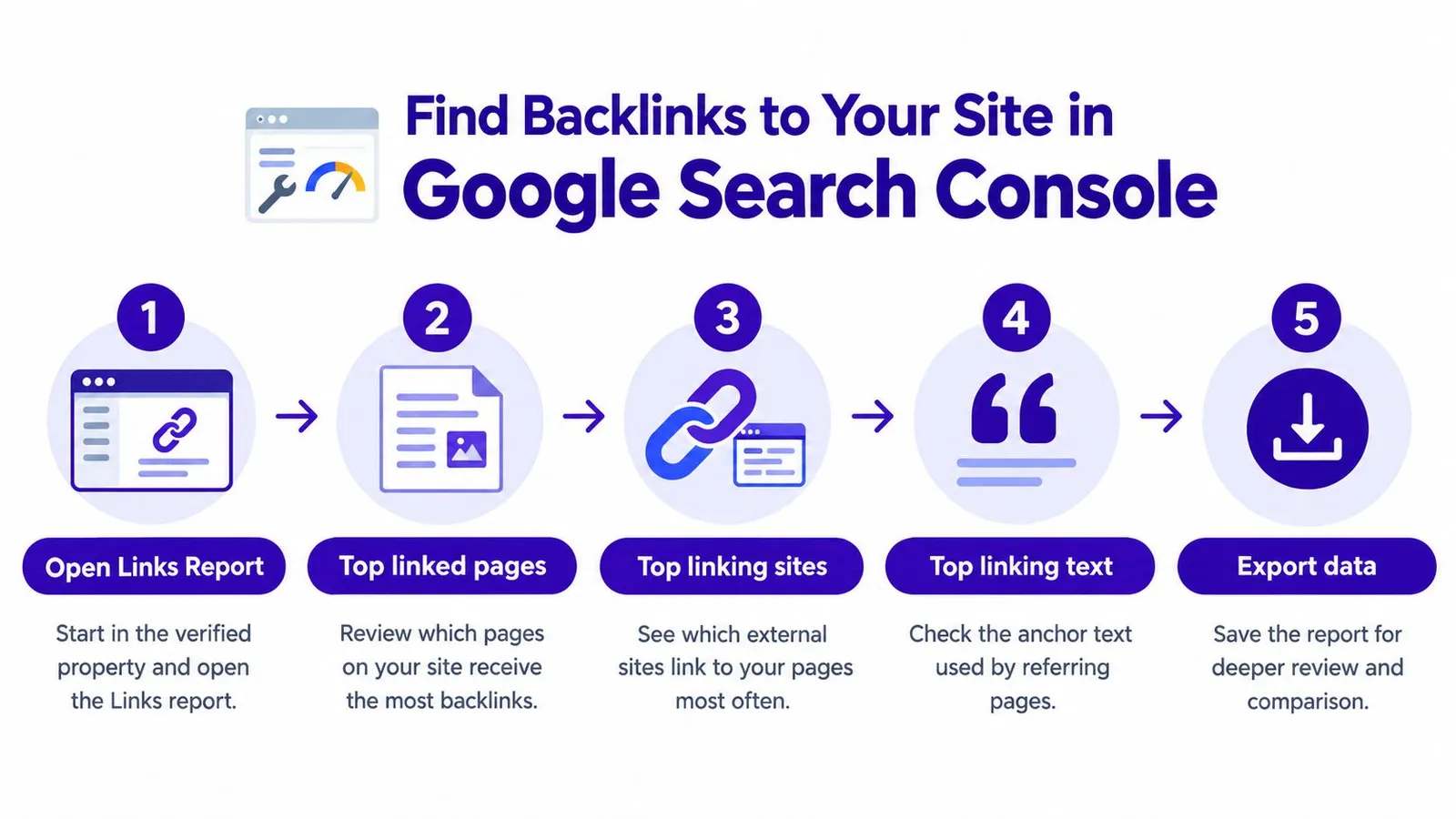
Open the external-link reports
Select the verified store property in Search Console, then open Links in the navigation. Under External links, locate Top linked pages, Top linking sites, and Top linking text. These views answer different questions, so the audit should retain each rather than export a single headline total.
Open More beneath each table and use Export to save the available data. Keep the exports in separate spreadsheet tabs and record the export date. That preserves the original evidence before any cleanup.
The views have distinct jobs:
- Top linked pages identifies destinations receiving external links. Compare these against priority product, collection, and editorial pages.
- Top linking sites reveals referring-domain concentration. Repeated links from the same website shouldn't be mistaken for independent recommendations.
- Top linking text surfaces anchor-text patterns. It provides a starting point for investigating repetitive or unexpected wording, not a verdict on intent.
Click through an important target page or referring site to inspect the available detail. Summary tables alone won't establish where a link appears or whether its surrounding text makes sense.
Normalize without destroying evidence
Create a working sheet alongside the untouched exports. Useful columns include original source, referring domain, linking page where available, target URL, anchor text, discovery date, and review status.
Normalize hostnames consistently and group referring sites by their underlying domain. Preserve subdomains separately when they help explain who published the content. Avoid blindly treating every subdomain as a distinct independent publisher.
For destination URLs, retain both the original target and the preferred canonical destination. A link pointing at an obsolete collection matters even when that collection redirects successfully. Removing the original target from the spreadsheet would hide the maintenance issue.
Practical rule: Deduplicate for reporting, but preserve individual referring pages for inspection.
Deduplicate domains in a separate summary tab. Don't delete page-level rows because several links originate from the same website.
Compare the cleaned destination list against commercially important pages. Pages missing from the export are candidates for further investigation, not proof that no external links exist.
The recurring pitfalls are straightforward:
- High counts mistaken for quality: Inspect the actual referring pages before assigning value.
- Obsolete URLs overlooked: Check redirects and final destinations.
- Sampled data treated as exhaustive: Keep Search Console as the baseline, not the entire inventory.
Expand Your Search with Backlink Tools
An independent link database adds another discovery route, not a definitive answer. Ahrefs, Semrush, and Moz are options to assess alongside Search Console, while free checkers and manual searches serve narrower tasks. Their usefulness depends on whether they reveal actionable evidence that the existing inventory missed.
Backlink Discovery Methods Compared
| Method | Cost | Coverage | Best For |
|---|---|---|---|
| Google Search Console | No separate subscription | Sampled first-party reporting | Establishing the store's baseline |
| Independent backlink indexes | Depends on provider and plan | Provider-specific crawler coverage | Expanding discovery and examining competitors |
| Free backlink checkers | Free access may be restricted | Limited results or functionality | Quick spot checks |
| Browser-based inspection | Manual effort | Individual pages under review | Confirming placement, destination, and attributes |
| Analytics referral review | Depends on the analytics setup | Recorded referring visits | Finding links associated with visitors |
| Brand searches and mention alerts | Varies by service | Mentions surfaced by the search or alert system | Discovering references and outreach opportunities |
Choose the tool around the missing answer
For a broader inventory, enter the store's domain into an independent backlink tool and inspect its backlinks and referring-domains reports. Check whether the selected scope includes the whole domain, a subdomain, or an individual page. A scope mismatch makes comparisons misleading before the audit even begins.
Export source pages and destinations where available. Add a discovery source column before merging the results with Search Console, then deduplicate matching source-and-target pairs.
A plausible audit scenario is a merchant finding an additional reference to an old collection through a separate index. The useful discovery isn't that the tool reports a larger total. It's that the merchant can inspect the reference, test the destination, and decide whether the old collection needs attention.
Free checkers suit an occasional lookup, but a restricted preview shouldn't be mistaken for a complete export. Before purchasing access, the merchant should establish whether the missing functionality is deeper discovery, historical comparison, or easier reporting.
Manual discovery adds context
Analytics provides another route: inspect referral sources, then visit the referring website to locate the actual recommendation. Search for the store name, distinctive product names, and article titles as well. Mention alerts can supply candidates for that same inspection process.
A brand mention isn't automatically a backlink. Google's guidance on crawlable links explains why the actual link implementation and descriptive context matter for discovery and relevance.
No single tool should be treated as exhaustive. The practical choice is a manageable combination whose findings can be verified, not a collection of subscriptions producing overlapping totals.
Evaluate the Quality of Each Backlink
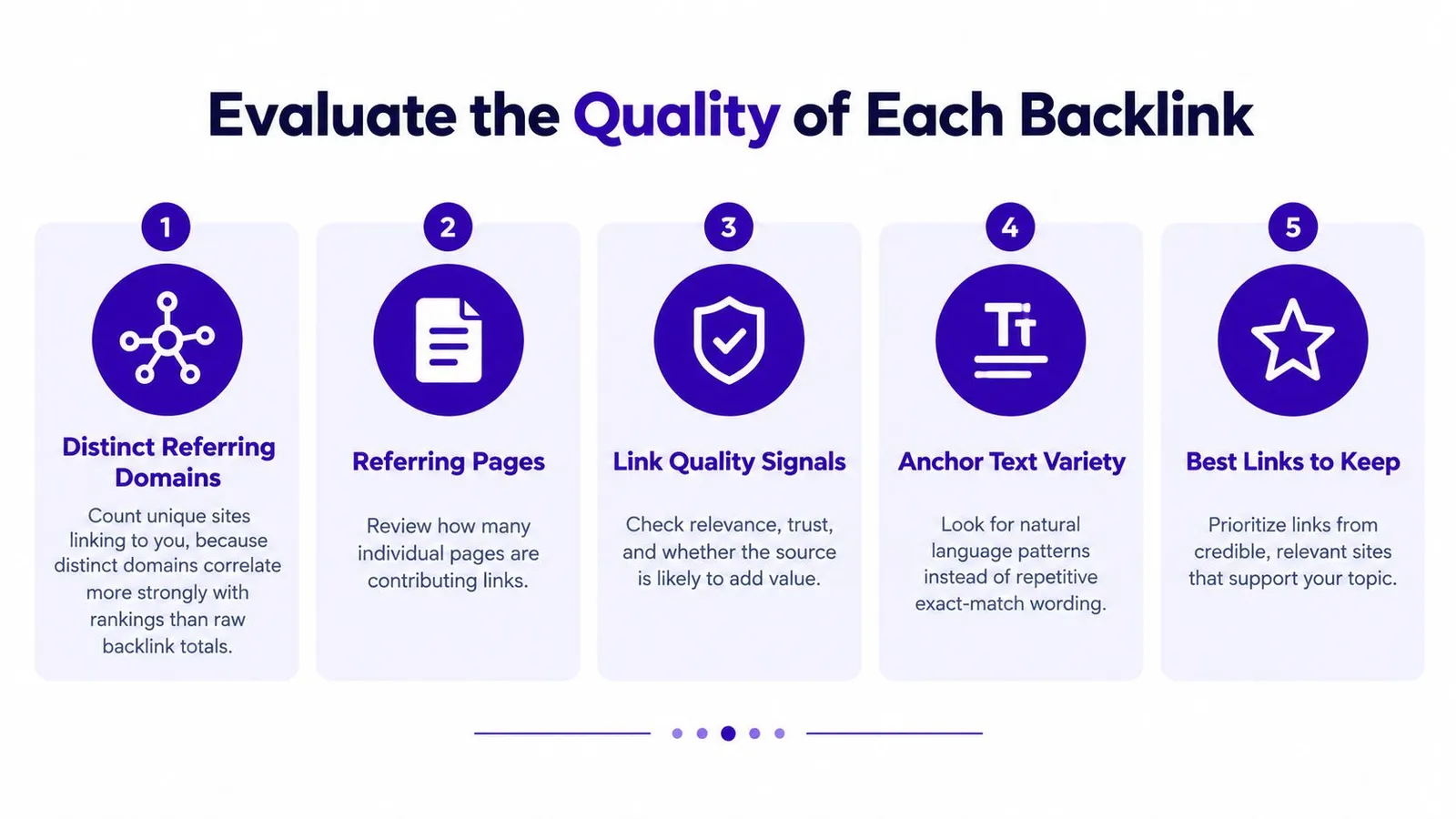
Distinct referring domains deserve a separate column from total backlinks. The correlation evidence favors domain diversity over raw volume, but correlation doesn't establish causation or predict what a particular link will accomplish. The sound sorting rule is to inspect independent, relevant recommendations before celebrating repeated link instances.
Consider a hypothetical comparison without relying on counts: one store receives numerous links from a small cluster of unrelated websites, while another earns fewer links across independent publications serving its audience. The latter is the more promising profile to investigate. That isn't a guarantee of stronger rankings, and the actual linking pages still require review.
Inspect the page, not just the domain
Open each priority referring page and read the passage around the link. A recognizable publication can host an irrelevant placement, while a modest specialist website may publish a recommendation that directly helps potential customers.
Use a page-level checklist:
- Topical fit: Does the page address a problem related to the linked product, collection, or article?
- Editorial purpose: Would the recommendation make sense if ranking benefits weren't part of the discussion?
- Accessibility and indexability: Does the page load, and are there visible technical reasons it might not be indexable? Record uncertainty rather than declaring index status from appearance alone.
- Placement: Is the reference useful within the main content, or repeated in an unrelated footer or template?
- Destination: Does the link reach the intended canonical page successfully?
- Anchor text and attributes: Record the clickable wording and whether the link is unqualified,
nofollow,sponsored, or user-generated throughugc.
Normal followed links don't require a special “dofollow” attribute. Conversely, a qualified link shouldn't be dismissed solely because it isn't an unqualified followed link. Audience usefulness and referral activity remain separate evaluation questions.
Turn observations into priorities
Google's link-spam guidance makes editorial legitimacy important when distinguishing useful promotion from manipulative acquisition. A domain-level score can help organize a queue, but it can't settle whether a particular placement is appropriate.
A backlink score is a sorting aid. The referring page and the acquisition relationship supply the evidence.
Assign practical statuses such as valuable reference, needs destination repair, needs origin review, and low priority. This produces a work queue rather than a vague list of good and bad domains.
Pages that earn worthwhile external references also deserve an internal linking audit. Check whether readers arriving at a guide can reach relevant merchandise naturally. An external recommendation is less useful commercially when the destination leaves visitors without an appropriate next step.
Spot Risky Links Before They Hurt You
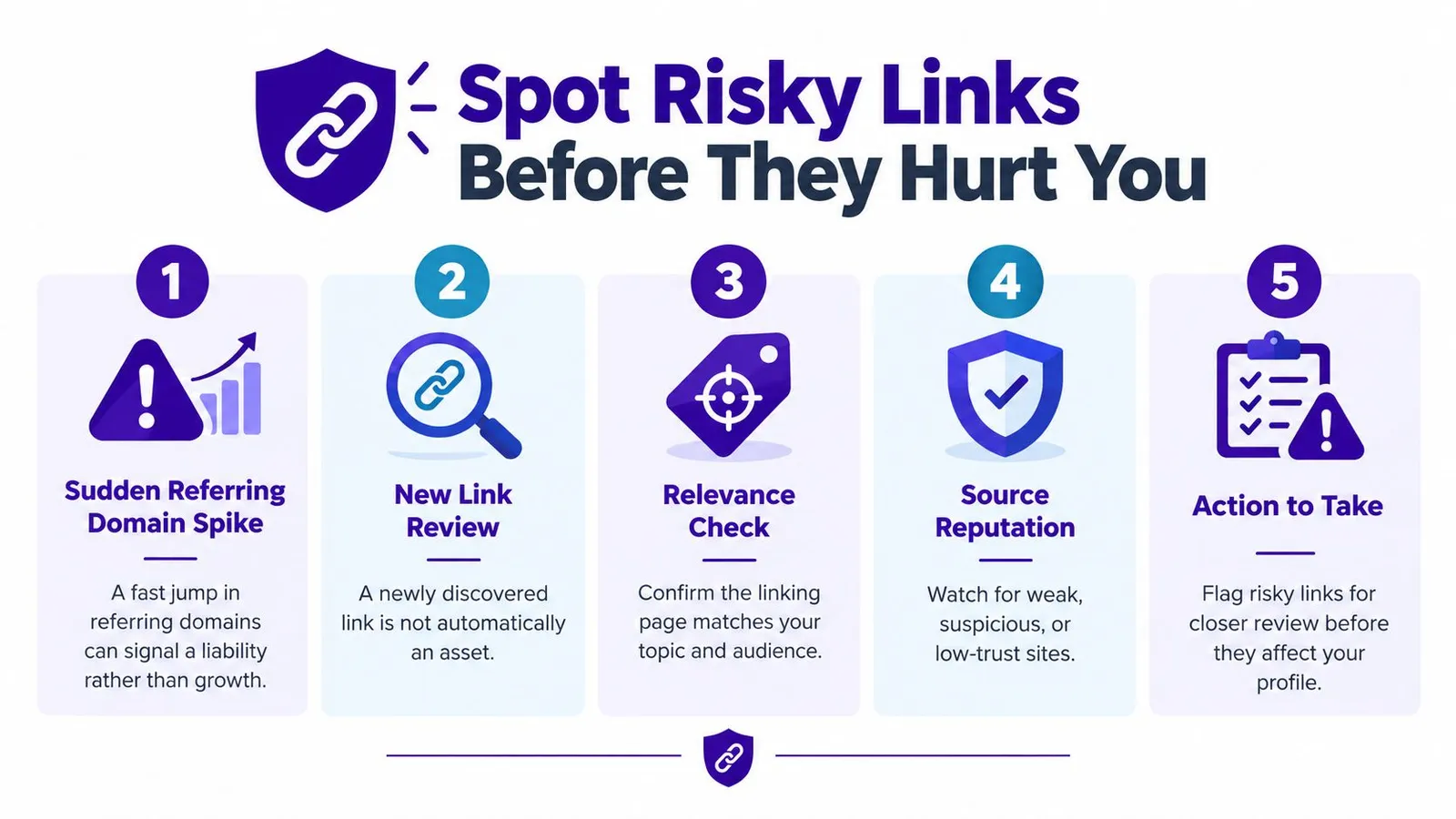
A newly discovered backlink is an event to investigate, not an asset to approve automatically. A jump in referring domains might follow genuine publicity, a campaign, or activity the merchant never authorized. The first question is where the links came from.
Google's spam policies identify buying or selling links for ranking purposes, paid guest-post links, product-for-link arrangements, and excessive exchanges as link-spam concerns. Manipulative links can be discounted algorithmically or contribute to manual actions, so acquisition history belongs in the audit.
Classify origin before assigning value
Add an acquisition origin field to the spreadsheet. This records the relationship behind the link rather than its visual appearance.
| Origin | Evidence to inspect |
|---|---|
| Editorial | Independent recommendation and surrounding context |
| Affiliate | Commercial relationship and link qualification |
| Sponsorship | Payment, disclosure, and appropriate attributes |
| Exchange | Reciprocal obligation, relevance, and campaign purpose |
| User-generated | Contributor context and applicable attributes |
| Unknown | Records or publisher confirmation needed |
For each flagged placement, compare the origin with anchor text, destination, attributes, and the referring page's accessibility. Check invoices, agency reports, outreach correspondence, and product-seeding records where available. An unfamiliar domain alone doesn't establish that the merchant participated in a scheme.
Disclosure doesn't replace judgment
Paid and sponsored links should carry rel="sponsored" or rel="nofollow", as described in Google's policy guidance. Product supplied in exchange for a link requires commercial scrutiny too.
Topical relevance doesn't excuse an arrangement designed primarily to manipulate rankings. Equally, a suspicious-looking anchor shouldn't be used as the sole basis for condemning an otherwise unexplained reference.
Backlink exchanges require particular care. Credits, reciprocal commitments, or promised placements should be recorded accurately rather than relabeled as independent editorial decisions.
- Check the obligation: Establish what the participants agreed to provide.
- Check the reader benefit: Confirm that the destination fits the referring content.
- Check qualification: Review whether the commercial or exchange relationship requires corrective treatment.
- Keep the evidence: Preserve the agreement, page details, and action taken.
Safety checkpoint: Relevance and disclosure belong in the review, but neither turns a ranking-manipulation scheme into an editorial recommendation.
Correct the arrangement before escalating
For a policy-violating placement, first seek removal or neutralization, such as appropriate qualification where applicable. Stop the underlying acquisition practice too, rather than cleaning individual links while the campaign continues.
Treat disavowal as an exceptional escalation, not routine spreadsheet maintenance. Google warns that the tool is often used incorrectly. A low metric, unfamiliar language, or ugly website isn't sufficient evidence on its own to justify disavowing a link.
Keep Monitoring New and Lost Backlinks
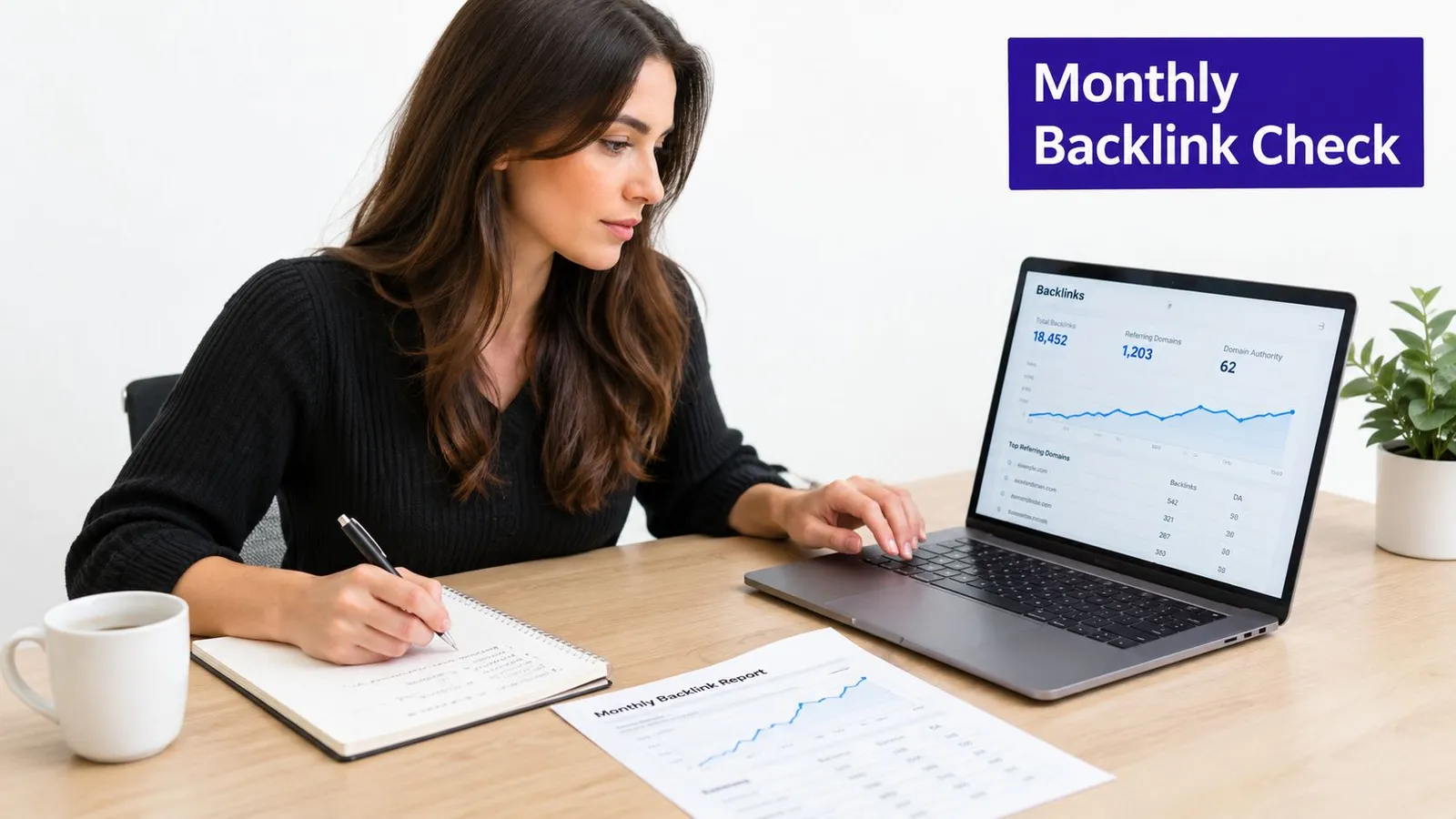
A completed audit becomes useful operationally when someone owns the follow-up. A monthly review is a practical cadence for a small store, provided each review ends with assigned actions rather than another archived export.
The working setup can stay simple: a dated spreadsheet, a review queue, and a record of completed fixes.
Compare changes without assuming causes
Re-export the Search Console tables and compare normalized domains and destinations against the previous snapshot. Label differences as newly reported or no longer reported until inspection confirms what happened. A reporting difference isn't necessarily a newly published or physically removed link.
The recurring queue should distinguish tasks:
- Newly reported references: Apply the established quality and origin checks before approving them.
- Missing priority links: Revisit the referring page and confirm whether the reference was removed, moved, or changed.
- Changed destinations: Test important links following collection reorganizations or content updates.
- Unfinished corrections: Follow up on publisher requests and document the outcome.
A removed editorial reference to a valuable product guide can justify a courteous reclamation request when the destination still helps the publisher's audience. An intentionally removed promotional placement may not deserve the same effort.
Keep alerts subordinate to verification
Mention notifications and third-party monitoring can shorten the gap between discovery and review. They shouldn't bypass the audit process, and a “lost” notification should trigger inspection rather than immediate outreach.
The following video can accompany a hands-on review.
For Shopify teams using reporting inside the store admin, Domain Rating and search-performance metrics can sit alongside the action log. Neither metric replaces the underlying link evidence, and exchange-earned placements need the same review as placements acquired elsewhere.
Track qualified referring domains, coverage of priority pages, referral visits, and assisted conversions where measurement supports them. Organic performance can provide context, but a ranking change alone doesn't prove that a particular backlink caused it.
Put Your Backlink Data to Work
The useful deliverable is a prioritized set of decisions, not an impressive export. Search Console supplies the baseline, independent discovery widens coverage, and page-level inspection establishes which references deserve attention. Origin classification keeps acquisition risk visible alongside potential value.
Choose actions that improve the store
The highest-value next move depends on the evidence already collected.
- Strengthen useful destinations: Improve the accuracy and usability of pages receiving credible references, then connect them to relevant products and collections.
- Repair broken journeys: Resolve obsolete destinations and request updated references when the publisher would benefit.
- Develop relevant outreach: Identify the kinds of publications already citing comparable resources, then offer useful material rather than demanding an exact-match anchor.
- Close safety issues: Assign an owner to questionable arrangements and retain the resolution record.
Content planning should respond to these findings without blindly copying whatever attracted links before. A step-by-step keyword research process helps connect promising subjects with customer intent and the store's catalog.
Start with a verifiable baseline
The first task is small: open the verified Search Console property, export Top linking sites, and count distinct referring domains in a working spreadsheet. Preserve the untouched file and record the export date.
That creates a defensible starting point for the next review. Progress can then be judged by better coverage, repaired destinations, useful referrals, and resolved risks instead of raw link accumulation.
Rankira provides Shopify merchants with keyword research, article publishing, internal linking, and search reporting that includes Ahrefs Domain Rating inside Shopify admin. Merchants can visit the site to assess how those tools fit their backlink-review and content workflow, while applying the same relevance and disclosure checks to its participating-store backlink exchange.
Keep reading
All articles
Shopify SEO
SEO Content Writing Principles for Readers and Search
Learn the principles of SEO content writing that balance search relevance, clear structure, and real reader value, with examples for online stores.
10 min read
Shopify SEO
Internal Linking Audit That Actually Improves Rankings
Run a practical internal linking audit to find orphan pages, fix broken links, and prioritize fixes that move revenue on your Shopify store.
10 min read
Shopify SEO
Share of Voice SEO: A Practical Measurement Guide
Learn how share of voice SEO works, how to calculate it, and how to use intent-based metrics to assess search visibility and business impact.
12 min read
Put your Shopify blog on autopilot
Rankira researches keywords, writes SEO articles, adds internal links, and publishes them to your store — every week. Start with a 7-day free trial.