SEO Content Writing Principles for Readers and Search
Learn the principles of SEO content writing that balance search relevance, clear structure, and real reader value, with examples for online stores.
Published 10 min read
In this article
- Table of Contents
- Why Publishing Articles Alone Does Not Win Search
- Defining Search Intent Before Writing a Word
- Writing Titles, Headings and Metadata That Match Results
- Balancing Keyword Use with Clear, Readable Copy
- Applying the Principles to Shopify Product Catalogs
- Choosing an Approach for Recurring Content Production
- Keeping Articles Accurate and Taking the Next Step
Only 29% of B2B marketers rated their organization's documented content strategy as extremely or very effective in Content Marketing Institute and MarketingProfs' 2025 B2B Content Marketing Benchmarks, Budgets, and Trends study, which collected 1,186 global responses between June 25 and August 16, 2024, while 58% called it moderately effective, 12% not very effective, and 1% not effective at all. The same study found that 54% cited insufficient resources, 45% lacked a scalable creation model, 20% were unsure a model existed, and 56% struggled both to attribute return on investment and to track customer journeys. A full editorial calendar can still sit on a weak plan. SEO content writing earns its place when research, capacity, measurement, and a real reader task stay connected.
Table of Contents
- Why Publishing Articles Alone Does Not Win Search
- Defining Search Intent Before Writing a Word
- Writing Titles, Headings and Metadata That Match Results
- Balancing Keyword Use with Clear, Readable Copy
- Applying the Principles to Shopify Product Catalogs
- Choosing an Approach for Recurring Content Production
- Keeping Articles Accurate and Taking the Next Step
Why Publishing Articles Alone Does Not Win Search
A store can ship a post every week and still have nothing a shopper can finish. Volume looks like progress because the blog index grows. Search visibility does not follow the index. It follows whether each URL has a job, an owner, and a way to tell if the job got done.
The benchmark above is a warning, not a content tip. Teams that cannot describe a scalable model, or cannot tie a page to a journey, are publishing in the dark. Keyword lists and article drafts then float free of planning, staffing, and reporting. That is how SEO content writing gets reduced to a writing task.
What has to stay connected
- A documented plan: each URL has a goal tied to the business, not only a phrase to rank for.
- Audience clarity: the writer knows the shopper's problem before the outline starts.
- Production capacity: someone can research, draft, and review on a rhythm the store can keep.
- Measurement: clicks, journeys, and commercial outcomes get checked, not just the count of posts.
A published article is not proof of maturity. Maturity shows up when strategy, capacity, and reporting can explain why that article exists.
Regular publishing fails as a strategy when those four pieces are missing. The work starts with intent, then with titles and body copy that match the page, then with catalog facts a merchant can stand behind, then with a production method that does not collapse in a busy week, and finally with upkeep after the post is live.
Defining Search Intent Before Writing a Word
Google's guidance on helpful content says ranking systems favor helpful, reliable, people-first pages and set those apart from material made mainly to manipulate rankings. The brief comes before the draft. It names the searcher's intent, the decision or problem the page must resolve, and the evidence or instructions that resolve it.
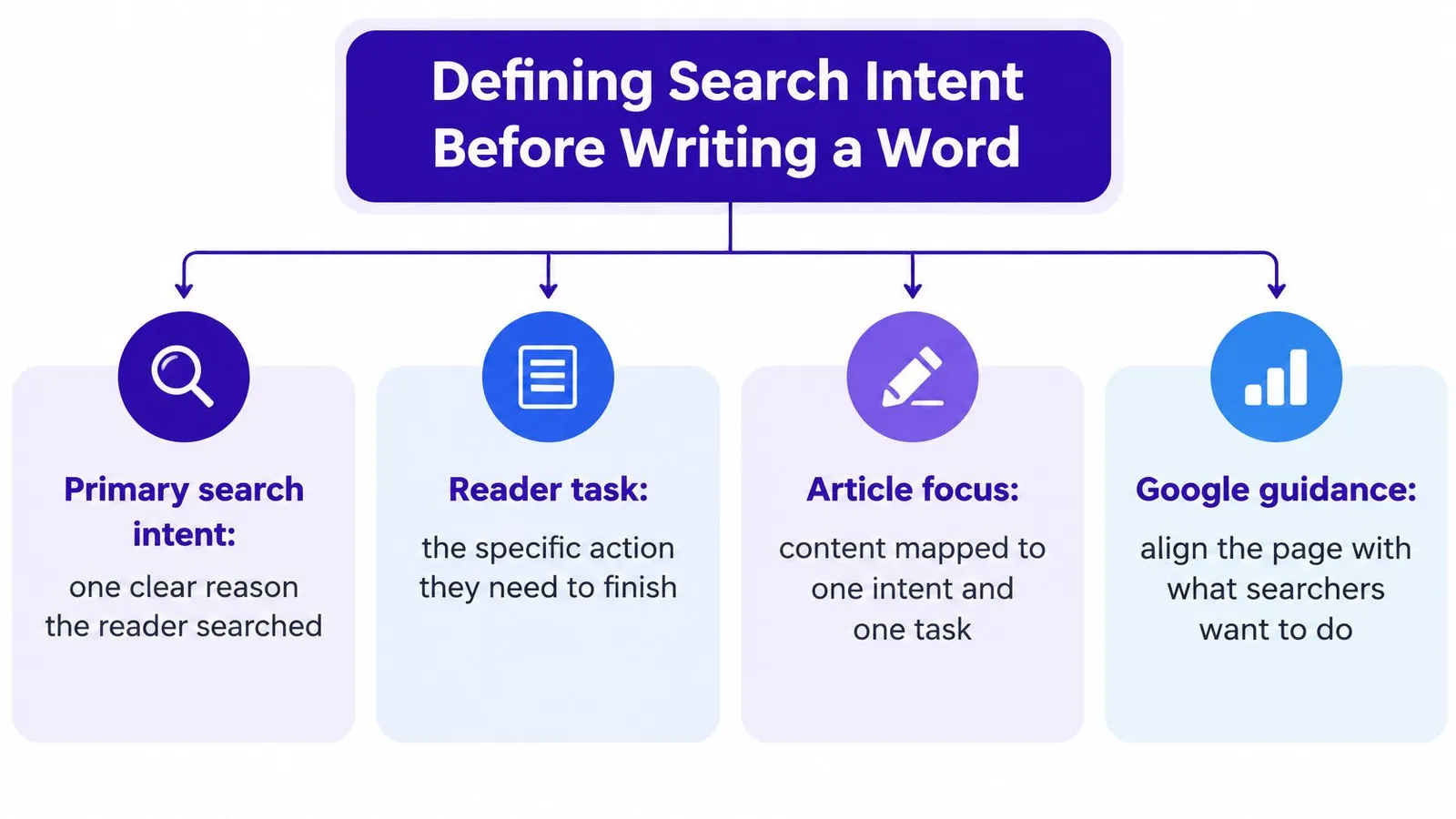
Build the brief in three lines
Treat the diagram as a stack. Primary intent sits on top. The reader task sits under it. Evidence holds the base. If any layer is missing, the draft will wander.
- Primary search intent: one clear reason the person searched. Informational, commercial investigation, and transactional visits are different jobs.
- Reader task: the specific finish line, such as choosing a product, comparing two options, sizing an item, or fixing something after delivery.
- Evidence: measurements, materials, policies, or steps the store can verify, plus the subquestions that sit under the main task.
Map one primary intent to one article. Supporting subquestions become sections, not extra URLs. A sizing question and a care question can share a page when they serve the same task. They should not become twin posts that chase close keyword variants.
Near-duplicate pages for variant phrases dilute internal signals and create competing URLs. Fold the variants into one page and link to it with descriptive anchors.
The practical test is whether a reader can act without bouncing straight back to results. SEO optimization still belongs on the page, but only after that test is passed. A step-by-step way to pick the primary phrase is in this keyword research walkthrough.
Writing Titles, Headings and Metadata That Match Results
Results pages are assembled in part on the fly, so the title tag, the visible heading, the opening copy, and the metadata have to tell the same story. A meta description is not a guaranteed snippet.
Google's notes on titles and snippets ask for a descriptive, concise title on every page and warn against keyword stuffing and boilerplate titles. Title links may be built from the title element, the main visual title, headings, prominent text, anchor text, and structured data. Snippets come mainly from page content and can change with the query. A meta description is used when it describes the page better than that automatic text.
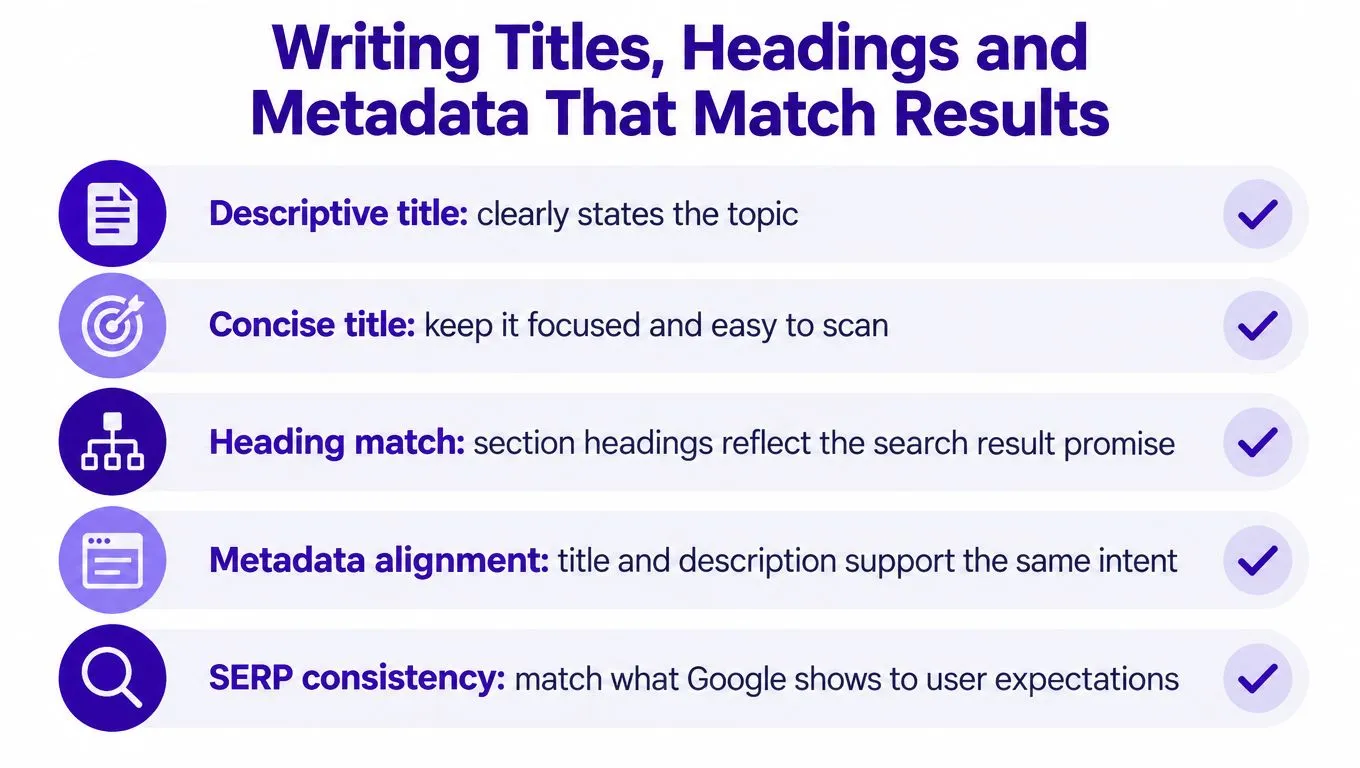
Check the elements in the order a searcher meets them
- Descriptive title: names the topic and a concrete outcome, such as a buying guide, a comparison, or a fix.
- Concise wording: stays easy to scan. Unnatural repetition of the target phrase does not make the promise clearer.
- One visible main title: matches the title tag so the click and the page agree.
- Opening copy: states the subject and what this page adds, because prominent text can become the link or the snippet.
- Metadata: a unique description that supports the same intent, written as a candidate, not a contract.
Read the result in Search Console
Pull impressions, clicks, and click-through rate by URL. A page that is seen and rarely chosen needs a clearer intent match and a stronger benefit, not a higher keyword count. Image descriptions belong in that same alignment. This note on the alt attribute and SEO covers how those labels should describe the picture rather than repeat a phrase.
For an ecommerce blog, the title should join the query to an outcome the store can deliver. If the body answers a different question than the title, the click was a mismatch before anyone measured a ranking.
Balancing Keyword Use with Clear, Readable Copy
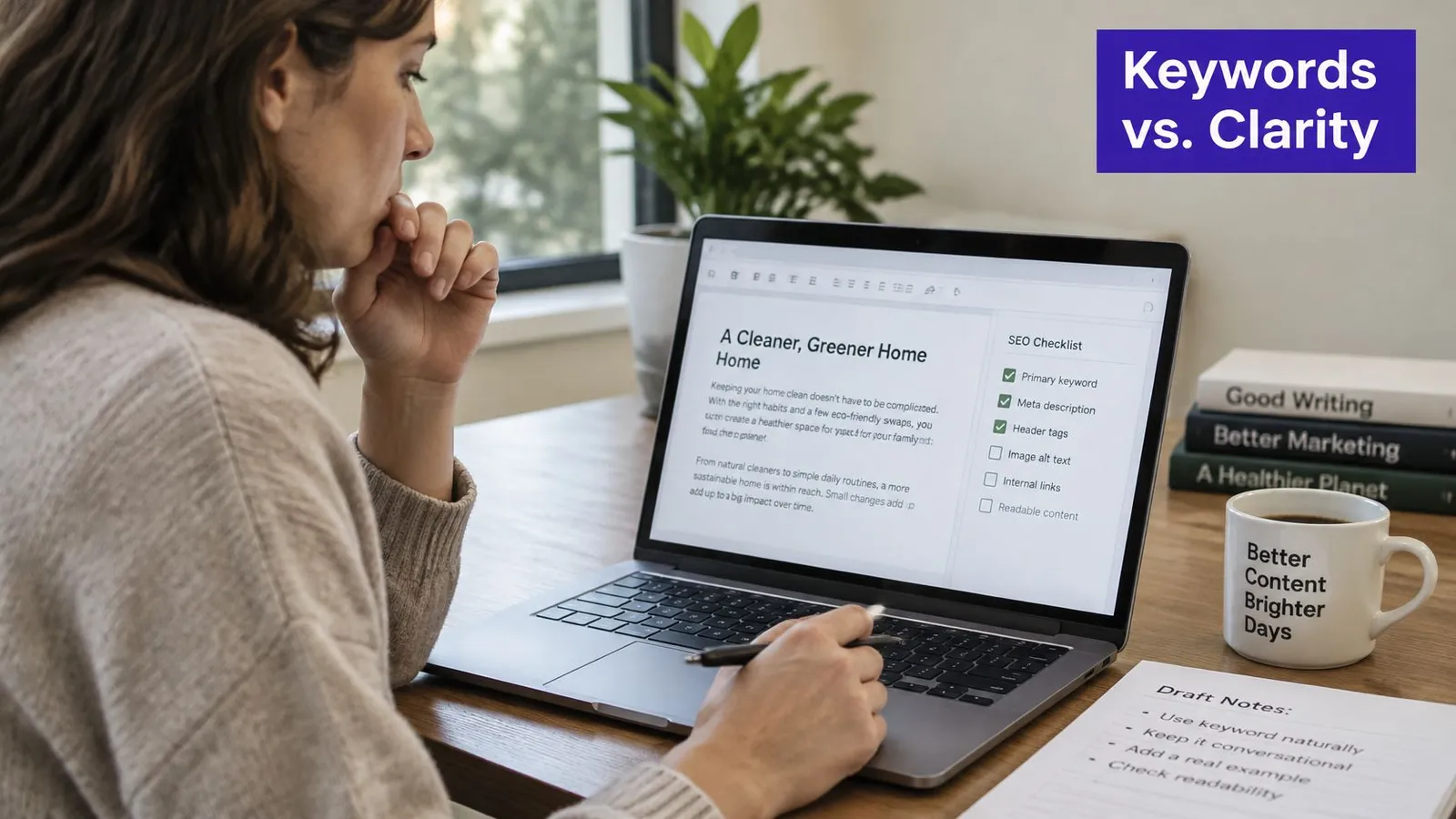
A correct title can still sit on copy that nobody wants to finish. The tension is simple. The primary subject has to be obvious, and the paragraphs still have to sound like help.
Place the subject, then stop repeating it
Name the topic and the page's specific angle early, then write in the language of the task: fit, fabric, compatibility, care, returns. Related terms and subquestion headings should appear because the section needs them. Dropping the exact phrase into every paragraph reads like manipulation and burns trust.
Class A Media's Shopify SEO guide is a solid companion for owners who want store-level on-page habits without turning the body into a keyword slot.
Use a paragraph test instead of a density target
Read each paragraph aloud. Keep it only if it adds a fact, a step, a comparison, or a decision the reader can use.
- Fact: a measurement, material, or policy the store will stand behind.
- Step: an action in order, such as how to measure a hem before ordering.
- Comparison: a real difference between options the catalog sells.
- Decision: the condition that tells a shopper which option fits.
Short paragraphs, descriptive subheadings, and a direct answer near the start of a section make that test easier to pass. There is no density number worth protecting. If a sentence exists only to repeat a phrase, cut it.
Smooth AI drafts often fail the aloud test because they say little. A practical edit pass is outlined in how to humanize AI content. The short video below shows how scannable structure and a clear subject work together on a live page.
SEO content writing that survives an out-loud read is the copy worth keeping. A density score is not.
Applying the Principles to Shopify Product Catalogs
Maya runs a small travel-gear shop on Shopify. The same chat question keeps arriving. Will this liner fit a 40-liter pack, and can it go in the wash? She nearly writes three posts, one for each wording. She writes one instead.
Answer first, then open the catalog
The article has a single job. Help a shopper judge fit and care. The opening states the fit rule in plain language. One section compares the two liners she sells, using fabric and weight from the product pages. Another covers washing, using the care notes already published there. She does not invent a third fabric to sound complete.
Links come after the answer. Anchor text names the lightweight liner and the insulated liner, each pointing at its product page. A collection link appears only where someone might want the wider pack range. The article solves the question first and then offers a route into merchandise.
Generic pages versus pages that know the store
A generic draft could sit on any outdoor blog. It says liners vary and shoppers should check the label. Maya's draft says which of her two liners fits a 40-liter pack, which fabric pills in a machine wash, and what her return window allows if the fit is wrong. Those lines exist only because the brief used catalog context.
The same move covers other repeat questions. How to choose between two materials. How to size an item. How to fix a problem after delivery. Each becomes one article tied to the products, collections, and policies involved. More store-side patterns are gathered in this Shopify SEO library.
Close phrasings of the liner question all point at that single guide. She never publishes the twins.
Choosing an Approach for Recurring Content Production
A store that knows what to write still has to produce it every week. Three paths cover most Shopify teams: fully manual writing, freelance production, and an AI-assisted workflow. Judge them on research depth, consistency, review effort, and whether results get measured.
How the three paths differ
Manual writing goes deep when the owner knows the products. It slips when the week fills up. Topics drift, and measurement is whatever someone remembers to open.
Freelance production adds craft if the brief is tight. Depth depends on whether the writer can see the catalog, the policies, and Search Console, not only a keyword. Review stays with the merchant, because an outside writer will miss a discontinued size.
AI-assisted drafts keep a calendar moving. Generic workflows often produce interchangeable articles. They blur informational, commercial-investigation, and transactional intent, so a comparison reads like a definition.
That split matters as answer boxes spread. BrightEdge reported that AI Overviews appeared for 20.7% of ecommerce queries in September 2025, up from 14.4% only 23 days earlier, with growth concentrated on specific product queries while comparison and review queries were largely unaffected, in its September 2025 AI search update.
Product-focused and direct-use pages need concise, verifiable specs. Comparisons and reviews still need evidence, first-hand detail, and classic organic authority. Turning every article into a direct answer flattens the detail those pieces need.
One assisted option inside Shopify
Rankira is one assisted option for this job. It builds keyword research from store information, competitor analysis, and Google Search Console data, and a drag-and-drop calendar schedules one keyword per day. Article generation can link to relevant products, collections, and pages. Merchants can publish on a schedule or save a draft, and reporting covers clicks, impressions, and search positions. The tool does not replace the intent brief or the review. It shortens the distance between a catalog and a planned post.
Whichever path fits the week, the brief still names one intent. A wider planning frame is in this guide to developing a content strategy. Reporting should also separate ordinary clicks from visibility inside AI-generated answers, because a page can shape a purchase without a conventional click.
Keeping Articles Accurate and Taking the Next Step
Publishing is the start of a page's useful life, not the end of the work. Prices, materials, compatibility, and policies change. ALM Corp's ecommerce AI SEO playbook notes that outdated pricing, discontinued products, and obsolete specifications can erode trust quickly, and that factual consistency and recent updates matter when systems choose among similar sources.
Give every article a trigger
- Immediate review: a linked product is unpublished, a stated price no longer matches the product page, or a collection link is dead.
- Periodic review: evergreen advice, such as how to measure a garment, on a set interval even when nothing obvious broke.
- Manual verification: health, safety, technical, or regulated claims, checked by a person against current sources rather than regenerated.
Checks should find mentions of changed products, collections, prices, materials, compatibility, and shipping or return rules, then send those posts for review. Compare claims with the live catalog. Do not only regenerate the prose and hope the facts came along.
Prefer a smaller library that stays true
Seven new posts a week can create less durable search value than a smaller set whose commercial facts stay correct and whose links still work. High-frequency publishing without upkeep leaves shoppers holding stale specs.
The move for this week is an audit. List posts that link to changed or unpublished products. Mark the ones most likely to mislead: a wrong price, a dead product, an obsolete size chart, or a return rule the store no longer offers. Update those first. Intent, on-page alignment, and freshness are one habit. A page that was right on publish day and wrong after a catalog edit is no longer a page worth ranking.
Rankira helps Shopify merchants research keywords from the store, draft articles that link to products and collections, and schedule or hold those posts for review, with reporting on clicks, impressions, and positions. That workflow fits SEO content writing that starts from intent and stays tied to a live catalog, including the refresh work after publish. Visit Rankira to see how the app runs inside Shopify administration.
Keep reading
All articles
Shopify SEO
Search Engine Positioning SEO Explained for Organic Growth
Search engine positioning SEO explained: learn how rankings and SERP visibility are measured, plus practical ways to improve and monitor organic positions.
11 min read

Shopify SEO
SEO New Website Guide: From Launch to First Rankings
SEO new website plan that actually works: indexing, site structure, keyword targeting, content, Core Web Vitals, and tracking from launch to growth.
13 min read
Shopify SEO
Internal Linking Audit That Actually Improves Rankings
Run a practical internal linking audit to find orphan pages, fix broken links, and prioritize fixes that move revenue on your Shopify store.
10 min read
Put your Shopify blog on autopilot
Rankira researches keywords, writes SEO articles, adds internal links, and publishes them to your store — every week. Start with a 7-day free trial.