SEO New Website Guide: From Launch to First Rankings
SEO new website plan that actually works: indexing, site structure, keyword targeting, content, Core Web Vitals, and tracking from launch to growth.
Published 13 min read
In this article
The store is live, the product photography looks polished, and the first articles are published. Then the owner opens Google Search Console and finds an almost empty report. The temptation is to publish more immediately, but SEO for a new website starts with proving that the right pages can be discovered, loaded, and measured, not filling a blog calendar.
Table of Contents
- Why New Websites Struggle to Get Seen
- Get Your Pages Crawled and Indexed
- Meet Core Web Vitals Before You Scale Content
- Target Keywords a New Site Can Actually Win
- Track Progress Before Rankings Arrive
- Choose a Workflow That Keeps You Publishing
- Start Your First Ninety Days of SEO
Why New Websites Struggle to Get Seen
An empty Search Console report feels like a judgment on the entire launch. The merchant has finished the difficult work of building the store, yet Google appears indifferent. Another refresh doesn't clarify whether the problem is technical, editorial, or a lack of evidence.
That uncertainty is the defining challenge of a new website. An established store can compare performance against its own history; a new store has little meaningful history to consult. Its owner shouldn't assume that silence proves weak content, but shouldn't assume everything is working either.
Silence needs a diagnosis
Consider a hypothetical store selling travel bags. Its collection pages explain the range, and its blog offers packing advice, but an important collection has no contextual links from other discoverable pages. Publishing another packing article wouldn't address that discovery problem.
The distinction matters because discovery, indexation, and commercial relevance are different jobs. A page can be technically accessible without being indexed, and an indexed page can still answer a question that has little connection to the store's products.
For owners still making design decisions, Boocoo's resource on website development with SEO in mind is a useful companion to the launch checklist. Development and search planning belong in the same conversation, before page templates and navigation become expensive to change.
Progress starts before rankings
The sensible launch sequence puts technical discovery ahead of performance checks, then connects keyword selection to measurement and a sustainable publishing process. That order prevents merchants from spending their content budget compensating for unresolved infrastructure problems.
- Technical progress means priority pages are reachable, internally connected, and eligible for indexing.
- Editorial progress means planned articles answer relevant buying questions rather than merely expanding the blog.
- Commercial progress means visitors have a useful route from an answer to a suitable product or collection.
Planning should allow months rather than promising results within weeks. That's a working expectation, not permission to leave errors unresolved while waiting.
The strongest launch plans treat the opening month as infrastructure work, not a deadline for competitive rankings.
Get Your Pages Crawled and Indexed
A submitted sitemap isn't proof that a website is ready for search. Google describes sitemaps as discovery signals, not guarantees that every submitted URL will be crawled or indexed. Its developer guidance for getting started with Google Search supports a staged approach that checks accessibility before submission.
Verify the pages that matter
The first review should follow the store's commercial priorities: the homepage, important collections, representative product pages, core policies, and high-value informational articles. Testing only the homepage leaves template-specific problems undiscovered.
- Check successful responses. Important URLs should load their intended content rather than an error, unavailable page, or unintended destination.
- Review indexing controls. Robots.txt restrictions and noindex directives shouldn't prevent intended search pages from being discovered or indexed.
- Confirm canonical consistency. Each important page should identify its preferred URL rather than send conflicting signals about duplicate versions.
- Check discovery paths. Relevant pages should receive contextual links from pages that search engines can already discover.
A coherent internal linking strategy makes these discovery paths deliberate. A newly published guide shouldn't depend entirely on its sitemap entry while remaining disconnected from the rest of the store.
The workflow below summarizes the launch checks and follow-up.
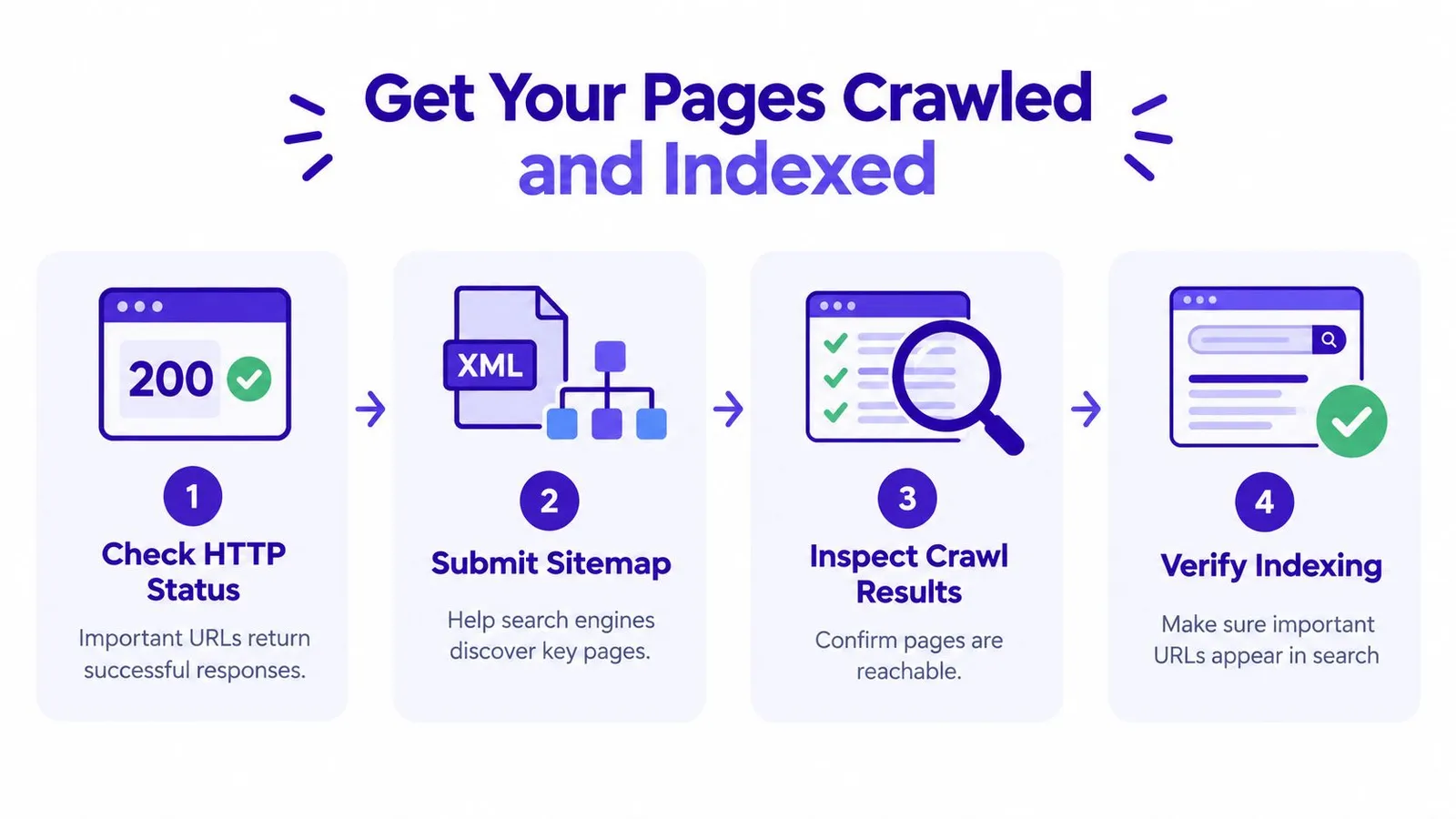
Submit, inspect, and preserve URLs
After verification, the sitemap should contain preferred canonical URLs only. Duplicate parameter URLs, thin tag archives, empty collections, and near-identical variants shouldn't become the store's launch priorities.
Search Console access comes next. ECORN's instructions to verify your Shopify store with Google provide a practical implementation reference for merchants setting up that connection.
Once the sitemap is submitted, URL Inspection should be used selectively for priority pages. The useful question isn't whether every article has received a manual request, but whether important pages are reachable and whether Search Console reports indexing or sitemap-processing problems.
A proper public custom domain should also be settled before content promotion. Rankira's backlink exchange requires one and excludes .myshopify.com addresses as having no SEO value within its participation policy. That eligibility rule shouldn't be confused with a universal explanation of Google's indexing decisions.
Published URLs should be treated as permanent. Renaming an article without preserving its old destination leaves existing links pointing to a page that no longer exists, along with the ranking strength those links were intended to pass. A necessary URL change therefore deserves a migration check, not a casual editorial edit.
Meet Core Web Vitals Before You Scale Content
A technically reachable store can still provide a frustrating visit. Performance deserves launch attention because publishing more articles won't fix a product template that shifts during loading or becomes unresponsive when widgets initialize.
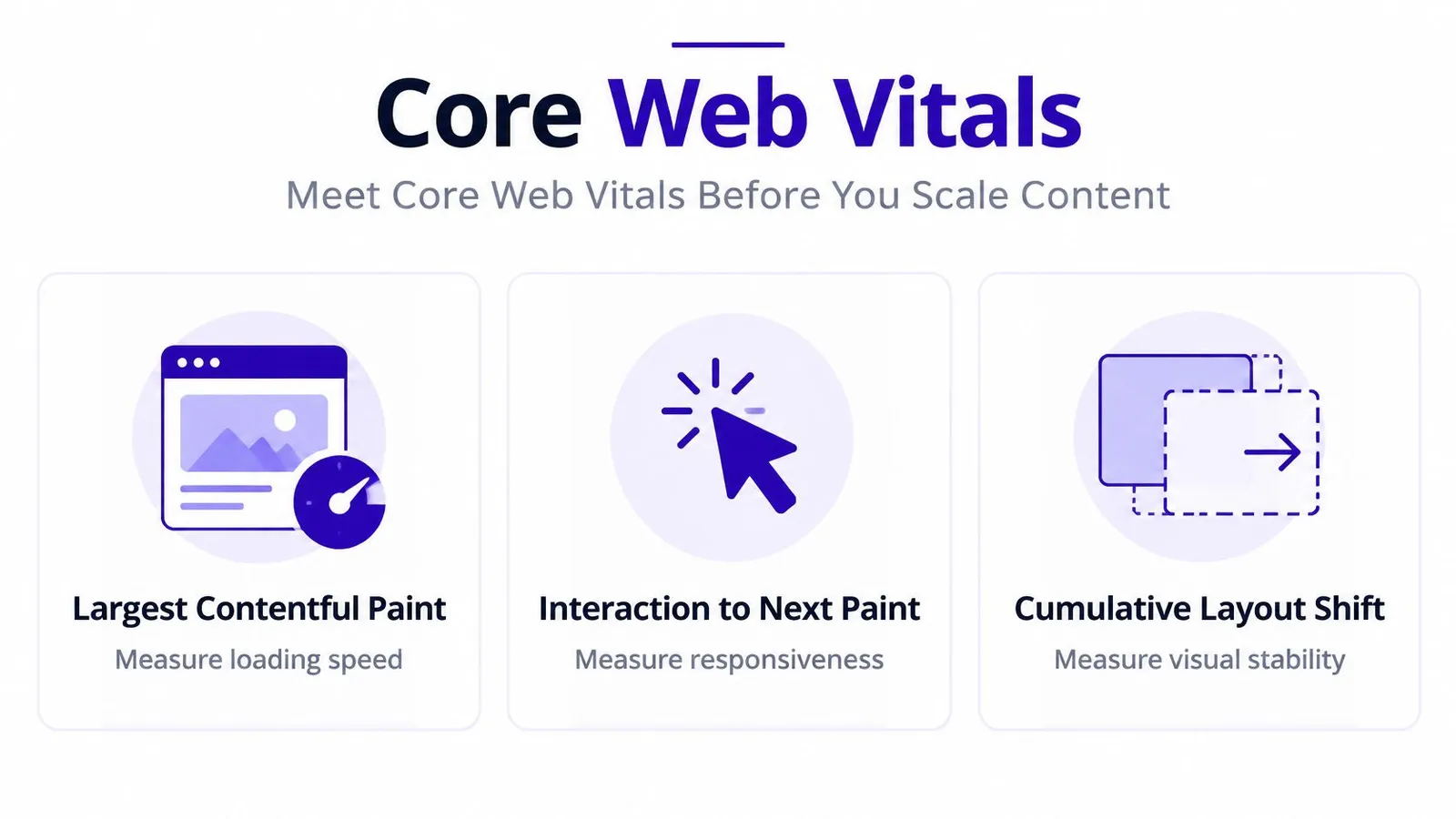
Google's recommended targets are LCP of 2.5 seconds or less, INP below 200 milliseconds, and CLS below 0.1, evaluated at the 75th percentile using real-user field data, as described in its Core Web Vitals guidance. Search Console's assessment uses indexed URLs and field data, so a fast result on a developer's laptop isn't equivalent to a passing real-world experience.
The metrics separate loading, responsiveness, and visual stability.
Audit templates rather than isolated URLs
The practical audit starts on mobile and covers representative homepage, collection, product, article, cart, and checkout-adjacent experiences. The aim is to identify shared causes, not accumulate screenshots of individual scores.
A large homepage image and an app-heavy product page may need completely different fixes. The former calls for image sizing and compression; the latter calls for a review of scripts and the business value of each feature.
- Loading problems deserve an inspection of the largest visible content element, oversized hero media, and fonts that delay rendering.
- Responsiveness problems call for investigation of long JavaScript tasks, app-injected code, and third-party widgets.
- Layout shifts require attention to media dimensions and elements that appear after the initial layout.
Removing a review widget may simplify the page but also remove useful purchase information. That's a real trade-off: the team should test whether the feature can load less disruptively before deleting something customers need.
Fix shared causes before adding more pages
The strongest performance work improves the underlying templates. Properly sized images, reserved media space, deferred noncritical scripts, and removal of unused apps are more useful than repeatedly polishing an isolated test page.
A new store may not immediately have enough field evidence for a meaningful assessment. In that situation, diagnostic testing can guide fixes, but the team shouldn't present laboratory results as confirmed real-user performance.
Performance also belongs alongside on-page optimization, not in a separate backlog that nobody owns. Content editors should know the image requirements, and whoever installs apps should understand that each addition needs testing.
Release rule: A visual improvement isn't finished until its effect on loading, interaction, and layout stability has been checked.
Target Keywords a New Site Can Actually Win
The best opening keyword isn't necessarily the phrase with the largest estimated audience. For a new store, product relevance and visible search-result evidence make better selection criteria than an ambitious traffic forecast.
Keyword selection needs deliberate review rather than automatic acceptance of a tool's suggestions.

Choose an answer the store can support
A hypothetical travel-bag retailer might investigate a specific question about choosing a work bag for carrying a laptop and gym clothing instead of leading with a broad category term. The narrower topic gives the editor a concrete problem to solve and a clear reason to reference relevant merchandise.
That doesn't make every long-tail phrase easy. The search results still need inspection: which page types appear, what questions they answer, and whether the store can contribute something useful.
A practical low-competition keyword selection process should distinguish attractive-looking scores from defensible opportunities.
- Product fit asks whether the store sells something relevant to the reader's problem.
- Result fit asks whether Google currently presents guides, collections, products, or another format.
- Editorial fit asks whether the planned page can offer specific selection criteria, limitations, or explanations.
- Commercial fit asks whether a relevant next step exists without forcing an unrelated product recommendation.
Search volume is a planning input, not a promise of visits. A modest topic closely connected to the catalog may deserve attention before a broad phrase that would attract the wrong audience.
The embedded video provides a supplementary learning resource.
Give each page a clear job
The brief should assign a primary search intent and an appropriate page type before drafting begins. An article explaining selection criteria shouldn't become an unfocused mixture of product catalog, company introduction, and general advice.
Descriptive titles and meta descriptions should accurately represent the answer. Clean, stable URLs and contextual links to suitable products or collections complete the publishing package. For longer articles, a jump-link contents list can make navigation easier, but extra search-result links shouldn't be treated as guaranteed.
Localize demand before multiplying pages
International expansion requires more than translated paragraphs. Shopify's multilingual SEO guidance identifies localized pages, hreflang, and translated sitemap entries as implementation requirements.
Market selection should come first. A localized cluster deserves priority when shipping, pricing, inventory, customer service, and relevant search demand support it.
Terminology, units, examples, and purchase concerns should then reflect the intended market. A mechanically accurate translation can still recommend unavailable products or answer the wrong local question.
Keeping a weak localization in draft is a valid decision. Fewer useful regional clusters are a better starting point than a large set of thin versions with no clear commercial purpose.
Track Progress Before Rankings Arrive
A new-site report should help the operator decide what to do next. A growing article count doesn't answer whether Google can discover those articles, whether they match useful searches, or whether visitors find relevant products.
Technical discovery and demand validation need separate views. Otherwise, an indexing problem can be mistaken for a keyword problem, and irrelevant impressions can be celebrated as commercial progress.
Establish a baseline that supports decisions
The initial record should include indexed-page count, impressions, clicks, average position, branded queries, and crawl or coverage errors. Weekly comparisons are more useful than reacting to daily movement while the site has little history.
A baseline dashboard can begin with empty search metrics. The visual below is an illustrative starting state, not a performance benchmark.
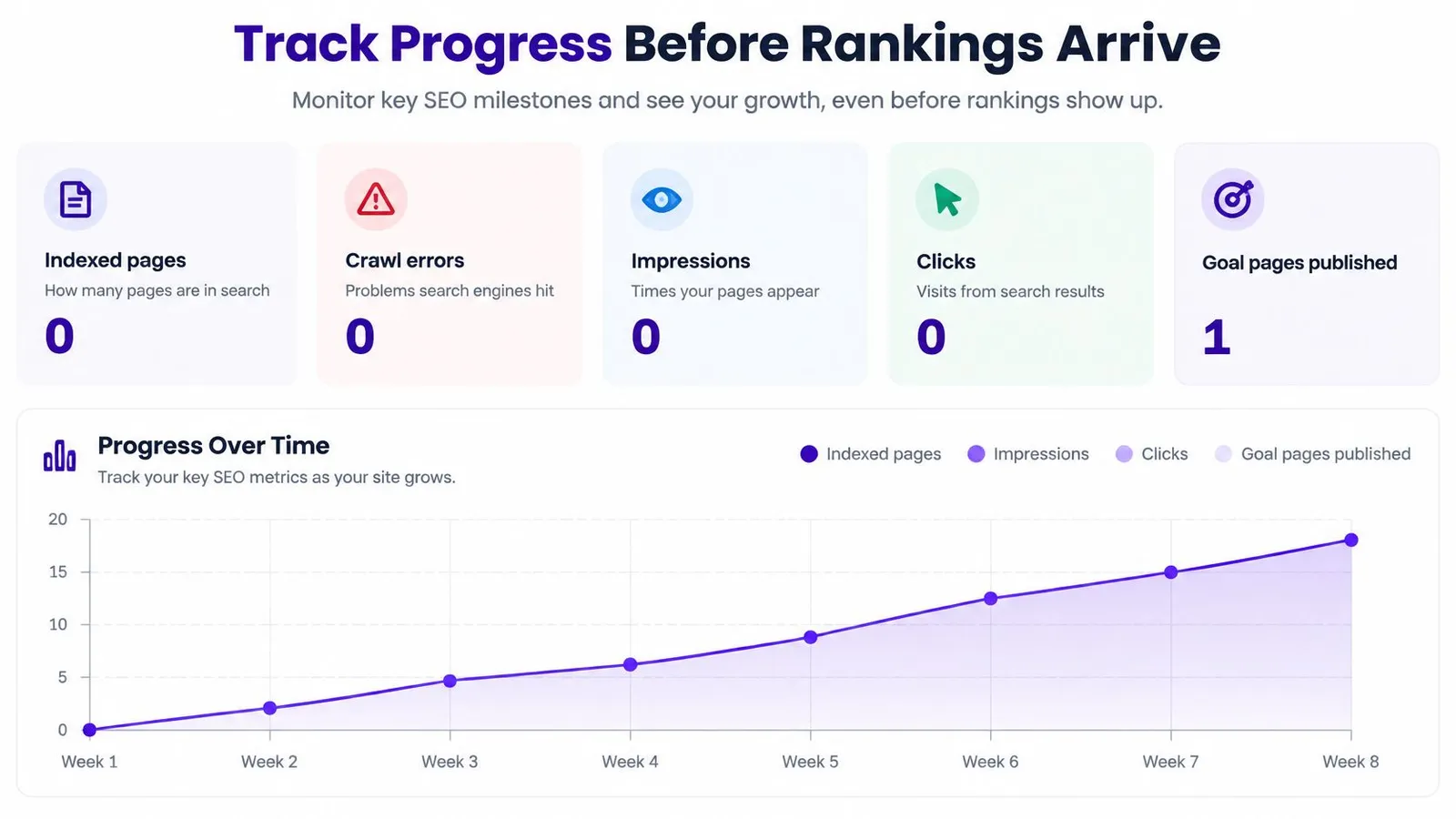
The review should connect each observation to a different response.
| Observation | Useful next investigation |
|---|---|
| Priority pages remain unindexed | Accessibility, canonical selection, internal discovery, and page usefulness |
| Impressions appear for unrelated queries | Whether the page's subject and intended audience are clear |
| Relevant impressions appear without meaningful clicks | Query fit and how the page is presented in results |
| Visitors reach articles but not relevant merchandise | Whether the answer provides a natural commercial next step |
For repeatable reporting, a Google ranking-checking process should preserve consistent comparisons rather than rely on occasional personal searches. Operosus's guidance to compare mobile and desktop search rankings also helps frame device differences instead of assuming every visitor sees the same results.
Keep AI referrals separate
AI-referred visits deserve their own channel review. A 2025 study of roughly 82,000 websites examined AI traffic quality, while a separate analysis reported average AI traffic growing about tenfold year over year as average search traffic fell approximately 21%.
Those figures don't forecast the outcome for a new Shopify store. They justify monitoring AI discovery separately, then checking which landing pages receive those visits and whether visitors take commercially relevant actions.
Rankira recommends two to three months of consistent publishing before judging results. That evaluation window shouldn't postpone fixes to broken pages or inaccurate content; it prevents premature strategic conclusions from sparse data.
Early reporting should distinguish “not discovered,” “not relevant,” and “not enough evidence yet.” Those diagnoses require different decisions.
Choose a Workflow That Keeps You Publishing
Consistency depends on ownership, not enthusiasm. Keyword selection, drafting, fact-checking, imagery, linking, publishing, and measurement all need an operator, even when software handles part of the production.
The practical choice is between workflows with different demands on money, time, and expertise. None removes the need for editorial judgment.
Three Ways to Run SEO Content on a New Site
| Approach | What You Handle Yourself | Cost Profile | Best Fit |
|---|---|---|---|
| Manual workflow with separate tools | Research, briefs, writing, editing, publishing, and reporting | Tool subscriptions plus substantial internal time | Teams with editorial expertise and capacity |
| Freelancer or agency | Business context, product accuracy, approvals, and commercial priorities | External service fees plus management time | Stores needing specialist judgment or execution |
| Shopify-integrated app | Topic approval, factual review, brand fit, and publishing decisions | App subscription plus editorial oversight | Merchants constrained by recurring production work |
Manual production offers close control, but the cost includes the operator's time. A merchant who repeatedly postpones research and publishing doesn't have a sustainable workflow merely because the software bill is low.
A freelancer or agency can take on execution and specialist decisions. The store still needs someone to explain inventory, positioning, product limitations, and which customers matter most. Outsourcing without that context creates polished content that may miss the business.
Automate production without outsourcing judgment
Rankira represents the Shopify-integrated approach. It researches keywords around the store's products, writes SEO-optimized articles, and publishes them to the Shopify blog automatically. Articles can include AI-generated images in five styles, and the Balanced and Sales-driven content goals open buying guide and product roundup formats while steering keyword research toward buying intent.
The supporting tooling covers the measurement side as well: a Search Console dashboard, an AI section rewriter for targeted revisions, support for more than 150 languages and 190 target regions, and Ahrefs Domain Rating tracking. A merchant choosing which Shopify blog receives the articles can also create a dedicated blog from the settings screen, keeping SEO content separate from store announcements.
Those capabilities address production friction, not every SEO requirement. An application doesn't make a weak topic commercially relevant or establish that a product claim is accurate.
A workable content strategy development process therefore needs explicit approval rules.
- Keep the draft when the article lacks a useful answer, local relevance, or reliable product information.
- Approve publication when the page serves a defined audience and provides a relevant destination for interested readers.
- Revise with evidence when reporting exposes a specific mismatch, rather than rewriting every article after a quiet week.
Rankira's optional backlink exchange works under strict conditions. Every store must pass an automated content check to join, participate from a real custom domain rather than a .myshopify.com address, and accept at most three new backlinks per day to keep growth gradual and natural-looking. That cap is a participation policy, not a guarantee that an exchanged link is valuable or that a particular growth pattern earns rankings.
The best workflow is the one the team can maintain while preserving these checks. Automation should remove repetitive work, leaving more attention for decisions that require knowledge of the store.
Start Your First Ninety Days of SEO
A ninety-day commitment should define work the operator can control: crawl coverage, page speed, published topics, and a measurement baseline set before traffic arrives. Ranking positions stay outside that promise. The useful outcome is a publishing and review system that produces enough evidence to name the next constraint.
That commitment also needs boundaries. Publishing more URLs isn't automatically progress. Waiting patiently isn't a substitute for investigating a known technical problem, and a quiet report after three weeks says almost nothing about a site this young.
Make the commitment operational
- Week one: assign a named owner to the launch checks and performance fixes. Important issues need a completion condition, a sitemap submitted, a template fixed, rather than an indefinitely open task.
- Recurring production: prioritize topics the store can answer accurately and connect naturally to its catalog. Publication follows approval.
- Weekly review: compare Search Console impressions, indexed page counts, and field performance data against the baseline recorded at launch, then write down what changed.
- Day ninety: decide what deserves expansion, revision, or a pause. The evidence guides the next cycle.
The review should leave a short decision log. A note such as "collection remains undiscovered, repair its discovery path" beats "traffic is disappointing." An article attracting the wrong queries calls for a different response than a relevant article that lacks observations yet.
Watch the channel nobody budgets for
Some of the earliest visits a new site earns arrive through AI assistants citing pages that rank nowhere yet. Those sessions land as referrals in analytics reporting, sit outside the clicks and impressions baseline, and are easy to misread as noise. Tag them separately from the start. A handful of AI-referred visits to a buying guide is a weak but real signal that the content answers something, and it often precedes the first page-one ranking by weeks.
Choose the next action
The durable advantage is continued, evidence-led execution. Stores that keep publishing useful material, correct their mistakes, and follow through on measurement give themselves a better basis for decisions than stores that restart their strategy whenever a report looks quiet.
Rankira researches keywords around a store's products, writes SEO-optimized articles, and publishes them to the Shopify blog automatically. Its Home dashboard tracks clicks, impressions, and positions once Google Search Console is connected, so the measurement baseline described above lives in the same place as the publishing queue. Merchants ready to turn a new-site SEO plan into a recurring workflow can visit Rankira and start a trial to test the process against their store's actual content needs.
Keep reading
All articles
Shopify SEO
SEO Content Writing Principles for Readers and Search
Learn the principles of SEO content writing that balance search relevance, clear structure, and real reader value, with examples for online stores.
10 min read
Shopify SEO
Internal Linking Audit That Actually Improves Rankings
Run a practical internal linking audit to find orphan pages, fix broken links, and prioritize fixes that move revenue on your Shopify store.
10 min read
Shopify SEO
Share of Voice SEO: A Practical Measurement Guide
Learn how share of voice SEO works, how to calculate it, and how to use intent-based metrics to assess search visibility and business impact.
12 min read
Put your Shopify blog on autopilot
Rankira researches keywords, writes SEO articles, adds internal links, and publishes them to your store — every week. Start with a 7-day free trial.