Low Competition Keywords Worth Ranking For
Find low competition keywords you can actually rank for. Learn how to weigh difficulty, search intent, and click potential before you publish.
Published 12 min read

In this article
A low difficulty score is not a reason to publish. Plenty of Shopify stores chase the easiest phrases on a spreadsheet, rank for a few of them, and still watch the blog send almost nobody to a product page. The phrase was attainable. The visit never arrived, or the visit had nothing to buy.
The more popular shortcut is just as weak in the other direction. Pick the biggest search volume in the category, write a broad post, and hope a small store can outrank brands that have spent years collecting links. Most of those posts sit on page two and never earn a click.
Low competition keywords are worth ranking for only when three things line up: a first page the store can join, a searcher whose job the store can finish, and a result page that still gives someone a reason to leave Google. The rest of this guide is a way to separate those phrases from the empty ones, using a catalog rather than a score.
Table of Contents
- Why Low Competition Keywords Still Matter
- What Makes a Keyword Low Competition
- How to Judge a Realistic Ranking Chance
- When Easy Keywords Fail to Earn Clicks
- Query Types That Fit a Store Catalog
- Choosing a Research Workflow That Sticks
- A Practical Next Step for Your Blog
Why Low Competition Keywords Still Matter
A home-goods store publishes a monthly post titled "best kitchen storage." The draft is careful, the photos are real, and Search Console shows impressions that never turn into sessions. The phrase is popular, so every large retailer and magazine already owns a version of it. Volume looked like demand. It was mostly a queue the store could not cut.
That pattern comes from how search is shaped, not from a bad writer. A large-scale Backlinko analysis of 306 million Google keywords found that 91.8% of distinct queries were long-tail terms with fewer than 100 searches a month. Those same queries made up only 3.3% of total search volume. The median keyword drew 10 searches a month, while the average sat at 989, because a handful of huge head terms pull the average up.
A content plan built only on those head terms fights brands a new or small domain will not outrank. A plan built only on the lowest difficulty number can fill a calendar with facts Google already answers. Neither habit is a catalog strategy.
Low competition keywords work as a portfolio bet. Each phrase is modest on its own. Together, many specific queries can match a product, a collection, a problem, or a narrow audience the store already serves. A candle shop does not need "candles." It might need the soy-wax question a buyer asks before choosing a jar, or the burn-time question that sits next to one collection.
Later checks cover whether the first page is realistic, whether the intent is commercial or merely curious, and whether anyone will click past an on-page answer. Those tests come after the job is clear. The job is choosing which phrases deserve a post, not memorizing SEO vocabulary. A practical SEO content marketing habit starts with that filter, then keeps only the phrases a product page can inherit.
Practical rule: If a phrase cannot point at merchandise the store already sells, it does not belong on this month's list, no matter how easy the score looks.
What Makes a Keyword Low Competition
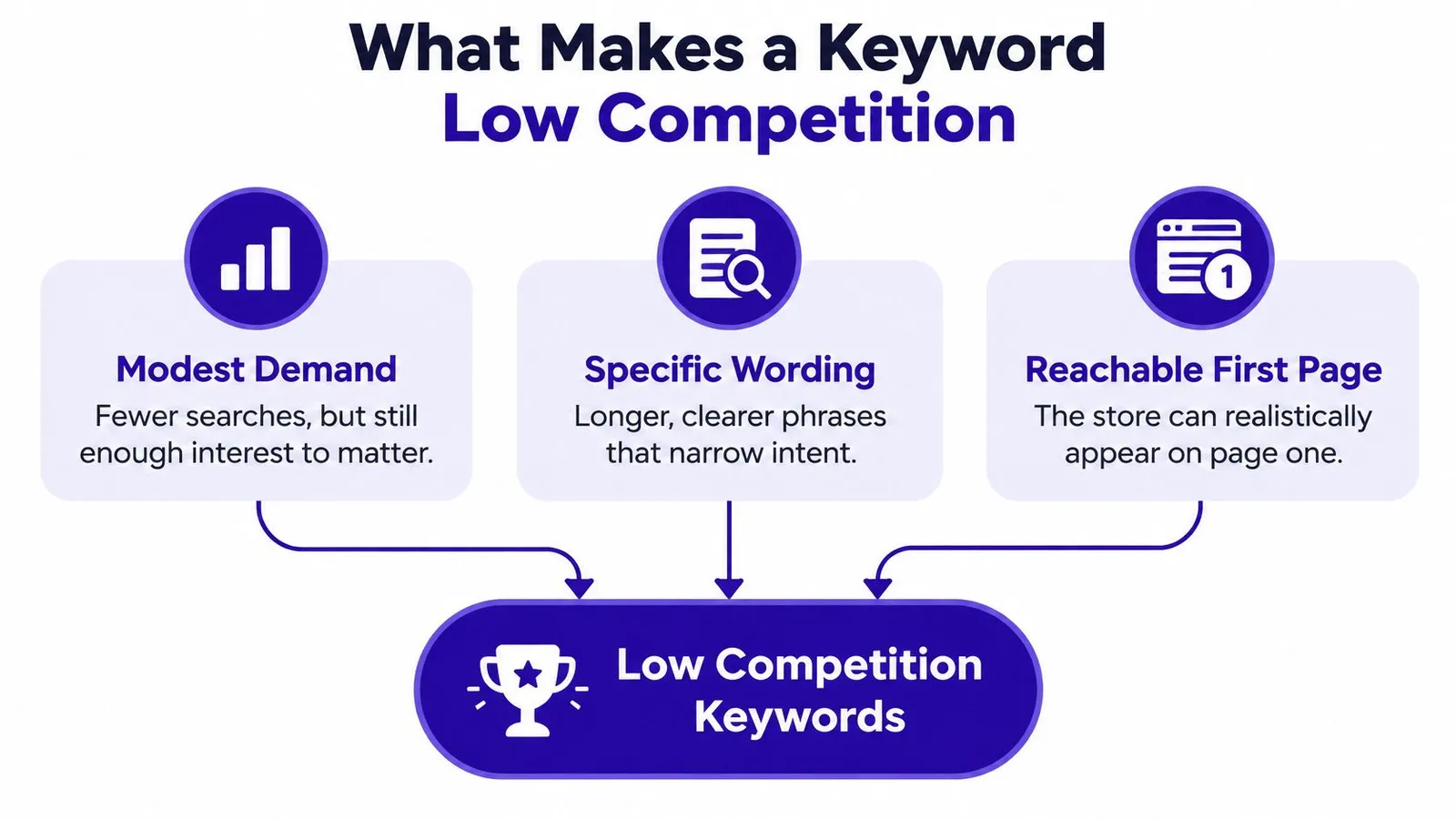
Low competition is not a synonym for long phrasing. It is a mix of modest demand, wording that names a precise need, and a first page a smaller domain can realistically join.
Think of a crowded main street versus a side street that ends at one shop. The main street is "running shoes." Everyone publishes there. The side street is "trail shoes for wide feet on wet rock." Fewer people walk it, and the ones who do are already close to a decision. That side street is the shape of a useful low-competition candidate.
Demand, wording, and a page one the store can join
Longer questions often meet less resistance than two-word category terms, and a 2024 Ahrefs comparison of 300,000 keywords shows why the pattern shows up in the data. Queries that triggered AI Overviews had a median Keyword Difficulty of 12, against 33 for other queries. Median length was four words versus two. Median search volume was 500 versus 29,000, and median traffic potential was 2,200 versus 18,000. Median difficulty sat 21 points lower, while non-overview terms carried 58 times the median volume.
Those figures describe a group of longer, more specific queries. They do not prove that adding words makes a phrase easy. "Best laptop" is short and brutal. "Best laptop for video editing under a tight budget with a bright screen" can still be owned by review sites with deep link profiles. Word count is a clue, not a verdict.
Keyword difficulty is a tool estimate, not a score Google publishes. Platforms build it from backlinks, domain strength, and who already ranks. Authority, intent, SERP features, and the quality of the page still decide the outcome. A candidate, said in plain language, is a specific phrase with limited demand whose current first page does not require a national publisher to match.
A backpack shop can describe one cleanly. "Waterproof roll-top backpack for a daily commute" names a material, a closure, and a use. "Backpack" does not. The first phrase might still be hard if three specialty brands already rank with exact product guides. The description comes before any scoring method. If the merchant cannot say who is searching and which product answers them, the phrase is not ready for a difficulty filter.
How to Judge a Realistic Ranking Chance
A definition does not pick the next post. Three checks do, held together: estimated volume, the job the searcher is trying to finish, and the pages that already rank.
Open the live results before trusting a score. Note whether the top URLs carry heavy backlink profiles, whether the domains are established category leaders, and whether a specialist page already matches the query word for word. A forum thread and a thin affiliate list are a different first page from a brand that has ranked that exact guide for years.
A score is a filter, not a green light
Difficulty bands are a starting sort, not a promise. One widely used scale, described in Backlinko's keyword analysis guide, treats scores below 30 as low competition, 30–60 as medium, and above 60 as high. A store with a thin link profile should pause on anything that already looks medium unless the live page is weak on intent.
The page being planned has to match the dominant intent better than what ranks now, and it has to link toward the relevant product or collection. A care article that never names the fabric the store sells is a blog orphan. A comparison that hides the collection until the footer wastes the click.
Store context, competitor results, and Search Console queries belong in the same pass. Search Console shows phrases the site already earns impressions for. Competitor URLs show who would have to be displaced. The catalog shows whether a collection can receive the link. A low score is not, by itself, a reason to publish. Learning how to check ranking on Google matters only after those three sources agree.
| Signal | What to Look For | Planning Use |
|---|---|---|
| Estimated volume | Enough interest to justify a page, without a head-term pileup | Drop dead phrases and fantasy category terms |
| Searcher job | A task the store can finish: compare, size, check compatibility, choose a material | Match the URL type to that job |
| Live first page | Backlink strength, domain authority, exact topical fit, specialist ownership | Pass, pause, or abandon |
| Catalog path | A product or collection the article can link to in the body | Keep only phrases that can sell |
A score under 30 that fails the live-page check is a pause, not a draft.
Pass means the store can plausibly sit on page one with a page that answers the job better than the current set. Pause means one signal is missing, usually the internal link or a SERP full of brands the store cannot resemble. That habit beats any promise that a band on a tool will rank itself.
When Easy Keywords Fail to Earn Clicks
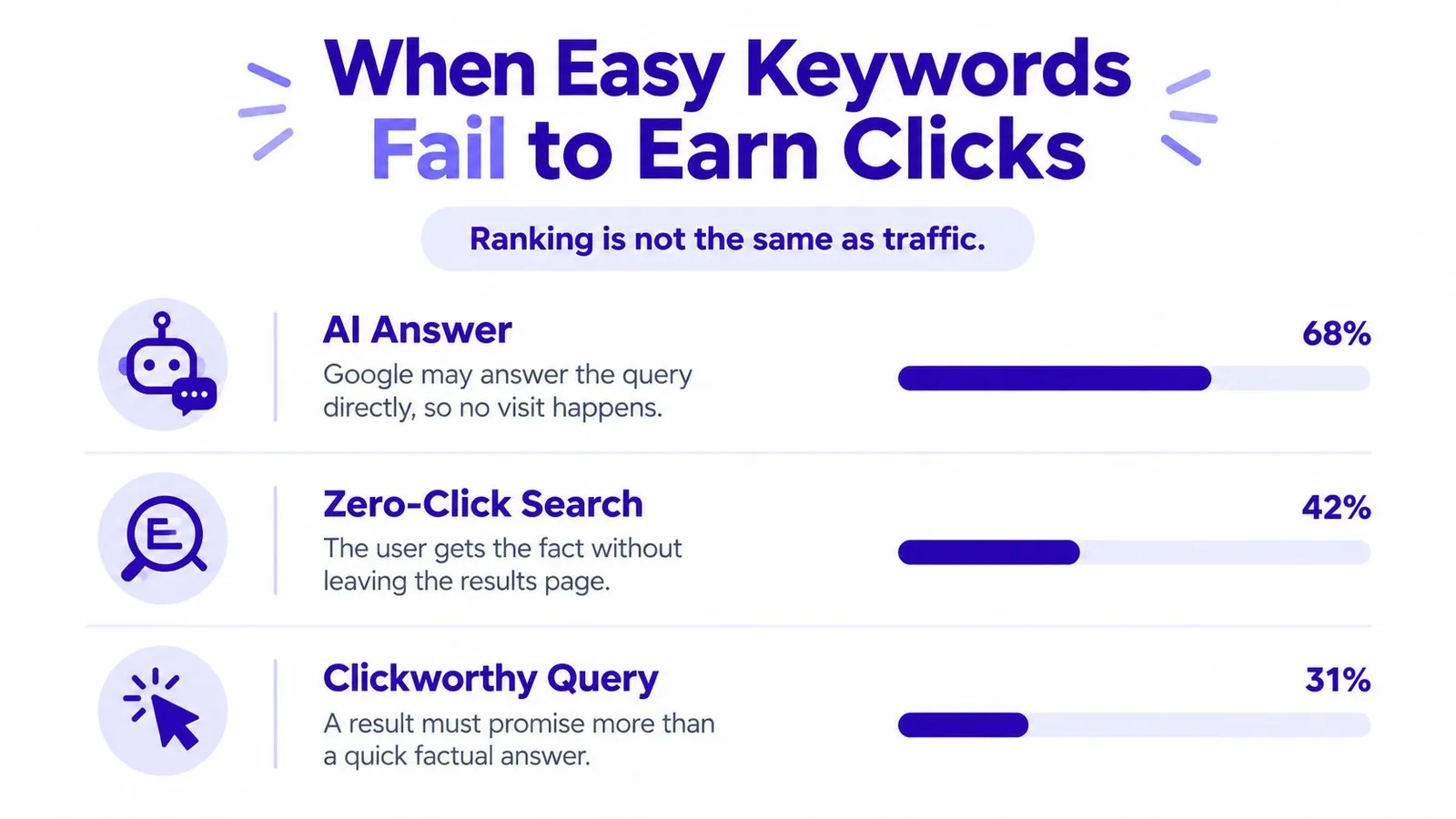
Ranking and earning a visit are different jobs. Google can answer a short factual query inside an AI Overview or another on-page feature. The store can hold a visible position and still send almost no one to the product grid.
Pew Research Center's March 2025 look at 68,879 Google searches, reported by Adgully, found users clicked a traditional result in only 8% of visits when an AI Overview appeared, compared with 15% when none appeared. Users also ended the browsing session on 26% of AI Overview pages, versus 16% of pages without one. An easy informational phrase can be a visibility win and a store loss in the same week.
Classify the query before it hits the calendar
Sort the phrase by what the click has to deliver:
- Product page: The searcher wants an item with a stated attribute, price band, or variant.
- Comparison: Two materials, two fits, or two use cases need a side-by-side the summary cannot finish.
- Sizing or compatibility help: A measurement, a device match, or a capacity limit decides the purchase.
- Visual guide or first-hand test: Photos, a wear trial, or a setup sequence add evidence a paragraph cannot replace.
- One-sentence fact: A definition, a year, or a yes-or-no that an overview can close.
The last group is a weak investment for a shop even when difficulty looks friendly. "What is organic cotton" can rank and still never introduce the tee. "Which organic cotton tee holds shape after a hot wash" can send a reader to the collection, because the answer needs evidence.
Treat click potential as a pause before the phrase enters the calendar. If a summary can finish the job, skip it or fold one sentence into a richer page. Stores trying to increase blog traffic get more from fewer posts that survive this pause than from a pile of easy definitions.
A query is clickworthy when the result must promise something a snippet cannot hold: a fit chart, a side-by-side, a photo sequence, or a product constraint. If the title could be replaced by a single bold sentence on the results page, leave it off the schedule.
Query Types That Fit a Store Catalog
Broader volume tends to come with harder results. Specific attributes, use cases, compatibility, sizing, delivery, and audience problems narrow the field. A long-tail study summarized by Orvus found a roughly linear pattern on a doubling scale: each doubling of search volume lined up with about a 1.63-point rise in keyword difficulty. Lower volume can mean less resistance. It only helps if the phrase still sits next to something the store sells.

Shapes a merchant can map to merchandise
A leather-bag shop keeps seeing the question "how to condition vegetable-tanned leather without darkening it." That is a material-care phrase. One article can answer the steps and link the care collection, or the bags made in that leather, from the second paragraph rather than a footer dump.
A kids-shoe store gets "do these boots fit wide calves." That is a fit phrase tied to one product. A short page with the calf measurement, a photo of the opening, and a link to the boot outperforms a generic "boot sizing" essay.
Delivery and compatibility work the same way. "Ships a framed print in a tube or a flat pack" belongs on the print collection. "Case that fits a phone with a thick wallet grip" belongs on the case product, not on a gadget glossary.
What Search Console already knows
Search Console impressions often reveal long phrasing the store already appears for and never built a page around. Export a month, sort by impressions, and ignore the head terms. Keep rows that name a material, a body type, a device, a climate, or a constraint.
- Turn a repeated impression into an article when the query needs steps, photos, or a comparison.
- Turn a narrow impression into an FAQ block on the product or collection that already ranks nearby.
- Add an internal link from an older post that mentions the problem but never points at the item.
The shortlist logic is small. The phrase is commercially relevant, specific enough that fewer publishers bother, and able to point at merchandise. Anything that fails one of those three stays in a note, not on the calendar.
A backpack buyer comparing roll-tops on a laptop is a useful picture of that logic. The query is not "bags." It is a closure, a commute, and a weather worry. The collection either answers that or it does not.
Choosing a Research Workflow That Sticks
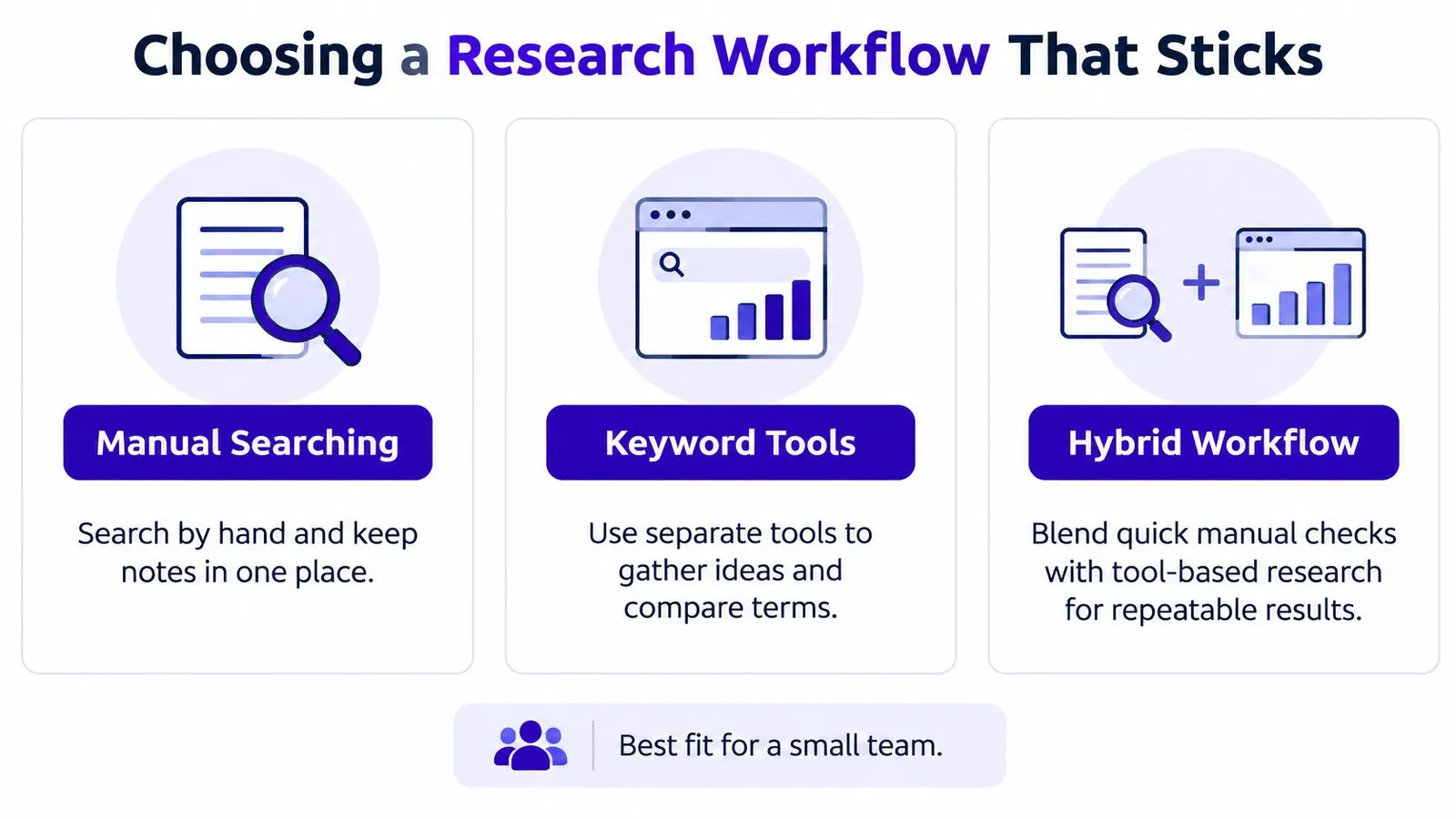
The list fails when the workflow does not fit a store with no content team. Three setups show up again and again, and each breaks in a different place.
Three ways small teams actually work
Manual searching means Google, autocomplete, a notes doc, and a look at the first page. It is honest and slow. It also misses country wording. The same English phrase can mean a size in one market and a material in another. Notes rot, and nobody repeats the check next month.
A stack of separate tools gathers volume, difficulty, and a content brief in different tabs. That is stronger on estimates and weaker on follow-through. A merchant exports a CSV, loses the afternoon, and never connects the winning phrase to a collection URL. Thin volume estimates get treated as zeros and thrown out.
Research inside Shopify admin keeps the catalog, the draft, and the schedule in one place. The merchant does not retype product names into another login. For stores whose third-party volumes jump around, the useful habit is stacking weak signals: Search Console impressions, product fit, autocomplete, competitor gaps, and any assisted conversion the phrase already touches. Semrush's AI Overviews study is a reminder that summarized results change click behavior, so a volume cell alone cannot green-light a phrase. A careful pass through Taja AI's keyword research guide helps a small team see which manual checks are worth keeping when tool numbers look unstable.
Zero volume is not the same as zero demand. It can be a new use case, a regional wording, or a purchase worry too specific for a database. Test it against impressions, clicks, engagement, and revenue before it joins an automatic schedule. Do not scale a guess.
Rankira is one in-admin option for that third setup. It combines store catalog context, competitor analysis, and Search Console data, then organizes terms with volume and difficulty. A calendar can schedule one keyword a day, up to seven days a week, or save drafts. Generation covers meta descriptions, tags, images, clean URLs, and links to products, collections, and pages, with reporting and a backlink exchange. The Standard plan is USD 39 a month and includes a seven-day trial. Merchants who want the research steps written out can follow a keyword research walkthrough and then decide whether the in-admin path or the manual path matches the hours they have.
The right workflow is the one a person will still open on a Tuesday. A perfect stack that nobody maintains loses to a short manual pass that ties every phrase to a product.
A Practical Next Step for Your Blog
Pick five specific queries this week. They can be phrases already earning impressions, or catalog problems customers ask in email and chat. Run each one through the three gates: a first page the store can join, an intent the store can serve better than the current results, and a reason to click rather than stop at a summary.
Keep one winner. Draft or schedule a single post. Put internal links in the body to the matching product or collection, not only in a related-products widget. Publish it, then wait long enough to read clicks, impressions, and average position before any second phrase joins an automatic calendar.
If the query fails click potential, stop. Do not "salvage" it with a longer introduction. A one-sentence fact dressed up as a guide still will not send a buyer to a product. Fold the fact into a page that already has a job, or drop it.
Merchants who want the research, the draft, the schedule, and the measurement inside Shopify can use Rankira's seven-day trial instead of stitching those steps across separate tools. The trial is a test of the workflow, not a promise that every low-difficulty phrase will sell. A fuller look at developing a content strategy helps set the weekly limit so the blog does not outrun the catalog.
One post, one product path, one review of the numbers. That is the whole experiment. If the winner earns clicks and the clicks reach the collection, add the next phrase. If it ranks and nobody comes, the phrase was easy and still the wrong investment.
Rankira researches keywords from a Shopify catalog, competitors, and Search Console, then drafts and schedules posts that link back to the products those phrases belong to. That is the difference between a low difficulty score and a phrase that can send a buyer to a collection. Visit Rankira to try the seven-day trial and run one catalog-backed keyword through a real publishing week.
Keep reading
All articles
Shopify SEO
SEO Content Writing Principles for Readers and Search
Learn the principles of SEO content writing that balance search relevance, clear structure, and real reader value, with examples for online stores.
10 min read
Shopify SEO
Internal Linking Audit That Actually Improves Rankings
Run a practical internal linking audit to find orphan pages, fix broken links, and prioritize fixes that move revenue on your Shopify store.
10 min read
Shopify SEO
Share of Voice SEO: A Practical Measurement Guide
Learn how share of voice SEO works, how to calculate it, and how to use intent-based metrics to assess search visibility and business impact.
12 min read
Put your Shopify blog on autopilot
Rankira researches keywords, writes SEO articles, adds internal links, and publishes them to your store — every week. Start with a 7-day free trial.