Developing a Content Strategy That Actually Works
Developing a content strategy? Set goals, research topics, plan publication, and measure results with a practical process built for Shopify growth.
Published 11 min read

In this article
Only 29% of marketers whose organizations had a documented content strategy rated it extremely or very effective, according to Content Marketing Institute and MarketingProfs' 2025 B2B research. Although that benchmark covers B2B marketers rather than Shopify merchants, it exposes a useful distinction: documenting a plan isn't the same as making sound investment decisions. For a small ecommerce team, developing a content strategy means deciding which customer questions deserve scarce production hours, which products those answers support, and what outcome would justify continued investment.
Table of Contents
- Why Most Content Strategies Stall
- Set Goals That Connect Content to Revenue
- Research Topics Buyers Actually Search
- Prioritize Topics and Build the Calendar
- Choose a Production Workflow That Fits Shopify
- Measure Results and Improve What Matters
- Make the Next 30 Days Happen
Why Most Content Strategies Stall
A calendar can look organized while the underlying decisions remain weak. Topics have deadlines, writers have assignments, and articles get published, but nobody has defined why those articles deserve priority over improving a collection page or answering a recurring product question.
The problem isn't necessarily writing quality. A polished article can still attract the wrong audience, support unavailable merchandise, or leave readers without a useful next step. For a merchant managing operations alongside marketing, the cost includes both production time and the work that didn't happen instead.
The gaps behind an active blog
Small teams should examine their programs for several operational weaknesses:
- Unclear goals: Organic growth is the aim, but the audience, supported collection, and expected business action are not named.
- Unrealistic capacity: The publishing schedule accounts for drafting but ignores product verification, editing, merchandising input, and maintenance.
- Weak attribution: Reporting ends at sessions, leaving the team unable to distinguish commercially useful content from unrelated attention.
Agencies face another complication: responsibilities can fall between teams. The agency supplies articles, the merchant owns product accuracy, and neither explicitly owns the path from article to merchandise. An internal linking audit can help structure that investigation before additional content enters the queue.
Practical rule: An article shouldn't enter production until someone can explain which customer decision it helps and which business action follows.
Treat strategy as allocation
A usable strategy establishes priorities and exclusions. It identifies the audiences worth serving, the questions the store can answer credibly, and the work the team will postpone.
That creates useful tension. A broad educational topic might offer substantial reach, while a narrow comparison may sit much closer to a relevant purchase. Neither automatically wins. The decision depends on the store's objectives, catalog, available evidence, and ability to measure progress.
The operating system needs goals connected to money, research grounded in customer language, a calendar matched to actual capacity, and explicit review decisions. Documentation supports those choices. It doesn't replace them.
Set Goals That Connect Content to Revenue
“Get more traffic” doesn't survive a serious budget conversation. A commercially useful goal explains whose attention matters, what those visitors need, and which action would indicate that the content helped.
Start with visibility, engagement, and commercial action, but keep their measurements separate. The distinction prevents a rise in search exposure from being presented as evidence of sales.
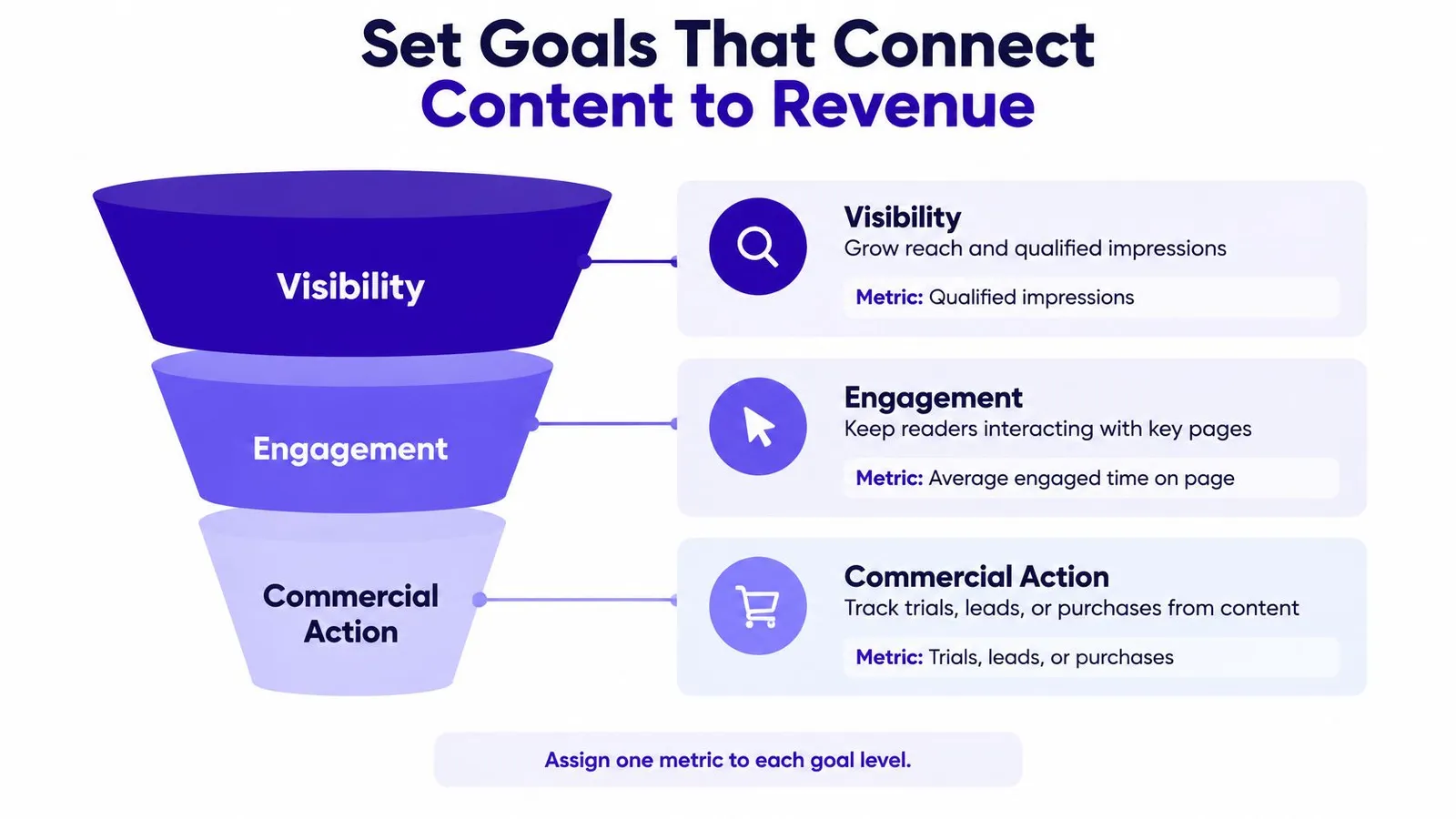
Assign a metric to each outcome
| Goal level | Question it answers | Suggested primary metric |
|---|---|---|
| Visibility | Is the store appearing for relevant needs? | Impressions for the selected query group |
| Engagement | Are readers moving toward relevant merchandise? | Article-to-product-page visits |
| Commercial action | Are readers completing the intended next step? | Content-assisted purchases |
The metric should follow the article's purpose. An educational guide might seek email subscriptions because the reader isn't ready to choose a product. A compatibility guide might prioritize visits to suitable accessories. Post-purchase instructions could support a return-prevention objective, provided the merchant can connect content exposure with an appropriate operational measure.
Avoid assigning every possible metric to every article. A crowded dashboard lets teams select whichever result looks favorable instead of evaluating the original decision.
Write a goal that can be reviewed
A hypothetical goal for a cookware store might read:
Help induction-hob owners understand cookware compatibility through organic search, direct relevant readers to the induction collection, and evaluate article-to-collection visits at the agreed review date.
The final version should include the existing baseline, an agreed target, a named owner, and an actual review date. Targets should come from the store's data and commercial requirements, not borrowed industry promises.
Before reporting revenue, the merchant and agency should also agree on attribution. Carti's resource to compare Shopify revenue attribution models provides a useful starting point for that discussion. The reporting agreement should state what qualifies as content-assisted activity and where tracking remains incomplete.
A purchase following an article visit isn't automatically proof that the article caused the purchase. Equally, an educational article shouldn't be dismissed because it wasn't the final interaction. The practical requirement is consistency: compare results using the same definitions, disclose limitations, and avoid adding overlapping revenue totals together.
Research Topics Buyers Actually Search
Customer questions provide a better starting point than an empty keyword-tool search box. Product reviews, support tickets, onsite searches, and sales conversations can supply the language for a research backlog.
A simple working document can keep customer evidence beside candidate queries.

Start with the purchase obstacle
Consider a hypothetical store selling insulated bottles. Its team might investigate questions about cleaning narrow openings, transporting hot drinks, or choosing a bottle that fits a bag. Each question suggests a different editorial job, even though all relate to the same catalog.
Keep the customer's original wording. Replacing a specific concern with a broad phrase such as “hydration tips” removes the detail that could make the article useful.
Research should collect:
- The audience need: The decision, uncertainty, or task behind the question.
- The candidate query: The search wording that appears to express that need.
- The intent and purchase distance: Whether the reader wants instructions, comparisons, reassurance, or a product.
- The catalog connection: The relevant product or collection, plus a sensible next action.
- The timing constraint: Any seasonal relevance or dependence on future stock.
Keyword tools can then expand the vocabulary and provide directional demand and difficulty estimates. A step-by-step keyword research process helps keep that expansion systematic without allowing tool suggestions to replace customer evidence.
Inspect the results before committing
Search the candidate query and examine what the results answer. A query dominated by product listings may need a collection-page improvement rather than a blog post. A troubleshooting query may require illustrated instructions rather than a buying guide.
For teams pairing written research with a video walkthrough, the following resource can accompany the exercise.
Look for a defensible contribution, not merely a missing keyword. Could the store demonstrate the task with its own products, explain a compatibility limitation, or organize an answer more clearly? If the proposed article would only paraphrase existing results, return it to research.
Search volume and difficulty remain inputs, not verdicts. A modest-demand query with a clear product relationship may deserve investigation ahead of a broad topic with little catalog relevance. The completed backlog should make that relationship visible before anyone writes an outline.
Prioritize Topics and Build the Calendar
A backlog becomes a strategy only when the team chooses what won't get made. Giving every plausible keyword a deadline converts research into an obligation rather than an investment decision.
The commercial case for clearer prioritization is substantial. In Content Marketing Institute's enterprise research, 47% of enterprise marketers cited unclear goals as a limitation on effectiveness, while 45% said their strategy wasn't tied to the customer journey or wasn't data-driven. Those findings aren't an ecommerce performance benchmark, but they support making the selection logic explicit.
Product-Aware Topic Scoring Matrix
Use qualitative ratings such as strong, uncertain, and weak. Weight the criteria according to current business priorities, and record the reasoning beside each rating.
| Criterion | Question to Ask | High-Score Signal |
|---|---|---|
| Search demand | Does evidence support recurring interest? | Customer questions and query research align |
| Ranking difficulty | Can the store offer a competitive answer? | A specific gap matches available expertise |
| Product relevance | Does the topic naturally support the catalog? | A direct route to suitable merchandise |
| Buying intent | What decision is the reader approaching? | The article resolves a purchase obstacle |
| Margin | Does the supported range justify investment? | Commercial value supports production effort |
| Inventory stability | Will recommended products remain available? | Dependable stock or suitable alternatives |
| Internal-link value | Does this strengthen an existing content path? | Useful connections to relevant pages |
| Distinctive contribution | What can the store demonstrate or explain? | Original images, tested instructions, or verified detail |
A hypothetical homeware store might defer a broad decor-trends article in favor of a guide to choosing washable rugs for dining areas. The narrower topic could deserve priority if it supports a profitable, reliably stocked collection and the team can provide credible care guidance. That's a decision example, not a promised outcome.
Schedule the work, not just publication
Build the calendar around the bottleneck. If product verification requires the merchant's approval, drafting capacity alone can't determine publishing frequency.
- Drafts: Assign an owner, evidence requirements, and an approval deadline.
- Refreshes: Reserve capacity for maintaining existing pages.
- Seasonal content: Work backward from the customer's buying period and stock availability.
- Paused ideas: Keep weak-fit topics outside the committed schedule.
A content calendar workflow should make those commitments visible rather than encourage filling every available slot. Distribution also needs an owner: email, relevant customer communities, or social channels should be selected deliberately.
For merchants considering community participation, Securify's Build DTC communities without fake engagement is a relevant companion resource. Distribution planning should focus on useful participation, not manufactured activity.
Choose a Production Workflow That Fits Shopify
The right production method depends on where the team needs judgment and where it needs execution support. Writing speed matters, but so do catalog accuracy, approval capacity, and the effort required to move an article from research into Shopify.
Generative AI adoption doesn't resolve those decisions. 81% of marketers reported team use of generative AI tools in Content Marketing Institute's 2025 B2B benchmark. That establishes widespread use within the surveyed population, not proof that automation produces commercially effective content.
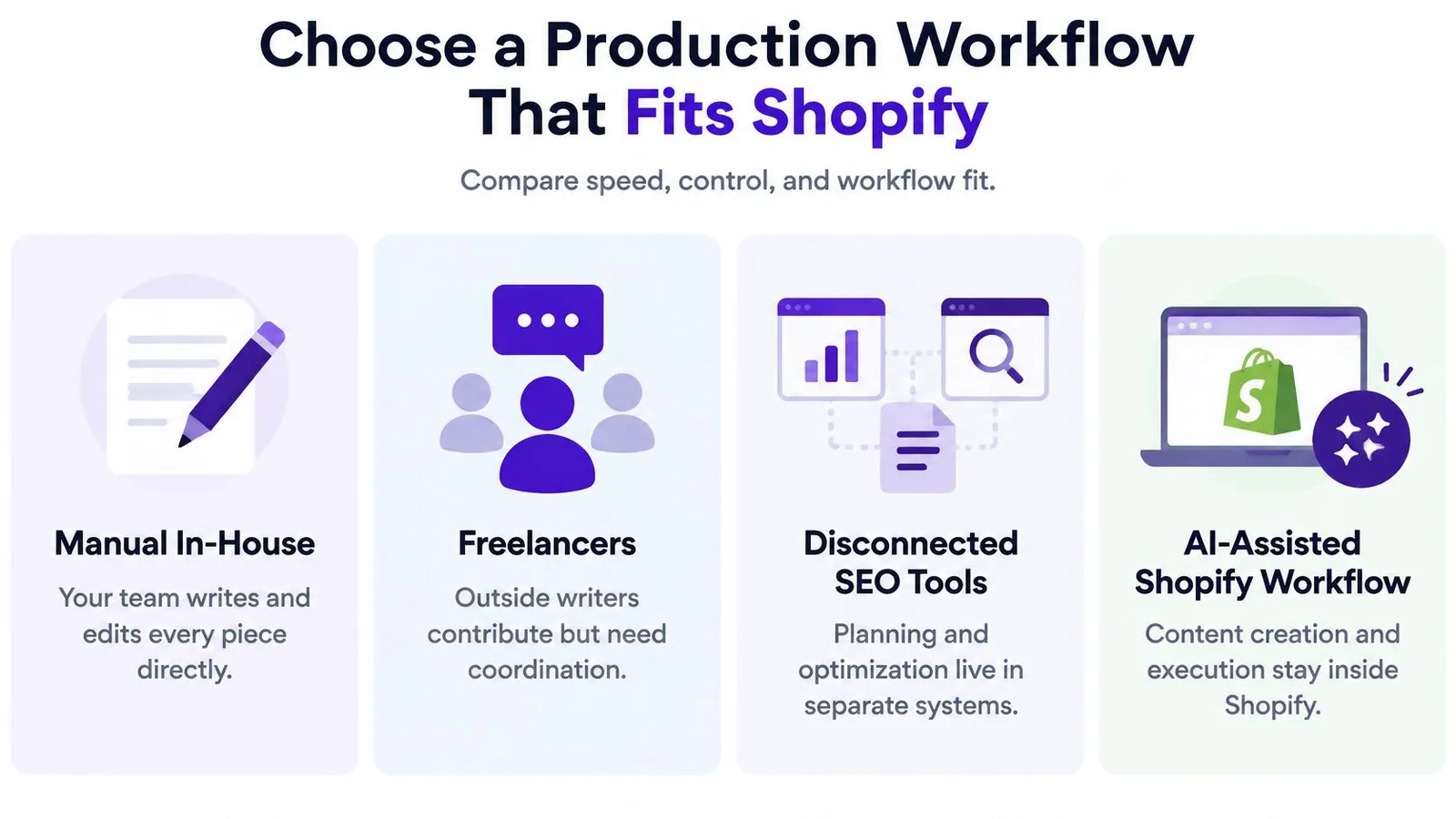
Compare the operational trade-offs
| Approach | Practical advantage | Responsibility that remains |
|---|---|---|
| Manual in-house | Direct access to product knowledge and brand decisions | Protecting staff time for drafting and editing |
| Freelancers | External writing capacity and specialist input | Briefing, coordination, and product verification |
| Disconnected SEO tools | Flexibility to choose separate research and optimization tools | Moving information between systems |
| AI-assisted Shopify workflow | Connected planning, generation, and publishing | Reviewing claims, intent, and merchandising relevance |
Manual production suits content that depends heavily on demonstrations, specialist judgment, or sensitive product distinctions. Its constraint is protected time. Assigning writing to someone already responsible for customer support doesn't create additional capacity.
Freelancers can contribute editorial skill, but the merchant still needs a reliable briefing process. Writers shouldn't have to infer compatibility, materials, or care requirements from scattered product descriptions.
Separate SEO tools may fit an agency's established reporting and research process. The trade-off is operational: someone must preserve decisions and context as work moves between spreadsheets, documents, optimization software, and Shopify.
Automate execution without delegating accountability
A Shopify-native application is another option. The publisher's application uses store information, competitor analysis, and Google Search Console data for keyword research, then connects planning with article generation and scheduling.
Its generated articles can include metadata, featured images, clean URLs, and links to products, collections, and pages. Merchants can choose draft review or scheduled publication through the Shopify publishing workflow. Those capabilities address handoffs, but they don't establish whether a topic deserves investment.
Faster drafting is useful only when the team can still verify what gets published.
Before expanding automation, assign responsibility for product claims, source checking, image suitability, and the recommended next action. A hybrid approach may fit: automation for preparation and routine production tasks, with staff contributing demonstrations and approving commercially important details. The preferred workflow is the one the team can supervise consistently.
Measure Results and Improve What Matters
Publication starts the evaluation period. Before an article goes live, record its intended query group, primary commercial event, measurement owner, and review date.
The observation window should reflect the store's existing search activity, seasonal context, and available data. There's no defensible universal deadline for declaring every article a success or failure. Keep technical checks separate from performance reviews so an indexing problem doesn't get mistaken for a weak topic.
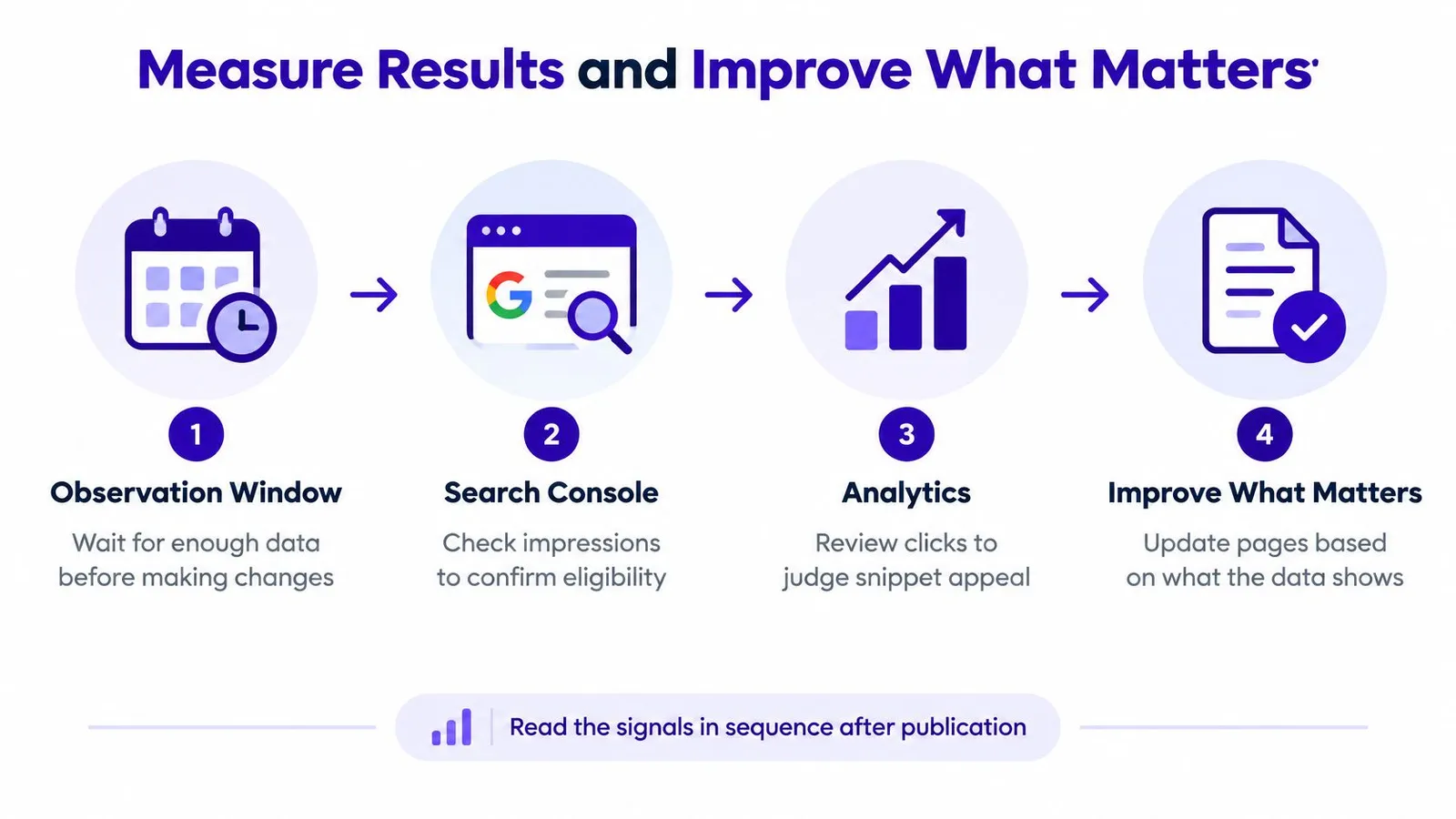
Diagnose the sequence
Read Search Console alongside onsite analytics, moving from search exposure to the intended business event. Treat each signal as evidence to investigate rather than a verdict.
- Impressions without meaningful clicks: Inspect query relevance, search position, and competing results before testing titles or descriptions.
- Clicks without relevant engagement: Check whether the opening answers the query and whether the article delivers the expected format.
- Engagement without merchandise visits: Review product relevance and the usefulness of contextual recommendations.
- Product visits without the intended action: Investigate availability, suitability, and the destination page rather than assuming the article needs rewriting.
- Little search exposure: Reassess indexability, internal discovery, competitiveness, and the usefulness of the answer.
Impressions confirm that a page appeared in search results, not that it reached its full potential. Clicks indicate a visit, not satisfaction. Keeping those distinctions intact prevents premature optimization and inflated reporting.
For broader competitive monitoring, a share-of-voice SEO framework can add context to the selected query group. It shouldn't replace page-level commercial evaluation.
Choose an action, not another report
Google's SEO guidance recommends readable, well-organized, original, current, helpful, and reliable content, with appropriate support from experienced or expert sources. It also advises updating or removing content that's no longer relevant. Those principles provide a useful quality check when deciding what to maintain.
Refresh pages when product details, instructions, or evidence have changed. Consider consolidation when overlapping articles would serve readers better as a coherent resource. Improve contextual links where the next useful destination is difficult to find.
Removal requires judgment. A page with little organic traffic may still serve customer support or post-purchase needs. Conversely, a page attracting unrelated visits may have little strategic value.
Record the decision and its rationale. The team should leave each review knowing what to keep, improve, combine, or stop funding.
Make the Next 30 Days Happen
The first month should produce a controlled pilot, not a complete rebuild. Choose a product line or audience segment with accessible customer questions, dependable merchandise, and someone available to verify the details.
Start with the store's existing evidence. Review relevant support conversations, current content, and available analytics, then write measurable goals covering visibility, engagement, and the intended commercial action. Establish the baseline before selecting a target.
Keep the pilot bounded
- Define the scope: Select a catalog area and document the customer decisions the pilot will support.
- Assess the candidates: Score a manageable topic shortlist using the commercial criteria above.
- Assign production: Agree on a sustainable weekly cadence and name the quality reviewer.
- Prepare evaluation: Confirm event tracking, attribution definitions, and the observation window before publication.
The merchant should also define what would justify expansion. That might include acceptable draft quality, manageable review effort, and evidence that readers take relevant next steps. Publishing volume alone shouldn't qualify.
A small portfolio connected to catalog value is a more useful starting point than an ambitious schedule nobody can maintain. Developing a content strategy becomes practical when the team can explain both the work it approved and the work it declined.
The pilot doesn't need to prove every long-term outcome immediately. It needs to reveal whether the team can make, execute, and evaluate disciplined decisions. Strategy is proven by decisions, not documents.
Rankira offers Shopify-focused keyword research, article generation, scheduling, internal linking, and search-performance reporting. Merchants considering a connected workflow can visit Rankira, run a limited draft-review pilot around a selected collection, and assess quality and review effort before enabling broader automated publishing.
Keep reading
All articles
Shopify SEO
SEO Content Writing Principles for Readers and Search
Learn the principles of SEO content writing that balance search relevance, clear structure, and real reader value, with examples for online stores.
10 min read

Shopify SEO
Internal Linking Audit That Actually Improves Rankings
Run a practical internal linking audit to find orphan pages, fix broken links, and prioritize fixes that move revenue on your Shopify store.
10 min read
Shopify SEO
Share of Voice SEO: A Practical Measurement Guide
Learn how share of voice SEO works, how to calculate it, and how to use intent-based metrics to assess search visibility and business impact.
12 min read
Put your Shopify blog on autopilot
Rankira researches keywords, writes SEO articles, adds internal links, and publishes them to your store — every week. Start with a 7-day free trial.