Keyword Research Step by Step for Shopify Growth
Learn keyword research step by step for Shopify. Find relevant queries, map search intent, prioritize opportunities, and build a measurable SEO plan.
Published 12 min read

In this article
- Table of Contents
- Why Shopify Keyword Research Needs a Decision System
- Prepare Your Store Research Inputs
- Discover and Validate Relevant Keywords
- Map Search Intent to the Right Shopify Page
- Prioritize Keywords by Business Opportunity
- Account for AI Search and Measurement Limits
- Build a Repeatable SEO Review Cycle
The keyword export is open, the Shopify blog needs fresh content, and the next publishing decision still isn't clear. A merchant selling coffee equipment has phrases about espresso machines, café interiors, brewing problems, and coffee subscriptions in the same spreadsheet. Plenty of ideas, but no defensible reason to choose one over another.
Working through keyword research step by step should produce decisions, not just a larger spreadsheet. For Shopify stores, each approved opportunity needs a suitable destination, a connection to the catalog, and a way to judge whether the work helped the business.
Table of Contents
- Why Shopify Keyword Research Needs a Decision System
- Prepare Your Store Research Inputs
- Discover and Validate Relevant Keywords
- Map Search Intent to the Right Shopify Page
- Prioritize Keywords by Business Opportunity
- Account for AI Search and Measurement Limits
- Build a Repeatable SEO Review Cycle
Why Shopify Keyword Research Needs a Decision System
Consider a hypothetical merchant selling grinders, brewers, and replacement filters. An export includes attractive phrases about opening a café, cleaning a grinder, and buying reusable coffee filters. All relate to coffee, but they don't deserve equal attention.
The café topic might attract an audience the store can't serve. The cleaning question could support existing customers and introduce compatible accessories. The filter query might belong on a collection that already exists, rather than in another blog post.
Relevance starts with what the store can credibly provide, not with a keyword tool's sorting order.
Make the decision explicit
A useful research sheet should answer these questions:
- Priority: Which opportunity deserves production or optimization time?
- Destination: Which page can satisfy the searcher's task?
- Action: Should the team improve an existing URL, create content, or reject the idea?
- Measurement: Which observable result would justify keeping the opportunity in the plan?
The diagram summarizes those connected decisions.
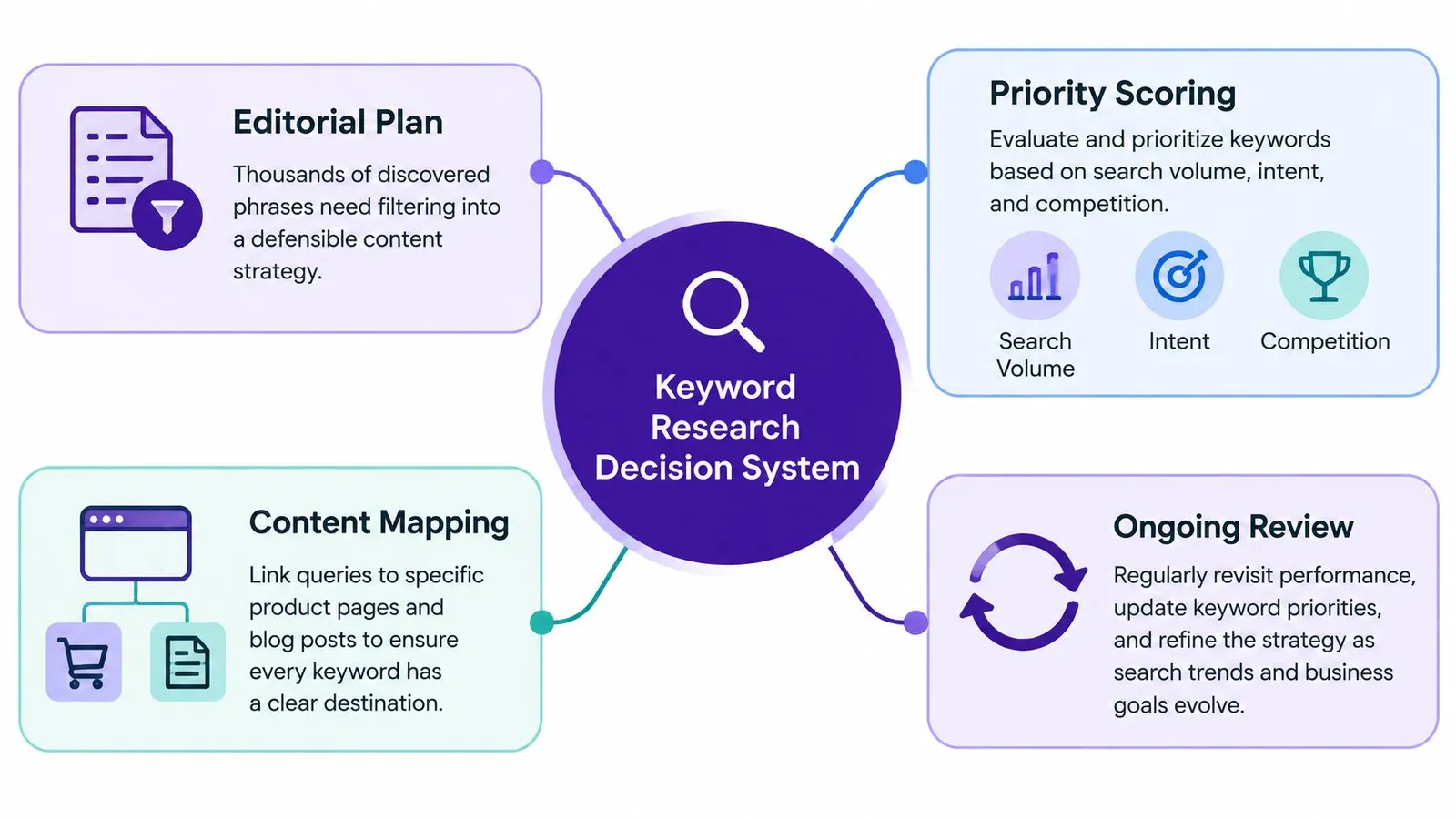
Store context, competitor pages, observed search queries, estimated volume, and difficulty all inform the decision. None should automatically override a mismatch between the search and the merchandise.
Discovery can also extend beyond Google. For merchants exploring visual search, Pin Generator's Pinterest keyword advice offers a separate resource to consult, but phrases discovered there should remain labeled by platform rather than treated as interchangeable Google demand.
Practical rule: A keyword without a proposed destination and business rationale belongs in a research backlog, not a publishing queue.
Broader Shopify SEO guidance can help place that queue within store optimization work. The useful outcome is a shortlist that explains what deserves attention and why, even when that means rejecting an appealing topic.
Prepare Your Store Research Inputs
Research preparation starts with the catalog, not a search box. A merchant can save considerable review work by recording commercial constraints before collecting suggestions.
A compact inventory should distinguish products worth promoting from products that merely happen to exist. A well-matched query still makes a poor immediate target when the relevant item is unavailable or the store lacks enough information to support a useful page.
Build a catalog brief
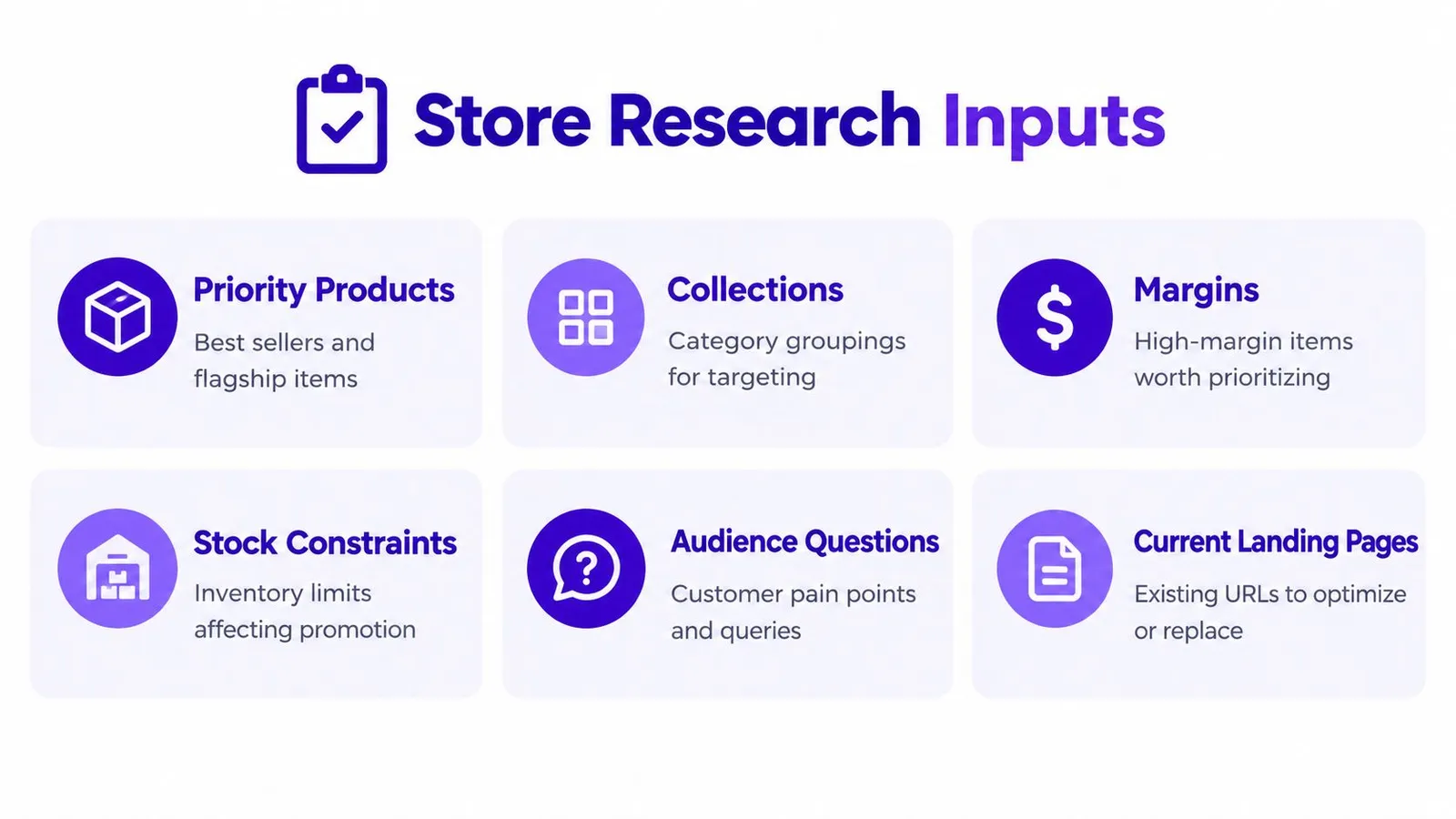
The research sheet should contain:
- Priority merchandise: Flagship products, strategically important collections, and items the merchant wants content to support.
- Commercial context: Known margins, available conversion information, average order value where useful, and inventory constraints.
- Customer language: Questions from support conversations, product inquiries, and recurring purchase objections.
- Existing destinations: Product pages, collections, guides, and weaker URLs that could benefit from clearer coverage.
- Business objectives: Separate acquisition, purchase assistance, customer education, and support goals.
Missing information should remain visibly missing. A blank margin field is more honest than an assumed profitability score, and an untested product shouldn't inherit the conversion performance of an established bestseller.
These inputs form the practical foundation for the research sheet.
Separate competitor roles
Commercial competitors sell comparable merchandise. Search competitors publish the pages appearing for the proposed query. Audience competitors address the same shoppers, even when they sell something different.
For the coffee merchant, another equipment retailer belongs in the commercial set. A brewing publication might belong in the search set for troubleshooting questions. A café training provider could compete for attention without offering a useful model for the store's collection pages.
Researchers should record what makes each competitor relevant. Copying every topic from a visible domain would reintroduce the irrelevant ideas the preparation work was meant to exclude.
Finally, establish consistent fields for query, topic group, market, language, page type, existing URL, evidence, and proposed action. Keep estimated tool metrics separate from observed store performance. That distinction prevents a promising forecast from being mistaken for demonstrated demand.
Discover and Validate Relevant Keywords
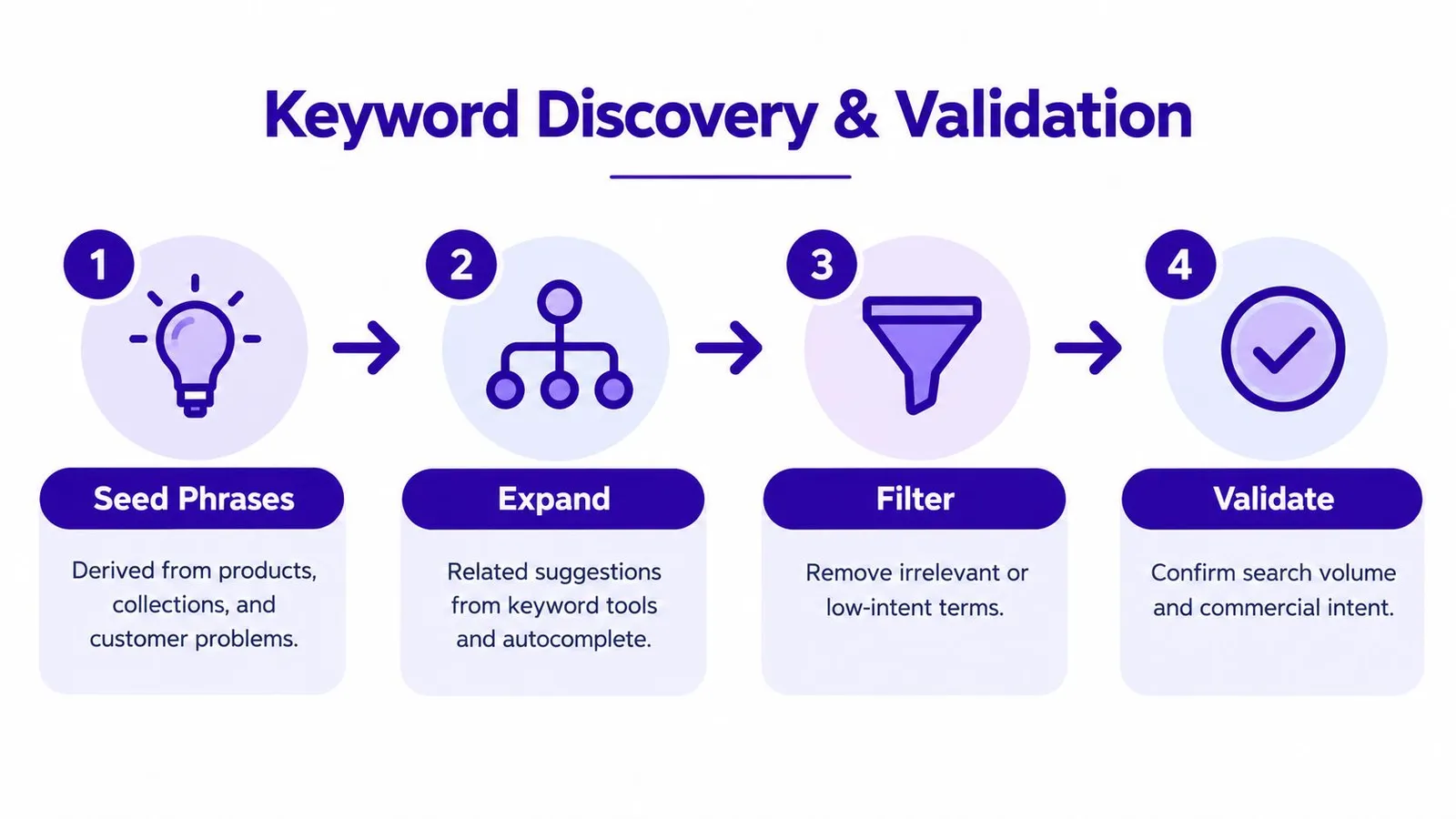
A practical discovery sequence moves from the store's vocabulary to external suggestions, then checks those ideas against observed queries and live search results. Expansion creates candidates. Validation determines whether they deserve a place in the working set.
The process should remain selective at every stage.
Start with products and customer tasks
Seed phrases should describe merchandise, distinguishing attributes, and problems the catalog can help solve. For the hypothetical coffee store, useful starting points might include burr grinders, reusable filters, grinder cleaning, and choosing a brewer for a small kitchen.
Expansion can come from keyword-tool suggestions, autocomplete, related questions, and relevant competitor pages. Researchers should preserve the wording shoppers use rather than replacing every plain-language phrase with the manufacturer's terminology.
The collection process needs boundaries:
- Keep catalog connections: Retain a product, collection, or customer task that explains the phrase's relevance.
- Label the evidence: Record whether an idea came from customer language, a tool, a competitor, or store query data.
- Reject unsupported promises: Exclude terms requiring specifications, compatibility, or claims the merchant can't substantiate.
- Preserve uncertainty: Mark unclear intent for inspection instead of assigning a page type prematurely.
A competitor's article title is a discovery prompt, not proof that the same topic will work for another store.
Validate with observed search behavior
Google Search Console provides a first-party check on the developing list. Its Performance report exposes queries and pages alongside impressions, clicks, click-through rate, and average position, with country and device dimensions available for closer inspection, as described in Google's Performance report documentation.
Begin with queries already generating impressions. Compare each relevant phrase with the landing page Google currently shows, then inspect cases where meaningful visibility produces weak engagement.
A low CTR isn't a diagnosis by itself. The researcher should examine position, the result's presentation, and the searcher's likely task before deciding that the page needs a new title or more content.
Country and device segmentation also deserve deliberate use. A query attracting visibility outside the store's serviceable market may be less actionable than its aggregate performance suggests.
Inspect results before grouping
Search the surviving phrases in the intended market. Record the kinds of pages appearing, the depth of information offered, and whether the results emphasize browsing, purchasing, comparison, or instruction.
For example, a reusable-filter term shouldn't automatically become an article assignment. If the inspected results chiefly offer product selection, the research sheet should reflect that expectation. A troubleshooting phrase may need a direct diagnostic answer rather than a merchandise grid.
Search results are evidence about the task to satisfy, not a template that every merchant must copy.
Group close variants only when the same page can answer them naturally. Remove duplicate exports and awkward variations, but keep distinctions that change the task, such as choosing a grinder versus cleaning one.
The following video offers an additional format for reviewing the research process.
The final working set should retain the query group, evidence, intent hypothesis, and likely destination. A keyword research workflow reference can support that organization. Once a destination is approved, Month17's resource on keyword placement for SEO provides a separate implementation reference, rather than a reason to insert every discovered variant into the copy.
Map Search Intent to the Right Shopify Page
A phrase's wording matters less than the job the searcher expects the page to perform. Page mapping should follow that job, with the inspected results used as supporting evidence.
For a Shopify catalog, the distinction between helping someone choose and letting someone buy is particularly important. A guide can explain selection criteria, but it can't substitute for a usable collection when the visitor expects to browse available products.
Compare the destination choices
A hypothetical material comparison, such as paper versus metal coffee filters, calls for an explanation of trade-offs the merchant can substantiate. A comparison guide may fit when readers need help evaluating alternatives before selecting merchandise.
A troubleshooting query, such as a grinder producing uneven grounds, needs diagnostic steps and clear limits. That page shouldn't assume the visitor needs a replacement product before addressing maintenance or setup questions.
A product-use question can take a different form. Instructions for cleaning a particular grinder may belong in a detailed guide linked from its product page, or within the product page when the answer is compact and specific.
A ready-to-buy category term generally points toward a collection, subject to the inspected results and the store's assortment. An exact model query is a stronger candidate for the corresponding product page.
The mapping record should contain:
- Primary intent: The task the visitor needs to complete.
- Proposed page type: Product, collection, comparison, instructional guide, or another justified destination.
- Destination rationale: Why that page can satisfy the task better than the alternatives.
- Commercial route: The relevant next step, without forcing a purchase into every answer.
Resolve overlap before commissioning content
Cannibalization risk deserves attention when proposed pages would serve substantially the same search demand. Sharing a few related phrases isn't enough to establish a problem; the concern is unclear ownership of the same task.
Before creating a broad buying article, inspect whether an existing collection already serves that opportunity. If so, the better action may be improving its selection guidance rather than publishing a competing destination.
Editorial boundary: A supporting guide should answer a distinct question, not reproduce a collection's purpose in article form.
TheContentMap's discussion of how topic clusters improve content workflows is a useful planning resource for related subjects. A store-level internal linking audit can then help review whether those relationships are reflected in navigation and contextual links.
Each approved group needs a clear owner. Supporting phrases can share that destination when they represent the same task, while different tasks deserve separate consideration.
Prioritize Keywords by Business Opportunity
A large estimated audience doesn't make a topic commercially useful. A modest opportunity can deserve attention when it matches available merchandise, addresses a purchase obstacle, and has a credible destination.
An ecommerce keyword prioritization methodology recommends considering revenue potential, current position, and content gaps rather than volume alone, including existing opportunities in positions 11–30. That range is a review cue, not a promise of easy gains.
Shopify Keyword Prioritization Matrix
| Keyword signal | Strong candidate | Weak candidate | Decision |
|---|---|---|---|
| Relevance | Direct match to merchandise or a supported customer task | Broad association with the industry | Reject poor fit |
| Business value | Useful path to a priority product or collection | No credible commercial or support purpose | Require a written rationale |
| Current performance | Relevant visibility tied to a suitable landing page | Unrelated queries or unclear destination | Inspect the query and page together |
| Ranking opportunity | Specific, addressable weakness in the existing coverage | No defensible improvement identified | Define the work before approval |
| Page suitability | An existing or proposed page can fully satisfy the task | The page format conflicts with expectations | Remap or defer |
| Cannibalization risk | Clear ownership and distinct supporting roles | Another URL already serves the same task | Improve or consolidate first |
| Production readiness | Verified details and available merchandise | Missing evidence or unavailable products | Hold until ready |
A transparent scoring method doesn't require invented precision. Label each signal strong, uncertain, or weak, then attach a short explanation and the evidence behind it.
Relevance and page suitability should act as gates. A topic that fails either shouldn't outrank a suitable candidate because its estimated volume is higher. Among suitable candidates, business value and addressable performance gaps can guide the order of work.
Compare the commercial trade-offs
Suppose the coffee merchant finds a generic café-themed term with a large estimated audience. It could produce an attractive article, but the store doesn't sell café furniture or provide business-planning services.
That candidate should remain low priority unless the merchant can explain its role beyond attracting visitors. Broad topical association isn't enough.
A narrower product-use query about choosing a reusable filter for an existing brewer presents a different opportunity. If the store sells a compatible, commercially important product and can document fit accurately, the topic has a clearer path from answer to merchandise.
Lower volume isn't automatically better, either. The narrower query still needs sufficient evidence of relevance, a useful answer, and a destination that doesn't duplicate another page.
When conversion data is sparse, researchers should record known margin bands, stock reliability, compatibility, purchase proximity, and content gaps. These are planning judgments, not revenue forecasts.
Where page-level commercial data exists, revenue per organic session by page type can support comparison. It shouldn't be presented as exact query-level attribution when the underlying measurement can't support that conclusion.
The approved shortlist should end with an action: improve, create, consolidate, defer, or reject. A written reason makes the plan easier to defend when publishing capacity is limited.
Account for AI Search and Measurement Limits
Page-one visibility doesn't guarantee a visit. A keyword review that ignores the search results surrounding a listing can mistake exposure for traffic opportunity.
A July 2025 Pew Research Center study summarized in this review of ecommerce search statistics examined 68,879 Google searches from more than 900 U.S. adults and found conventional-result clicks in 8% of searches with an AI summary versus 15% without one, while 1% included a click on a source cited within the summary. Those findings describe the observed searches, not a forecast for every Shopify category or market.
Record reasons to click
Researchers should inspect whether the query produces an AI summary and whether the store can provide something beyond a generic answer. Product specifications, documented compatibility, original photographs, and clearly explained use cases can give a visitor a reason to inspect the merchant's page.
- Generic definitions: Consider whether the proposed page offers meaningful value beyond an easily summarized explanation.
- Comparisons: Require specific distinctions supported by the store's actual product information.
- Troubleshooting: Provide a usable diagnostic sequence, including cases where buying something isn't necessary.
- Experience-led topics: Include first-hand detail only when the merchant can substantiate it.
These are editorial choices, not guaranteed protection from click loss. Query-level observation remains necessary.
Measure without overstating attribution
Privacy protections omit some queries, and Search Console stores top rows rather than every possible search; Google also documents up to 16 months of history, ordinary data availability within two to three days, and a possible wait of up to one week for new properties in its Search Console reporting guidance. An incomplete or empty report therefore shouldn't be treated as a complete account of demand.
Review search engagement alongside product-page visits, branded searches, and available commercial outcomes. A broader SEO share-of-voice assessment can complement that review without replacing traffic or revenue measures.
Assisted and direct outcomes may provide context when CTR falls. They don't prove that an unclicked appearance caused a later purchase, so merchants should keep visibility, contribution, and demonstrated conversions distinct.
Build a Repeatable SEO Review Cycle
Approved research belongs in a production queue with an owner, destination, intended task, internal-link path, and review date. A shared content calendar makes those commitments visible.
The planning process should connect editorial decisions with production capacity.
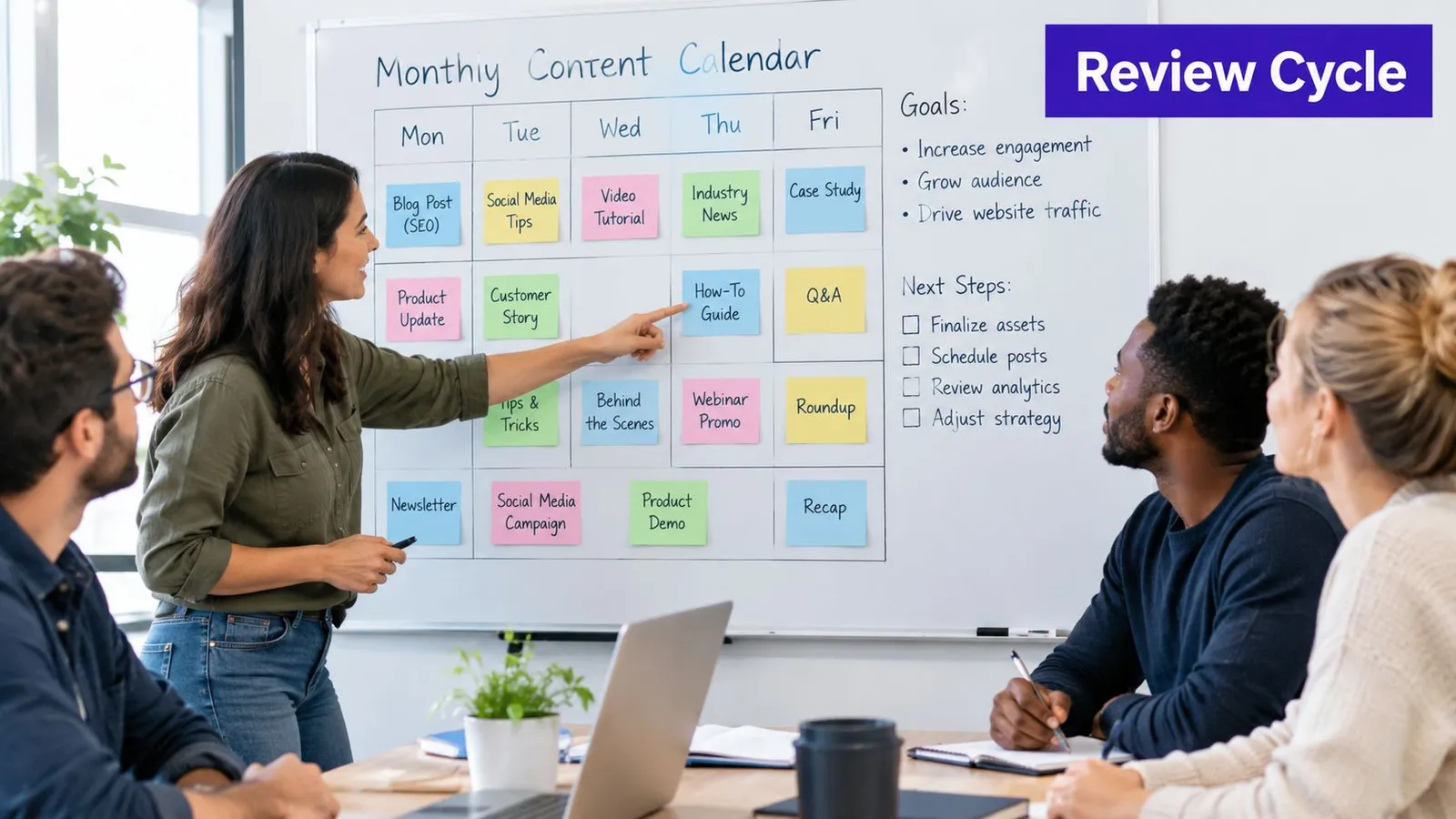
Manual publishing, reviewed drafts, and automated scheduling are all workable options. Automation doesn't remove the need to check product accuracy, destination choice, and unsupported claims.
Close the loop
- Before production: Confirm the query owner, evidence, page type, and commercial route.
- Before publication: Check the answer, product details, links, and potential overlap.
- During review: Compare the intended query and landing page with observed impressions, clicks, CTR, and position.
- After diagnosis: Update, consolidate, redirect, or expand only when the evidence supports that action.
Limited early data calls for patience. Persistent visibility for the wrong task, an unsuitable page format, or competing destinations calls for revisiting the original mapping decision.
A repeatable process preserves the reasoning behind each assignment. That makes future changes deliberate rather than another round of topic guessing.
Rankira offers Shopify-centered keyword research, article generation, internal linking, scheduling, and search performance reporting using store context, competitor analysis, and Search Console data. Merchants can visit the application to turn a validated shortlist into a content calendar, with draft review or scheduled publication matched to their workflow.
Keep reading
All articles
Shopify SEO
SEO Content Writing Principles for Readers and Search
Learn the principles of SEO content writing that balance search relevance, clear structure, and real reader value, with examples for online stores.
10 min read
Shopify SEO
Internal Linking Audit That Actually Improves Rankings
Run a practical internal linking audit to find orphan pages, fix broken links, and prioritize fixes that move revenue on your Shopify store.
10 min read
Shopify SEO
Share of Voice SEO: A Practical Measurement Guide
Learn how share of voice SEO works, how to calculate it, and how to use intent-based metrics to assess search visibility and business impact.
12 min read
Put your Shopify blog on autopilot
Rankira researches keywords, writes SEO articles, adds internal links, and publishes them to your store — every week. Start with a 7-day free trial.