How to Increase Blog Traffic: A Shopify Merchant's Plan
Learn how to increase blog traffic with a step-by-step system for Shopify stores: pick proven topics, build topic clusters, promote posts, and measure results.
Published 12 min read

In this article
Publishing more posts isn't a reliable answer to how to increase blog traffic. A Shopify merchant can maintain a busy editorial calendar and still attract few qualified visitors if the articles target the wrong questions, sit disconnected from the catalog, or receive no promotion.
A stronger approach treats the blog as a content portfolio, not a production quota. Each article needs a clear audience, a distinct purpose, a route to relevant merchandise, and a reason to receive continued investment.
Table of Contents
- Why Blog Traffic Growth Is a System Problem
- Find Topics With Proven Search Demand
- Connect Posts Into Topic Clusters
- Set a Publishing Schedule You Can Sustain
- Promote Every Post Beyond Search
- Pick Tools That Fit Your Team and Budget
- Measure Results and Plan Your Next Move
Why Blog Traffic Growth Is a System Problem
Traffic growth requires connected decisions. Topic selection determines whether an article addresses demand. Search optimization makes its purpose clear. Internal links connect it to the store. Distribution introduces it to potential readers, while measurement helps the merchant decide what deserves more work.
Weakness in any part can limit the whole effort. Better writing won't fix a topic with little relevance to the catalog, and additional promotion won't rescue an article that doesn't answer its headline.
Search matters, but publishing isn't distribution
HubSpot's blogging research found that 36% of businesses use organic search as a blog-traffic source, 38% receive blog traffic mostly through organic channels, and 34% blog specifically for SEO, establishing search as a central distribution consideration in its State of Blogging research.
For Shopify merchants, that supports planning articles around identifiable searches rather than whatever topic happens to fill an empty calendar slot. It also means distinguishing between publishing a page and helping potential customers discover it.
Up North Media's resource on ways to improve your blog's organic reach offers an additional reference for merchants reviewing their organic growth approach. The practical priority remains diagnosing the weakest part of the store's existing process before adding more production.
Practical rule: An article deserves a place in the portfolio when it answers a distinct customer question and supports a clear business purpose.
Define success before adding output
Not every article should do the same job. A comparison guide might help readers choose a product, while a care guide might support customers after purchase and encourage return visits.
Merchants can classify proposed content by purpose:
- Discovery: Address a question potential customers search before knowing the brand.
- Evaluation: Explain choices, trade-offs, compatibility, or suitability.
- Product support: Help customers use, maintain, or understand an item.
AI Overviews add another reason to define these roles carefully. Visibility, visits, and commercial usefulness aren't interchangeable, so a traffic plan should connect demand research, catalog structure, sustainable production, promotion, and decision-focused reporting.
Find Topics With Proven Search Demand
A useful topic shortlist starts with evidence, not headline brainstorming. The strongest candidates sit where customer questions, observable search demand, and the merchant's product expertise overlap.
Start with existing signals
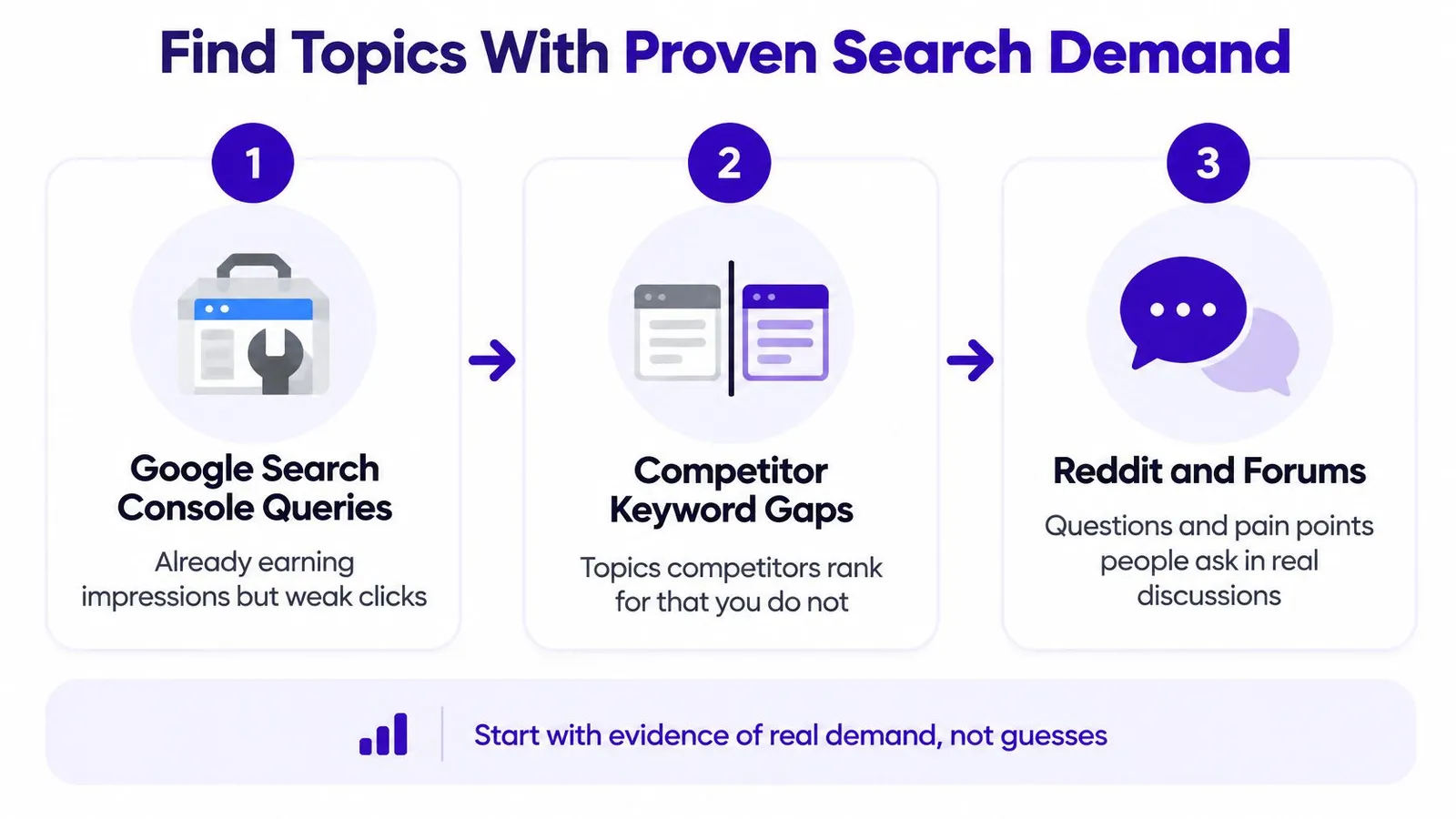
Google Search Console is the first place to inspect an established store. Queries already receiving impressions offer a practical starting point, especially when the associated page earns weak clicks or appears poorly matched to the search.
Merchants should record the query, the page appearing for it, and the likely task behind the search. Before commissioning another article, they should check whether an existing page could answer that task more clearly.
Competitor research fills a different gap. Relevant competitors can reveal questions the store hasn't addressed, but their topic lists shouldn't become a copying exercise. A competing article matters only when the merchant can provide a useful answer related to the catalog.
Customer language adds context that keyword lists may miss. Product reviews, support tickets, social comments, Reddit, and specialist forums can reveal uncertainty about fit, usage, maintenance, or comparisons. These questions are topic hypotheses, not automatic proof of search volume.
Rank opportunities before assigning articles
A shortlist needs consistent decision criteria. A simple worksheet can use qualitative ratings instead of pretending every opportunity has a precisely measurable value.
- Catalog relevance: Can the article naturally help readers understand or select something the store sells?
- Demand evidence: Does Search Console or keyword research show searches, rather than merely an interesting discussion?
- Ranking difficulty: Can the merchant offer something distinctive compared with the pages already appearing?
- Purchase intent: Is there a plausible next step toward product evaluation, even if the initial question is informational?
A step-by-step keyword research workflow can keep those judgments consistent across the shortlist.
For example, a hypothetical skincare store might investigate how to layer vitamin C serum. That's a candidate query, not a claim about its search volume. The merchant would validate demand, inspect the existing results, and confirm that its product instructions support an accurate answer.
The article's primary intent would be usage guidance, not a broad serum comparison. If an existing routine guide already addresses that same task thoroughly, improving it may be preferable to publishing a competing page.
A focused research session should finish with a manageable shortlist: the query, intended reader task, proposed destination page, relevant merchandise, and evidence supporting the choice. Exhaustive keyword collection can wait.
Connect Posts Into Topic Clusters
Consider a hypothetical Shopify store selling hiking socks. A broad sock-buying guide, a fit article, and a washing guide could all be useful, yet readers shouldn't have to search the blog archive to discover how those resources relate.
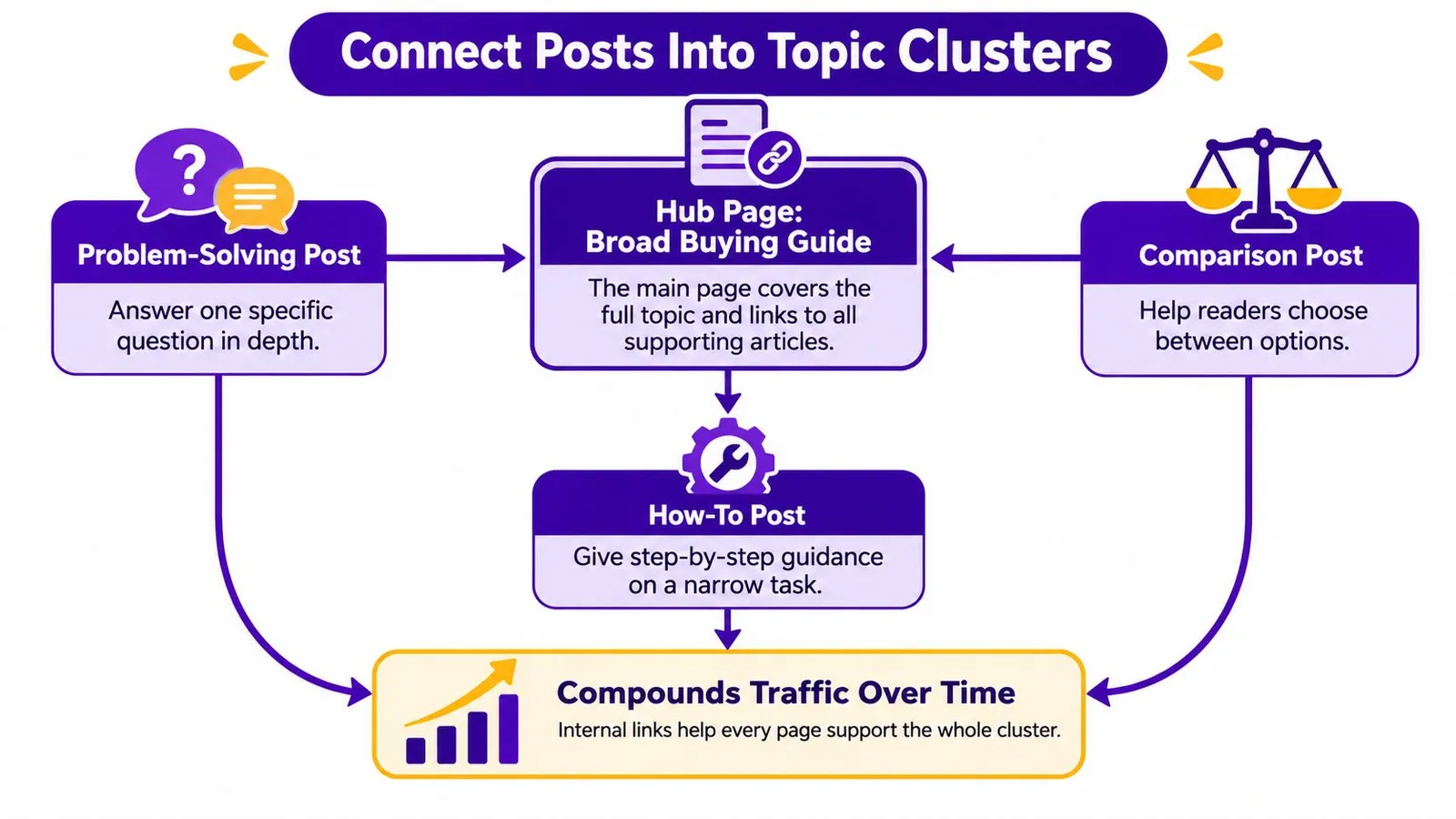
A hub-and-spoke structure gives each page a defined role. The hub helps shoppers understand the broader decision; supporting articles answer narrower questions and direct readers toward relevant merchandise when appropriate.
Build around a catalog decision
The hub should provide a useful overview, not merely list links. It can explain the buying criteria, summarize important trade-offs, and direct readers to detailed guidance where the question needs more space.
A merchant could adapt this illustrative map:
| Page | Editorial purpose | Relevant catalog destination |
|---|---|---|
| Hiking sock buying guide | Explain selection criteria | Hiking sock collection |
| Choosing hiking sock thickness | Address footwear and preference considerations | Lightweight and cushioned sock collections |
| Hiking sock fit guide | Explain fit checks using store-specific guidance | Relevant product sizing information |
| Merino-blend versus synthetic hiking socks | Compare documented product characteristics | Applicable material-based collections |
| Washing hiking socks | Explain care using verified product instructions | Products covered by those instructions |
The supporting pages should link back to the hub where broader buying context helps. Links between supporting pages belong only where the reader's next question makes them useful.
Make the connections accessible
Google recommends crawlable links, prominent use of searchers' language, and helpful, text-based content; it also explains that links are an important way it discovers pages in its Search Essentials guidance.
For a Shopify blog, the operational requirement is straightforward: important destinations should have ordinary, crawlable HTML links. Essential explanations shouldn't exist only inside an infographic or depend entirely on a scripted interaction.
Anchor text should describe the destination naturally. Hiking sock sizing guide communicates more than click here. Repeating an exact-match phrase everywhere, however, isn't a substitute for editorial judgment.
An internal linking audit can begin with a list of published articles and the pages linking to them:
- Find disconnected articles: Identify useful posts with no contextual links from related pages.
- Check destination relevance: Confirm that linked products and collections match the advice.
- Repair older pathways: Add appropriate links from established articles when a new supporting page appears.
A useful cluster makes the shopper's next question easier to answer. A collection of loosely related links doesn't.
Set a Publishing Schedule You Can Sustain
Publishing frequency should be a capacity decision supported by an experiment, not a promise to publish daily regardless of quality. A merchant who can review fewer articles carefully shouldn't imitate a larger team's calendar.
Historical HubSpot benchmarks reported that businesses publishing 16–20 times monthly received more than twice the traffic of those publishing fewer than four times monthly; those findings appear in its business blogging benchmark report. These are observational comparisons, not proof that increasing output alone produces the result.
Larger publishers may also have more established sites, broader distribution, and more staff. The useful lesson is that a substantial content program can matter, not that every small store needs the same quota.
Run a controlled production experiment
A practical approach is to establish a 90-day baseline, then test a sustainable batch of differentiated articles while comparing indexed pages, non-brand clicks, and conversions against that baseline, following the experimental approach associated with the historical benchmark above.
The calendar should reflect the complete workload. Research, product fact-checking, editing, internal linking, publishing, and promotion all require capacity.
- Reserve review time: Product instructions, comparisons, and suitability claims need checking.
- Budget for maintenance: Existing articles shouldn't become untouchable once published.
- Separate drafts from approvals: Automated generation doesn't require automatic publication.
- Record responsibilities: Every scheduled article needs an owner for final review and distribution.
A shared content calendar helps expose bottlenecks before they become a backlog of unfinished drafts.
Choose refreshes when they offer the clearer opportunity
An article receiving more impressions without corresponding clicks deserves investigation before another related post enters production. Its headline may overpromise, its answer may be incomplete, or the query may no longer match the page's purpose.
Overlapping articles require a different decision. When they address the same reader task without meaningful distinctions, consolidating them may produce a clearer resource than maintaining both.
The quality bar should remain concrete: accurate product context, a distinct purpose, readable explanations, and a useful next step. Adding a new date or expanding an introduction doesn't meet that bar.
Capacity test: A publishing schedule is sustainable only when the merchant can maintain the same standard during a busy trading period.
Promote Every Post Beyond Search
An article shouldn't depend entirely on someone eventually finding it through Google. Distribution belongs in the publishing workflow, with channels selected according to the audience and the merchant's available time.
The Content Marketing Institute's B2B research found that 84% of respondents use blogs on corporate websites and 89% use organic social media for distribution, illustrating the combination of an owned publishing destination and outside amplification in its content marketing benchmark research. That's B2B evidence, not a forecast for Shopify traffic, but the operating model is useful.
Blog Distribution Channels Compared
The comparisons below are planning judgments, not guaranteed traffic timelines.
| Channel | Best For | Typical Effort | Speed of Traffic Impact |
|---|---|---|---|
| Email newsletter | Merchants with an engaged subscriber audience | Low to moderate per send | Can produce visits after delivery |
| Organic social | Demonstrations, comparisons, and recognizable customer problems | Moderate and recurring | Can produce early visits, with variable persistence |
| Visually explainable products, projects, and guides | Moderate creative work | Better treated as an ongoing test | |
| Relevant communities | Detailed questions in specialist niches | High participation effort | Depends on relevance and community response |
| Editorial partnerships | Complementary brands serving related audiences | High coordination effort | Depends on outreach and publication timing |
A small team should select a limited mix rather than maintain every channel superficially. Email plus a visually appropriate social channel may be more manageable than a scattered presence across unrelated platforms.
Turn the article into channel-specific material
A newsletter can introduce the problem and explain why the full guide is useful. Social posts can extract a comparison, demonstrate a process, or answer a narrow question without copying the article's opening paragraph.
Pinterest is worth testing where the subject can become a useful visual reference. Community participation requires more restraint: merchants should follow promotional rules, answer the question directly, and add a link only when permitted and helpful.
For broader planning, The AI CMO's content amplification tactics for 2026 provide an additional distribution resource. External mentions should still be evaluated on audience relevance rather than pursued merely to accumulate links.
A backlink workflow can organize potential partners, but reciprocal arrangements shouldn't be treated as guaranteed ranking improvements.
A reusable publication checklist can stay brief:
- Prepare the email: Explain the reader benefit before requesting a click.
- Adapt the social asset: Match the format to the chosen platform.
- Identify relevant conversations: Participate only where the article answers an existing need.
- Record referral results: Compare visits and subsequent product activity by channel.
Pick Tools That Fit Your Team and Budget
The right tooling depends on the bottleneck. A merchant struggling to choose topics needs a different intervention from a merchant with approved briefs but no writing capacity.
Buying more software won't resolve unclear responsibilities. Hiring writers won't fix a weak editorial brief either.
Compare operating models before subscriptions
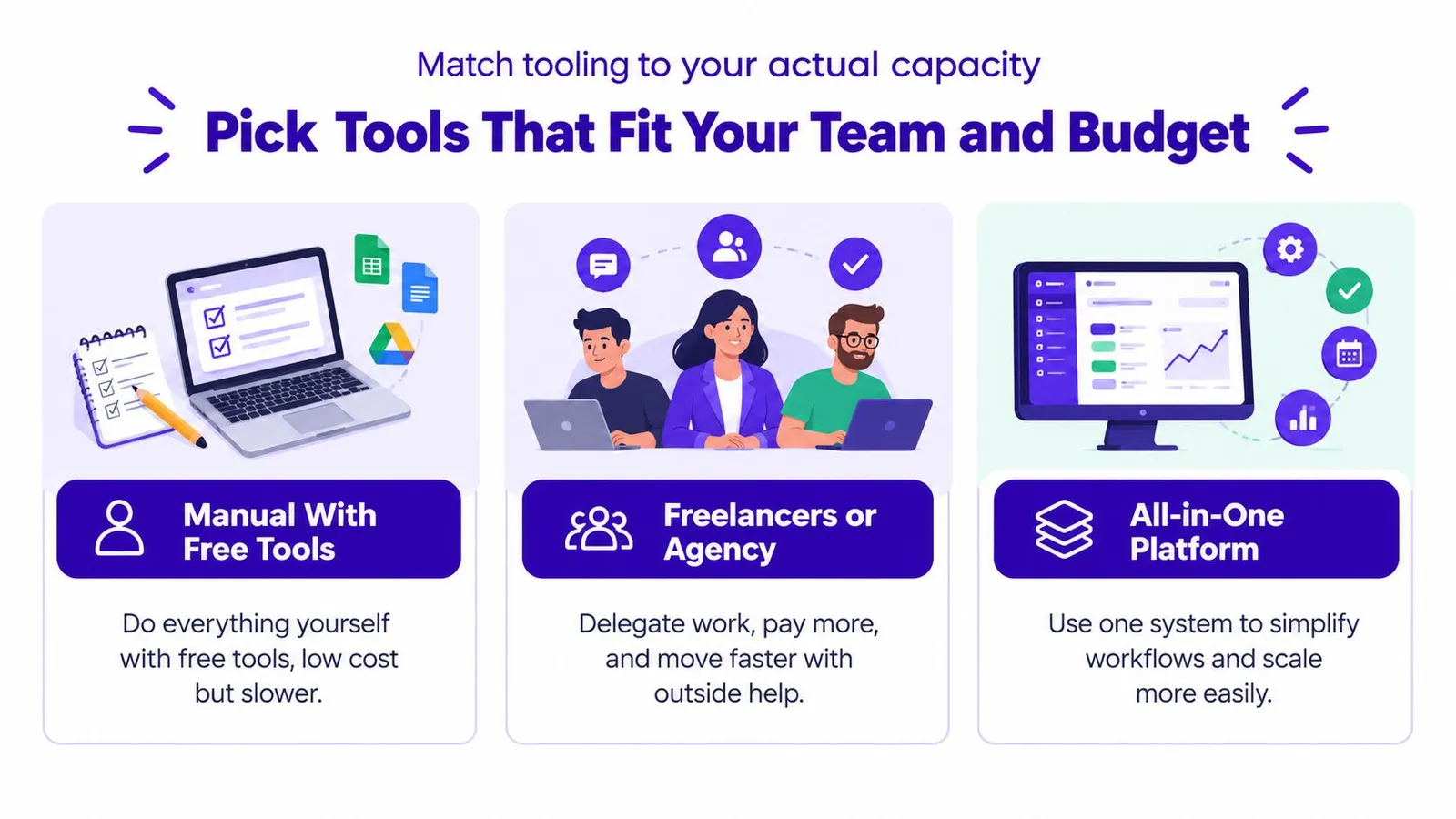
| Approach | Suitable situation | Main trade-off |
|---|---|---|
| Manual work with free tools | The merchant can handle research, writing, and publishing | Lower software spending, greater owner workload |
| Freelancers or an agency | The store needs outside writing, strategy, or specialist review | Additional budget and briefing requirements |
| An automation platform | Recurring production tasks consume available capacity | Faster execution still requires editorial oversight |
A manual workflow might combine Google Search Console, a spreadsheet, Shopify's editor, and existing analytics. Its advantage is direct control; its limitation is the number of separate tasks the merchant must complete consistently.
Freelancers can take responsibility for defined deliverables. An agency may also manage planning and distribution, but the scope needs to specify who verifies product claims, maintains older articles, and reports commercial outcomes.
Assess automation by the work it removes
Rankira is an automation option for Shopify merchants. It combines store information, competitor analysis, and Search Console data for keyword research, using search volume and difficulty scores to organize potential topics.
Its workflow includes a drag-and-drop publishing calendar, generated articles with meta descriptions and featured images, automatic links to relevant products and collections, and reporting on clicks, impressions, and search positions. Planning, editing, and publication take place inside Shopify administration, with generated content available for draft review rather than compulsory automatic publication.
Those functions address execution work. They don't remove the need to check whether an article reflects the actual product, answers the intended question, or deserves publication.
Before choosing an operating model, merchants should assess:
- Available attention: Who can review drafts during normal trading weeks?
- Subject complexity: Does the catalog require specialist scrutiny or detailed demonstrations?
- Existing assets: Would improving current articles be more valuable than generating new drafts?
- Total workload: Does the quoted service or subscription cover the tasks creating the bottleneck?
International stores need another check: local terminology, product availability, and regional buying concerns. Translating an article isn't the same decision as confirming that the localized page serves a useful search intent.
The sensible choice is the workflow the team can maintain, not the one with the longest feature list.
Measure Results and Plan Your Next Move
A useful reporting review ends with decisions. A dashboard showing rising impressions but no explanation of what happens next offers little help to a merchant deciding where to spend limited content time.
Google reports that overall organic clicks have remained relatively stable year over year while AI Search encourages longer, more complex questions, and it emphasizes the quality of resulting visits in its discussion of AI Search and click behavior. That's Google's account of aggregate behavior, not a promise about an individual store.
Separate visibility from useful visits
Concise factual explanations can make an article useful as a reference, while detailed comparisons, usage guidance, and catalog-specific advice provide reasons to visit the store. Neither citation nor visibility should automatically be counted as a commercial result.
A recurring review should distinguish:
- Discovery signals: Impressions, clicks, and average search position.
- Shopping signals: Product views after article visits and add-to-cart activity.
- Relationship signals: Returning visitors and changes in branded search interest.
- Editorial outcomes: Which pages justify expansion, revision, consolidation, or retirement.
Search visibility can also be compared across a defined topic set through a share-of-voice SEO review. That perspective is most useful when the same relevant competitors and queries remain in the comparison.
Assign an action to each pattern
| Observed pattern | Recommended next decision |
|---|---|
| More impressions, weak click response | Review query fit, headline clarity, and the search results themselves |
| Visits without relevant product exploration | Check whether the article attracts the intended shopper |
| Overlapping pages serving the same task | Assess consolidation and preserve useful material |
| Product exploration from a focused topic | Investigate adjacent unanswered customer questions |
| Weak discovery despite useful content | Check accessibility, contextual links, and distribution |
Traffic remains important, but qualified visits and assisted shopping behavior make the evaluation more useful. Attribution won't always be complete, so merchants should look for consistent patterns rather than credit every sale to the last article viewed.
This week's practical action is to export Search Console queries, group related customer tasks, and identify a catalog-connected topic with existing evidence of demand. That produces a defensible starting point without committing the store to an oversized publishing schedule.
Rankira offers Shopify-focused keyword research, article generation, scheduling, internal linking, and search performance reporting. Merchants seeking a more repeatable blog workflow can visit Rankira to assess whether those tools fit their research, review, and publishing needs.
Keep reading
All articles
Shopify SEO
SEO Content Writing Principles for Readers and Search
Learn the principles of SEO content writing that balance search relevance, clear structure, and real reader value, with examples for online stores.
10 min read
Shopify SEO
Internal Linking Audit That Actually Improves Rankings
Run a practical internal linking audit to find orphan pages, fix broken links, and prioritize fixes that move revenue on your Shopify store.
10 min read
Shopify SEO
Share of Voice SEO: A Practical Measurement Guide
Learn how share of voice SEO works, how to calculate it, and how to use intent-based metrics to assess search visibility and business impact.
12 min read
Put your Shopify blog on autopilot
Rankira researches keywords, writes SEO articles, adds internal links, and publishes them to your store — every week. Start with a 7-day free trial.