SEO Content Marketing: How It Works from Start to Finish
Learn how SEO content marketing works, from audience research and keyword planning to publishing, internal links, and measuring search performance.
Published 12 min read
In this article
- Table of Contents
- What SEO Content Marketing Is and Why It Works
- How Search Engines Decide Which Content to Rank
- Researching Your Audience and Planning Keywords
- Creating Content That Matches Search Intent
- Publishing and Connecting Articles to Store Pages
- Measuring Performance and Choosing the Right Tools
- Putting Your SEO Content Plan Into Practice
A Shopify merchant publishes helpful-looking blog posts, adds product photos, and waits for visitors. The posts look polished, but search traffic stays quiet and readers rarely reach the catalog. The missing piece often isn't more writing. It's a connected process that starts with customer demand and ends with a measurable business outcome.
Table of Contents
- What SEO Content Marketing Is and Why It Works
- How Search Engines Decide Which Content to Rank
- Researching Your Audience and Planning Keywords
- Creating Content That Matches Search Intent
- Publishing and Connecting Articles to Store Pages
- Measuring Performance and Choosing the Right Tools
- Putting Your SEO Content Plan Into Practice
What SEO Content Marketing Is and Why It Works
SEO content marketing means creating useful pages around the questions people search for, then connecting those answers to a relevant business offering. For an ecommerce store, that means treating the blog as part of the shopping experience rather than a separate publishing project.
Consider a hypothetical Shopify store selling coffee equipment. A company announcement might interest existing customers, but an article explaining how to choose a coffee grinder addresses a question a potential buyer already has. The difference is search intent, the task someone wants to complete through a search.
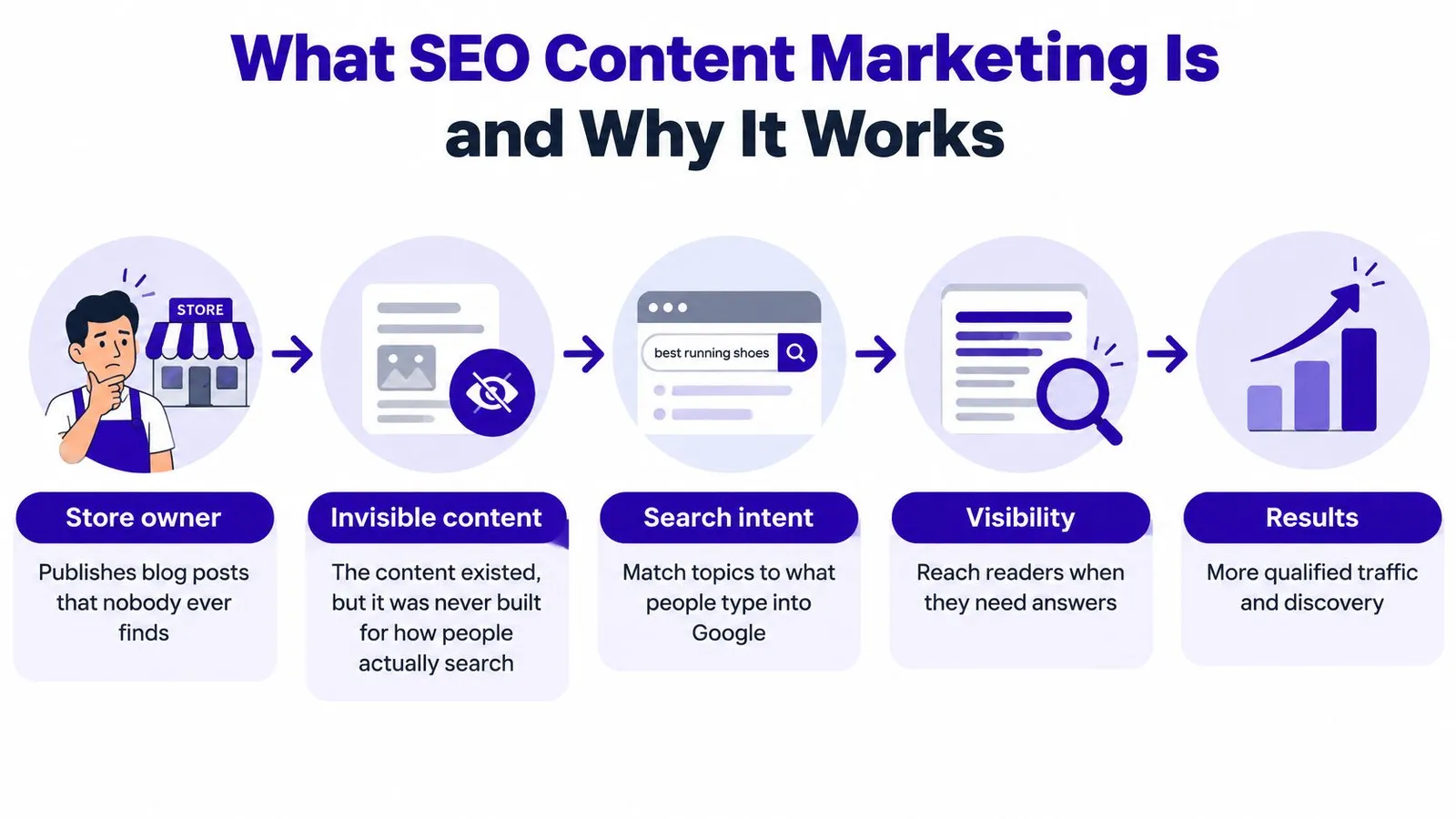
Publishing without that connection resembles stocking shelves in a room shoppers never enter. Search-led planning puts useful information along a route people already take.
The diagram shows that progression from invisible content to relevant discovery.
Search meets shoppers at different stages
Organic search generates approximately 53.3% of website traffic, compared with about 5% from social media, according to the organic-search traffic benchmarks collected by Search Atlas. Those figures are directional benchmarks, not forecasts for an individual store. Industry, geography, brand recognition, technical quality, and search-result features affect actual performance.
A coffee shopper's searches illustrate the different opportunities:
- Informational searches, such as why coffee tastes bitter, call for an explanation and practical troubleshooting.
- Commercial searches, such as burr grinder versus blade grinder, call for meaningful comparisons.
- Transactional searches, such as buying a particular grinder, call for an appropriate product or collection page.
The merchant doesn't need to push every reader straight toward checkout. Someone diagnosing bitter coffee may need help understanding grind consistency before considering equipment.
Educational content needs a commercial destination
A useful article should answer the question fully, even when the answer doesn't require buying something. Its commercial role is to make the next relevant step accessible.
For example, a grinder guide could explain selection criteria and direct interested readers toward suitable products. A troubleshooting article might instead recommend a maintenance guide before presenting replacement equipment.
Practical rule: An article needs both a reader purpose and a business purpose. Neither should replace the other.
That distinction separates a purposeful content program from a collection of posts that happen to mention products.
How Search Engines Decide Which Content to Rank
Google's systems assess how well pages match a query and whether their content is useful and reliable. Publishing frequently doesn't replace those requirements, and repeating a phrase doesn't demonstrate expertise.
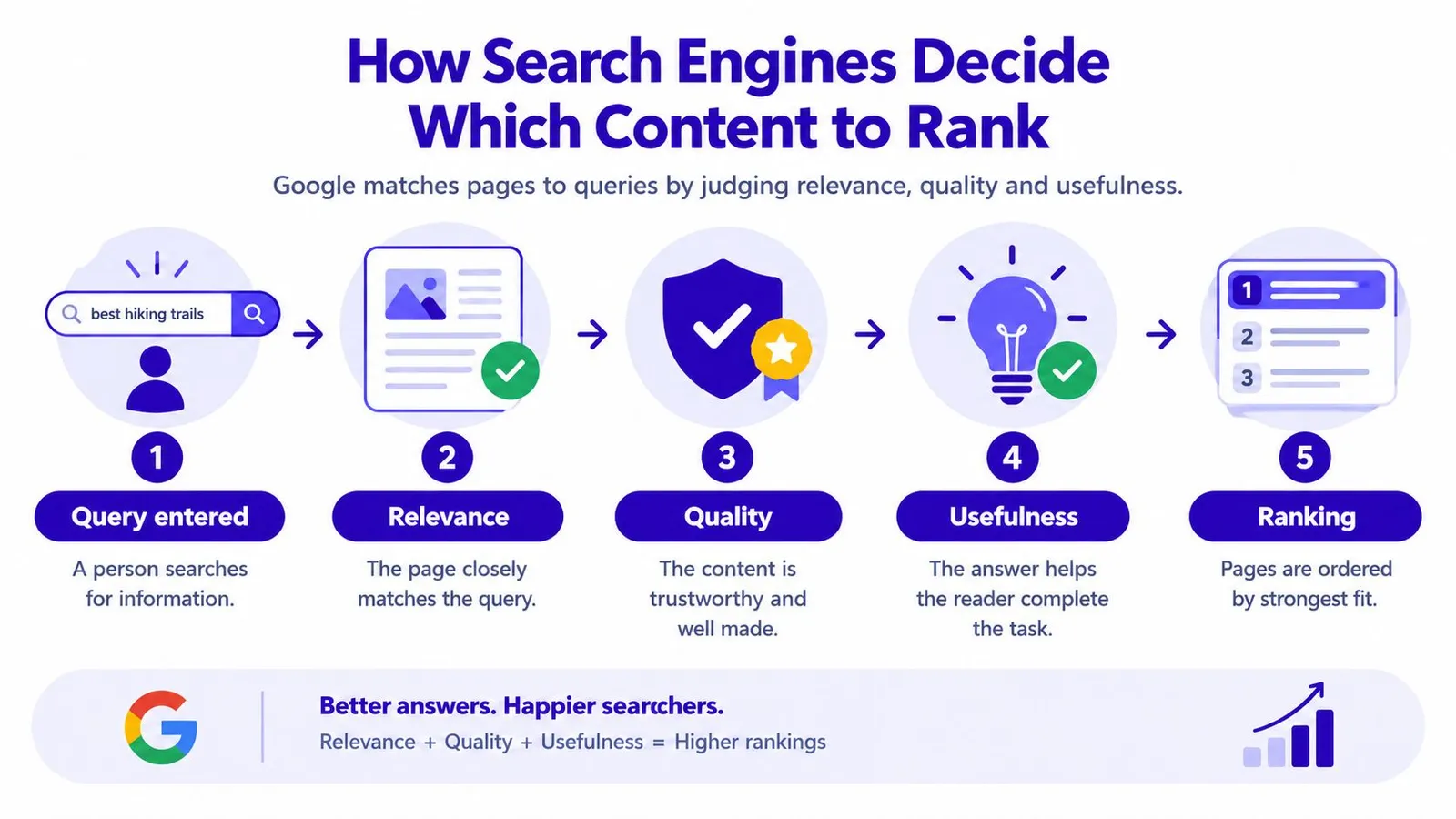
This simplified diagram illustrates the relationship between a searcher's question and the pages presented in response. It isn't a literal description of every ranking-system operation.
Relevance needs useful substance
A hypothetical article about choosing a grinder can include the right terminology yet still disappoint readers. If it never explains which characteristics matter for different brewing methods, the page hasn't completed the task suggested by its title.
A practical editorial assessment separates related questions:
- Relevance: Does the page address the actual question rather than a loosely associated topic?
- Quality: Are the explanations accurate, supported, and carefully reviewed?
- Usefulness: Can the reader make a decision or complete an action after reading?
These are editorial lenses, not a published formula for calculating rankings. They help merchants identify weaknesses that keyword placement alone won't fix.
Search changes make shortcuts fragile
Google reported 4,725 changes to Search in 2022, averaging roughly 13 changes per day. Its Helpful Content Update arrived in 2022, followed by developments in September 2023 and March 2024 emphasizing useful, original content rather than material created primarily to manipulate rankings, as documented in Search Engine Land's Google update history.
Those changes included interface and system modifications, not thousands of major ranking disruptions for every website. The practical conclusion is narrower: merchants operate in an evolving search environment, so a tactic based on exploiting a temporary weakness is a fragile foundation.
The accompanying video provides additional context for search and content.
A more defensible editorial standard asks whether a store has a legitimate reason to publish the page. A coffee-equipment merchant can contribute product knowledge, maintenance instructions, and selection guidance. Publishing unrelated topics because their keywords appear attractive creates a weaker connection between the audience, the content, and the business.
Quality over volume doesn't mean endlessly polishing every sentence. It means refusing to publish a page that lacks a useful answer.
Researching Your Audience and Planning Keywords
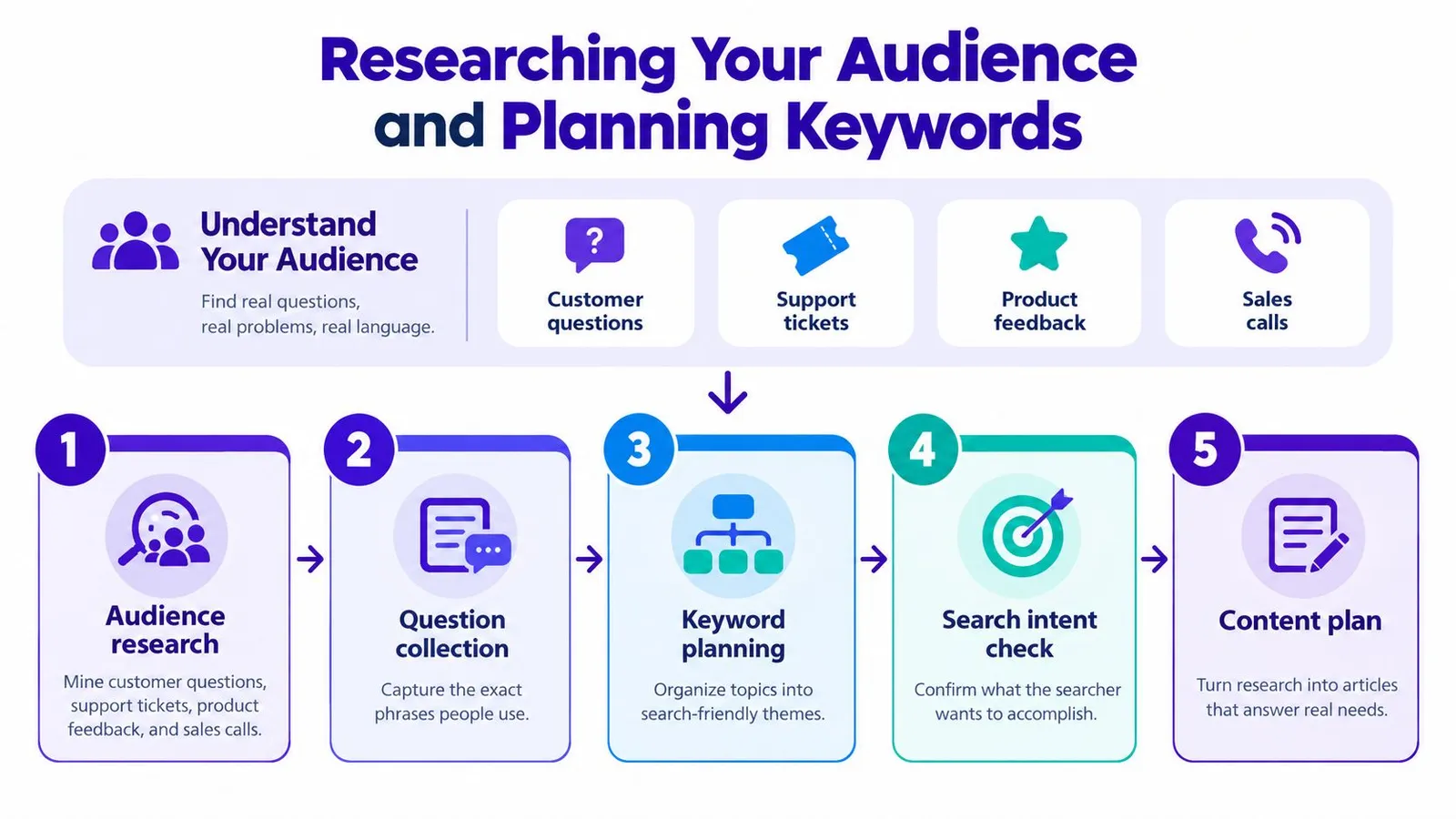
A workable content plan starts with customer language, not an empty keyword-tool search box. Support tickets, product reviews, return questions, and catalog descriptions provide material for identifying the decisions shoppers struggle to make.
For the hypothetical coffee store, recurring questions might concern grinder cleaning, countertop space, or compatibility with a brewing method. Each question suggests a possible topic, but not every topic deserves a separate article.
The research process turns those raw questions into publishing decisions.
Turn questions into a prioritized shortlist
A simple research worksheet can capture the customer question, candidate keyword, likely intent, relevant collection, and available product evidence. That commercial destination should be considered before drafting, not added as an afterthought.
Keyword metrics then help organize the shortlist:
- Search volume: Use estimated demand to compare opportunities, without treating the estimate as a traffic promise.
- Keyword difficulty: Treat the score as a planning signal, not a guarantee that a store can or can't compete.
- Existing search visibility: Examine Search Console queries for relevant subjects already receiving impressions.
- Catalog fit: Favor questions the store can answer with specific, accurate information about its offering.
A query with modest demand and a strong catalog connection may deserve attention before a popular topic with little commercial relevance. For implementation guidance, the step-by-step keyword research workflow provides a place to organize the process.
Check intent and group related questions
The merchant should inspect the search results for each promising query. Product listings, comparison guides, and instructional articles suggest different expectations; an article shouldn't be forced into a task better served by a collection page.
Related questions can then form topical clusters. A grinder-selection guide, cleaning article, and brewing-compatibility explanation can belong to a coherent subject area without each repeating the same answer.
International research requires another check. For location-sensitive vocabulary, Digital Skyrocket's guide can help merchants validate local search terms before adapting a topic for another market.
Translation is a production task. Choosing whether a market deserves localized content is a business decision.
Merchants should assess demand alongside product availability, shipping eligibility, support capacity, and local terminology. The contrasting ecommerce AI Overview datasets discussed by Search Engine Land also reinforce the need to validate market and query conditions rather than assume universal benchmarks.
Finally, the calendar should assign each approved topic an owner, review status, destination page, and publication slot. The appropriate rhythm is the one the team can maintain without skipping research or editorial checks.
Creating Content That Matches Search Intent
An article targeting a maintenance question shouldn't open with a lengthy sales pitch. A comparison shouldn't hide disadvantages. A purchase-oriented page shouldn't make shoppers read an essay before finding the product.
Intent matching determines what information appears, how it's organized, and what action makes sense afterward. The keyword identifies an opportunity; the article still has to earn the reader's attention.
Build the answer around the shopper's task
Consider a hypothetical guide about choosing a grinder for a compact kitchen. A useful draft would explain relevant dimensions, storage considerations, cleaning access, and the trade-offs between convenience and flexibility. Product recommendations would follow those criteria rather than appear as an unrelated shopping list.
Different tasks need different treatment:
- An explanation needs clarity: Define unfamiliar terms, identify likely causes, and describe appropriate actions.
- A comparison needs trade-offs: Explain who each option suits and where it falls short.
- A buying decision needs specificity: Present verified suitability information and an accessible route to the relevant merchandise.
Google's people-first content guidance emphasizes a defined audience, useful and reliable information, and evidence of firsthand knowledge. For a merchant, that translates into details grounded in actual products, documented processes, and legitimate experience.
A draft shouldn't claim that staff tested a grinder unless that testing happened. It also shouldn't infer compatibility, maintenance requirements, or performance from a product name.
Make the evidence easy to use
Descriptive headings should tell readers what a passage answers. Short paragraphs, comparison tables where appropriate, and clearly labeled instructions help readers find the part relevant to their situation.
The introduction should resolve the central question quickly, then develop the explanation. A meta description should accurately summarize the page rather than promise an answer absent from the article.
Before approval, the editor should check:
- Product accuracy: Verify specifications, compatibility statements, materials, and care instructions against reliable store information.
- Original contribution: Add useful catalog knowledge rather than rephrasing generic advice.
- Claims and attribution: Remove unsupported superlatives, fabricated experience, and unverified statements.
- Audience fit: Explain necessary terminology without burying experienced readers in irrelevant background.
Automated drafting can assist with outlines and initial copy, but it doesn't remove responsibility for those checks. The article creation and editing documentation is relevant when defining how drafts move through production.
Editorial checkpoint: A fluent sentence isn't evidence that its claim is correct.
The final review should ask whether the article leaves the shopper better equipped to decide. If the answer remains vague, additional keywords won't solve the problem.
Publishing and Connecting Articles to Store Pages
A finished draft isn't yet a functioning part of the store. The merchant still needs to check the live presentation, confirm the destinations, and make sure readers can move between related pages.
Publishing should therefore include a quality gate rather than a simple change of status. Scheduling can organize the workload, but it shouldn't bypass approval when a draft contains unresolved questions.
Check the live page
A Shopify publishing checklist should cover the visible article and the paths around it:
- Presentation: Check heading order, mobile readability, image relevance, and formatting after publication.
- Metadata: Confirm that the title, description, and URL accurately describe the content.
- Destinations: Open linked products and collections to check availability and relevance.
- Discoverability: Confirm that readers can reach the article through an appropriate existing page or navigation path.
Publication doesn't guarantee immediate indexing or visibility. Merchants should distinguish between making a page available and seeing it attract search impressions.
Map links to useful next steps
Google explains that links help its systems discover pages and assess relevance, while descriptive anchor text helps readers and search systems understand the destination. Its crawlable-link guidance recommends crawlable HTML <a> elements with href attributes and an internal link to each important page.
A practical article map identifies a primary commercial destination, then adds supporting pages where they help. A grinder-selection guide might point toward the appropriate grinder collection, while a maintenance passage could reference a detailed cleaning guide.
The anchor should describe the destination. Compact coffee grinders gives readers more useful information than a generic instruction to click.
Links also need editorial restraint. Repeatedly sending readers toward an irrelevant product doesn't create a useful shopping path, even if the link works technically.
For an existing blog, an internal linking audit workflow can help organize checks for isolated pages, unsuitable anchors, and broken destinations. Automatic linking can handle part of the implementation, but a merchant should still review context and destination status.
The publish-day decision is therefore broader than whether the prose is finished. The article needs to function within the store's architecture, with clear ways in and appropriate ways onward.
Measuring Performance and Choosing the Right Tools
A high-ranking article can still attract the wrong audience. A useful article can also influence a later purchase without receiving credit for the final visit. Measurement needs to distinguish visibility, visits, shopping activity, and revenue.
The reporting question isn't whether traffic increased. It's whether the content reached relevant people and contributed to a worthwhile outcome.
Read performance as a sequence
A practical reporting view separates signals rather than combining them into a single success score:
- Impressions and average position: Assess where the page appears for relevant queries.
- Clicks and click-through rate: Examine whether search visibility becomes a visit.
- Commercial engagement: Track movement toward products, collections, and meaningful store actions.
- Conversions and revenue: Evaluate direct and assisted outcomes without assuming every sale belongs to the last article viewed.
- Brand demand and citations: Monitor branded searches and observable AI-answer mentions separately from ordinary rankings.
A share-of-voice measurement approach can complement page-level reporting by organizing visibility across a relevant topic set. It shouldn't replace checks on visitor quality or business outcomes.
AI Overviews change what a ranking means
An analysis covering more than 300,000 keywords found a 34.5% lower average click-through rate for top-ranking pages when an AI Overview appeared; a December 2025 update reported a 58% lower CTR for position-one pages, according to the GrowthSRC organic CTR study and update.
Those findings don't establish the expected loss for an individual Shopify article. They do show why a strong position can no longer serve as a complete proxy for traffic opportunity.
Merchants should distinguish informational pages that could contribute useful cited explanations, commercial pages designed to support purchases, and brand information that establishes who stands behind the store. Clear facts, original product evidence, and transparent attribution are sensible editorial investments, but none guarantees an AI citation.
Manual Tool Stack vs Rankira Workflow
A manual setup might combine a keyword tool, Search Console, a spreadsheet, a text editor, Shopify's publishing interface, and store analytics. Rankira is a consolidated option inside Shopify administration, combining catalog-aware research, drafting, scheduling, internal linking, and search reporting.
| Pipeline Stage | Manual Multi-Tool Workflow | Rankira Inside Shopify |
|---|---|---|
| Research | Combine keyword estimates, competitor review, and Search Console exports | Uses store, competitor, and Search Console information for keyword planning |
| Scheduling | Maintain a spreadsheet and transfer approved work into Shopify | Provides a drag-and-drop content calendar |
| Production | Prepare copy, metadata, images, and product links separately | Generates article drafts with metadata, images, and relevant internal links |
| Publishing | Copy, format, review, and schedule posts in Shopify | Supports draft review and scheduled publication |
| Reporting | Reconcile search reports with store analytics | Reports clicks, impressions, positions, and Domain Rating |
The right choice depends on where the team loses time and control. A manual workflow may suit an established editorial operation; a consolidated application may reduce handoffs for a merchant managing content alongside store operations.
Neither approach removes the need for editorial judgment. Search reporting also doesn't automatically establish revenue attribution, and a third-party authority metric isn't a substitute for sales evidence.
Putting Your SEO Content Plan Into Practice
The pipeline works when each stage produces something the next stage can use. Research supplies a justified topic, the draft supplies a useful answer, publication creates an accessible store page, and measurement supplies evidence for the next decision.
The practical challenge is maintaining those connections during ordinary store operations. A backlog of keywords won't help if nobody approves drafts, and a full calendar won't help if the commercial destinations are unsuitable.
Start with a manageable pilot
A merchant can begin with a focused product category rather than a store-wide publishing commitment. Customer questions provide the starting material; catalog knowledge determines which answers the business can contribute credibly.
A useful pilot has clear boundaries:
- Choose the category: Select merchandise with documented details and recurring customer questions.
- Select the strongest question: Favor a problem the store can explain accurately and connect to an appropriate collection.
- Assign the review: Identify who will verify claims and approve the destination pages.
- Define the outcome: Decide which search and shopping signals will inform the next revision.
The content-calendar documentation can support the scheduling stage without requiring a commitment to maximum publishing frequency. A smaller reviewed queue is more manageable than a large backlog of unverified drafts.
Use the first result to improve the process
If the article receives impressions but few visits, the merchant can investigate query fit and search presentation. If readers arrive but don't explore relevant merchandise, the next review should examine the article's audience, recommendations, and destination pages.
SEO content marketing shouldn't be judged on an immediate sales deadline. The useful operating habit is to review evidence, identify the weakest connection, and make a specific improvement rather than respond to every disappointment by publishing more.
This week's practical commitment is straightforward: select a category, collect genuine customer questions, and prepare an article answering the most commercially relevant question without turning the answer into a pitch.
Rankira connects keyword research, catalog-aware article drafting, internal linking, scheduling, and search reporting for Shopify stores. Merchants can visit Rankira to assess whether a consolidated workflow fits their content process, starting with a product category and a draft that can be reviewed before publication.
Keep reading
All articles
Shopify SEO
SEO Content Writing Principles for Readers and Search
Learn the principles of SEO content writing that balance search relevance, clear structure, and real reader value, with examples for online stores.
10 min read
Shopify SEO
Internal Linking Audit That Actually Improves Rankings
Run a practical internal linking audit to find orphan pages, fix broken links, and prioritize fixes that move revenue on your Shopify store.
10 min read
Shopify SEO
Share of Voice SEO: A Practical Measurement Guide
Learn how share of voice SEO works, how to calculate it, and how to use intent-based metrics to assess search visibility and business impact.
12 min read
Put your Shopify blog on autopilot
Rankira researches keywords, writes SEO articles, adds internal links, and publishes them to your store — every week. Start with a 7-day free trial.