How to Humanize AI Content with an Editing Workflow
Learn how to humanize AI content with a practical editing workflow — add real experience, fact-check every claim, and measure reader trust.
Published 11 min read

In this article
- Table of Contents
- Why Raw AI Drafts Need a Human Editing Pass
- What Humanized Content Actually Looks Like
- Designing a Human in the Loop Writing Workflow
- Editing AI Drafts in Two Focused Passes
- Measuring Whether Your Content Feels Human
- Scaling Humanized Content Across a Shopify Store
- Your Humanization Checklist and Next Step
The popular advice on how to humanize AI content starts with contractions, anecdotes, and less predictable wording. That advice starts too late. A draft can sound relaxed while giving readers nothing they can verify, use, or distinguish from a competitor's article. Humanization starts with editorial judgment, not a paraphrasing tool.
Table of Contents
- Why Raw AI Drafts Need a Human Editing Pass
- What Humanized Content Actually Looks Like
- Designing a Human in the Loop Writing Workflow
- Editing AI Drafts in Two Focused Passes
- Measuring Whether Your Content Feels Human
- Scaling Humanized Content Across a Shopify Store
- Your Humanization Checklist and Next Step
Why Raw AI Drafts Need a Human Editing Pass
A merchant opens an AI-generated buying guide. The grammar is clean, the headings look sensible, and every paragraph sounds confident. Yet the recommendations could belong to any store, the product descriptions avoid meaningful differences, and the conclusion offers no help with the purchase decision.
That's a publishing problem, even if a detector labels the text human-written. In a peer-reviewed evaluation of AI text detectors, tested tools produced both false positives on human writing and false negatives on AI writing. A detector score doesn't establish whether a buying guide is accurate, useful, or responsible.
Fluent writing can still lack judgment
The weak point is often what the draft leaves undecided. It might recommend choosing a product based on personal preferences without explaining which preference changes the recommendation. It might describe every option positively because nobody has supplied the limitations that would help a shopper rule something out.
An editor should look for unresolved decisions:
- Audience ambiguity: Does the article address a first-time buyer, an experienced user, or someone troubleshooting an existing purchase?
- Unsupported confidence: Does a recommendation depend on specifications or experience that nobody has checked?
- Interchangeable advice: Could a competing store publish the article unchanged?
- Missing consequences: Does the reader understand what happens when the wrong option is chosen?
Practical rule: A smooth paragraph that doesn't help the reader decide deserves revision, not protection.
Editing beats repeated regeneration when the missing ingredient is knowledge rather than wording. Another draft can rearrange the same generalities; an editor can supply the actual constraint, correct the recommendation, or remove an unsupported promise.
A workable process therefore needs a defined quality bar, clear ownership, structural editing, sentence-level editing, and post-publication checks. The result should be content with an accountable point of view, not merely fewer recognizable AI phrases.
What Humanized Content Actually Looks Like
Google's February 2023 guidance on AI-generated content emphasizes original, high-quality, people-first content demonstrating experience, expertise, authoritativeness, and trustworthiness. Those dimensions provide a more useful editorial checklist than a vague instruction to sound natural. They aren't a numerical score or a ranking guarantee.
The framework helps distinguish readable copy from content that deserves a reader's confidence.
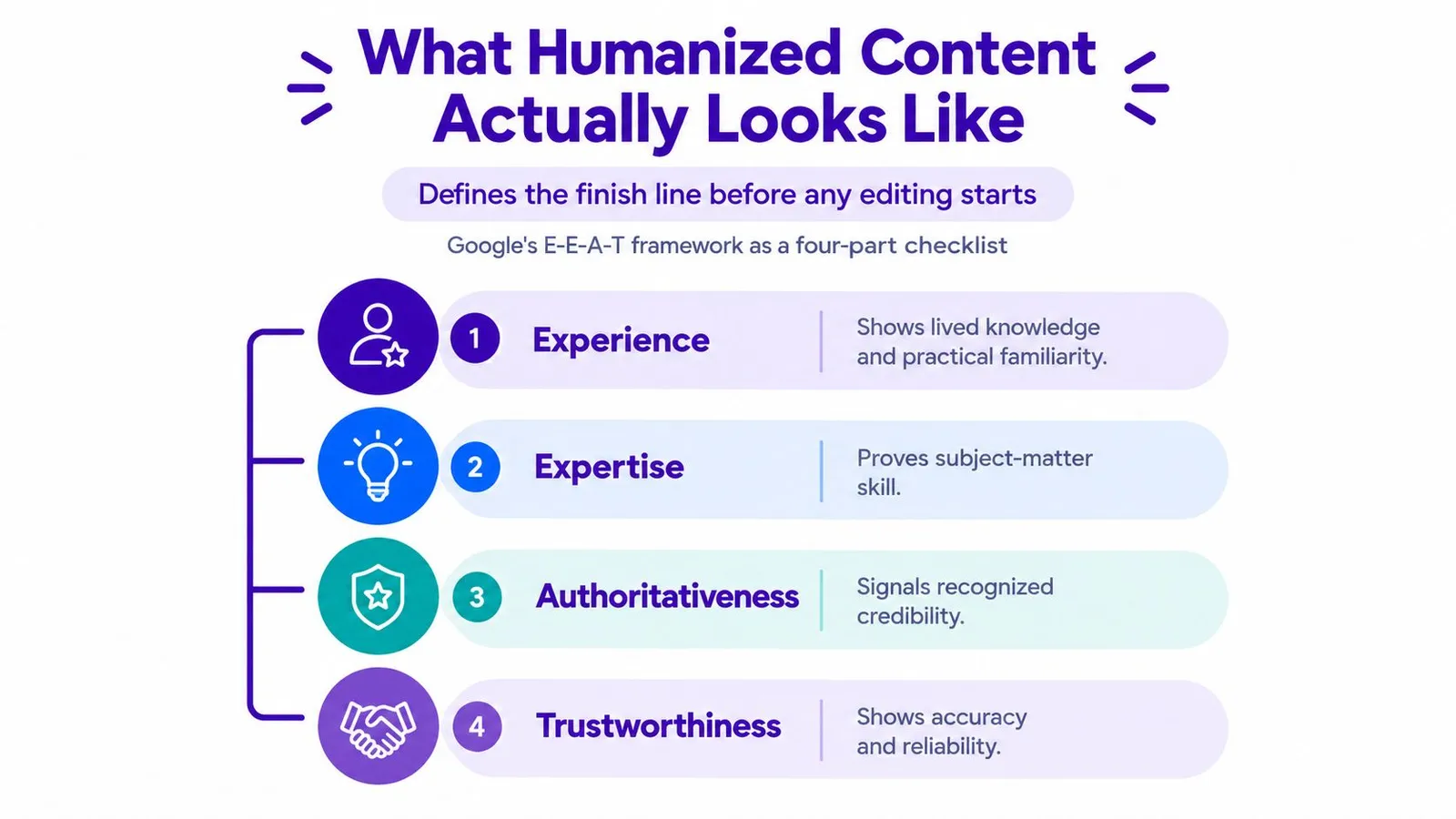
Apply the framework to the page
Experience requires a real basis. In a hypothetical luggage guide, a merchant could add observations from an actual packing demonstration or explain a documented customer question. Without that evidence, the article should offer a clearly labeled comparison rather than invent a product test.
Expertise appears in precise explanations. A cookware article should distinguish a product's construction from its surface treatment when that distinction affects the recommendation. Replacing technical language with cheerful adjectives would make the advice less useful.
Authoritativeness requires more than confident phrasing. An editor should check whether the author's relevant background is visible, the cited evidence supports the recommendation, and the article stays within the publisher's competence. A store shouldn't imply independent testing when it has only reviewed supplier specifications.
Trustworthiness is the most practical publishing test:
- Verifiable details: Product claims agree with the current specification sheet.
- Visible limitations: The article explains where an option won't suit the reader.
- Clear evidence boundaries: Readers can distinguish merchant observations, manufacturer statements, and editorial analysis.
- Accurate destinations: Product and policy links lead to information that supports the surrounding advice.
Match the format to the decision
An editor can use a step-by-step keyword research process to frame the reader's question before judging whether the draft answers it. Keyword selection should define the problem, not become an excuse to repeat the same phrase.
For comparison-led pages, teams exploring how to build mobile-first product listicles with Landra should apply the same standard to every product entry: a clear use case, a supported distinction, and a relevant limitation. A polished layout can make a comparison easier to scan, but the editor still has to make the comparison worth reading.
Designing a Human in the Loop Writing Workflow
The division of labor needs to be explicit before drafting begins. Otherwise, a team can delegate decisions accidentally, allowing an AI-generated outline to determine the audience, commercial angle, and evidence requirements without approval.
The workflow diagram provides a useful task map rather than permission to automate every stage.
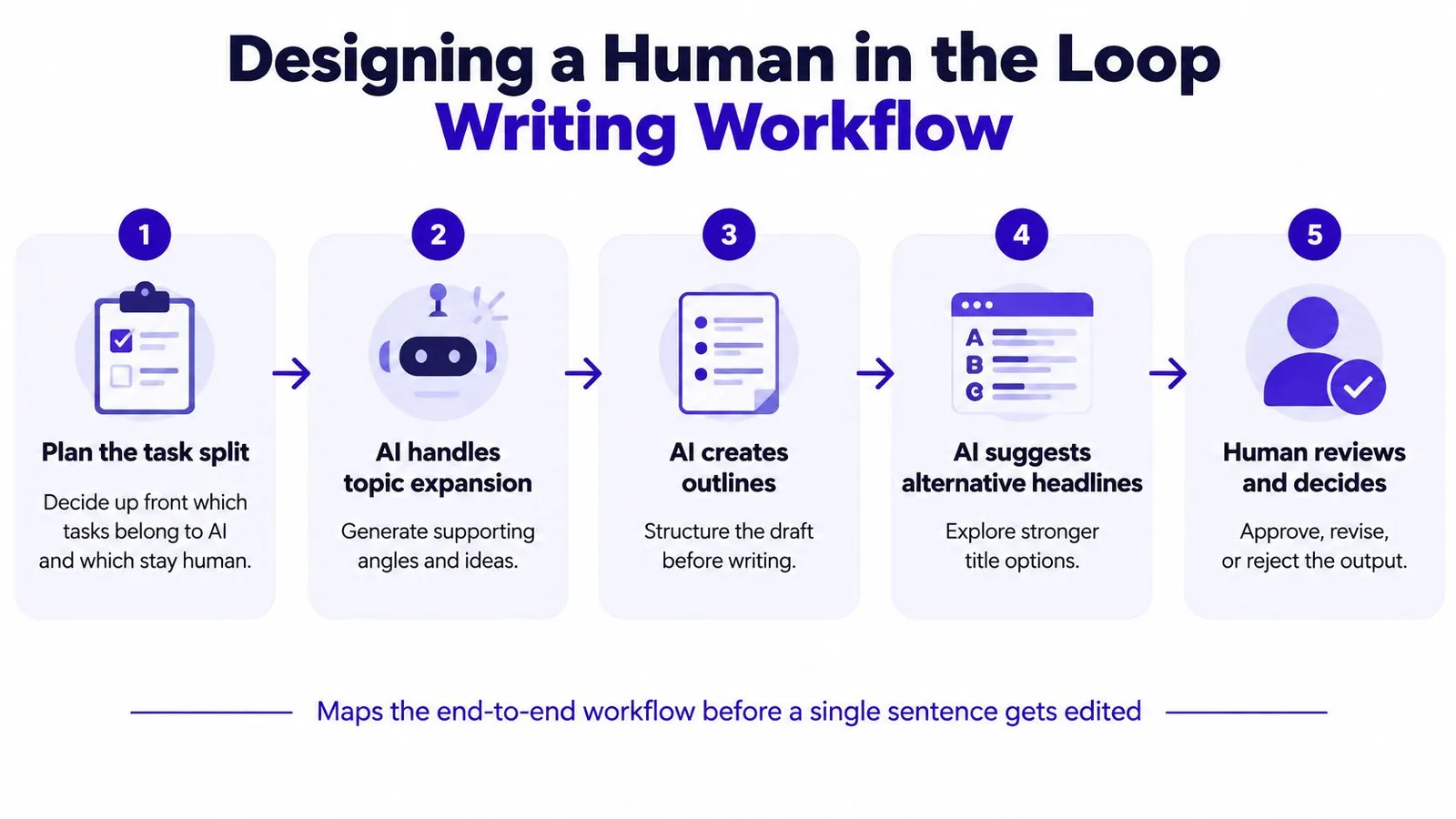
A 2024 study of human-AI collaborative writing reported an average task-sharing score of 0.68, while measured mutuality was 0.05 and human-AI trust was -0.04. These are study-specific measures, not percentages or universal benchmarks. They support a useful distinction: substantial task-sharing doesn't automatically mean writers feel aligned with, or confident in, the collaboration.
Keep decisions with the editor
AI can propose supporting topics, organize supplied material, suggest headlines, produce translation drafts, and assemble initial prose. Humans should retain responsibility for the brief, source selection, factual judgments, market suitability, and approval.
A reusable brief makes those responsibilities concrete:
| Brief field | What the editor supplies |
|---|---|
| Target reader | Purchase stage, relevant knowledge, market, and immediate concern |
| Reader outcome | The decision or task the article must enable |
| Store context | Approved specifications, collection distinctions, and applicable policies |
| Evidence requirements | Claims needing documentation, specialist review, or removal |
| Voice boundaries | Preferred terminology, prohibited promises, and suitable examples |
| Approval owner | The person responsible for the final recommendation |
For a hypothetical Shopify footwear guide, the inputs might include the store's published sizing guidance, verified material descriptions, and anonymized questions supplied by its support team. The editor should establish permission and relevance before reusing customer material. A model shouldn't fill gaps by inventing customer experiences.
Make review part of scheduling
The content owner should approve the angle and outline before a full draft enters production. That prevents a polished article from consuming review time when it addresses the wrong shopping problem.
A content calendar workflow should reserve space for evidence collection and approval, not just a publication date. Missing documentation should block release rather than become a request for more persuasive wording.
The accompanying video offers another format for considering the writing process.
The operational trade-off is straightforward: more explicit inputs require preparation, but they give the editor something concrete to assess. Without them, review becomes a subjective argument about whether the prose feels right.
Editing AI Drafts in Two Focused Passes
Sentence polishing should wait until the article's argument works. Otherwise, an editor spends time improving paragraphs that should be deleted, moved, or replaced.
The Two-Pass Editing Method
| Editing Pass | What to Fix | Signals to Watch For |
|---|---|---|
| Structural editing | Intent, answer placement, reasoning, evidence, missing distinctions | Delayed answers, repeated sections, unsupported recommendations |
| Line editing | Precision, rhythm, voice, transitions, unnecessary wording | Inflated adjectives, vague qualifiers, repetitive openings, awkward substitutions |
Structural editing fixes the answer
Start with the reader's intended outcome and inspect the order of information. A buying guide should establish the relevant selection criteria before recommending products. A troubleshooting article should make the next safe action easy to find.
Consider this hypothetical draft sentence:
Before: Choosing the right backpack involves considering various factors, including comfort, functionality, and personal preferences.
After: For a commuting backpack, compare laptop fit, access during travel, and the items carried each day before considering decorative features.
The revision doesn't claim a product was tested. It replaces an empty category list with a usable decision sequence.
An editor should then compare each recommendation with the available evidence. If the article names a product, the explanation should identify the verified feature that makes it relevant. If no evidence supports the recommendation, the choice is to research, qualify, or remove it.
Line editing fixes the delivery
Once the structure holds, cut language that makes the reader work without adding meaning.
Before: This solution offers numerous benefits that can significantly enhance the overall shopping experience.
After: The comparison places the relevant product specifications beside each option.
The second version is suitable only when the page does that. Concrete wording isn't permission to invent concrete facts.
Useful edits include:
- Replace vague qualifiers: Change various materials to the actual materials, if verified.
- Remove automatic transitions: Delete unnecessary transitions when the relationship is already obvious.
- Preserve technical terms: Explain necessary terminology instead of substituting a less accurate synonym.
- Adjust rhythm by meaning: Use a short sentence for a conclusion and a longer one when a condition needs explanation.
For an additional editing reference, Pure Write offers a humanizing guide for content creators. Any rewriting approach should remain subordinate to the original evidence and intended meaning.
A natural-sounding fabrication is still a fabrication.
Teams can keep revisions within their article editing workflow so the approved version remains connected to publication. Reject the draft if it still lacks a distinctive point of view, verifiable support for substantive claims, or a clear reader outcome. A final stylistic pass can't repair those omissions.
Measuring Whether Your Content Feels Human
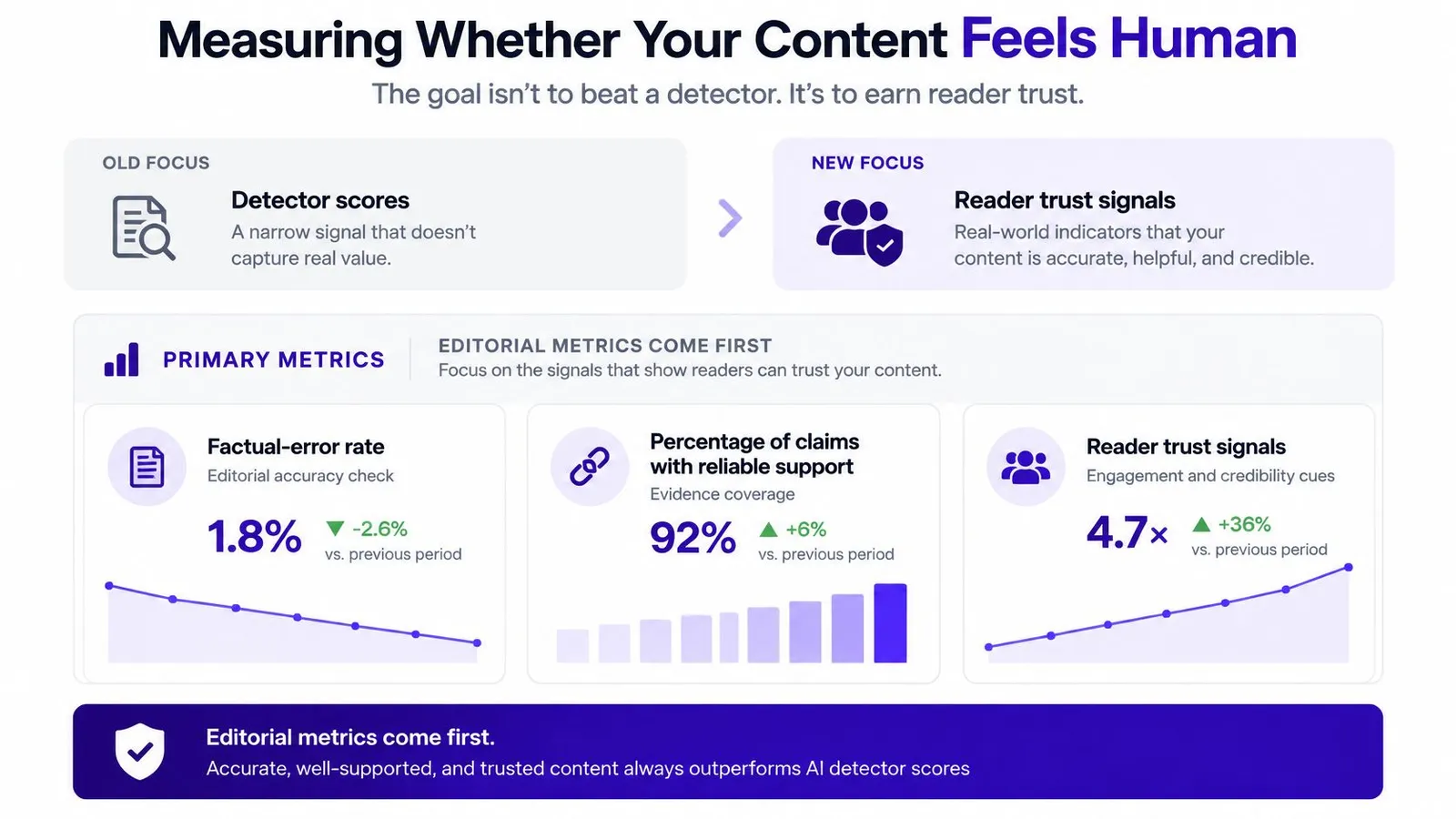
Editorial teams need separate measures for correctness and reader response. An article can be accurate but difficult to use, or engaging while giving the wrong advice. Combining everything into a single humanization score would hide those differences.
The dashboard below puts editorial checks ahead of detector results.
Track evidence before engagement
A review log can record factual errors, unsupported claims, misleading implications, and corrections required before publication. Evidence coverage can be tracked as the proportion of checkable claims with reliable support. The team should also assess whether examples are original, explanations are readable, and a reader can identify the recommended next action.
Behavioral measures answer different questions:
- Search impressions and click-through rate: Is the page appearing for relevant queries, and does its search presentation attract interest?
- Product-page visits: Do readers follow the intended route from explanation to relevant merchandise?
- Time on page: Does engagement merit closer inspection? Longer visits alone don't prove satisfaction.
- Conversions and returns: Do purchasing outcomes suggest a need to investigate the advice?
- Support questions: Which uncertainties remain after readers encounter the article?
These are diagnostic signals, not proof that an edit caused a commercial result. Catalog changes, availability, promotion, and traffic mix should remain part of the interpretation.
Assess cultural fit by market
A translation can be grammatically correct while using unfamiliar product terminology or an unsuitable tone. A culturally competent reviewer should check local expectations, relevant policy wording, measurement conventions, and whether examples make sense in that market.
In RWS's 2025 research across 5,000 consumers in 14 markets, 82% of respondents who cared about AI said human involvement in development would increase their trust, while 84% preferred explainable AI. Those findings concern AI attitudes, not measured improvements from edited ecommerce articles. They provide context for making human responsibility visible, without promising a conversion lift.
Accurate author attribution and a truthful review note can explain who stands behind an article. Neither should imply testing, specialist credentials, or manual review that didn't happen.
Market-level feedback should then guide revisions. Repeated questions about a translated sizing explanation are a reason to inspect that passage, even if the prose sounds perfectly natural.
Scaling Humanized Content Across a Shopify Store
A solo merchant and an agency managing multiple stores won't use the same review system. The useful distinction is content risk, not enthusiasm for automation. A descriptive article based on stable catalog information needs a different approval process from advice involving compatibility, safety, or sensitive claims.
Choose an operating model deliberately
| Operating model | Suitable circumstances | Main trade-off |
|---|---|---|
| Fully manual editing | Complex recommendations, unfamiliar topics, or a developing editorial standard | Close control requires more editorial capacity |
| Scheduled publication with spot checks | Narrow, low-risk content with established inputs and a proven template | Problems in unchecked articles may reach readers |
| Automated drafting with mandatory review | Recurring production where an editor can approve drafts before release | Production still depends on available reviewers |
Fully manual editing gives the reviewer room to challenge the premise, rebuild the argument, and inspect evidence closely. It's a sensible choice when the team can't yet describe what an acceptable draft looks like. Automating publication before establishing that standard merely accelerates inconsistency.
Scheduled publication with spot checks involves a real compromise. Sampling can reveal recurring problems, but it doesn't establish that an unreviewed article is correct. Merchants choosing that model should restrict eligible topics, maintain approved source material, and have a clear process for pausing publication.
Standardize inputs rather than personality
Automated drafting with a mandatory gate preserves a place for editorial judgment without requiring a blank-page start. The reviewer receives a prepared article and checks the decisions that matter, rather than treating fluent prose as approval.
A shared reference library can contain:
- Catalog evidence: Current specification documents and approved product terminology.
- Policy references: Authoritative destinations for shipping, returns, and warranty information.
- Editorial boundaries: Claims the store won't make without supporting documentation.
- Review responsibilities: Named owners for catalog accuracy, localization, and final release.
Scaling principle: Standardize the evidence and review process; preserve room for a topic-specific conclusion.
For agencies, store-specific source libraries matter more than imposing the same voice everywhere. A technical supplier and a gift retailer may need different explanations, even when both articles follow the same approval process.
Broader Shopify SEO guidance can support planning, but production capacity should remain a publishing constraint. If the review queue exceeds the team's ability to check important claims, reducing output is more responsible than lowering the quality bar.
Your Humanization Checklist and Next Step
A pre-publication checklist should make approval observable. Passing it means an editor can point to evidence in the draft or supporting material, rather than relying on an overall impression of polish.
Review the finished page
- Intent matched: The article resolves the reader's actual question without burying the answer beneath general background.
- Useful specifics added: Product distinctions and examples come from documented inputs, not plausible invention.
- Substantive claims verified: Recommendations, comparisons, and statements affecting purchase decisions have appropriate support.
- Experience represented: Any testing, customer insight, or firsthand observation has a real and describable basis.
- Generic phrasing removed: Remaining sentences explain, substantiate, qualify, or direct.
- Technical meaning preserved: Simplification hasn't changed the substance of the advice.
- Market fit reviewed: Terminology, examples, and policy references suit the intended audience.
- Accountability visible: Authorship and review statements accurately describe responsibility.
Inspect more than the body copy
The title, meta description, structured data, image alt text, and linked destinations need review too. A careful article can still mislead if its metadata promises a test that never occurred or its featured image suggests unsupported product capabilities.
Google's guidance on using generative AI content recommends accuracy and quality checks, including attention to generated metadata. It also warns that generating many pages without adding value can violate scaled-content-abuse policy. AI assistance itself isn't the deciding issue.
For Shopify teams, the publishing workflow should make approval status unambiguous. A draft awaiting factual review shouldn't look ready merely because its formatting is complete.
Humanization is an editing discipline measured by usefulness and trust. Style matters, but it belongs inside that discipline rather than replacing it.
The next action is modest: an editor can take the latest AI draft, preserve the original, and apply the structural pass before touching individual sentences. The comparison should identify which decisions became clearer, which claims gained support, and which unnecessary passages disappeared. For a Shopify merchant, a scheduled draft is a practical starting point because the review happens where publication already occurs.
Rankira offers Shopify-focused keyword research, article drafting, internal linking, scheduling, and search performance reporting. Merchants can visit Rankira to build an assisted publishing workflow, save generated articles as drafts, and make the human editing pass part of normal production.
Keep reading
All articles
Shopify SEO
SEO Content Writing Principles for Readers and Search
Learn the principles of SEO content writing that balance search relevance, clear structure, and real reader value, with examples for online stores.
10 min read

Shopify SEO
Internal Linking Audit That Actually Improves Rankings
Run a practical internal linking audit to find orphan pages, fix broken links, and prioritize fixes that move revenue on your Shopify store.
10 min read
Shopify SEO
Share of Voice SEO: A Practical Measurement Guide
Learn how share of voice SEO works, how to calculate it, and how to use intent-based metrics to assess search visibility and business impact.
12 min read
Put your Shopify blog on autopilot
Rankira researches keywords, writes SEO articles, adds internal links, and publishes them to your store — every week. Start with a 7-day free trial.