How to Do Backlinks the Right Way in 2026
Learn how to do backlinks ethically: earn quality links with useful content, relevant outreach, and safe tracking for Shopify SEO.
Published 12 min read
In this article
A Shopify merchant publishes a useful buying guide, improves a collection page, and waits for search visibility to improve. The products are solid, the content answers real questions, but other publishers still have little reason to reference the store. Another batch of articles won't necessarily fix that gap.
Learning how to do backlinks starts with a different question: what could this store publish that an independent editor would want to cite? That question leads to a more useful workflow than buying placements, sending generic pitches, or collecting domains without checking where the links appear.
Table of Contents
- Why Quality Backlinks Still Decide Visibility
- What Makes a Backlink Worth Earning
- Create Assets People Can Cite
- Run Relevant Outreach Without Spamming
- Measure Results and Audit Risk
- Choose the Right Backlink Approach
- Backlink Tips and Your Next Move
Why Quality Backlinks Still Decide Visibility
Consider an apparel store with an informational post about caring for delicate fabrics and a collection page selling those garments. A blogger writing about wardrobe maintenance might find the topic relevant, but relevance alone doesn't justify a citation. The blogger still needs a reason to choose this store's resource over an existing reference.
A generic article repeating washing-label advice offers little distinction. A carefully documented care guide, with clear material-specific limitations and input from a qualified textile specialist, gives the blogger something concrete to reference. The difference isn't the merchant's enthusiasm for a backlink. It's the usefulness of the destination.
A Citation Needs a Reason
Backlinks should be treated as editorial citations, not a publishing quota. Google's distinction between earned references and manipulative links makes the reason behind a placement central to evaluating it.
For the hypothetical apparel store, the informational post and collection page serve different purposes:
- The informational post helps the blogger explain a maintenance problem and gives readers a useful next destination.
- The collection page helps shoppers explore relevant merchandise, but a direct citation needs a product-related reason.
- The publisher's decision should depend on whether the destination improves the article, not whether the merchant needs ranking signals.
A useful outreach test is whether an editor can explain the citation without mentioning SEO.
Visibility Needs More Than a Link Count
A backlink campaign shouldn't be blamed for every stalled ranking, either. Before outreach begins, the merchant should check whether the target page satisfies its intended query and provides a credible answer.
A broader share-of-voice SEO assessment can help frame the visibility question around competitors and relevant searches rather than a backlink total alone. The practical objective is a defensible portfolio of mentions from publishers whose readers could use the store's expertise.
What Makes a Backlink Worth Earning
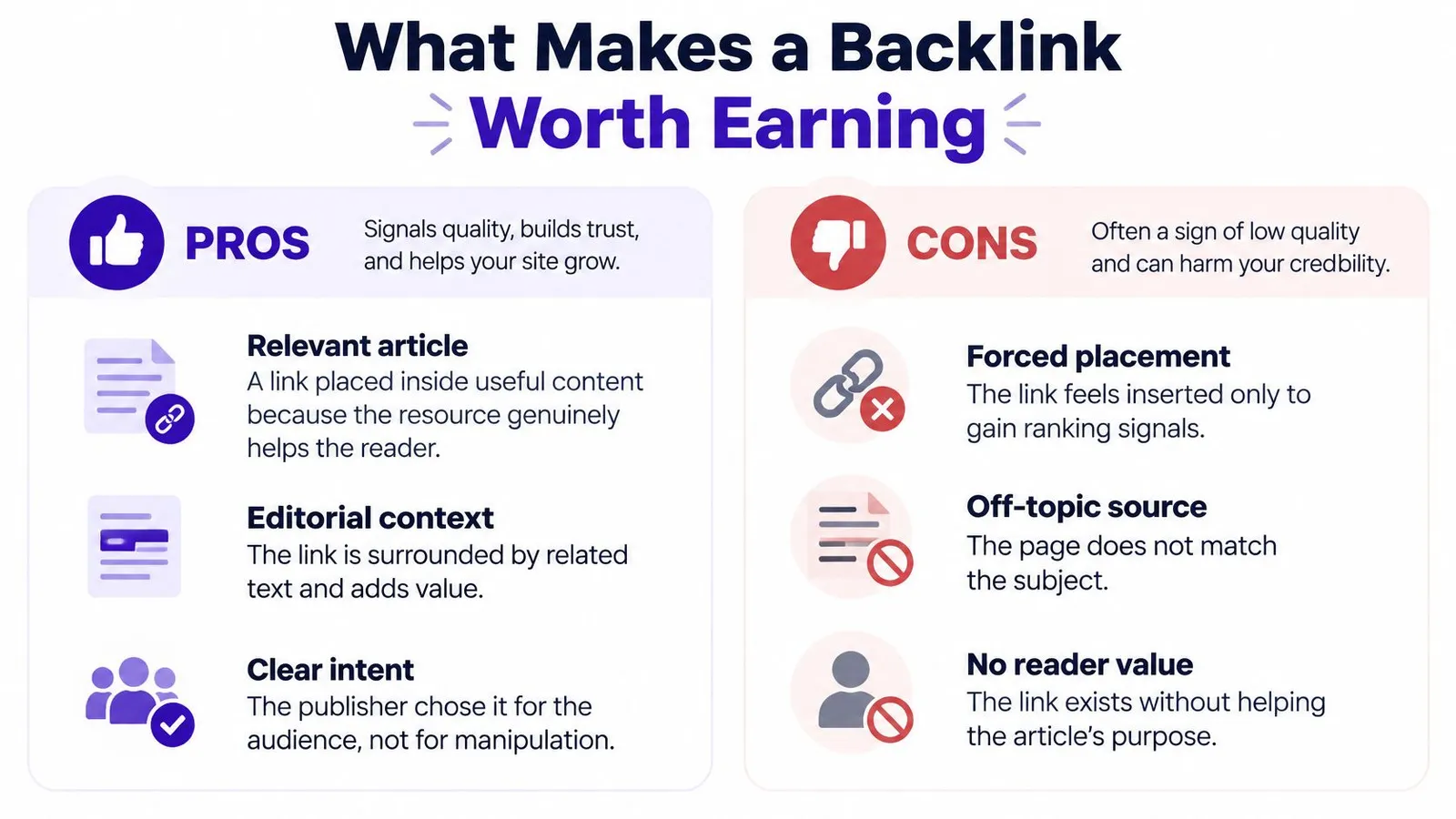
A placement doesn't become worthwhile just because a website agrees to publish it. A merchant needs to examine relevance, editorial context, and intent before considering any apparent SEO benefit.
Google identifies buying or selling links for ranking purposes and excessive reciprocal exchanges as link spam, while recommending rel="nofollow" or rel="sponsored" for paid advertising relationships in its spam policies for Google web search. An advertising arrangement can therefore be legitimate without being an acceptable way to purchase ranking credit.
The distinction is easier to apply when the placement is judged from the reader's perspective.
Apply a Reader-First Filter
The merchant should open the proposed linking page, not rely on a domain-level score or a seller's description. A convincing opportunity should survive these checks:
- Category fit: The publication covers the product category, its use cases, or a closely related subject.
- Contextual value: The surrounding paragraph gives readers a clear reason to visit the destination.
- Editorial independence: The publisher can reject the suggestion, change the wording, or choose a different resource.
- Page visibility: The page is accessible, appears eligible for indexing, and shows signs of being maintained for readers.
- Natural wording: The anchor describes the destination without forcing a commercial search phrase into an awkward sentence.
Keyword relevance needs interpretation rather than exact-word matching. A store's keyword research process can identify related questions, but matching a keyword doesn't prove that a publication serves the right audience.
Reject Forced Placements
A gardening publication mentioning an unrelated fashion collection in an old article isn't a strong prospect merely because the link can be inserted. The same applies to an advertorial sold specifically to transfer ranking signals.
By contrast, a specialist publication citing a merchant's useful compatibility guide has an understandable editorial purpose. The practical question is straightforward: would this mention still make sense if search engines didn't exist?
A qualified sponsored mention may still be worth considering for advertising or audience exposure. It should be evaluated on those terms, without presenting it as an earned editorial endorsement or demanding that its advertising attributes be removed.
Create Assets People Can Cite
The strongest starting point is often information the store already holds but hasn't organized for outsiders. Product specifications, recurring support questions, supplier guidance, and practical use observations can become useful references when their scope and limitations are clear.
For an apparel merchant, that might mean replacing a broad fabric-care article with a material-by-material reference. For an accessories store, it could mean a compatibility finder that distinguishes confirmed matches from untested combinations.
Product knowledge needs editorial work before it becomes a dependable citation.

Turn Store Knowledge Into Reference Material
Start by identifying questions that require more than a generic explanation. A step-by-step keyword research workflow can help connect those questions with the store's catalog and the language customers use.
Then choose the format that makes the answer easiest to verify and apply.
| Potential asset | Likely citing page | Improvement before outreach |
|---|---|---|
| Fabric-care guide | Clothing maintenance tutorial | Separate advice by material and explain exceptions |
| Specialist sizing chart | Fit guide for a particular garment type | Explain measurement technique and sizing limitations |
| Accessory compatibility finder | Setup guide or product comparison | Distinguish confirmed compatibility from assumptions |
| Material comparison table | Buying guide | Explain trade-offs instead of declaring a universal winner |
| Maintenance checklist | Ownership or troubleshooting article | Add clear conditions for each recommended action |
These are proposed assets, not claims that a particular store has earned links with them. Each merchant should prioritize the resources supported by genuine product knowledge and accessible expertise.
Make the Asset Credible Before Promoting It
Original observations need a method. If a merchant describes product-use findings, the page should explain what was examined, under which conditions, and what remains uncertain. Marketing language shouldn't be presented as research.
Expert commentary needs similar care. A supplier or specialist should review the wording attributed to them, and the page should distinguish their expertise from the merchant's interpretation.
Practical rule: A publisher should be able to understand the resource's evidence without contacting the store for an explanation.
For outreach planning, assign each shortlisted asset a target query, a likely citing-page type, and a specific improvement required before launch. That prevents the content team from polishing pages that have no identifiable editorial use.
An informational guide is often the more sensible outreach destination because it answers the publisher's question directly. Relevant internal links can then give readers a route to Shopify products and collections without turning the guide into a disguised sales page.
Run Relevant Outreach Without Spamming
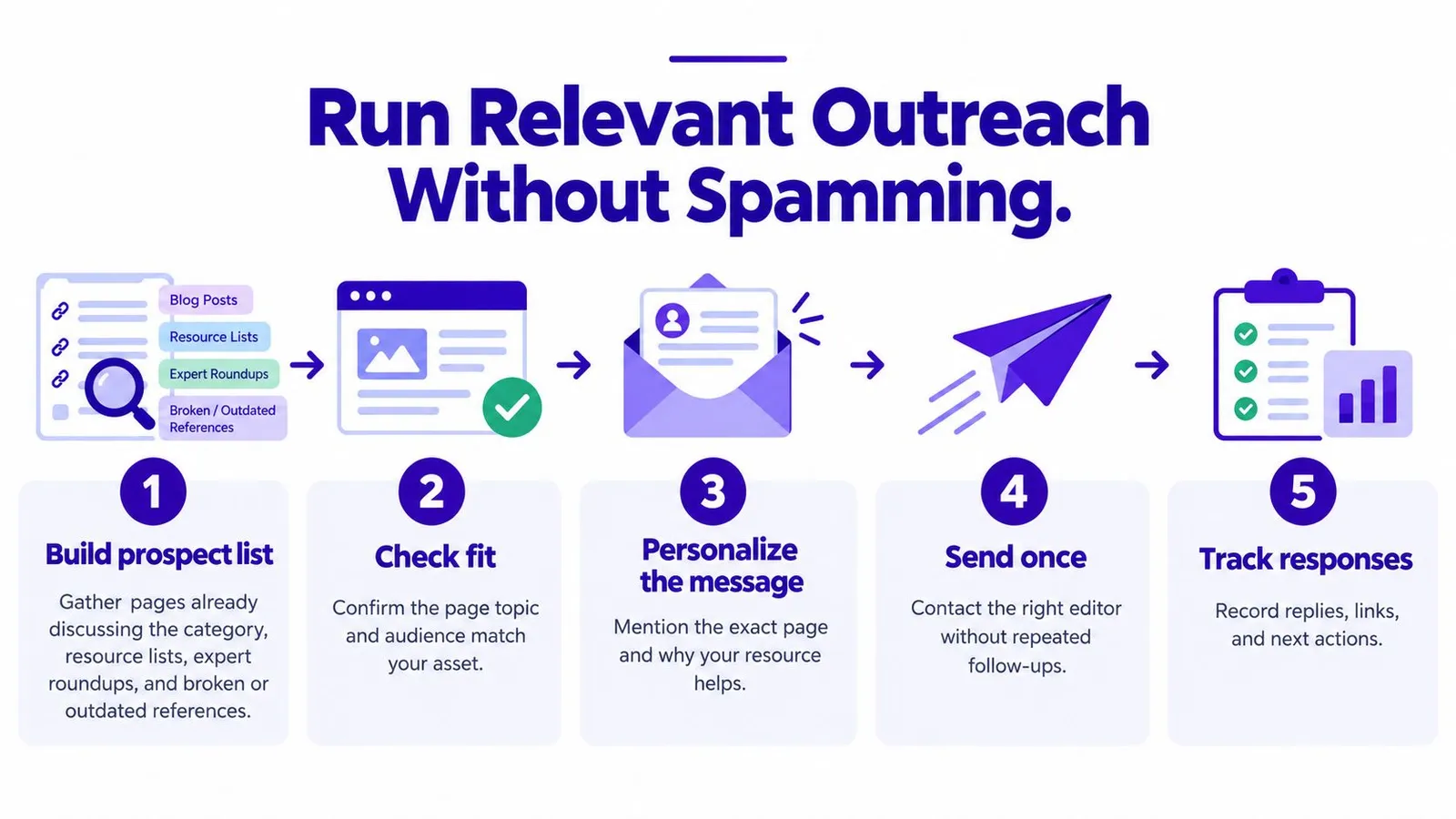
A prospect list should begin with pages, not email addresses. The useful prospect is a specific article whose readers would benefit from the asset, together with an identifiable editor who can evaluate the suggestion.
That might be a resource list missing an important reference, a tutorial containing an outdated explanation, a review discussing an unresolved compatibility issue, or a complementary brand's educational article. None is automatically a fit merely because it mentions the category.
The working sequence keeps qualification ahead of sending.
Qualify the Page Before Finding the Contact
The outreach sheet should record the candidate URL, topic, intended audience, relevant paragraph, and reason the asset belongs there. If the researcher can't write that reason clearly, the prospect isn't ready for outreach.
Editorial independence also needs checking. A site that accepts every unrelated placement for payment shouldn't pass qualification just because its metrics look attractive.
For merchants also operating a software product, the SubmitMySaas resource on how to build SEO backlinks for your SaaS provides a separate category-specific reference. Shopify campaigns still need their own qualification criteria rather than a prospect list copied from another business model.
Write Around the Editorial Gap
A useful pitch explains a small, concrete improvement to an existing page. For a hypothetical apparel campaign, the message could identify a paragraph about drying knitwear and explain that the proposed reference distinguishes care requirements by material.
The editor needs enough information to evaluate the suggestion without opening a long sales presentation:
- Name the page: Identify the article and the relevant passage.
- Explain the contribution: Describe the missing distinction, correction, or practical resource.
- Make a modest request: Suggest consideration as a contextual reference, without prescribing keyword-heavy anchor text.
- Respect the response: Accept a rejection and avoid repeated follow-ups to an unresponsive editor.
Subject lines should describe the subject of the message, not manufacture urgency. Follow-up timing can be tested where a follow-up is warranted, but silence shouldn't become permission for a persistent automated sequence.
Forecast Placements, Not Activity
Low conversion is part of the planning problem. An Ahrefs poll of more than 800 respondents reported average outreach conversion of 1–5%, while a documented campaign sent 515 emails, received a 17.55% reply rate, and achieved 5.75% conversion, as detailed in Ahrefs' link outreach guide.
Those figures aren't a promise for a Shopify campaign. They support a narrower conclusion: replies and sent emails aren't substitutes for qualified placements.
For teams evaluating outreach training, video demonstrations can supplement the written process.
The tracking sheet should distinguish contacted prospects, replies, editorial interest, and verified live mentions. Placement records should include the referring domain, destination, anchor, and link attributes.
When results disappoint, examine prospect type and asset usefulness before rewriting every email. A polished message can't repair a resource that adds nothing to the recipient's article.
Measure Results and Audit Risk
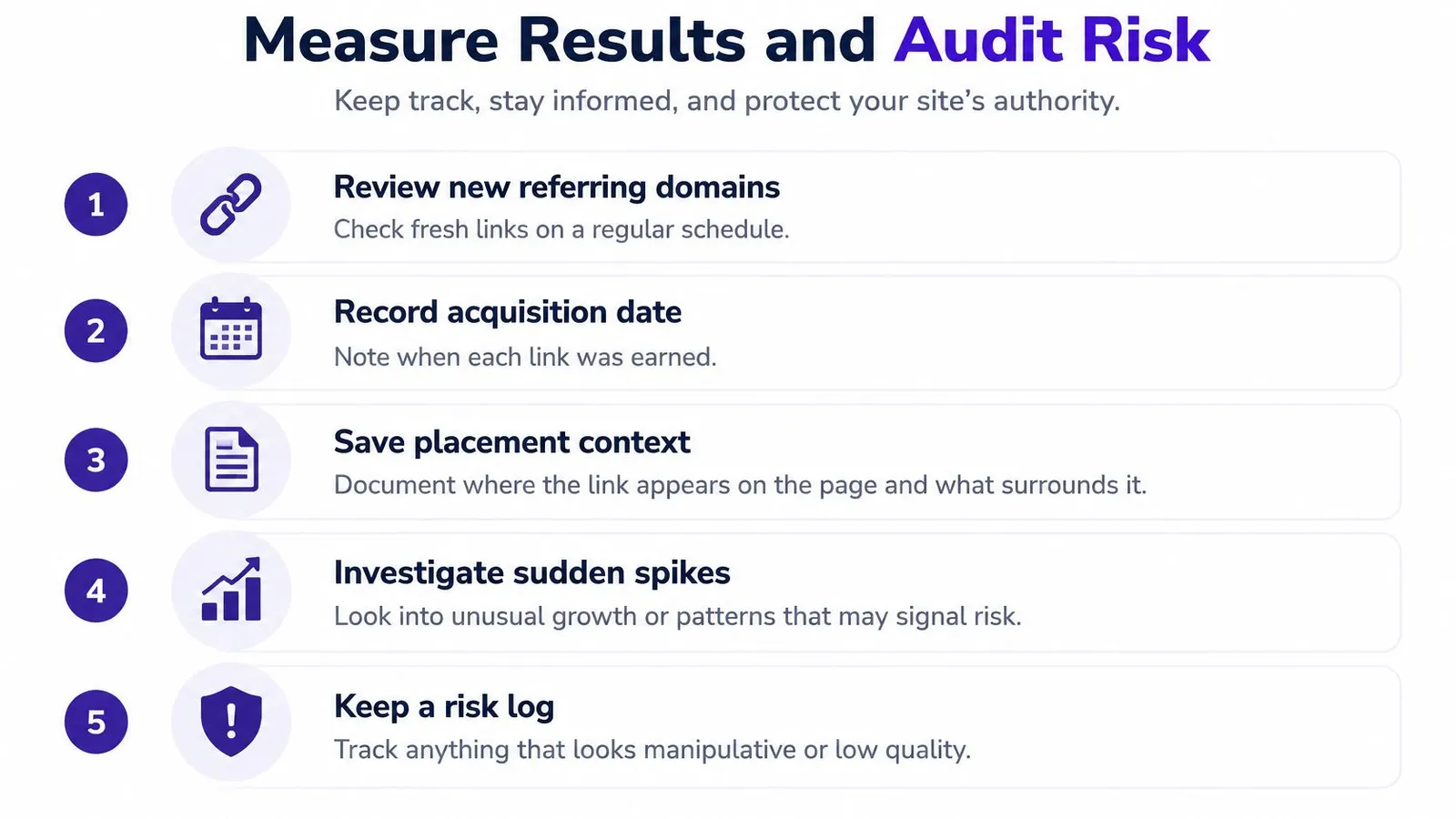
Once a mention goes live, the task changes from persuasion to verification. The merchant should confirm that the destination is correct, the surrounding text is accurate, and the placement matches the arrangement that was discussed.
The acquisition record should preserve the date, source page, editorial context, and any commercial relationship. That information becomes useful when staff change or an agency's campaign needs reviewing.
A recurring audit should examine both new opportunities and unexpected patterns.
Build a Scorecard That Supports Decisions
Raw totals hide too much. A practical review should separate acquisition quality, audience response, and potential risk.
| Signal | Question for the reviewer |
|---|---|
| Unique referring domains | Which independent publishers are providing coverage? |
| Topical relevance | Does each source serve a related audience? |
| Linking-page visibility | Is the actual article discoverable and maintained? |
| Anchor-text patterns | Does the wording reflect independent editorial choices? |
| Referral traffic | Are readers visiting from the placement? |
| Conversions and assisted journeys | Do those visitors take useful actions or return later? |
A relevant mention can deserve retention without immediate ranking movement, particularly when it sends interested visitors. Conversely, a large batch of unrelated domains deserves investigation rather than automatic celebration.
An internal linking audit can complement this review by checking whether readers arriving at cited resources can reach relevant products and collections. External coverage and on-site navigation should be evaluated separately, then connected through the visitor's experience.
Investigate Before Escalating
Google's manual-action guidance for unnatural links describes reviewing linking data, seeking removal or PageRank-blocking treatment, and using disavow when problematic links can't be removed. The guidance also explains that systems can remove ranking benefits previously associated with link spam, so a merchant shouldn't assume those benefits can be recovered through unrelated site changes.
A sensible monthly review is to export available linking data, inspect recent and frequent sources, and compare suspicious placements with the acquisition log. Sudden low-quality growth, unexplained commercial anchors, or placements from an unknown supplier warrant closer examination.
Disavow shouldn't become an automatic response to every unfamiliar domain. Escalation should depend on evidence of problematic linking and the applicable Google guidance, not a dashboard warning alone.
Choose the Right Backlink Approach
The right acquisition model depends on who can judge editorial quality, who has time to contact publishers, and who remains accountable after a placement appears. Outsourcing the sending doesn't remove the merchant's responsibility for the arrangement.
A small store may prefer manual outreach because the owner understands its products well. An agency managing Shopify clients may need a shared workflow, documented approvals, and outside help with prospect research.
Backlink Approaches for a Shopify Store
| Approach | Best for | Main risk | What to verify |
|---|---|---|---|
| Manual outreach | Merchants who need direct editorial control | Research and correspondence consume operating time | Every pitch addresses a real page-level need |
| Freelancer or agency | Teams needing research and outreach capacity | Suppliers may prioritize delivery quotas over relevance | Prospect examples, acquisition methods, and live placement records |
| Community and partner mentions | Brands with genuine industry relationships | Coverage may be limited or become conditional | The mention serves readers independently of a reciprocal obligation |
| Software-assisted workflow | Stores coordinating recurring content and reporting | Automation can accelerate poorly judged decisions | Human review, placement context, and link attributes |
Manual work offers visibility into rejection reasons and editorial preferences. Its trade-off is capacity: a merchant handling merchandising and customer support may struggle to sustain careful research.
Hiring help can address that constraint, but the contract should define acceptable methods before delivery begins. A supplier should explain how prospects are selected, disclose paid relationships, and provide enough context for the merchant to reject unsuitable placements.
Keep Software in an Operational Role
For Shopify stores, an integrated content application can handle keyword research, article scheduling, internal links to products and collections, and search-performance reporting. Reporting that includes Ahrefs Domain Rating can provide another reference point, but it shouldn't replace examination of the actual linking page.
Credit-based backlink exchanges require particular care. Earning and spending credits doesn't establish editorial independence or make an otherwise manipulative arrangement safe.
A software feature can organize an opportunity. It can't make the editorial decision legitimate on the publisher's behalf.
The exchange should remain subject to the quality criteria established earlier. Participation shouldn't require irrelevant insertions, reciprocal obligations, or unqualified paid ranking transfer.
A practical operating choice is a primary acquisition route with a supporting channel. For example, a merchant might use manual asset outreach as the main activity and genuine supplier commentary as support, while software handles publishing and records.
The important distinction is between automating administration and automating judgment. Research organization, scheduling, and reporting are reasonable candidates for automation; deciding whether a publisher should cite a resource still requires editorial scrutiny.
Backlink Tips and Your Next Move
The most useful change is to manage backlinks as relationships between specific pages, rather than transactions between domains. That shifts attention toward what the publisher needs, what the store can substantiate, and what a visitor gains after clicking.
It also makes disappointing results easier to diagnose. A campaign can fail because the asset lacks evidence, the prospect list is too broad, the proposed destination is commercial when the article needs a reference, or the outreach team counts interest as delivery.
Diagnose the Bottleneck Before Expanding
Each failure calls for a different response. More sending won't resolve weak evidence, and a larger asset won't fix outreach to the wrong audience.
- Few relevant prospects: Reconsider whether the asset addresses a question publishers cover.
- Interest without placements: Check whether the editor needs clearer evidence, a more suitable destination, or has other priorities.
- Placements without useful visits: Review the article's readership and the reason readers would click.
- Unexpected sources: Compare the live mentions with supplier records before continuing the campaign.
- Repeated objections: Feed those objections back into asset development rather than treating every rejection as a copywriting problem.
This diagnosis should happen before the team expands its list or hires another outreach provider. Otherwise, the store may pay to reproduce the same mismatch at greater scale.
Keep a Short Operating Checklist
A repeatable routine doesn't need to be elaborate. It needs a clear standard that survives busy weeks and changes in personnel.
- Offer value before asking: The resource should be useful without the promised backlink.
- Pitch the page: Domain-level relevance isn't enough when the proposed article has no suitable context.
- Leave editorial wording flexible: The publisher should choose language that fits the sentence.
- Verify delivery: A positive reply remains a lead until the mention is live and checked.
- Reject ranking guarantees: A vendor's confidence isn't evidence that its methods are acceptable.
- Preserve context: Notes about the placement should remain accessible to whoever performs the next audit.
For the coming week, a merchant can select a single asset, identify a manageable set of relevant pages, and qualify each against the editorial filter before contacting anyone. A small personalized batch then provides a controlled opportunity to test whether the proposed resource solves a real publishing need.
The next monthly review should connect those conversations with verified placements and visitor behavior. Better editorial fit, not more noise, is the useful direction of progress.
Rankira offers Shopify merchants keyword research, content generation, scheduling, internal linking, search reporting, and a credit-based backlink exchange within Shopify administration. Merchants can visit Rankira to evaluate how those tools fit an earned-citation workflow, while keeping every exchange placement subject to independent relevance and link-policy checks.
Keep reading
All articles
Shopify SEO
SEO Content Writing Principles for Readers and Search
Learn the principles of SEO content writing that balance search relevance, clear structure, and real reader value, with examples for online stores.
10 min read
Shopify SEO
Internal Linking Audit That Actually Improves Rankings
Run a practical internal linking audit to find orphan pages, fix broken links, and prioritize fixes that move revenue on your Shopify store.
10 min read
Shopify SEO
Share of Voice SEO: A Practical Measurement Guide
Learn how share of voice SEO works, how to calculate it, and how to use intent-based metrics to assess search visibility and business impact.
12 min read
Put your Shopify blog on autopilot
Rankira researches keywords, writes SEO articles, adds internal links, and publishes them to your store — every week. Start with a 7-day free trial.