Comparison to Competitors: A Practical SEO Framework
Learn how to run a comparison to competitors that goes beyond feature lists, and benchmark SEO visibility, content quality, and operational fit.
Published 12 min read

In this article
- Table of Contents
- Why Most Competitor Comparisons Measure the Wrong Things
- The Three Dimensions of a Useful Competitor Comparison
- Benchmarking SEO Visibility and Search Performance
- Comparing Content Quality and AI Discovery Readiness
- Evaluating Operational Fit and Commercial Impact
- Applying the Framework to Real Store Scenarios
- Turning Your Competitor Comparison Into Action
Google's first organic result received an estimated 9.28% click-through rate, compared with 5.82% for the second result and 3.11% for the third, in Strzelecki and Miklosik's study of organic search behavior. That concentration reframes a comparison to competitors: the commercial question isn't who publishes more content, but who captures the available search demand.
For an e-commerce store, a larger article library isn't evidence of a stronger acquisition strategy. A useful comparison connects visibility to content substance, operational requirements, and measurable commercial outcomes.
Table of Contents
- Why Most Competitor Comparisons Measure the Wrong Things
- The Three Dimensions of a Useful Competitor Comparison
- Benchmarking SEO Visibility and Search Performance
- Comparing Content Quality and AI Discovery Readiness
- Evaluating Operational Fit and Commercial Impact
- Applying the Framework to Real Store Scenarios
- Turning Your Competitor Comparison Into Action
Why Most Competitor Comparisons Measure the Wrong Things
Feature tables are convenient because their inputs are easy to collect. An analyst can count writing templates, compare subscription tiers, and record whether each application includes scheduling. None of those observations establishes whether the resulting pages attract relevant shoppers.
The mistake is treating production capacity as competitive performance. Publishing capability describes what a team can produce. Search performance describes whether prospective customers encounter that work and choose to visit.
Separate capabilities from results
An automated workflow and a manual editorial process can both produce articles. The meaningful comparison concerns their published output: which questions the articles answer, which search positions they earn, and whether visitors reach relevant merchandise.
For example, a hypothetical footwear retailer might publish broad lifestyle articles while a smaller rival answers specific questions about fit, materials, and intended use. Article count alone can't establish which approach performs better. The analyst needs query-level evidence and a clear connection between each topic and the catalog.
Practical rule: A feature belongs in the decision only when the evaluator can explain which outcome it enables and how that outcome will be checked.
Pricing deserves the same discipline. A subscription fee doesn't include editorial correction, merchandising review, translation checks, or the effort required to move drafts between systems. Those are evaluation categories, not assumed costs or invented savings.
Compare the right objects
A defensible audit separates two questions that feature-led comparisons often blend together:
- Business competition: Which retailers appear for the same shopping problems and product-related searches?
- Workflow competition: Which combination of software, staff, and external support can address those opportunities?
- Decision evidence: Which observed results would justify keeping, changing, or rejecting that workflow?
The distinction matters beyond retail. Any business can compare search competitors separately from the tools used to compete with them.
For Shopify merchants, the practical consequence is straightforward: first identify the visibility or content gap, then evaluate the production method. Buying a tool before defining the gap makes the feature list the strategy. An evidence-led comparison does the reverse.
The Three Dimensions of a Useful Competitor Comparison
A useful comparison to competitors connects search visibility, content quality and AI readiness, and operational fit. Each dimension answers a different question. Together, they distinguish an attractive demonstration from a sustainable acquisition workflow.
The Three Comparison Dimensions at a Glance
| Dimension | Core Question | What to Measure |
|---|---|---|
| Search visibility | Which businesses appear for relevant demand? | Shared-query rankings, impressions, clicks, device differences |
| Content quality and AI readiness | Which pages provide useful, verifiable answers? | Evidence quality, catalog accuracy, first-hand detail, observed AI citations |
| Operational fit | Which workflow can the team sustain and evaluate? | Review effort, approval controls, portability, publishing reliability, commercial reporting |
Select competitors by query overlap
The competitor set should begin with search results, not a list of brands the merchant already knows. A national retailer, specialist store, and editorial publisher may compete for the same informational query even when their businesses look different.
A practical starting point is a small group of rivals that repeatedly appear across the same non-branded searches. This is a sampling recommendation, not a claim about an optimal sample size. The group should remain manageable enough for page-level inspection.
A step-by-step keyword research process can help organize those searches by customer problem, product category, and intent. Brand-name searches should remain separate because existing brand familiarity can obscure competition for new customers.
Keep market context separate from proof
Shopify accounted for an estimated 27% of worldwide e-commerce-platform usage in August 2024, according to Oberlo's platform-market estimates. That establishes the platform's scale, not the difficulty of any particular keyword.
A merchant still needs to inspect the actual results in the relevant country and language. Platform popularity can't substitute for query-level competition analysis.
The analyst should also label evidence by confidence:
- Observed: A competitor's page ranks for a tracked query or contains a particular product link.
- Estimated: A third-party tool models traffic or keyword demand.
- Unknown: Competitor conversion rates, internal review time, or unpublished workflow rules aren't accessible.
This distinction prevents false precision. A comparison becomes more useful when it states its limits rather than filling missing fields with assumptions.
Benchmarking SEO Visibility and Search Performance
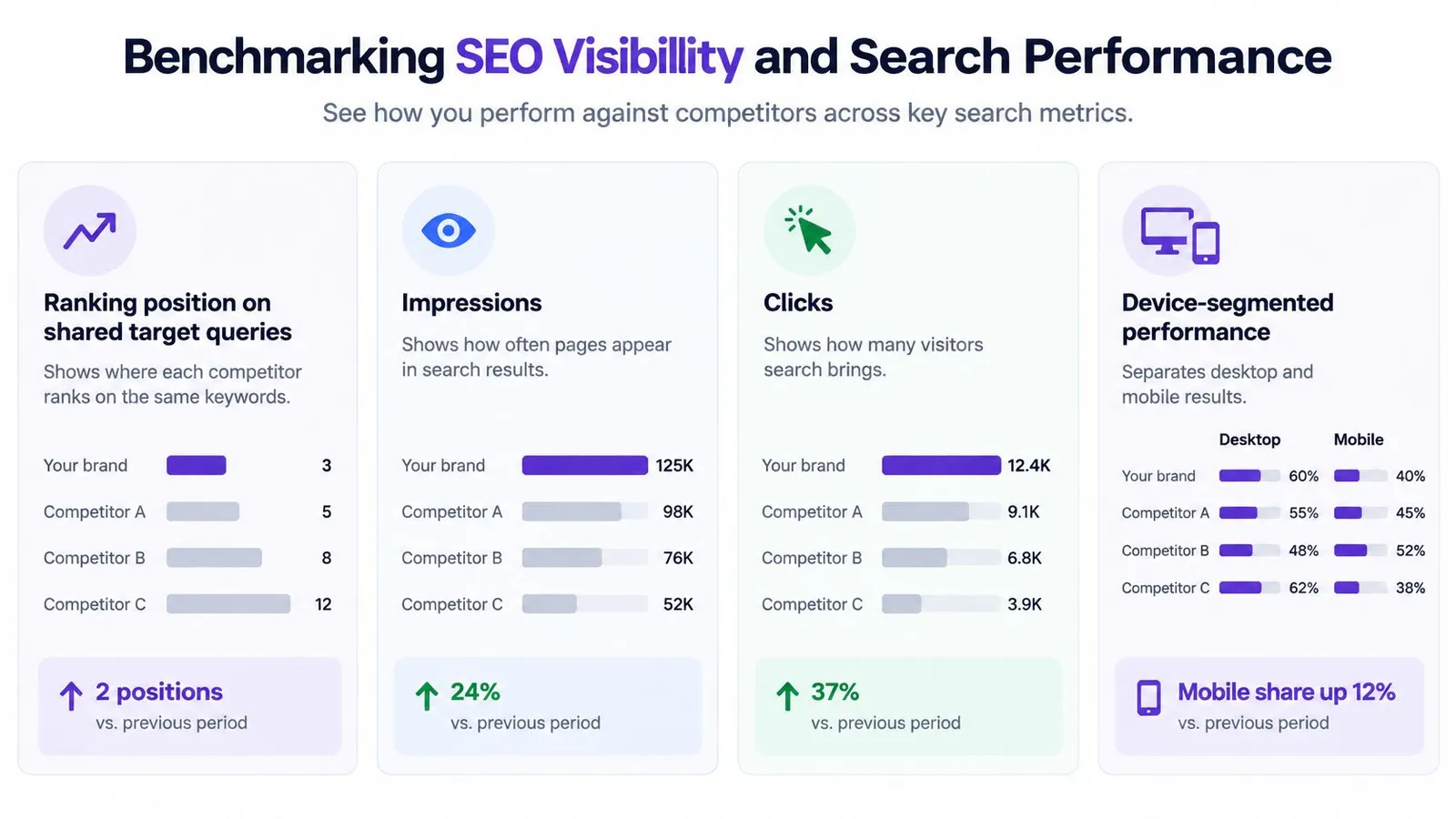
A shared query set provides the foundation for meaningful search comparison. Search Console supplies the merchant's observed query and page performance; keyword tools and manual results checks help identify competing domains. Competitor clicks remain estimates unless the competitor supplies first-party data.
Build a reproducible visibility benchmark
The analyst should record the query, intent, market, device, ranking URL, and observation date. Product searches and informational searches belong in separate groups so a change in the query mix doesn't masquerade as competitive progress.
One transparent visibility measure is observed top-result presence: a domain's qualifying appearances divided by all qualifying appearances across the selected competitor set. The analyst must define the qualifying ranking band before collecting results. This is a proposed benchmarking method, not an industry-standard traffic estimate.
A more detailed SEO share-of-voice approach can incorporate demand weighting. Any weighting should remain consistent across domains and reporting periods.
- Ranking position: Compare the same queries rather than unrelated keyword totals.
- Impressions: Use the store's observed exposure to distinguish visibility changes from changes in click behavior.
- Clicks: Separate branded and non-branded acquisition.
- Device segments: Check whether desktop averages conceal weaker mobile performance.
The opening study's device findings reinforce that last requirement: its authors observed different click-through patterns across desktop, smartphones, and tablets. Its average rates shouldn't be treated as a forecast for an individual store.
Control technical conditions
Search outcomes and storefront experience should be evaluated together. Shopify identifies good Core Web Vitals thresholds as LCP below 2.5 seconds, INP below 200 milliseconds, and CLS below 0.1, with good experience assessed at the 75th percentile, as described in its e-commerce technical SEO guidance.
App evaluations should therefore record performance before installation and after a controlled publishing test. Blog, collection, and product templates should be inspected separately rather than merged into a storewide average.
AI observations need a separate measurement process. AY Rank's guide to AI search monitoring tools provides a starting point for evaluating monitoring options, not evidence that any particular tool guarantees visibility.
A competitive dashboard should distinguish observed store performance, modeled competitor visibility, and sampled AI answers. Combining them into a single score hides their different limitations.
Trend reporting should cover comparable periods over subsequent months. A ranking snapshot can identify a page worth investigating, but it can't establish sustained competitive advantage.
Comparing Content Quality and AI Discovery Readiness
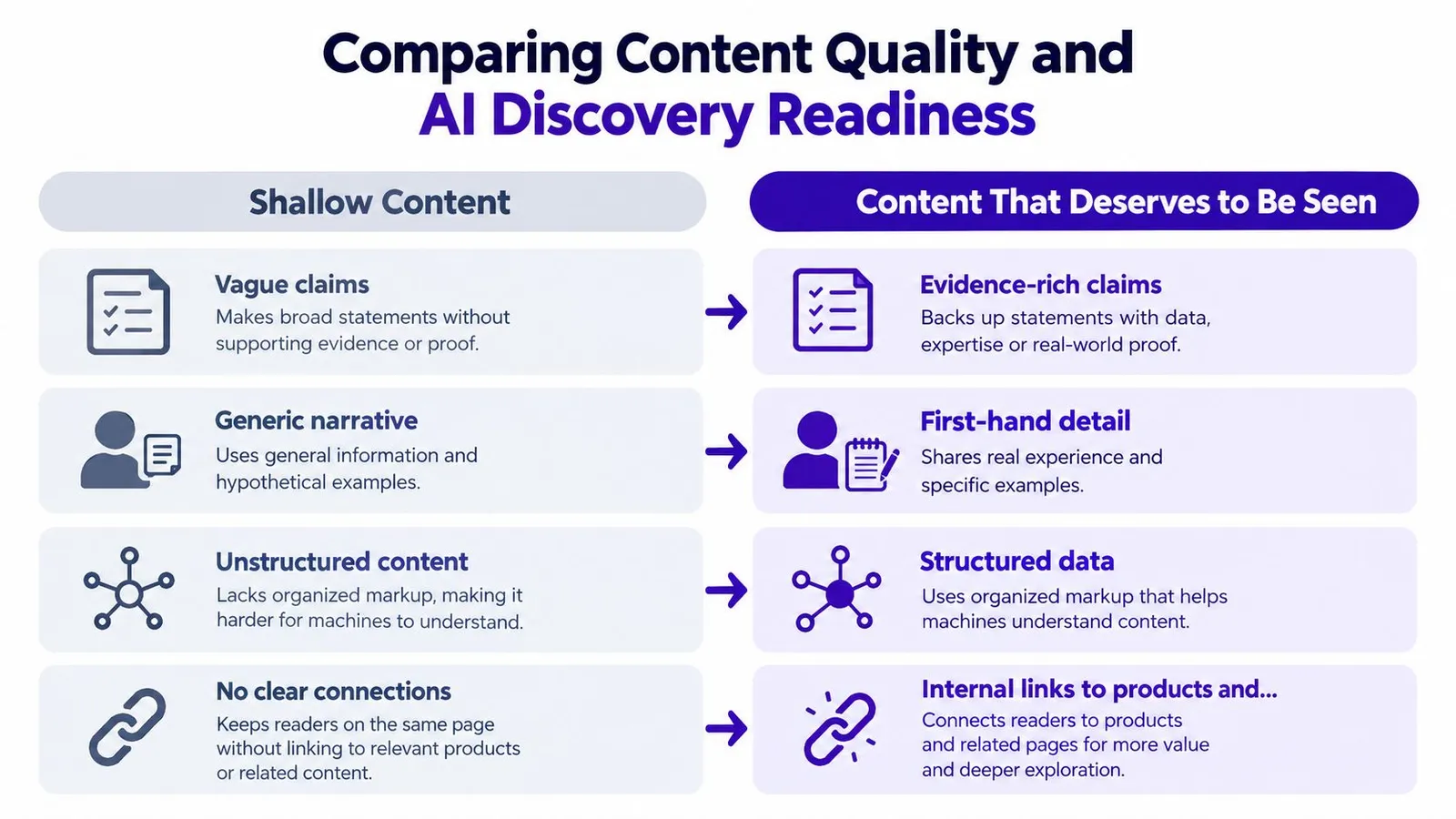
Consider two hypothetical buying guides. One repeats product descriptions and ends with a general recommendation. The other explains selection criteria, supports its claims, identifies limitations, and connects each recommendation to an appropriate product.
The second guide provides more material for a reader to evaluate. That doesn't guarantee rankings or AI citations, but it creates a testable quality difference instead of a subjective judgment about writing style.
Audit the substance behind the recommendation
A page-level assessment should examine what supports the conclusion, not merely whether the page contains familiar SEO elements.
- Evidence-rich claims: Check whether material, compatibility, performance, and suitability statements have support.
- First-hand detail: Look for documented testing, original observations, or clearly identified experience. Specificity alone isn't proof.
- Structured context: Inspect relevant markup and whether it accurately describes the visible page.
- Merchandise connections: Follow product and collection links to confirm that the destination supports the article's recommendation.
- Maintenance: Compare current catalog details with article claims and record outdated recommendations.
An update date is useful evidence of editorial activity, but it doesn't establish that anyone rechecked the content. The stronger test is whether the current page remains accurate.
Measure separate discovery outcomes
AI Overviews appeared on 14.0% of 20.9 million shopping keywords in March 2026, compared with 2.1% in November 2025, according to the report covered by Search Engine Land's shopping-query analysis. The implication is that a comparison should inspect more than conventional rankings.
Click acquisition concerns visits from search results. Recommendation eligibility concerns whether a page offers clear, supportable material that an AI system could use. Eligibility is an audit judgment; an observed mention or citation is an outcome.
NanoPIM's overview of AI visibility tools for 2026 can help evaluators identify monitoring approaches. Any trial should use a consistent prompt set and record the answer context, cited URL, and observation date.
AI mentions, citations, referral visits, and assisted purchases belong in separate fields. A cited page may receive no measurable visit, while a referral may produce commercially relevant behavior. Neither should be inferred from the other.
Evaluating Operational Fit and Commercial Impact
Content generation is already a common application of merchant AI. Shopify's merchant survey found that 69% of AI-using merchants applied it to content generation, making content the most common surveyed use case, as reported in Shopify's SEO marketing guidance.
That adoption makes generation capability an insufficient differentiator. The harder comparison concerns what happens between a generated draft and an accountable publishing operation.
Inspect the complete publishing workflow
A merchant should evaluate the workflow that would be used, including manual blogging, outsourced editorial support, and automated applications. A polished sample article doesn't reveal approval controls or ongoing maintenance requirements.
The following questions belong in a demonstration or trial:
- Editing: Can reviewers change every material part of the draft before publication?
- Approval: Can an agency stop publication until the relevant client signs off?
- Product selection: Can reviewers replace unsuitable product links and prevent irrelevant recommendations?
- Ownership: Which posts, drafts, images, and URLs remain after cancellation or uninstall?
- Localization: Can teams control language, regional product availability, and local destinations?
- Recovery: Who corrects an inaccurate article, and how is that correction recorded?
Portability requires an explicit answer. A vendor's ability to export text isn't necessarily equivalent to preserving published URLs and hosted images. A test-store uninstall, supported by documentation, can establish what remains.
Commercial test: A workflow isn't accountable merely because it reports activity. The merchant must be able to connect that activity to a defined business question.
Distinguish reporting from attribution
Impressions and rankings describe visibility. They don't establish revenue contribution. An evaluation should separately examine product-page visits originating from articles, subsequent shopping behavior, and purchases attributed under a documented analytics model.
AI-referred traffic should remain a distinct acquisition segment rather than being assumed equivalent to organic search. The comparison can then test whether visitors behave differently without assuming a conversion advantage.
External-link workflows require their own review. Merchants considering an exchange should inspect backlink exchange documentation and assess destination relevance, editorial control, and participation terms independently of article-generation features.
The decisive operational metric may be review effort rather than publishing speed. A draft that requires extensive correction can be less useful to a small team than a slower workflow that produces accurate, approvable work. That conclusion must come from recorded trial observations, not a vendor's throughput claim.
Applying the Framework to Real Store Scenarios
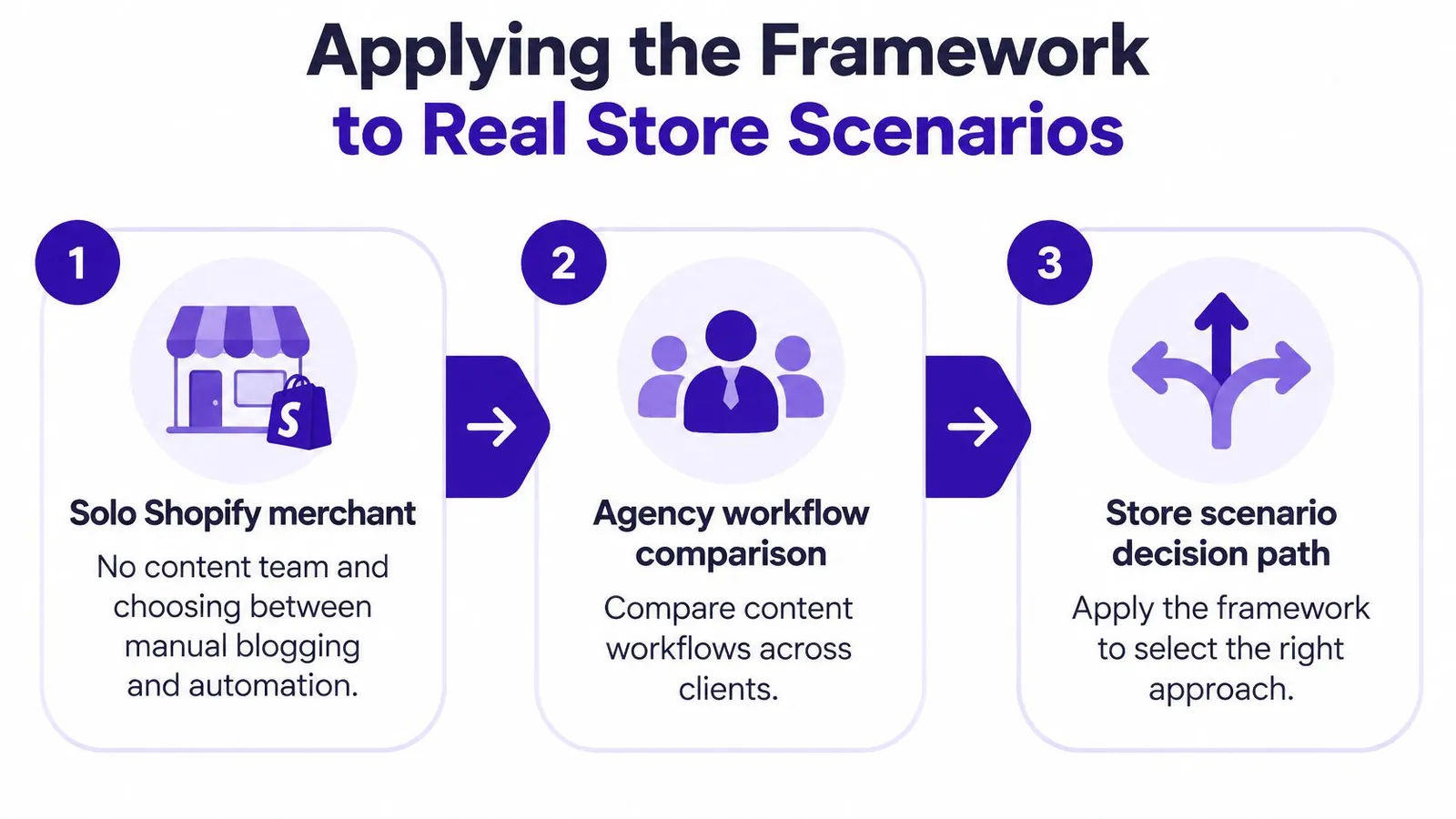
Different stores should assign different weights to the same evidence. The following scenarios are illustrative decision models, not customer case studies or claims of measured results.
Match the decision to the operating constraint
A solo Shopify merchant choosing between manual blogging and automation should prioritize reviewability. The relevant comparison includes time spent correcting product claims, the relevance of proposed topics, and whether finished articles give readers a sensible route to merchandise. Automation is a candidate, not the predetermined winner.
An agency managing client stores should place more weight on repeatable approvals and reporting consistency. An effective workflow must let the agency distinguish work completed from outcomes observed. A process that suits an owner-publisher may be unsuitable when a client must approve every recommendation.
An international retailer should prioritize local accuracy. Translation quality alone doesn't answer whether a recommended product is available in the target market or whether its link leads to the appropriate regional destination. Each language-market combination needs its own review.
For all of these scenarios, content-calendar documentation can inform scheduling evaluation. Calendar convenience should be tested against actual approval deadlines and publishing responsibilities.
Use matched cohorts rather than selected success stories
Google's e-commerce search guidance supports explicit structured data, clear site architecture, internal linking, and controlled before-and-after evaluation. Stable pages with several months of Search Console history provide a more informative baseline than newly launched pages alone.
A practical extension is to compare matched article cohorts across workflows. Match topics by intent, catalog relevance, and competitive difficulty; keep publication timing reasonably comparable; and document differences that can't be controlled.
- Indexing: Compare indexed-page rate rather than assuming every published URL becomes discoverable.
- Acquisition: Compare non-branded clicks per published article.
- Position: Track median position within the predefined target-query set.
- Commercial progression: Examine assisted product-page sessions under the same analytics definition.
Markup should be validated after changes, with URL-level impressions, clicks, and ranking monitored over subsequent months. Equivalent themes and representative mobile templates help prevent technical differences from dominating the comparison.
This remains a field test, not a perfectly controlled experiment. Catalog changes, seasonal demand, and search-result changes should be recorded as possible alternative explanations. A defensible verdict states those limitations alongside the result.
Turning Your Competitor Comparison Into Action
The appropriate response depends on which constraint the evidence exposes. A store with weak visibility needs a different intervention from a store whose articles attract visitors but recommend unsuitable products.
Visibility gaps favor measurement-first work. The merchant should refine the shared-query set, identify the relevant competing URLs, and verify whether the existing site has an appropriate page for each search intent. More publishing isn't automatically the next step.
Translate findings into decisions
Content gaps favor substantive revision. Unsupported recommendations, missing product context, and outdated catalog references justify editorial work before expansion. An internal-linking audit can help organize the connection between informational pages and merchandise, but link quantity shouldn't replace destination relevance.
Operational gaps favor workflow consolidation or stronger controls. If reviewers can't prevent inaccurate publication, additional output increases the amount of material requiring oversight. If reporting can't distinguish acquisition from commercial progression, a new dashboard alone won't resolve attribution.
| Observed Constraint | Appropriate First Response | Evidence Required Before Expansion |
|---|---|---|
| Poor query coverage | Map intent to existing and proposed pages | Relevant pages appearing for the intended searches |
| Weak recommendation quality | Correct claims and catalog connections | Reviewed content that supports its conclusions |
| Unmanageable review process | Clarify ownership and approval requirements | Drafts reaching publication through a repeatable process |
| Unclear business contribution | Define analytics events and attribution rules | Consistently recorded product-assisted behavior |
Place Shopify-native automation in the comparison
A Shopify-native application is one option alongside manual publishing and agency-managed production. The application described by the publisher combines store context, competitor analysis, and Search Console signals for keyword planning; generates articles with product and collection links; and supports calendar-based scheduling.
Its reporting covers clicks, impressions, and search positions within Shopify administration. The publisher also states that generated posts and files remain in the store after uninstall. Those capabilities address identifiable evaluation criteria, but they don't establish superior search or revenue performance.
The trial decision should therefore remain conditional: does the workflow address the store's demonstrated constraint without creating unacceptable accuracy, review, or portability problems? Current subscription terms should be checked directly before purchase rather than treated as evidence of SEO value.
The most practical starting task is a bounded visibility benchmark. A merchant can select the recurring SERP competitors this week, record their positions against a shared non-branded query set, and preserve that baseline before changing the publishing workflow.
Rankira offers Shopify-based keyword research, article generation, internal linking, scheduling, and search-performance reporting. Merchants evaluating those capabilities can visit the product site and use the competitor benchmark as the acceptance test, checking whether the workflow addresses an observed gap rather than merely increasing output.
Keep reading
All articles
Shopify SEO
SEO Content Writing Principles for Readers and Search
Learn the principles of SEO content writing that balance search relevance, clear structure, and real reader value, with examples for online stores.
10 min read

Shopify SEO
Internal Linking Audit That Actually Improves Rankings
Run a practical internal linking audit to find orphan pages, fix broken links, and prioritize fixes that move revenue on your Shopify store.
10 min read
Shopify SEO
Share of Voice SEO: A Practical Measurement Guide
Learn how share of voice SEO works, how to calculate it, and how to use intent-based metrics to assess search visibility and business impact.
12 min read
Put your Shopify blog on autopilot
Rankira researches keywords, writes SEO articles, adds internal links, and publishes them to your store — every week. Start with a 7-day free trial.