Meta Description Length: 2026 Limits and Best Practices
Meta description length explained with Google guidance, real snippet limits by device, and concise optimization tips for Shopify pages.
Published 12 min read

In this article
- Table of Contents
- The Short Answer on Meta Description Length
- What Meta Descriptions Do in Search Results
- Display Limits by Device and Snippet Features
- Google Guidance Versus Common Character Rules
- Why Google Rewrites Descriptions and What It Means
- Recommended Lengths by Page Type and Intent
- Writing Formulas and Practical Examples
- Shopify Workflows and Tools Including Rankira
- Related Concepts That Change the Snippet
- Quick Reference Checklist and Next Step
Google sets no fixed maximum for meta description length, so the practical rule is to put the key message in roughly the first 100 to 120 characters for mobile and treat about 150 to 160 characters as a desktop convention, not a rule. That distinction changes the task from hitting a number to ordering information well.
Most advice collapses three separate things into one target. There's the meta field a merchant fills in, the visible snippet window that changes by device, and Google's decision to use supplied copy or replace it. A description can be technically valid, partly hidden on a phone, and ignored for a long-tail query at the same time. Treating those outcomes as one problem leads to padded copy and false confidence.
Table of Contents
- The Short Answer on Meta Description Length
- What Meta Descriptions Do in Search Results
- Display Limits by Device and Snippet Features
- Google Guidance Versus Common Character Rules
- Why Google Rewrites Descriptions and What It Means
- Recommended Lengths by Page Type and Intent
- Writing Formulas and Practical Examples
- Shopify Workflows and Tools Including Rankira
- Related Concepts That Change the Snippet
- Quick Reference Checklist and Next Step
The Short Answer on Meta Description Length
There's no fixed Google maximum for the HTML meta description itself. The limit merchants experience is visual. Google truncates the displayed snippet to fit available width, and factors such as screen size, font rendering, a displayed date, and query context can shrink that window further.
Three Limits Readers Confuse
- Field length: The text stored in the tag can run longer than what's shown, and extra context isn't automatically wasted.
- Display length: Only part of that text may appear, with mobile windows materially shorter than desktop windows.
- Selection length: Google may disregard the supplied text entirely and build a snippet from page copy that better matches the query.
The practical hierarchy follows from that split. Writers should place the page's primary benefit, category, or topic first, then add supporting detail that remains useful if it's cut off or used selectively. Familiar character targets still help as editing conventions because they force concision, but they don't guarantee display.
A description hasn't succeeded because it reached a character count. It's succeeded when the snippet a searcher actually sees explains the page clearly.
That standard reframes the whole topic. Official guidance defines what's allowed, measured display data shows what's likely to be visible, rewrite evidence shows how often supplied copy survives, and page type determines what deserves the earliest words. A Shopify merchant who works through those layers in order doesn't need a single magic number.
What Meta Descriptions Do in Search Results
A meta description is text placed in a page's head section to summarize the page for search engines. The snippet is different. It's the text Google displays beneath the title in results, and it may come from the meta description, from visible page copy, or from a combination shaped by the query.
Where Truncation and Replacement Happen
Truncation happens at display time. The stored description stays intact in the page source, but the visible snippet is shortened to fit the device. A merchant checking Shopify admin therefore sees the full field, while a shopper on a phone may see only its opening.
Replacement happens earlier, at selection time. Google can choose a passage from headings, product details, or body copy instead of the supplied description. That's why the same product page can show one snippet for a branded search and a different snippet for a query about material, sizing, or shipping.
- Supplied copy: The description the merchant writes and controls directly.
- Extracted copy: Visible page text Google selects when it judges another passage more relevant.
- Query-dependent display: The snippet changes because the search terms change, not because the page changed.
This means a meta description functions as influence, not instruction. It gives Google a concise, intentional summary to consider. It also gives searchers a clearer relevance signal when it's used. Wording near the start carries the most weight operationally, since it's the portion most likely to survive a narrow display window and the portion a scanning shopper reads first.
Display Limits by Device and Snippet Features
Measured display windows show why a universal target fails. A Portent analysis published in September 2020 found desktop snippets without a date peaked at approximately 160 displayed characters and declined rapidly after about 167 characters, while mobile snippets without a date peaked around 118 characters and generally fell off after about 121, according to Portent's analysis of how often Google ignores meta descriptions.
Dates compress the window further. That same measurement placed the desktop peak near 147 characters when a date appeared, with visibility dropping quickly after approximately 149 characters. On mobile with a date, the peak sat around 100 characters, within a practical range of about 99 to 105 characters. These are observations of displayed snippets, not limits imposed on the tag itself.
Observed Snippet Display Peaks
| Device | Date shown | Peak visibility | Practical takeaway |
|---|---|---|---|
| Desktop | No | About 160 characters | Supporting detail can follow the opening message |
| Desktop | Yes | About 147 characters | Move the core point earlier on dated content |
| Mobile | No | About 118 characters | Treat the opening clause as the full pitch |
| Mobile | Yes | About 100 characters | Put topic and benefit before any secondary context |
The drop-off pattern matters as much as the peak. Visibility doesn't decline gently word by word. It falls quickly once the window closes, so a key differentiator placed near the end behaves as if it wasn't written for many searchers.
Mobile-first rule: If the opening doesn't make sense as a standalone summary, the description is relying on space that may not exist.
For stores selling across languages, the implication is stronger. Word length and character density vary by language, so a translation that preserves meaning may not preserve visibility. Front-loading protects the message in every version.
Google Guidance Versus Common Character Rules
Google's own position is straightforward. Google's documentation on controlling snippets states that a meta description may be any length and that the visible snippet is truncated as needed to fit device width, framing descriptions as a way to influence snippets rather than a guarantee that supplied text will appear verbatim.
Why the Familiar Target Persists
The widely repeated desktop range survives because it's useful, not because it's official. It roughly matches observed desktop display, gives editors a shared standard, and prevents rambling copy. Problems start when teams treat that convention as a technical ceiling or a quality score.
Conflicting advice online usually reflects different measurements. Some sources describe the tag, some describe displayed characters or pixels, and some repeat older rules of thumb without separating the two. A reader who asks which thing is being measured can reconcile most contradictions quickly.
Three decision rules follow:
- Don't pad to reach a target: A short, specific description beats a longer one filled with generic reassurance.
- Don't assume extra text is wasted: Supporting context after the opening can still give Google relevant material to select from.
- Don't bury the point: Responsive display rewards early clarity more than total length.
Historically, SEO workflows treated a character ceiling as a compliance check. Google's documented position makes relevance and responsive presentation the governing principles instead. Character counts remain a useful editing aid. They aren't evidence that a description will display as written.
Why Google Rewrites Descriptions and What It Means
Length doesn't reliably determine whether Google shows supplied text. A large Ahrefs analysis summarized by Patrick Stox compared hardcoded descriptions with displayed snippets across 20,000 keywords and 192,656 pages and found Google rewrote descriptions 62.78% of the time, with a rewrite rate of 65.62% for long-tail queries versus 59.65% for broad, high-volume queries, as detailed in Patrick Stox's summary of the Ahrefs meta description analysis.
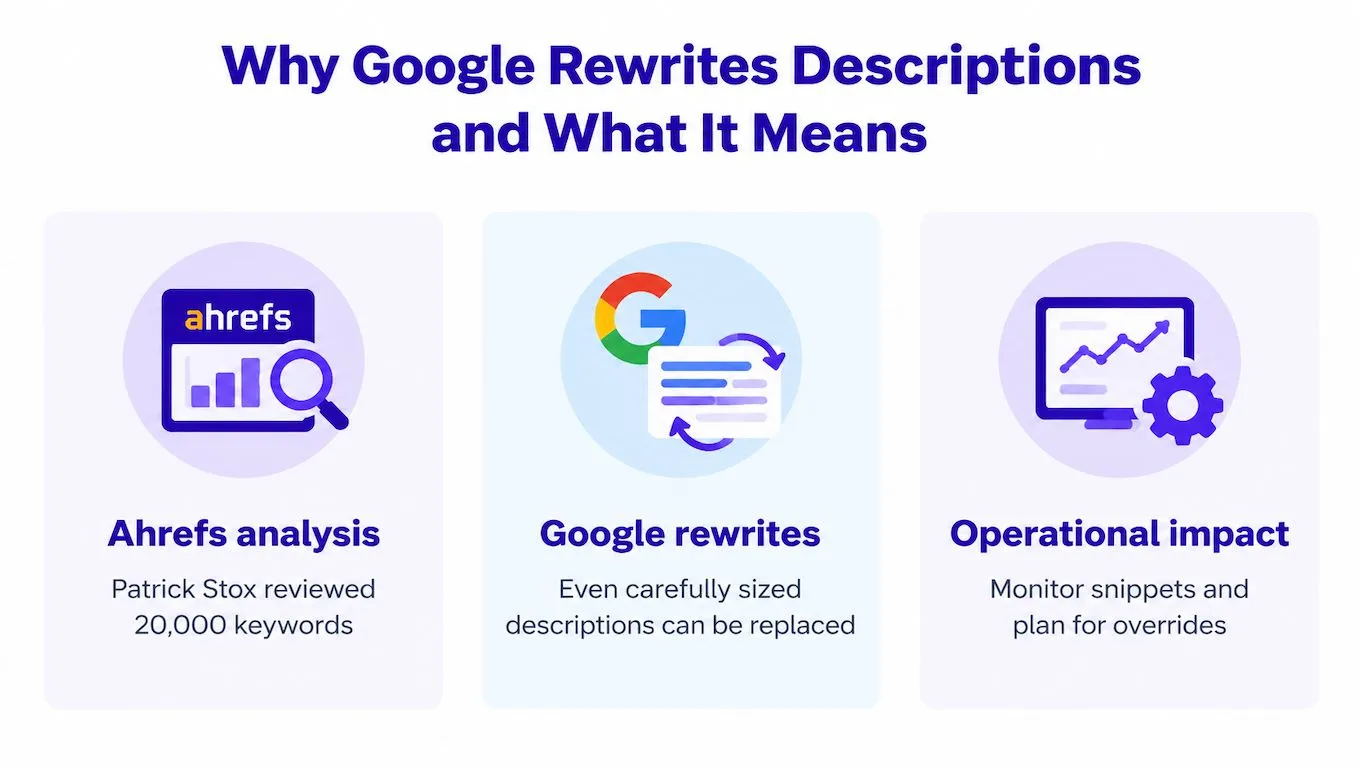
That finding reorders priorities. A perfectly sized description can still be replaced when Google judges a page passage more relevant to the query. Long-tail searches create more replacement pressure because they contain specific attributes, use cases, or questions that a general summary may not mention.
The Operational Response
The better goal is alignment. Meta descriptions, headings, product attributes, and nearby page copy should describe the page in compatible language. When they agree, an extracted replacement snippet still reads as a coherent summary instead of a random fragment.
- Branded queries: Check whether the snippet reflects the store's intended positioning.
- Collection queries: Check whether category language and range cues survive replacement.
- Product and long-tail queries: Check which attributes Google pulls, then strengthen those passages on the page.
For Shopify catalogs, one description shouldn't be assumed to behave consistently across query types. Auditing intended copy against displayed snippets by query class reveals where page copy needs work. Meta description length remains a weak success metric on its own. Snippet usefulness is the metric that matches how Google presents results.
Recommended Lengths by Page Type and Intent
Page type determines what belongs in the opening window, because intent differs before length does. A merchant who hasn't clarified intent should resolve that first, following a structured approach such as a step-by-step keyword research process for Shopify stores, then write the description around the searcher's task.
Homepage and Collection Pages
Homepages serve navigational and branded intent. The opening should name what the store sells and its clearest differentiator, with audience or positioning detail after. Generic welcome language wastes the most visible space on the page type where supplied copy has a strong chance to matter.
Collection pages serve commercial browsing intent. The opening should state the category and the theme of the range, such as material, season, or use case. Supporting text can mention breadth, popular subcategories, or service reassurance. Collection copy on the page itself should echo those cues, since category queries often trigger extracted snippets.
Product, Article, and Support Pages
Product pages need attribute-led openings. Product type plus the attribute shoppers compare, such as fit, material, capacity, or compatibility, belongs first. Shipping or returns reassurance works better as supporting context unless it's the page's main differentiator.
Blog articles serve informational intent, and many carry dates that shrink the window. The topic and the reader's takeaway belong at the front. Background, scope, and audience cues can follow.
Policy and support pages serve help-seeking intent. The opening should name the exact issue covered, such as returns, delivery timing, or warranty terms, in plain language. Searchers for these pages want confirmation they're in the right place, not brand messaging. Across all five types, the pattern holds. Intent decides the first clause, and length decisions follow from it.
Writing Formulas and Practical Examples
Reusable formulas keep the opening disciplined without making every description sound identical. Each formula puts the searchable, decision-relevant element first and treats later text as optional context. That structure also supports broader SEO content marketing for Shopify stores, where article and catalog copy need to reinforce each other.
Three Working Formulas
- Benefit plus category plus differentiator: Best for products and collections where comparison drives the click.
- Problem plus solution plus scope: Best for guides that answer a defined question.
- Topic plus takeaway plus audience: Best for articles where readers judge relevance by what they'll learn.
A weak product description reads, "Welcome to our store. We offer high-quality products you'll love with great service and fast delivery." Nothing in the opening identifies the product. A stronger version reads, "Waterproof trail shoes with wide-fit sizing and grippy soles for wet hikes. Free returns within the stated policy period." If the second sentence disappears on mobile, the first still works.
A weak collection description lists adjectives. A stronger one leads with category and theme, such as organic cotton bedding in breathable weaves for warm sleepers, then adds range detail. For a blog post, "Learn how to choose running shoes by foot type, mileage, and surface, with fitting checks to do at home" front-loads topic and takeaway instead of opening with background.
Write the first clause as if it's the only text that will ever be seen, because on a phone with a date showing, it nearly is.
Sitewide boilerplate, stuffed keywords, and superlatives like "best ever" undermine every formula. Descriptions that contradict visible page copy create a second risk. Google may extract the page version anyway, leaving the merchant's preferred wording unused.
Shopify Workflows and Tools Including Rankira
Managing descriptions across a catalog is an operations problem before it's a writing problem. The workflow choice determines whether descriptions stay aligned with page copy as products, collections, and articles change.
The image below shows the manual reality many merchants start with, editing product information page by page.
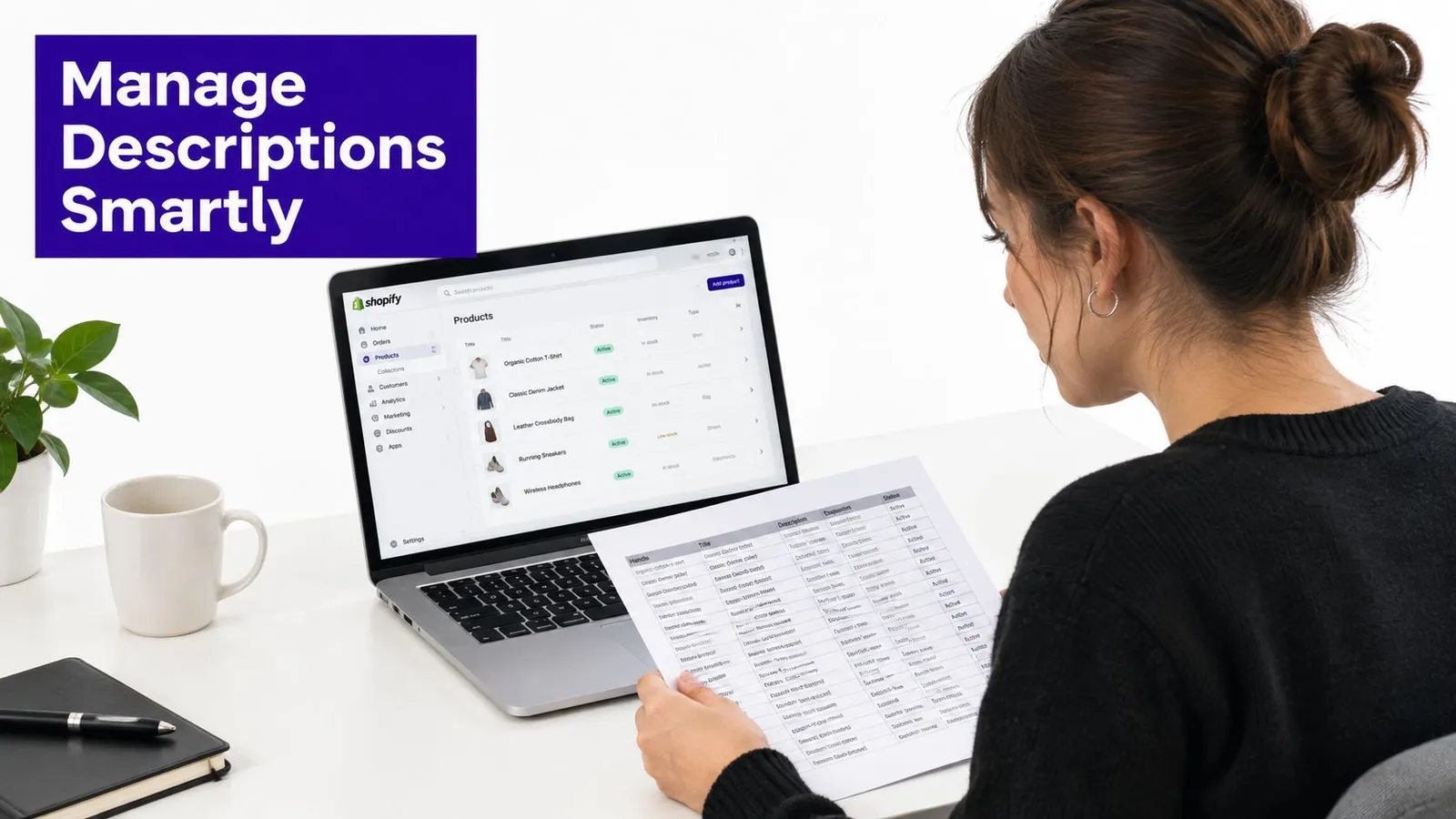
Manual editing in Shopify suits small catalogs and flagship pages. Control is total, but coverage is slow, and consistency depends on whoever edits that week. Spreadsheet audits suit periodic reviews. They make duplication and missing descriptions visible across many URLs, though the sheet drifts from the live store as soon as edits happen elsewhere.
Where an In-Store App Fits
Rankira runs inside Shopify administration and generates articles with meta descriptions, tags, clean URLs, featured images, and links to products, collections, and pages, using store, competitor, and Search Console context for keyword research. It supports drafts or scheduled publishing and reports clicks, impressions, positions, and Ahrefs Domain Rating. The Standard plan costs USD 39 monthly with a seven-day trial, which gives merchants a concrete basis for comparing it against manual effort. Stores evaluating that route should review publishing options and draft controls in Shopify before automating output.
The video below shows how that kind of in-store workflow operates in practice.
Whichever workflow a store chooses, the selection criteria stay the same. Descriptions should be generated or edited close to the page content they summarize, reviewed before publication where quality matters, and checked against real snippets afterward. A tool that produces descriptions disconnected from headings and product attributes recreates the rewrite problem at scale. Alignment, not volume, is the workflow outcome worth buying.
Related Concepts That Change the Snippet
A meta description doesn't act alone. Several nearby elements change what a searcher sees even when the meta field stays identical, which is why snippet problems are often misdiagnosed as length problems. Merchants reviewing the wider picture can browse Shopify SEO guides and category resources for how these elements interact across a store.
Direct Inputs and Nearby Influences
- Title tags: They set the headline the snippet sits under, so duplicated wording between title and description wastes visible space.
- Headings and opening paragraphs: These are prime extraction sources when Google replaces supplied copy, making them indirect snippet copy.
- Structured data: Product schema can shape eligibility for enhanced presentation, including availability or pricing cues, without changing the description text itself.
- Dates and sitelinks: Both consume result space and change how much snippet text remains visible or how attention is distributed.
International stores face an added variable. Languages differ in word length and character density, so a description that fits comfortably in one language may truncate earlier in another. The mobile-first opening protects meaning across versions without requiring identical character counts.
The diagnostic habit matters most. When a snippet underperforms, the cause may be a title that repeats the description, an opening paragraph Google prefers, or a date compressing the window. Checking those elements first prevents pointless rewrites of a description that wasn't the problem.
Quick Reference Checklist and Next Step
A short pre-publish check captures the evidence without reopening every decision. Stores building a repeatable routine can pair it with guidance on creating and managing Shopify articles so descriptions are reviewed alongside the content they summarize.
Before Publishing
- Opening window: The primary benefit, category, or topic sits at the front and reads clearly on its own.
- No padding: The text respects desktop convention without filler added to reach a count.
- Rewrite readiness: Headings, attributes, and opening copy agree with the description, so an extracted snippet still works.
- Page uniqueness: Wording reflects this page's intent rather than sitewide boilerplate.
- No contradictions: Title, headings, and description describe the same offer in compatible terms.
One verification exercise closes the loop. A merchant selects ten representative URLs across product, collection, article, and branded queries, records the intended description beside the snippet shown, and notes where they diverge. The weakest cases then get rewritten in pairs, description and page passage together, so both versions Google might show carry the same message. That single audit teaches more about a store's real meta description length than any universal target, because it measures display and selection where they happen, in live results.
Rankira generates Shopify blog articles complete with meta descriptions, internal links to products and collections, and scheduled publishing inside Shopify admin, so descriptions stay aligned with the pages they summarize. Stores that want that workflow handled in one place can start at Rankira and put the front-loaded approach from this guide into practice.
Keep reading
All articles
Shopify SEO
SEO Content Writing Principles for Readers and Search
Learn the principles of SEO content writing that balance search relevance, clear structure, and real reader value, with examples for online stores.
10 min read

Shopify SEO
Internal Linking Audit That Actually Improves Rankings
Run a practical internal linking audit to find orphan pages, fix broken links, and prioritize fixes that move revenue on your Shopify store.
10 min read
Shopify SEO
Share of Voice SEO: A Practical Measurement Guide
Learn how share of voice SEO works, how to calculate it, and how to use intent-based metrics to assess search visibility and business impact.
12 min read
Put your Shopify blog on autopilot
Rankira researches keywords, writes SEO articles, adds internal links, and publishes them to your store — every week. Start with a 7-day free trial.