Compare SEO Software for Shopify: Features and Fit
Compare SEO software by capabilities, data accuracy, workflow and cost, with Shopify fit for merchants, agencies and international teams.
Published 13 min read

In this article
Google users clicked a traditional search result in 8% of visits with an AI summary, compared with 15% without one, in a Pew Research Center study of 68,879 searches from 900 U.S. adults, summarized by Progression Agency. That changes the buying question: an SEO platform can report visibility without demonstrating that a store received more visits.
Merchants looking to compare SEO software should judge whether a platform's recommendations can be checked against the store's own search results. For Shopify, publishing controls, product links, and market-specific reporting deserve as much scrutiny as keyword databases.
Table of Contents
- SEO Software Categories at a Glance
- Core Capabilities Worth Comparing
- Keyword Data and Why Volumes Disagree
- Measuring Results Beyond Rankings
- Shopify and Multi-Market Workflows Compared
- How Pricing Models Compare
- Which Software Fits Which Team
- Confirm Your Shortlist Before You Commit
SEO Software Categories at a Glance
| Category | Strongest at | Main limitation | Best fit |
|---|---|---|---|
| All-in-one SEO suites | Keyword, backlink, site audit and rank data in one login | Heavy for a single store; modeled data differs by vendor | Agencies and in-house SEO teams |
| Keyword research tools | Search volume, difficulty and keyword ideas | Volume estimates disagree across tools | Content planning and topic selection |
| Rank and backlink trackers | Position history and link profiles | Shows rankings, not what users click | Monitoring competitors and link growth |
| Search Console reporting | Actual impressions, clicks and positions for a verified site | Covers only the verified site, with no competitor data | Measuring real results after publishing |
| Shopify-native content apps | Research, writing, publishing and reporting inside Shopify admin | Narrower than suites and tied to the Shopify blog workflow | Merchants without an in-house content team |
The limitation column matters most. It identifies the work that will remain after purchase, whether that's measuring clicks, commissioning articles, or diagnosing technical problems.
Each category answers a different question. A keyword tool helps a merchant choose a topic; a publishing application helps turn that topic into a live article; Search Console helps establish whether that article appeared in search and attracted clicks.
Start with the job, not the subscription
A sensible shortlist begins with the store's next planning period. A merchant preparing buying guides needs a different workflow from an agency investigating indexing problems across client stores.
- Publishing backlog: Prioritize drafting, review, scheduling, and Shopify integration.
- Uncertain topic selection: Prioritize relevant keyword discovery and transparent market settings.
- Technical obstacles: Prioritize actionable audits with affected URLs and repair evidence.
- Unclear results: Prioritize first-party reporting before adding another discovery database.
A store may need a research source and a measurement source, rather than overlapping subscriptions. Feature counts don't establish whether tools contribute distinct evidence or merely display similar estimates differently.
For teams also evaluating answer-engine visibility, LLMrefs' resource on choosing tools for AI-driven search offers an additional comparison lens. Merchants should still identify the category that matches their immediate work before considering specialized additions.
Core Capabilities Worth Comparing
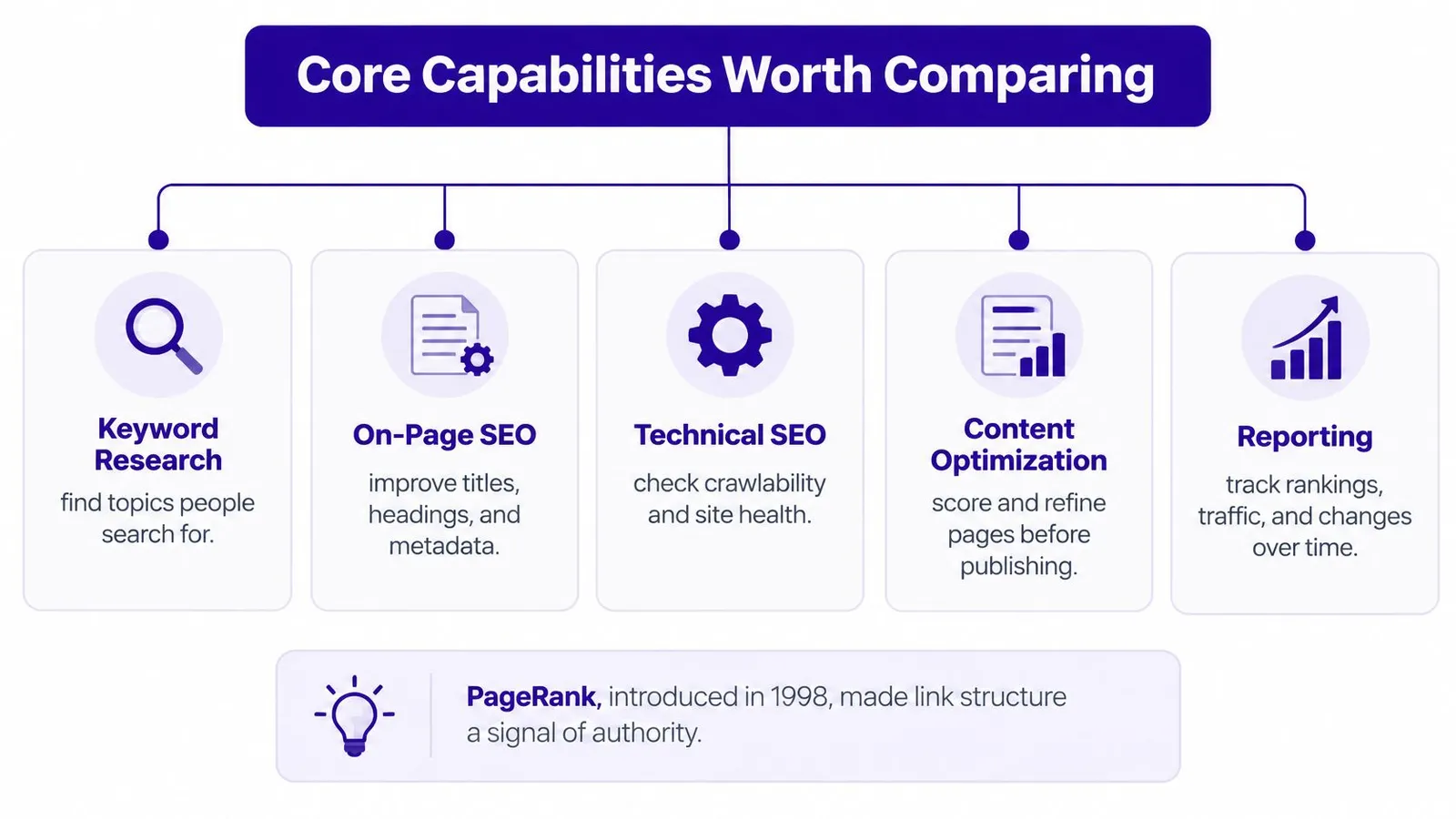
Keyword research, backlink analysis, technical auditing, content evaluation, and performance reporting form a practical comparison checklist. Each capability should answer a distinct operational question, not add another score without explaining its meaning.
The historical rationale is straightforward: PageRank, introduced in 1998, used link structure as a signal of authority and relevance, explaining why links and site architecture remain foundational comparison criteria, according to the academic overview of SEO's development.
Questions that expose useful differences
- Keyword research: Which country, language, and collection period underpin volume and difficulty? A merchant needs enough context to distinguish a relevant local opportunity from a broad estimate.
- Backlink analysis: Which index supplies the links, how frequently does it refresh, and can individual referring pages be inspected? A summary authority score isn't a substitute for examining links.
- Technical auditing: Does the tool identify crawlability, indexing, and page-speed problems with affected URLs? The useful output is a repairable diagnosis, not merely a site-health grade.
- Content evaluation: How does the platform determine whether a page matches search intent? A buying guide, collection page, and instructional article shouldn't receive interchangeable recommendations.
- Performance reporting: Can impressions, clicks, and positions be reviewed by page and query? The analyst should be able to trace a recommendation through publication to an observable result.
A platform measuring distinct inputs is more useful than one repeating the same visibility metric across dashboards. During a demonstration, a merchant can request an example recommendation, its supporting evidence, and the report that would establish whether the resulting change helped.
Practical rule: A recommendation deserves more weight when another person can inspect its inputs and reproduce the reasoning.
AI-answer monitoring requires additional scrutiny. Riff Analytics' AEO tools comparison is a supplementary resource for examining that category, but buyers should distinguish brand mentions, page citations, and referral visits rather than treating them as equivalent outcomes.
Before evaluating plans, the store's owner should mark each capability essential, useful, or optional. Those ratings prevent an impressive but irrelevant module from determining the purchase.
Keyword Data and Why Volumes Disagree
A higher search-volume estimate doesn't establish that a topic is better. In a large cross-platform comparison, Sistrix reported median volumes 233% above the cross-tool median, while Ahrefs reported volumes 37% below it, according to the SEO Web Design analysis of keyword research tools.
Those findings don't identify a universally accurate vendor. They show why an analyst shouldn't mistake agreement with a preferred number for evidence of quality.
Volume and difficulty are prioritization signals, not traffic forecasts. A merchant should use them to organize investigation, then inspect commercial relevance, existing search exposure, and the page type required.
Test the ordering rather than the headline number
A practical pilot can begin with catalog-derived topics already represented on the store's site. The merchant exports each candidate tool's estimates under matching country and language settings, then sorts the topics by apparent opportunity.
The comparison record should include:
- Topic and intended page: The product category, customer question, and suitable destination.
- Tool settings: Country, language, device where available, and export date.
- Priority order: Which topics each platform recommends first.
- Observed evidence: Search Console impressions and clicks for relevant existing pages and queries.
The preferred tool is the one whose ordering leads to useful decisions, not necessarily the one whose absolute estimates look most generous. A structured keyword research services evaluation can help merchants distinguish a usable topic plan from an exported keyword list.
There's an important limitation: Search Console impressions aren't total market demand. A store with little visibility can receive few impressions for a valuable topic, so weak exposure doesn't prove that a keyword tool is wrong.
Handle markets and seasonality separately
International stores should compare candidates within the same country rather than mixing worldwide estimates with local impressions. Seasonal products need comparable demand periods, while long-tail queries deserve manual inspection when tools disagree.
A topic's connection to the catalog can justify testing it even when estimates are small. The merchant should record the initial priority, the publication decision, and the observed result, creating an evidence trail rather than retrospectively declaring every successful topic predictable.
Measuring Results Beyond Rankings
| Ranking position | Median organic CTR | What it shows |
|---|---|---|
| Position 1 | 4.72% | Highest single-position CTR in the benchmark |
| Position 2 | 1.90% | Drops sharply below the top spot |
| Position 10 | 0.22% | Lowest of the three single positions shown |
| Top three positions | 71% of median site clicks | Most clicks come from the top three |
| Positions 4 to 10 | 21% of median site clicks | Lower positions together still contribute clicks |
These figures come from a benchmark covering 893 websites and 359.1 million impressions, described by SmartSites; the individual-position rows show median CTR, while the grouped rows show shares of a median site's clicks.
The distinction matters. Grouped click share isn't another CTR measurement, and neither measure should become a promised outcome for a Shopify store.
Read visibility and behavior together
An organic click records a click on an unpaid search listing. Average position summarizes ranking positions in the reported search activity; it isn't a fixed placement that every searcher saw.
A useful dashboard presents these measures together:
- Impressions: Whether pages are appearing for relevant searches.
- Clicks: Whether searchers are visiting the store.
- CTR: Whether impressions are translating into clicks.
- Average position: Whether reported ranking visibility is changing.
- Query coverage: Which relevant searches expose the store's pages.
A store can expand into new queries, gain impressions, and see its aggregate average position worsen because those new appearances occur lower in results. That isn't automatically failure. The analyst needs page and query detail before interpreting the headline trend.
For example, Rankira's dashboard tracks clicks, impressions, positions, and Domain Rating using Google Search Console and Ahrefs. Its Search Console connection is read-only and can be disconnected at any time; the authority metric should remain explanatory context rather than a replacement for click performance.
Separate measurement from market estimates
Search Console describes the verified store's search activity. Competitor traffic products provide market intelligence, not access to another merchant's private analytics.
AdLibrarySpy's guide to compare competitor website visits provides context for that separate task. Competitor estimates belong in a clearly labeled report area, away from observed store results.
A ranking improvement is evidence of changed visibility, not proof of additional visits or sales.
AI-summary reporting deserves the same discipline. Buyers should ask how a tool identifies affected queries, whether classifications are sampled, and whether it can distinguish observed clicks from inferred exposure.
A post-publication review should use consistent comparison windows and retain publication dates, page changes, and market filters. Reusable SEO report templates can keep those comparisons stable while product-page visits and conversions are evaluated through the appropriate analytics system.
Shopify and Multi-Market Workflows Compared
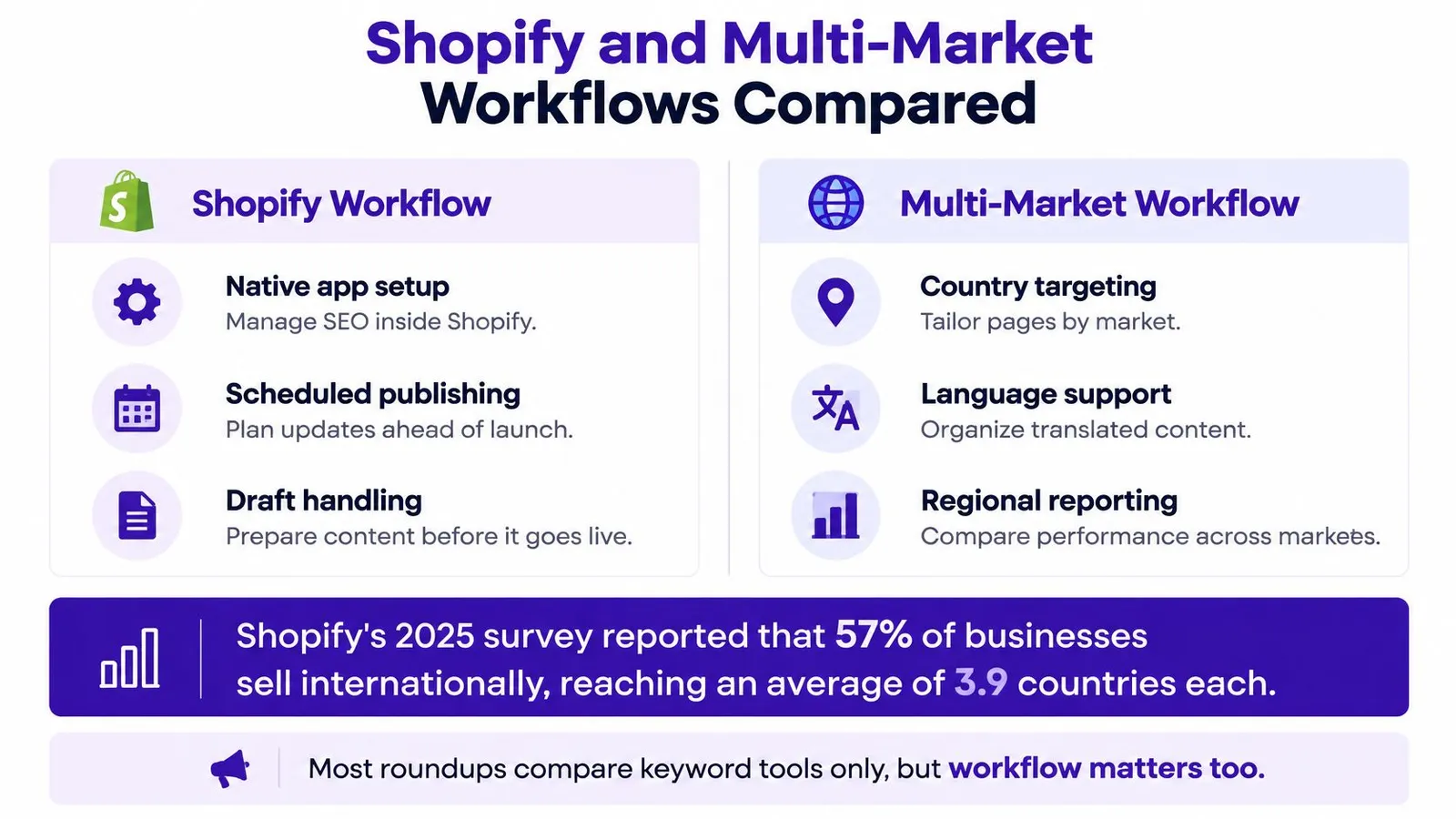
Shopify's 2025 survey reported that 57% of businesses sell internationally, reaching an average of 3.9 countries each, according to its enterprise SEO guide. Market-specific publishing therefore deserves explicit testing, not a checkbox labeled multilingual support.
Keyword databases, backlink indexes, and seat limits don't reveal whether a merchant can produce an accurate regional article and link it to the right merchandise.
| Criterion | Why it matters | How to test it before buying |
|---|---|---|
| Country-level keyword data | Search volume and intent differ by market | Compare volume for one target term in each country |
| Localization versus translation | Search terms, currencies and categories vary by market | Review a localized draft for market-specific terminology |
| Internal links to market products | Links to the wrong regional collection waste buyer intent | Check that links point to the correct regional collection |
| Draft approval and scheduling | Keeps quality control in place before publication | Confirm drafts can be reviewed before scheduled publishing |
| Posts after uninstall | Protects published work if the store changes tools | Confirm posts remain in the blog after removal |
| Reporting by country and language | Separates performance across markets | Check that reports segment results by market |
Test the entire regional publishing path
A merchant can select a product category and follow it from local keyword discovery through draft review and publication. The reviewer should inspect terminology, spelling, currency references, product availability, and links, rather than merely checking whether the prose is grammatical.
Separate market URLs require additional attention to regional URL handling and hreflang. A publishing app's ability to generate another language doesn't establish that the store's localization configuration is correct.
A Shopify-native workflow can consolidate production, but convenience shouldn't bypass review. A merchant still needs someone accountable for factual product descriptions and market-appropriate recommendations.
Compare execution, approval, and portability
Rankira researches keywords around store products, writes SEO-optimized articles, and can publish them automatically within Shopify administration. Merchants can instead retain manual draft approval; articles are ordinary Shopify blog posts, and published content and drafts remain after uninstalling.
New installations include a 7-day free trial with full access and nothing charged; cancellation before it ends means nothing is paid. That trial provides an opportunity to inspect the workflow, not enough time to establish lasting search performance.
An SEO CMS system assessment should distinguish content generation from content management. The stronger operational fit is the system that preserves approval, correct destinations, and usable content after the subscription ends.
How Pricing Models Compare
Sticker price is only part of the comparison. A plan can appear inexpensive until the merchant adds seats, market tracking, exports, or the separate service needed to turn recommendations into finished articles.
The buyer should price the actual workload rather than the vendor's smallest package. A research subscription that leaves publishing untouched and a Shopify application that completes blog production aren't purchasing equivalents.
| Pricing model | Appropriate comparison | Limit to inspect |
|---|---|---|
| Per seat | Cost for everyone who needs access | Editor, analyst, and client permissions |
| Per site or project | Cost across managed stores | Extra properties and project allowances |
| Usage capped | Cost at the expected workload | Tracked keywords, crawled pages, reports, and credits |
| Shopify app subscription | Cost within store operations | Included production, billing, and exit conditions |
Calculate the cost of completed work
A procurement worksheet should capture:
- People: Required seats, onboarding, and editorial review time.
- Properties and markets: Stores, regional projects, and reporting requirements.
- Usage: Keyword tracking, audit coverage, content production, and exports.
- Supplementary services: Writing, technical implementation, and report reconciliation.
- Exit costs: Data exports, retained content, and migration work.
Google Search Console has no license fee, but reconciling it with commercial reporting still consumes staff time. That labor belongs in the comparison, particularly when someone must explain why dashboards disagree.
Budget check: A cheaper subscription isn't cheaper work if the team must repeatedly repair its output.
Monthly billing preserves flexibility during evaluation. An annual commitment should follow a workload test, not precede it merely because the advertised equivalent looks lower.
Current vendor pages should determine the final purchase figures. Before committing, the buyer should retain the plan terms and confirm what remains accessible when the subscription ends.
Which Software Fits Which Team
Team structure determines which limitations are acceptable. The right category removes a recurring bottleneck without requiring an operating process the team can't maintain.
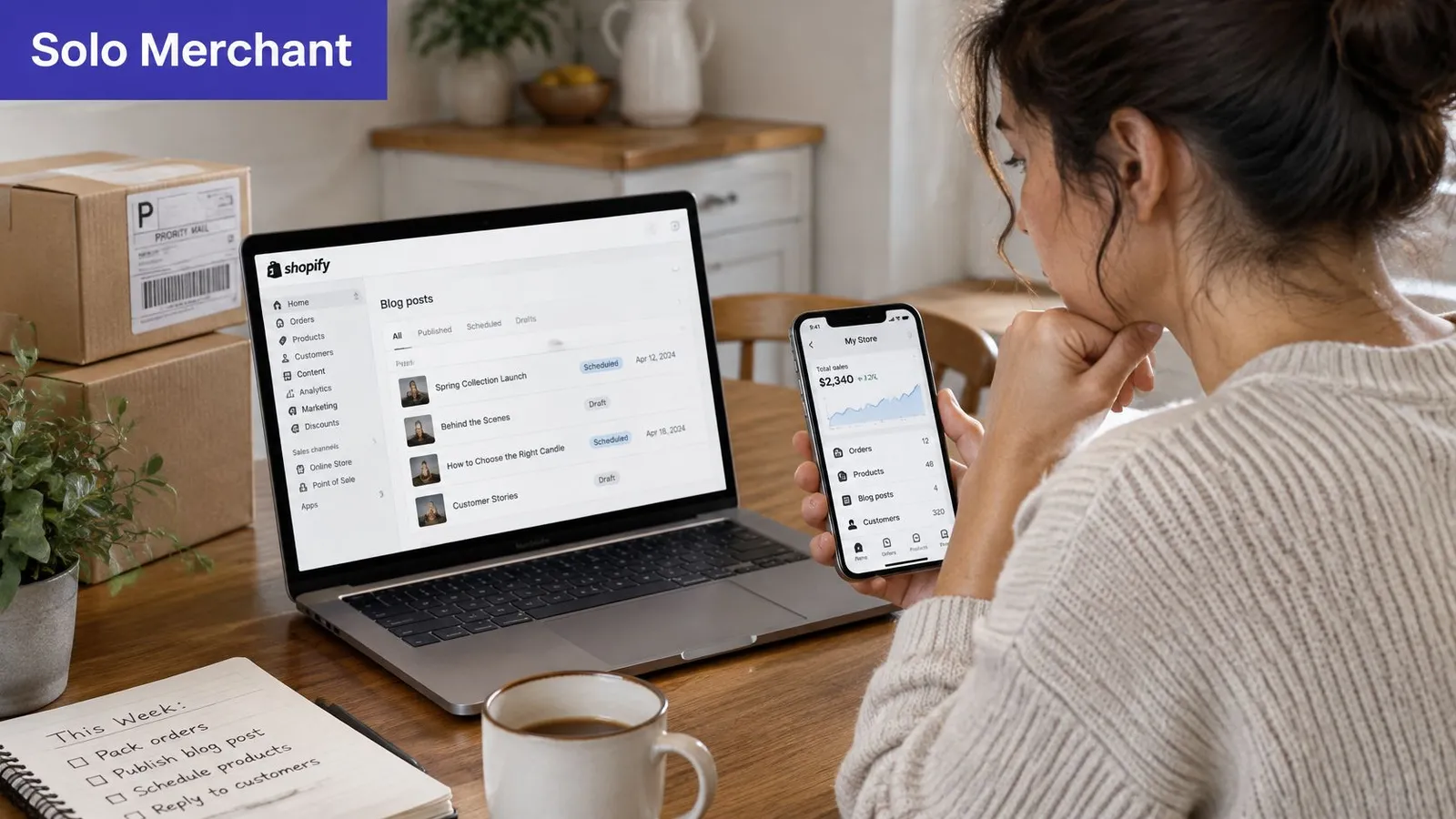
For a solo merchant, the working environment matters alongside research depth.
Solo merchants and agencies
A solo merchant without a content team should favor a Shopify-native application when recurring blog production is the bottleneck. The verification task is completing a catalog-based draft, reviewing it, and scheduling publication without an awkward handoff. Enterprise backlink analysis can remain optional if nobody will act on it.
An agency managing several stores needs separation between client workspaces, exportable reporting, appropriate permissions, and sufficient audit depth. Its verification task should use a representative client site and include an actual report handoff. Production volume is a poor substitute for account controls, and overlapping suites should be skipped unless they change decisions.
A repeatable SEO competitor analysis workflow can help an agency assess whether a platform produces actionable comparisons rather than larger exports.
A workflow demonstration is useful when evaluated against a specific task rather than watched as a feature tour.
International retailers and in-house teams
An international retailer should prioritize per-market topic selection, local review, and segmented reporting. The verification task is following the same product category through each target market, with a reviewer checking local terminology and destination URLs. A language-count badge shouldn't determine the purchase.
An in-house ecommerce marketing team can justify a broader research suite when specialists own content, technical implementation, and analysis. Its verification task is reconciling a recommendation with the store's observed page and query results. An owner should resolve discrepancies rather than allowing departments to select whichever dashboard supports their preferred narrative.
Product-heavy stores also need page-type separation. Informational visibility, product-page visits, and collection-page conversions answer different commercial questions; combining them can conceal whether a publishing program supports merchandise discovery.
The team should skip any aggregate success score that cannot be unpacked by page type. Even a convenient dashboard is insufficient when the analyst can't distinguish an article gaining exposure from a product page attracting qualified visitors.
Confirm Your Shortlist Before You Commit
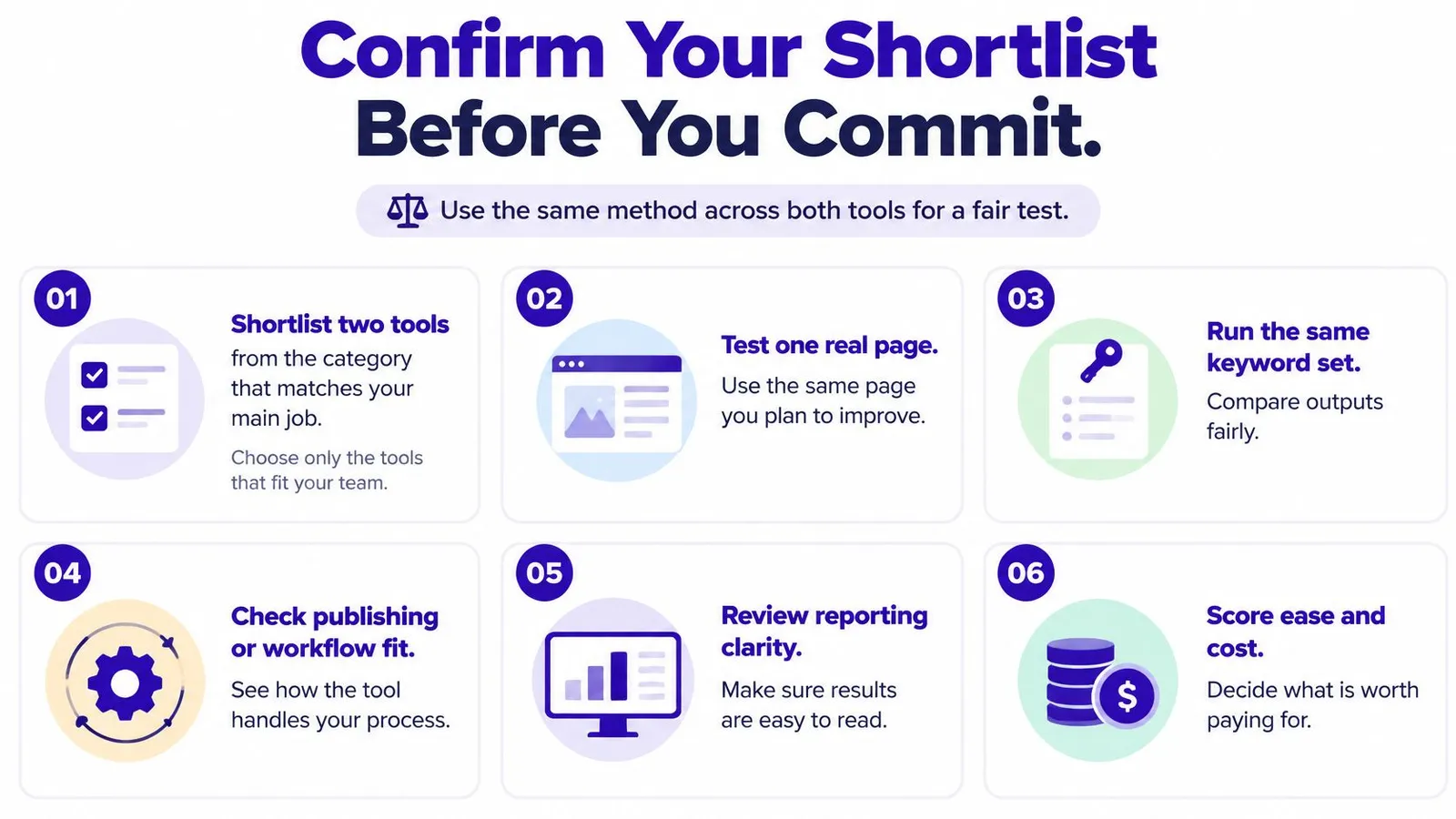
A shortlist becomes defensible when it includes a dated test, a named owner, and a decision rule. More impressive demonstrations won't resolve uncertainty about the store's actual workflow.
A study of 33,377 keywords, cited by Mission Growth, found that 69% of top-10 queries received more Search Console impressions than Google Keyword Planner reported. The finding supports validating planning estimates against observed exposure, not replacing every estimate with an assumption that the store already captures all demand.
Run a documented pilot
- Select candidates by job. The buyer should shortlist tools in the category that addresses the principal bottleneck. A structured comparison to competitors can help document alternatives without turning procurement into an unrestricted feature contest.
- Record topic priorities. Each candidate should process the same catalog-derived topics under matching settings. The analyst retains the original ordering, proposed page types, and reasons for accepting or rejecting recommendations.
- Connect first-party measurement. Rankira can feed Search Console data into keyword research and Home-screen charts; connection can happen during setup or later through Settings › Google Search Console. Its integration requires a couple of days after connecting to collect data.
- Test publication under normal controls. The merchant should publish a small, reviewed batch on a fixed schedule, recording editing effort, link corrections, and technical changes. Trial convenience and search outcomes should receive separate assessments.
- Review comparable reporting windows. The analyst checks impressions, clicks, position, and query coverage for the target pages, with market filters retained. Changes elsewhere on the site shouldn't be credited automatically to the tested workflow.
- Make the renewal decision on a scheduled date. The publisher recommends two to three months of consistent publishing before judging results. It doesn't guarantee rankings, traffic, revenue, or another specific outcome.
Apply a keep-or-drop rule
Keep a platform when its workflow is usable and target-page improvements can be examined by query and market. Rising impressions and clicks strengthen the case, though overlapping promotions, seasonal demand, and technical changes still need consideration.
Drop or limit a platform when its reporting cannot expose those changes, even if its feature list is longer. The single most important check is whether the store can verify the platform's apparent progress in its own search performance. A shortlist without a dated test remains a guess.
For merchants comparing research and publishing workflows, Rankira offers product-based keyword planning, article generation, Shopify blog publishing, and Search Console reporting. Its free trial gives merchants an opportunity to test a real catalog topic, inspect draft quality and product links, and assess whether the workflow fits before committing.
Keep reading
All articles
Shopify SEO
Keyword Research Services Compared: 10 Options for 2026
Compare 10 keyword research services by price, deliverables, and best-fit use case. Selection criteria, limitations, and when a Shopify-native option fits.
13 min read
Shopify SEO
SEO CMS System: A Shopify Merchant Guide
An SEO CMS system plans, optimizes, publishes, and tracks Shopify content. See the gates, AI review rules, and what to measure in 2026.
13 min read
Shopify SEO
Competitive Backlink Analysis: Find and Rank Outreach Gaps
Learn how competitive backlink analysis works: pick rivals, judge link quality, find gaps, and rank outreach targets for your Shopify store.
13 min read
Put your Shopify blog on autopilot
Rankira researches keywords, writes SEO articles, adds internal links, and publishes them to your store — every week. Start with a 7-day free trial.