Keyword Research Services Compared: 10 Options for 2026
Compare 10 keyword research services by price, deliverables, and best-fit use case. Selection criteria, limitations, and when a Shopify-native option fits.
Published 13 min read
In this article
A keyword list is only useful if the search terms match what a Shopify store sells. A cheap report can contain irrelevant phrases, duplicate topics, and searches from people who have no intention of buying. The harder work comes next: removing poor matches, avoiding overlap with existing product and collection pages, choosing which topics deserve articles, and turning the final list into a publishing plan.
The cheapest keyword list can become the most expensive option when the merchant has to redo the strategy. Price per keyword doesn't capture intent analysis, page mapping, competitor gaps, or implementation. A useful comparison also accounts for the work left after delivery, including briefs, writing, product links, publishing, and measurement.
The options below represent different buying models, not a quality ranking. Some sell a report, others supply a defined project, and others connect research to recurring production or agency support. The practical selection criteria are pricing transparency, deliverable format, catalog and market coverage, intent analysis, implementation support, and Shopify workflow fit.
A keyword deliverable should make the next publishing decision easier, not create another spreadsheet that needs interpreting.
Published prices and performance claims are provider-stated and should be verified before ordering. Merchants should also decide how they'll measure SEO content's impact on pipeline, rather than treating a larger keyword file as evidence of commercial value.
Table of Contents
- 1. Rankira
- 2. WebFX
- 3. Victorious
- 4. BlueStone SEO
- 5. Growth Asteroid
- 6. Outsource Assassin
- 7. Kendall Devt
- 8. Portland Peak SEO
- 9. Izotov Agency
- 10. Jane Augustine
- Keyword Research Services at a Glance
- Matching the Right Keyword Research Service to Your Store
1. Rankira
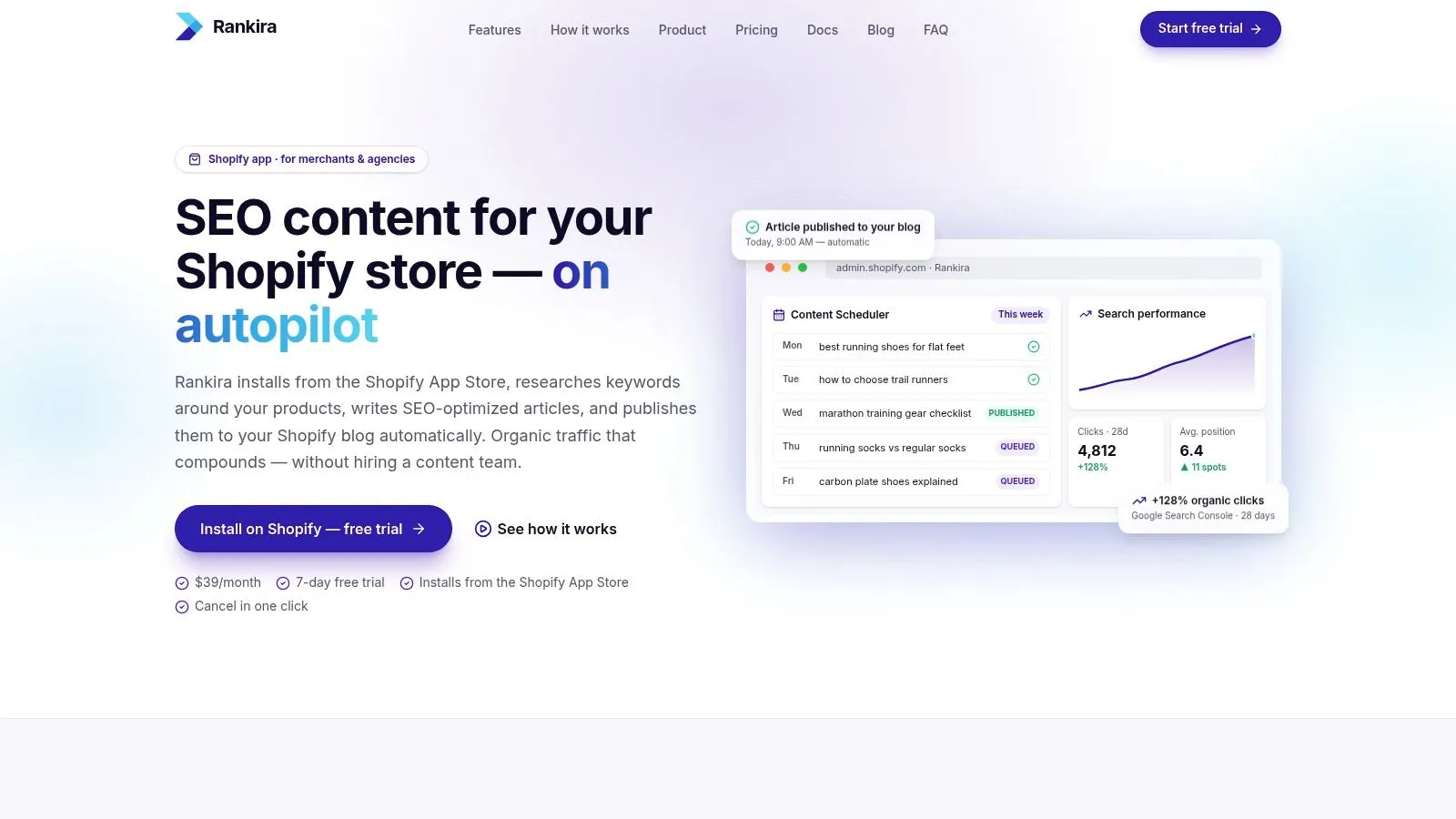
Buying model: Shopify-native software subscription with content production. Rankira fits merchants who need articles published, not just keywords delivered. It researches the store's products, competitors, and Google Search Console data, then places keywords with volume and difficulty scores on an editable content calendar.
The $39 monthly plan includes keyword research, unlimited article generation on schedule, publishing, internal linking, AI images, and performance reporting. New installations receive a 7-day free trial, with billing through Shopify. Writing supports 150+ languages, while keyword research covers 190+ target regions.
What Moves Beyond the Keyword List
The application generates structured articles with meta descriptions, tags, featured images, clean URL handles, and links to relevant products, collections, and pages. Merchants can edit sections, rearrange the calendar, publish automatically, or keep articles as drafts for approval.
Best buying situation: A Shopify store has useful products and expertise but no dedicated content team.
Work still required: A merchant must review product claims, brand voice, factual accuracy, and whether recommendations match the merchandise.
Scope boundary: This is a blog-production workflow, not a substitute for technical SEO fixes, collection-page redesigns, or human market strategy.
Connecting Search Console adds observed search performance to the planning process. A Semrush methodology study involving more than 50 experienced SEO professionals identified Search Console as the panel's preferred accuracy benchmark, while distinguishing impressions from a conventional search-volume metric.
The step-by-step keyword research guide provides a useful framework for reviewing the resulting plan. The strongest fit is recurring catalog-related education, comparisons, buying advice, and care content. AI generation still needs editorial judgment, and rankings, traffic, and revenue aren't guaranteed.
2. WebFX
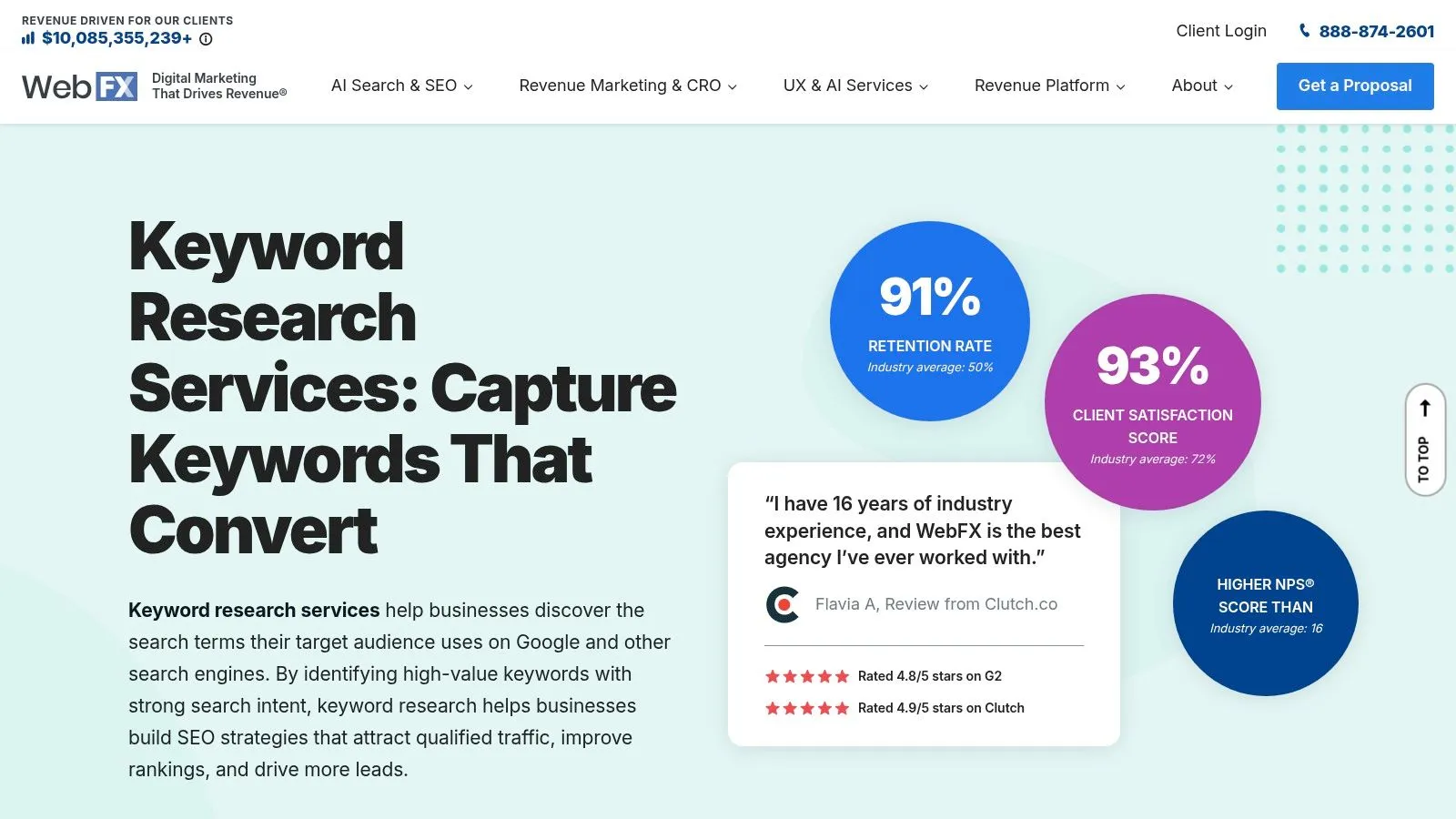
A store with content gaps, technical problems, and limited internal capacity may need an agency rather than a research order. WebFX uses the ongoing-agency model, connecting keyword discovery with audience research, competitor analysis, page targeting, and broader SEO work.
WebFX's keyword research service sits within customized SEO engagements, with published SEO plans starting at $3,000 per month. That's a different purchase from a spreadsheet: the merchant is evaluating a continuing delivery team and its agreed scope.
Where the Retainer Helps
Research can inform content production, technical recommendations, optimization, and reporting within the same relationship. This suits an established store whose bottleneck isn't merely finding topics, but coordinating the people responsible for improving pages.
The trade-off is commitment and scope management. An agency relationship doesn't automatically mean every recommended article, collection revision, or development task is included. The proposal should identify who writes, who uploads to Shopify, who approves changes, and which tasks require separate payment.
For stores comparing agencies, a review of competitive analysis services helps distinguish a useful page-level gap assessment from a generic competitor export.
Merchant responsibility: Supply product expertise, approve priorities, and make someone available for implementation decisions. A retainer won't solve a stalled publishing process if approvals and developer access remain unresolved.
3. Victorious
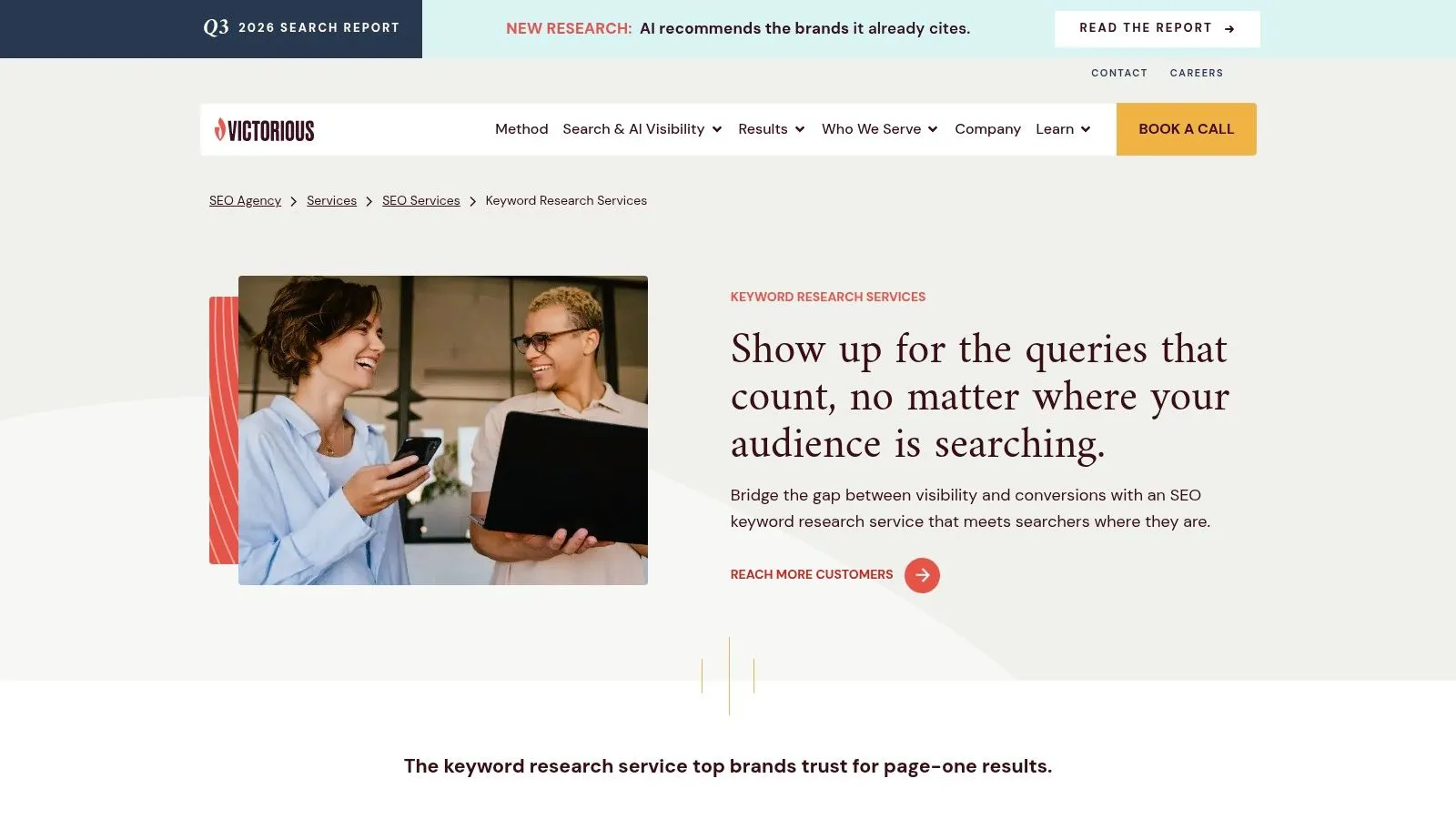
Victorious fits a strategy-led SEO relationship. Its stated approach connects keyword selection with conversion points, search intent, competitor gaps, and thematic groups. That makes it relevant when a store needs to decide which commercial topics deserve investment before commissioning more content.
The Victorious keyword research service doesn't publish a standalone research price. Merchants therefore need a scoped proposal rather than assuming the service is available as a small, fixed-price report.
For example, a skincare store might need to separate ingredient education, routine comparisons, and product-category searches. Those topics can relate to the same merchandise while requiring different pages and different calls to action.
Useful deliverable: Thematic groups connected to customer needs and relevant conversion pages.
Important boundary: A strategic recommendation isn't the same as a finished Shopify article or an implemented collection-page update.
Best internal partner: A marketing lead who can translate agreed priorities into writing, design, and development assignments.
A practical analysis of keywords should identify why a searcher would land on a particular page, not merely attach a volume estimate to a phrase.
Victorious is a stronger buying-model fit for merchants seeking sustained strategic direction than for stores needing an inexpensive batch of blog ideas. Before signing, the merchant should establish which deliverables are recommendations and which become completed work.
4. BlueStone SEO
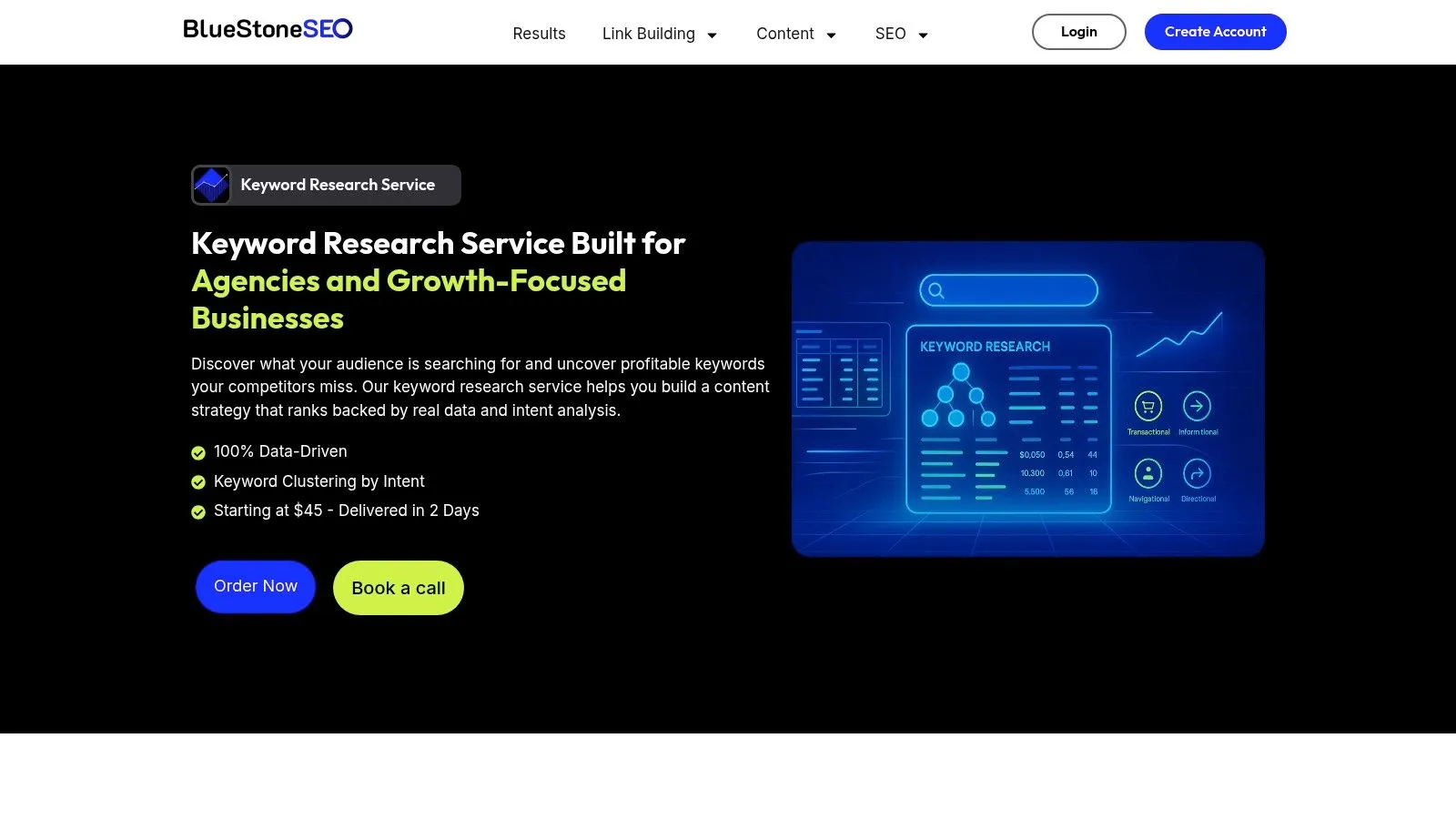
Buying model: A small, defined research package. BlueStone SEO publishes a starting package of 15 keywords for $45, with a two-business-day turnaround. Its stated service includes intent-based clustering, with content briefs, writing, and other SEO services available separately.
This model suits a limited test, such as planning content around a newly launched pet-travel collection. It's easier to evaluate a focused package against a specific product line than to expect it to establish a complete store-wide strategy.
Keep the Test Narrow
The order brief should include the collection URL, target country, existing articles, excluded topics, and the products the merchant wants to support. Otherwise, a small package can be consumed by variations of the same broad phrase.
What works: A bounded assignment with clear catalog context and someone ready to turn the result into briefs.
What doesn't: Treating a modest keyword allowance as sufficient coverage for unrelated collections, regional variants, and different stages of the buying journey.
A competitor SEO analysis can help define useful exclusions and missed topics before placing the order. The merchant should still confirm whether the selected package includes competitor review and URL mapping.
Writing, publishing, and measurement remain separate unless explicitly purchased. The relevant cost is therefore the research package plus the resources needed to put it to work.
5. Growth Asteroid
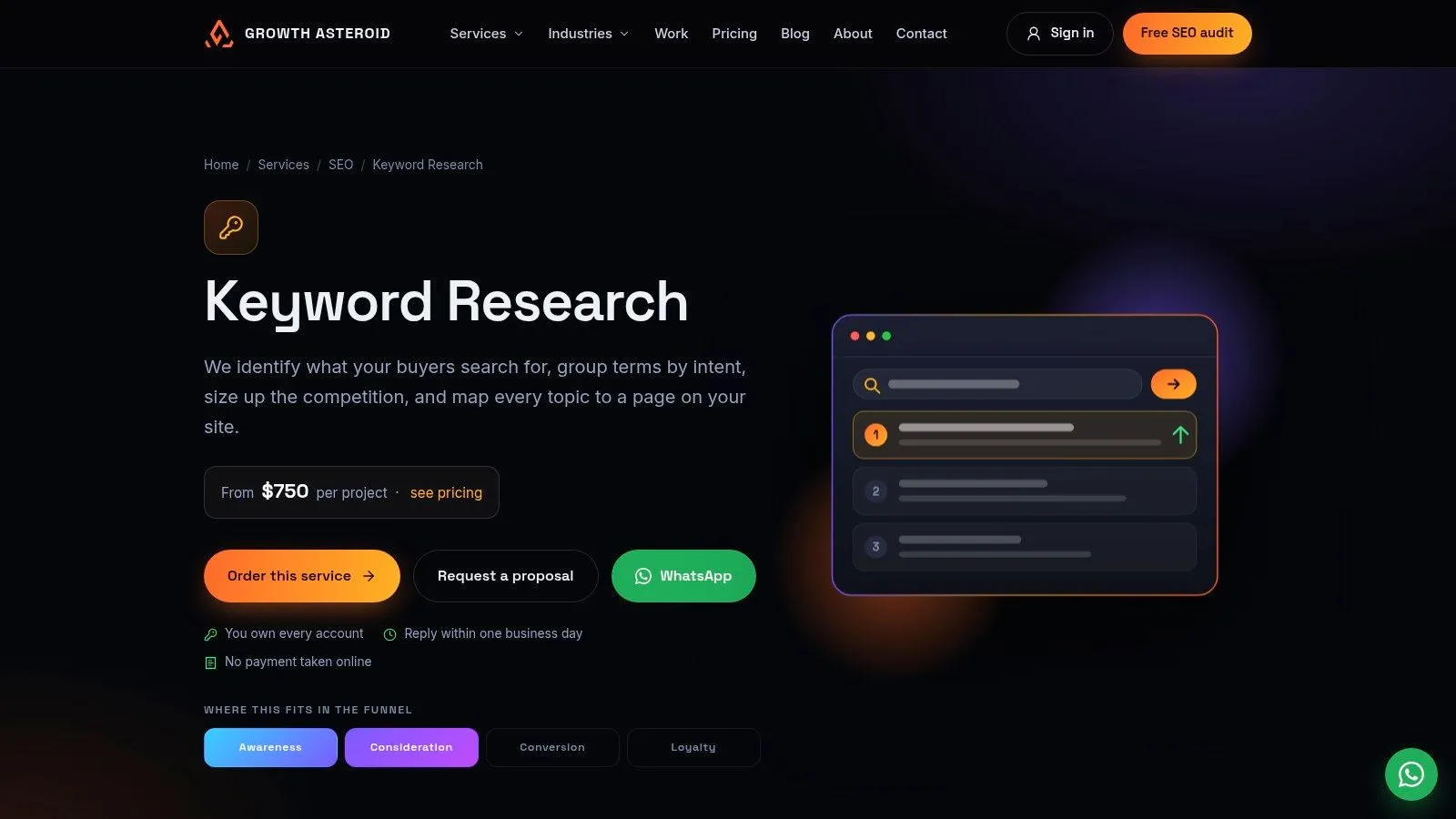
A broad catalog or market launch calls for project scope, not just a larger keyword count. Growth Asteroid lists keyword research projects from $750 to $3,000, depending on scope, covering intent, competition, prioritization, and topic-to-page mapping.
Its described approach also considers questions people ask search engines and AI assistants. That can be useful for planning buying guides, comparisons, and product questions, provided the deliverable distinguishes measured search demand from proposed conversational topics.
Say an outdoor retailer is expanding into another market. The assignment should identify which collection pages need localized targeting, which buying guides deserve new content, and which existing articles can be adapted without creating overlapping pages.
Scope before volume: A project should define the catalog sections, markets, page types, and decisions it will cover before promising a keyword total.
The main advantage is a coordinated plan across related pages. The trade-off is that research alone doesn't necessarily include copywriting, translation, Shopify implementation, or ongoing measurement.
Merchants comparing a consultancy project with an SEO software platform should separate strategic planning from recurring production. Software can maintain a publishing workflow, while a scoped project can address structural decisions before that workflow begins.
Best fit: A store preparing a launch, category expansion, or substantial content reorganization, with an implementation team ready to act.
6. Outsource Assassin
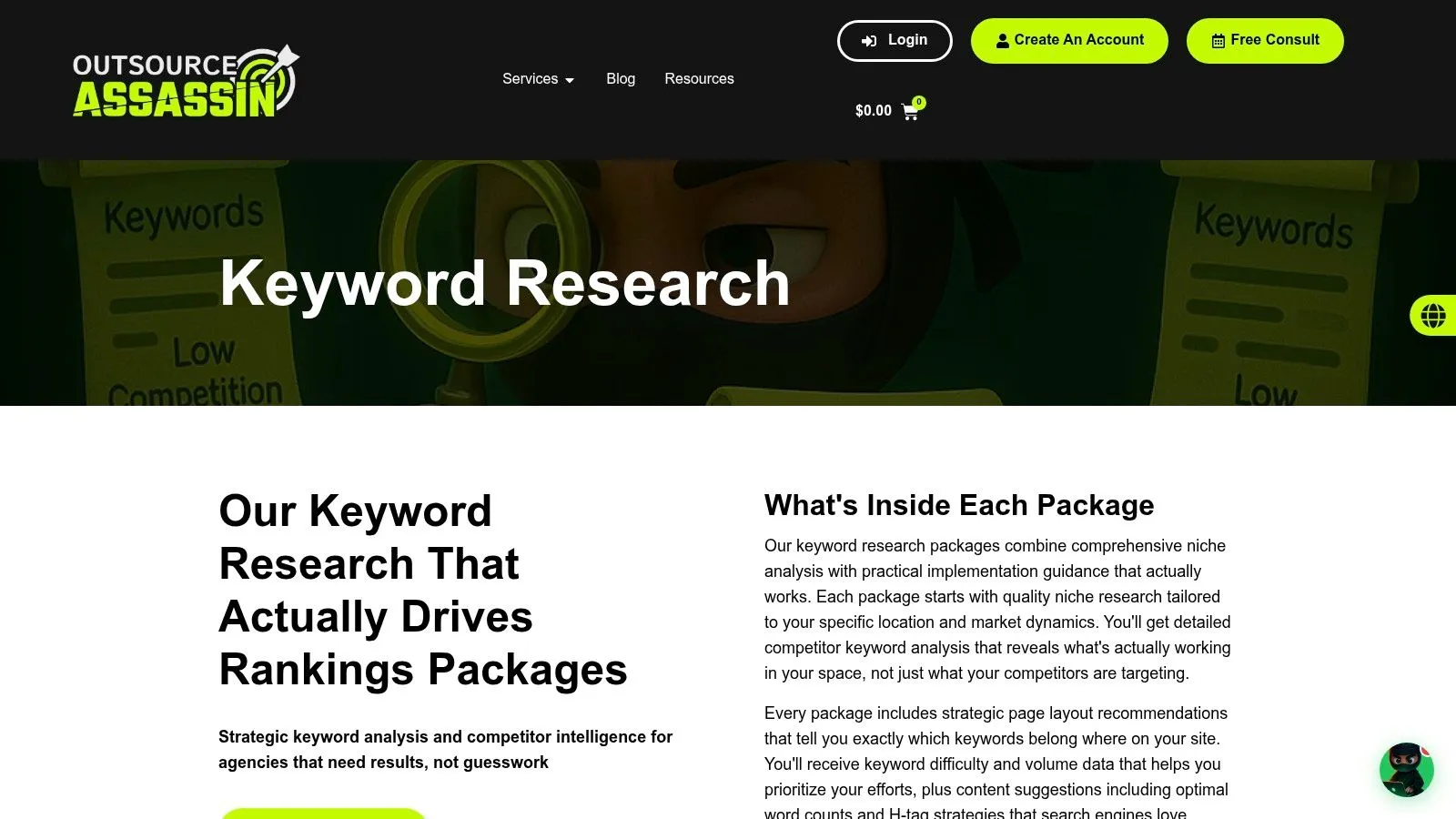
Outsource Assassin is a packaged fulfillment option, particularly relevant to agencies that already manage strategy and client communication. Its stated deliverables can include competitor research, search volume and difficulty, page organization, heading suggestions, and page-layout recommendations.
Outsource Assassin's published packages include $99 for a single niche and location, $149 for multiple locations, and $189 for national or e-commerce research. The important comparison is the scope behind each label, especially for a store with many distinct collections.
A Handoff for an Existing Team
An agency with writers and Shopify implementers may find page-organized recommendations more useful than an unfiltered export. Headings and layout guidance can reduce interpretation during briefing, although they still need checking against live search results and the store's actual inventory.
Agency advantage: White-label delivery can support a repeatable research-to-brief process.
Merchant trade-off: A fulfillment package may offer less direct strategic collaboration than a dedicated consultant.
Remaining work: Someone must approve page targets, write content, upload it, add relevant merchandise links, and measure results.
The e-commerce label shouldn't be treated as unlimited catalog coverage. Before ordering, the buyer should establish which categories and markets are included, whether existing URLs are reviewed, and how conflicting page targets are resolved.
This model works best when research is the missing production input. It's less suitable when the merchant also needs someone to decide the broader commercial strategy.
7. Kendall Devt
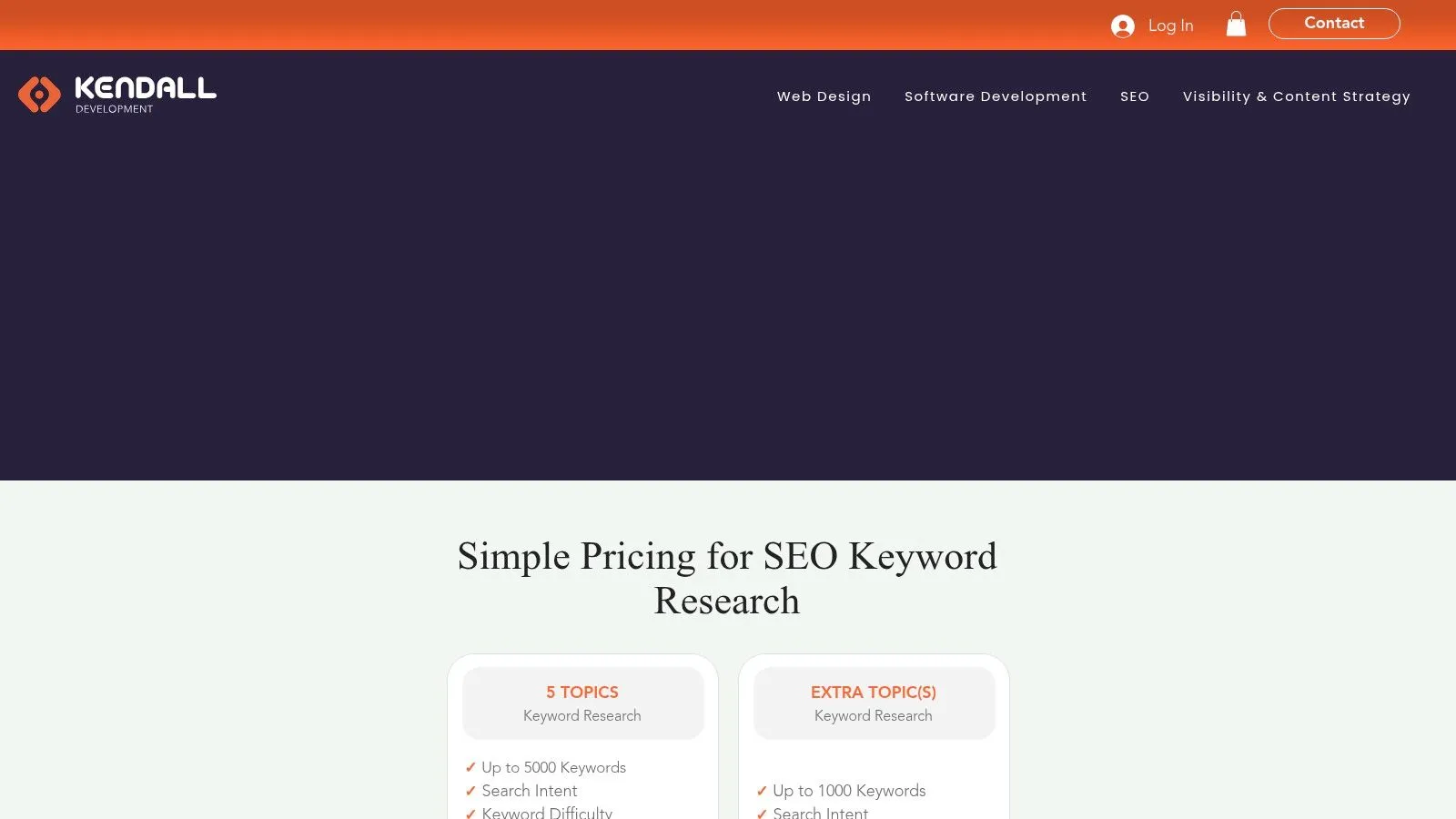
Kendall Devt sells a report rather than an ongoing relationship. Its described format includes search intent, difficulty, volume, cost per click, search-result features, current rankings, and recommended actions. Clients can specify topics, domain, country, and exclusions.
Kendall Devt's service page lists $33 for a five-topic report covering up to 5,000 keywords, with $66 for an extra topic. That pricing structure deserves confirmation before purchase, including how topic limits and additional-topic charges apply.
A large export can support discovery, but it isn't automatically a publishing plan. The useful test is whether the report helps a merchant choose a relevant page and action.
Make the Report Usable
In most keyword exports, very low-volume terms make up the bulk of the list but a small share of total search demand. Keyword totals alone are a weak purchasing criterion. A 5,000-keyword deliverable sounds generous until you count how many rows a store could realistically target.
For a specialist store, a narrow phrase may still describe a valuable product requirement. The merchant needs to filter recommendations by catalog relevance, buying intent, existing coverage, and realistic publishing capacity. Sorting by volume alone pushes that work onto whoever opens the file.
Best fit: A capable operator or agency that wants a research input and can perform the prioritization independently. Writing, page mapping, publishing, and ongoing measurement shouldn't be assumed unless the order explicitly includes them.
8. Portland Peak SEO
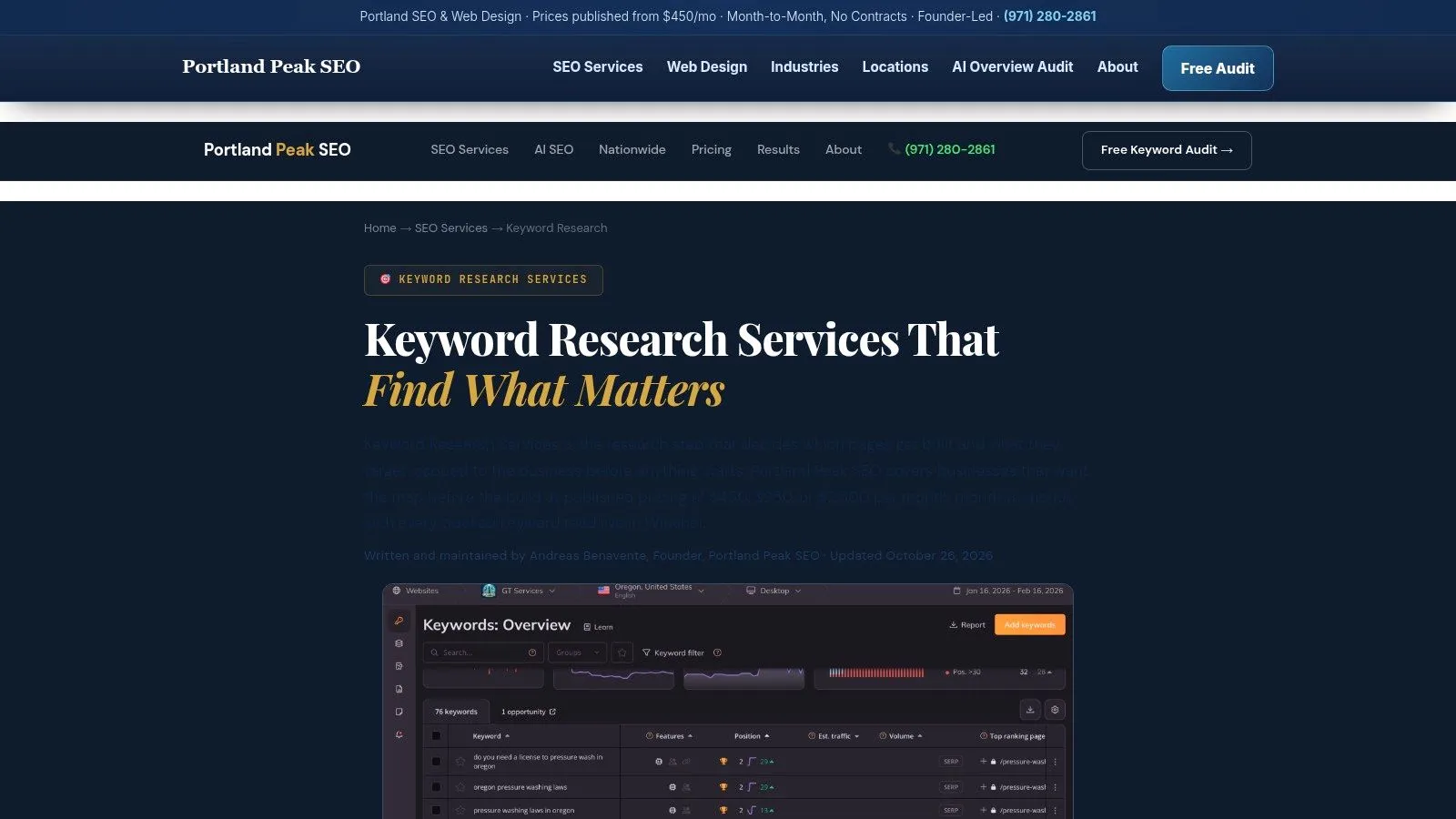
A store that adds categories regularly may outgrow a static keyword map. Portland Peak SEO offers a recurring planning model, emphasizing intent classification, clustering, competitive analysis, and page priorities.
Portland Peak SEO publishes monthly tiers of $450, $950, and $2,500, and describes its plans as month-to-month. The useful question is what changes between tiers: research coverage, tracking, strategic access, or actual implementation.
For a larger catalog, recurring research can support decisions about new collection pages, existing content updates, and topics that no longer match available products. However, a monthly invoice isn't justified merely because another report arrives.
Good fit: A store has a continuing publishing schedule and someone responsible for acting on recommendations.
Potential mismatch: A merchant needs only an initial map for a stable product line.
Scope to resolve: Which activities involve research, which involve tracking, and which produce completed page changes?
International retailers should also verify regional and language coverage rather than assuming a general SEO plan includes localization.
The merchant's next job is operational: Assign each approved recommendation to a writer or implementer, provide product information, and track completion. If the store can't consistently approve and publish work, a bounded project may be more practical than ongoing research.
9. Izotov Agency
Izotov Agency combines one-time keyword research with an AI-question map. Its described process collects terms, checks intent against live search results, removes unsuitable phrases, clusters the remainder, and maps groups to existing or proposed pages.
Izotov Agency prices the service at $0.25 per final keyword, with a 100-keyword minimum of $25. Billing against the cleaned final list makes the definition of an accepted keyword especially important.
Separate Search Evidence From AI Questions
A conventional keyword cluster can guide a collection page or article. An AI-question map can suggest useful comparisons and buying scenarios, but it doesn't establish that an AI system will cite the resulting page.
For a cookware store, questions about induction compatibility, weight, coatings, and care may deserve attention. The resulting content still needs accurate product attributes and clear guidance, not merely conversational headings.
An AI-question deliverable is a content-planning input, not a promise of citation, rankings, or sales.
The service lists a walkthrough call, which can help clarify mapping decisions and ambiguous clusters. Writing, publishing, and ongoing SEO aren't included in the research price.
Best buying situation: A merchant or agency already has production capacity and wants a cleaned keyword map with additional question-led planning. Before ordering, the buyer should confirm target-country coverage, data sources, and how existing Shopify pages are incorporated.
10. Jane Augustine
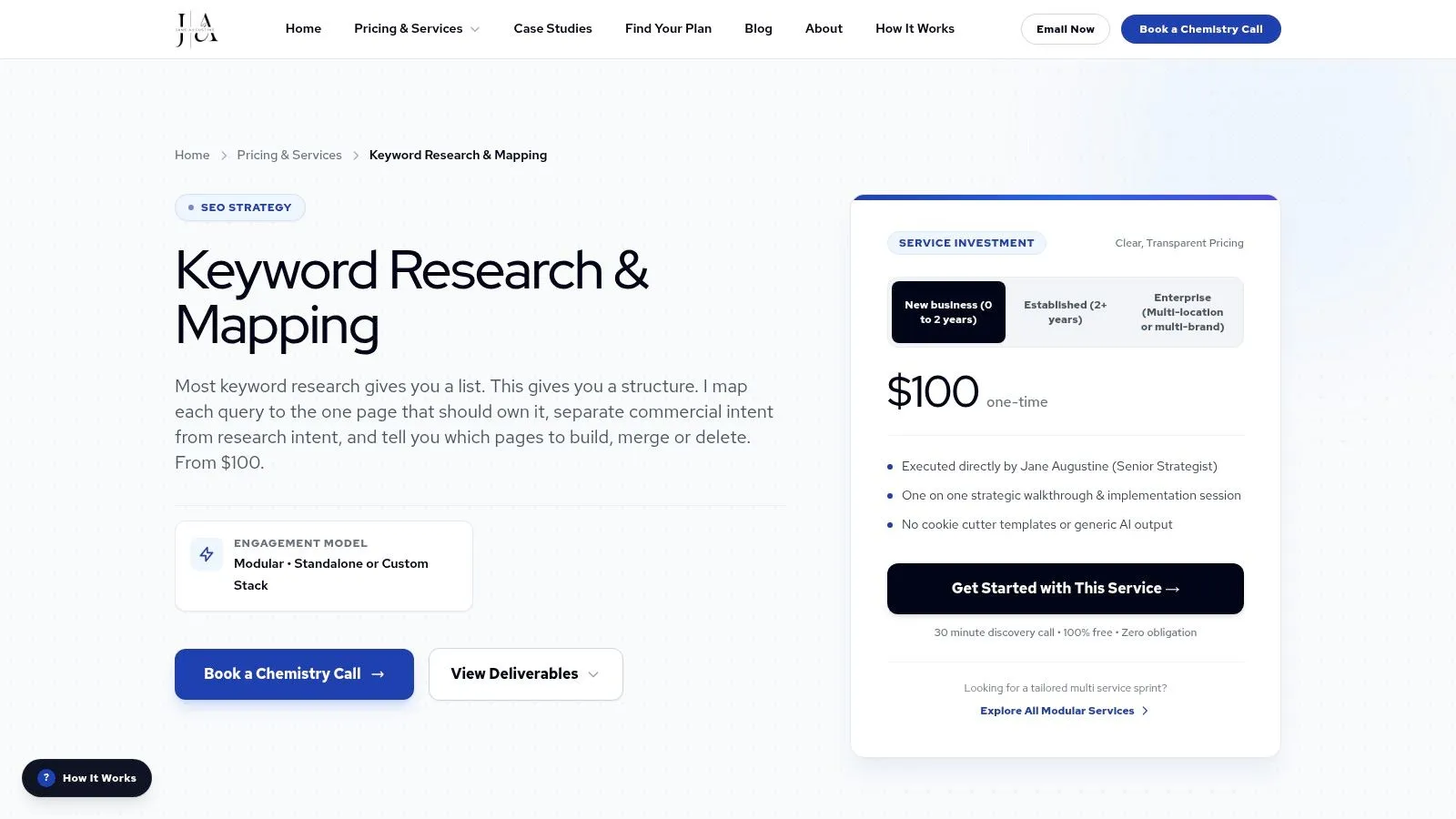
Sometimes the problem isn't a shortage of keywords. It's uncertainty about which existing page should target them. Jane Augustine's modular research and mapping service fits merchants who need page-level decisions and strategic interpretation.
Jane Augustine publishes one-time options starting at $100, with higher tiers available. The service distinguishes commercial and research intent and can recommend pages to build, merge, or remove, alongside a strategy and implementation session.
A store with overlapping buying guides may benefit more from consolidation than another topic list. Mapping should establish whether the collection page serves the buying query and whether an article answers a distinct supporting question.
Strategy Still Needs an Implementer
The direct-strategist model can be useful for resolving a specific content architecture problem. It may be less suitable for a large, multilingual catalog requiring extensive parallel research and production.
Useful purchase: A defined mapping problem with access to existing URLs and performance information.
Deliverable to inspect: A sample showing priorities, recommended actions, and the reasoning behind page assignments.
Work left behind: Copy changes, redirects where appropriate, internal-link updates, publishing, and performance review.
Recommendations to merge or remove pages deserve careful implementation. The merchant should preserve useful content, check existing search visibility, and identify technical dependencies before making changes.
This option suits a team that needs direction from a strategist but can execute the agreed work independently.
Keyword Research Services at a Glance
| Item | Starting Price | Pricing Model | Best For |
|---|---|---|---|
| Rankira | $39/month | Monthly subscription | Shopify merchants seeking an all-in-one SEO content workflow |
| WebFX | $3,000/month | Customized agency plans | Businesses wanting keyword research alongside broader SEO services |
| Victorious | Not published | Strategic SEO engagement | Businesses seeking keyword research as part of an SEO strategy |
| BlueStone SEO | $45 | One-time packages; subscriptions available | Focused keyword research with optional content support |
| Growth Asteroid | $750 | Project-based, scope-dependent | Businesses planning across products, markets, or site launches |
| Outsource Assassin | $99 | One-time packages | Agencies or businesses needing packaged, white-label research |
| Kendall Devt | $33 | One-time report; extra topics cost more | Teams wanting a compact report with standard SEO metrics |
| Portland Peak SEO | $450/month | Monthly tiers | Businesses seeking ongoing research and planning, including larger e-commerce sites |
| Izotov Agency | $25 | Per-keyword pricing with a 100-keyword minimum | Teams wanting keyword and AI-prompt research mapped to pages |
| Jane Augustine | $100 | One-time modular service | Teams needing keyword-to-page mapping and strategic guidance |
Matching the Right Keyword Research Service to Your Store
Choose the buying model before comparing keyword counts. A one-time report or small package suits a limited test, a single product line, or a team that already knows how to brief writers. Project-based research fits category expansion, multi-market planning, and decisions about site structure. A retainer makes sense only when someone will act on the research every month.
Catalog size matters, but publishing capacity matters just as much. A broad plan won't help a store that can't review drafts or update collection pages. Conversely, a merchant with writers ready to work may need detailed mapping and priorities rather than bundled article production.
Before paying, verify deliverables, keyword limits, target-country coverage, and implementation responsibilities. Request a sample where possible, and check whether it contains page assignments, intent labels, priorities, and clear actions rather than only metrics.
Judge the Evidence and the Handoff
Search Console is valuable, but it isn't a complete record of customer language. Google's Search Console documentation explains that the system stores and displays only the most important query rows. Sparse query data shouldn't automatically disqualify an emerging product topic or regional variation.
External estimates should therefore be checked against catalog language, competitor pages, on-site searches, and actual performance. For teams keeping research in-house, Semrush and SpyFu compared by job offers another way to evaluate tools around the task rather than the size of a database.
The handoff should also define measurement. Track which pages were published or updated, their search impressions and clicks, and whether visitors reach relevant merchandise or convert. Rising visibility without a sensible route to products may indicate a targeting or content problem.
Match the Workflow to the Available Team
For merchants seeking research tied directly to Shopify publishing, Rankira costs $39 per month and includes a 7-day free trial. Its research runs in the background and places keywords on a content calendar, with article generation, editing, publishing controls, internal links, and performance reporting in the same workflow. It doesn't guarantee rankings or traffic, and merchant review remains important.
The next step is concrete: list the store's priority collections, identify the target markets, and assign responsibility for writing, approval, publishing, and measurement. Then compare providers against those responsibilities. The right service is the one that supplies the missing work without leaving the store with a plan nobody can execute.
Rankira connects catalog-based keyword research with article creation, internal linking, and Shopify blog publishing. Merchants can visit Rankira to explore the workflow and use the free trial to review a content calendar before committing to recurring production.
Keep reading
All articles
Shopify SEO
SEO CMS System: A Shopify Merchant Guide
An SEO CMS system plans, optimizes, publishes, and tracks Shopify content. See the gates, AI review rules, and what to measure in 2026.
13 min read
Shopify SEO
Competitive Backlink Analysis: Find and Rank Outreach Gaps
Learn how competitive backlink analysis works: pick rivals, judge link quality, find gaps, and rank outreach targets for your Shopify store.
13 min read
Shopify SEO
Search Engine Optimization Plan for Shopify: 2026 Guide
Build a search engine optimization plan for your Shopify store: set a baseline, pick keywords, publish in batches and measure results.
11 min read
Put your Shopify blog on autopilot
Rankira researches keywords, writes SEO articles, adds internal links, and publishes them to your store — every week. Start with a 7-day free trial.