Competitive Backlink Analysis: Find and Rank Outreach Gaps
Learn how competitive backlink analysis works: pick rivals, judge link quality, find gaps, and rank outreach targets for your Shopify store.
Published 13 min read
In this article
- Table of Contents
- Why Competitor Backlinks Show Where Your Store Can Win
- The Five-Stage Workflow Behind Every Competitor Audit
- Choosing Competitors Worth Studying
- Finding Link Gaps Across Rivals
- Metrics Worth Tracking and What They Miss
- Judging Link Quality Before You Copy Anything
- Ranking Gaps Into Outreach You Can Act On
- Start Your First Outreach Shortlist This Week
A Shopify store can have strong product pages and a well-organized gift collection but still struggle to outrank a smaller competitor. One possible reason is backlinks. Before adding more products or publishing more content, it's worth looking at which websites link to competing candle gift sets, what makes those links valuable, and which opportunities your store could realistically pursue. This gives you a clearer starting point for building backlinks that improve search visibility.
Table of Contents
- Why Competitor Backlinks Show Where Your Store Can Win
- The Five-Stage Workflow Behind Every Competitor Audit
- Choosing Competitors Worth Studying
- Finding Link Gaps Across Rivals
- Metrics Worth Tracking and What They Miss
- Judging Link Quality Before You Copy Anything
- Ranking Gaps Into Outreach You Can Act On
- Start Your First Outreach Shortlist This Week
Why Competitor Backlinks Show Where Your Store Can Win
Competitive backlink analysis means examining the websites that link to competing stores, then separating useful evidence from opportunities worth pursuing. The distinction matters: a competitor's profile isn't a shopping list.
For the candle merchant, that profile might reveal a regional gift guide, a fragrance blogger, and a maker's stockist directory. Together, these sources map who already recommends businesses in the category. It's similar to discovering which local suppliers and publications vouch for a neighboring shop.
That principle has a long history. Google's founders presented link-based ranking in 1998, treating hyperlinks like academic citations, with links from important pages carrying more weight, as described in The Anatomy of a Large-Scale Hypertextual Web Search Engine.
The practical comparison starts with the sources behind competing pages.

Compare endorsements, not just totals
A useful audit considers referring domains, the credibility of linking sites, and which destination pages receive attention. A collection page supported by relevant buying guides presents different evidence from a homepage supported mainly by thin directories.
Links also sit within a broader off-page SEO strategy. They don't explain every ranking difference, and matching a competitor's total won't guarantee the same position.
The merchant's job is to choose comparable rivals, examine individual placements, identify missing sources, and rank realistic outreach targets. The strongest opportunity isn't necessarily the most prestigious publication. It's the relevant source with a credible reason to recommend the store.
The Five-Stage Workflow Behind Every Competitor Audit
| Stage | Question it answers | Output |
|---|---|---|
| Select competitors | Which stores compete for the target queries? | Shortlist of overlapping stores and ranking pages |
| Export link profiles | Which sites link to each rival? | Referring-domain list per rival |
| Assess link quality | Which links would help a comparable store? | Each link tagged useful, neutral or risky |
| Map gaps | Where do rivals have links the store lacks? | Gap list grouped by source type |
| Rank outreach | Which opportunities deserve attention first? | Prioritized target list with owner and date |
The sequence prevents a common waste of effort: collecting contact details before deciding whether the underlying links are worth earning. A shortlist defines the exports, quality tags determine which gaps count, and the remaining opportunities become assigned outreach tasks.
Build a working file before opening more tools
A spreadsheet is sufficient for managing the audit. Keep separate fields for the referring domain, exact linking page, competitor destination, anchor text, placement type, quality decision, and outreach status.
Ahrefs or Semrush can supply competitor exports. The store's own export is equally important, so the process for finding backlinks to a site should run alongside competitor collection. Otherwise, the merchant may pitch sources that already provide a mention.
Clean the exports before comparison. Standardize domain names, remove duplicate records, and preserve exact page URLs for manual inspection. A domain-level summary helps with sorting, but it shouldn't replace the page-level evidence.
Audit discipline: Every prospect should retain the page that justified its inclusion. A domain name without supporting context isn't an outreach brief.
Scope should follow the catalog. A small specialist store can keep the first pass focused on its core collection; a broad retailer should repeat the export, assessment, and comparison work by category rather than mix unrelated products.
Technical readiness belongs alongside this work. For merchants allocating a limited budget, 3228 Digital UK's explanation of how to reduce business costs through website audits provides useful context for checking destination-page problems before funding promotion.
The workflow is only as good as the quality judgment applied during assessment.
Choosing Competitors Worth Studying
Start with purchase intent. Select a manageable set of queries tied to revenue-producing collections, such as scented candle gift sets or handmade ceramic mugs. Avoid building the shortlist around broad informational searches alone.
Record organic results. Note the ranking domain and exact page for each query. Keep advertisements separate from organic listings, and use the store's target location.
Count repeated appearances. A domain appearing across several relevant searches deserves closer inspection than a brand appearing for an isolated phrase.
Exclude unsuitable benchmarks. Major marketplaces and social networks can reveal search intent, but their institutional link advantages rarely translate into attainable merchant outreach.
Add commercial rivals. A similar store with weaker rankings may still reveal supplier relationships, association memberships, and regional coverage.
Keep a balanced shortlist. Include a direct rival ranking above the store, a comparable business, and an aspirational brand with relevant content or partnerships.
The selection should happen at both domain level and page level. A lifestyle retailer might compete with the candle shop for gift sets while attracting most of its backlinks through unrelated furniture content. Exporting everything without segmentation would bury the useful evidence.
Handle imperfect comparisons deliberately
A narrow niche may have very few genuine rivals. A store selling specialist pottery tools shouldn't add unrelated craft retailers merely to make its spreadsheet look complete. A short, relevant comparison is more useful than a large, diluted one.
Regional relevance also changes the shortlist. A florist serving Bristol should favor businesses whose customers, delivery areas, and local coverage overlap, rather than study a national florist solely because its profile looks stronger.
Language requires a commercial judgment. A foreign-language competitor may sell similar goods but earn coverage from publications whose readers cannot buy from the target store. Unless the merchant serves that audience, those sources should remain contextual evidence rather than active prospects.
A suitable competitor overlaps with the store's customers and search queries, not merely its industry label.
A structured comparison with competitors helps preserve those distinctions. Record why each rival belongs in the audit, which collections overlap, and which parts of its business should be excluded.
That note prevents scope drift when an impressive but irrelevant backlink appears later. The question isn't whether the rival is successful. It's whether its endorsements offer evidence a comparable merchant can use.
Finding Link Gaps Across Rivals
A shared link gap is a referring domain that links to multiple selected rivals but not to the target store. A link-intersect report makes these overlaps visible without requiring separate manual comparisons of every export.
Build the intersect
Export consistently. Use the same backlink database and comparable filters for each rival, retaining linking-page URLs alongside domain names.
Merge by domain. Create a master sheet with a row for each referring domain and a column for each competitor. Mark which competitors receive links.
Remove existing relationships. Match against the store's own referring domains. Keep existing sources in a separate expansion list if a new collection mention could still be useful.
Sort by overlap. Put sources covering several rivals above isolated mentions. Repetition suggests a source may regularly feature businesses in the category.
Verify the placement. Open the actual page and confirm that the link remains live. Record whether it sits in editorial text, a resource list, a footer, or a commercial listing.
Overlap is a screening signal, not approval. A directory network can link to many rivals and still be a poor prospect.
Apply the pattern to a candle store
Suppose a regional gift guide features several competing candle makers, while a supplier's stockist page mentions only a single rival. The gift guide deserves early inspection because it demonstrates broader category coverage.
The stockist page belongs in a separate lane. Its value rests on whether the target merchant carries that maker's products, not on how many competitors appear there.
For editorial prospects, Carlos Alba Media's guide to earning publisher references as a UK SME offers context for approaching coverage as a story proposition rather than a request for a bare link.
The output should be grouped by source type: suppliers, buying guides, editorial features, resource pages, directories, and communities. Each group requires different evidence and a different outreach message. A supplier needs proof of a trading relationship; an editor needs a useful reason to include the store.
Metrics Worth Tracking and What They Miss
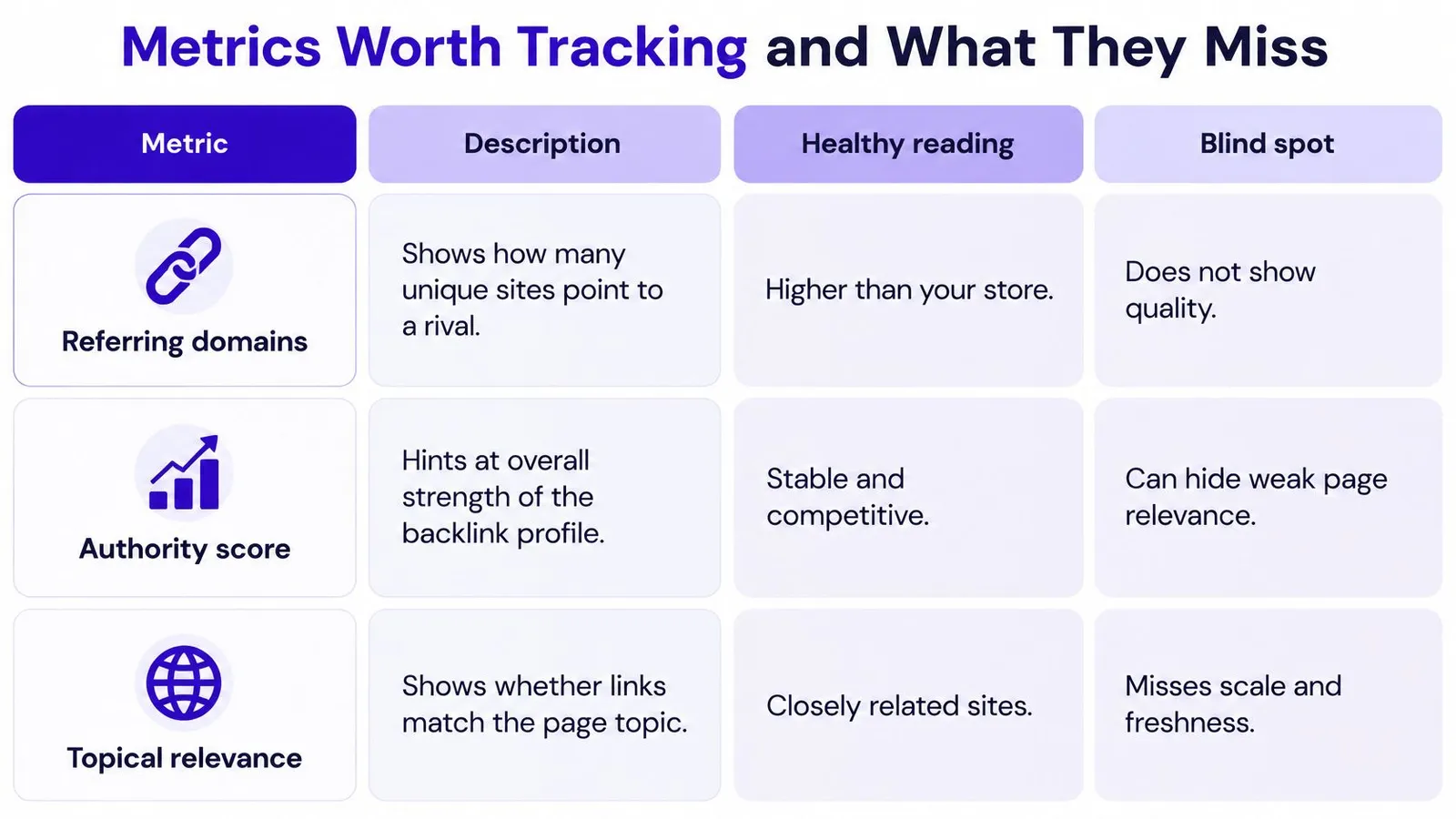
Metrics help sort a large export, but they don't settle which placements deserve attention. The reading guide below pairs each signal with the judgment it cannot replace.
| Metric | What it tells you | Healthy reading | Blind spot |
|---|---|---|---|
| Referring domains | Breadth of sites linking to a rival | Compare rivals on the same keyword set | Says nothing about whether links help rankings |
| Domain Rating | Relative strength of a linking domain | Rank sources within a tier, not whole profiles | Third-party score that varies by database |
| Estimated traffic to linking page | Likely visibility of the link | Prefer linking pages with real readers | Traffic figures are modeled estimates |
| Anchor text distribution | How links describe the target page | Mix of brand, URL and descriptive phrases | Heavy exact-match concentration warrants review |
| Link acquisition over time | Pace at which new links arrive | Growth that matches publishing and publicity | Sudden spikes need investigation before copying |
| Linked vs unlinked mentions | Brand recognition with and without links | Track both separately | Unlinked mentions pass no link equity |
The visual summary highlights why breadth, authority, and relevance need separate readings.
Use authority scores as sorting aids
Rankira describes Domain Rating as a 0 to 100 industry score for a domain's apparent strength. For prospect evaluation, it's most useful after sources have been grouped by relevance and placement type.
Comparing relevant specialist publications against each other is more defensible than allowing a large general site to outrank every niche resource automatically. The domain score doesn't describe the specific article's audience, editorial standards, or relationship to the product.
Estimated traffic also needs context. A seasonal gift guide may look quiet outside the buying period, while an article with broad traffic may attract almost no suitable customers. Inspect the topic, freshness, navigation, and likely reader intent rather than treating the estimate as measured referral traffic.
Separate ranking evidence from brand visibility
BuzzStream's review of link-building evidence reports a 2025 analysis of one million keywords with a backlink-count correlation of 0.248 with rankings, and separate findings associating branded web mentions with Google AI Overview visibility at 0.664, compared with about 0.218 for backlinks.
Those findings describe associations, not proof that acquiring a particular placement causes improved visibility. Branded web mentions also shouldn't automatically be interpreted as exclusively unlinked mentions.
For a merchant's dashboard, record linked mentions, unlinked mentions, and observed AI citations separately. Note which destination or source page appears, what subject prompted the mention, and whether the store's product expertise was central.
A product link and an informational citation can serve different purposes. Tracking both helps distinguish commercial discovery from broader recognition without pretending that an authority score captures either outcome completely.
Judging Link Quality Before You Copy Anything
A large rival profile can look like a safe template. It isn't. The history of Google Penguin, announced on April 24, 2012, includes an estimated impact on approximately 3.1% of English-language queries and a focus on manipulative practices such as link schemes.
The practical lesson is selective imitation. A competitor can rank despite questionable links, not necessarily because of them. Copying the visible profile without inspecting its contents confuses coexistence with usefulness.
Inspect the placement, not the sales pitch
Topical relevance. The source should cover the product category, customer problem, region, or purchasing occasion. A candle mention in a home-fragrance guide has a clearer rationale than one in an unrelated finance article.
Page visibility. Check whether readers can reach the article through normal site navigation and whether its content appears maintained. A buried page deserves different treatment from an active resource.
Editorial intent. Look for a reason the writer selected the business. Product testing, specialist knowledge, supplier status, or a useful reference provides context.
Anchor context. Read the complete sentence. A descriptive recommendation differs from an awkward commercial phrase inserted into unrelated copy.
Placement pattern. Inspect sitewide footers, blogrolls, and repeated templates separately. Their repetition can inflate totals without representing independent endorsements.
Replicability. Identify what qualification the target store would need. If no credible route exists, mark the placement as evidence rather than outreach inventory.
A practical guide to building backlinks should support this distinction between earning a relevant recommendation and merely obtaining a placement.
Separate editorial updates from manufactured insertions
Existing articles can legitimately need updated resources. However, the presence of a competitor link doesn't prove an editor accepts unsolicited additions, and it certainly doesn't prove the placement was earned.
When assessing this route, Linkbuilding's guide to niche edits from Linkbuilding.services provides terminology for reviewing existing-page placements. The merchant still needs to inspect editorial relevance, commercial terms, and whether the proposed addition improves the page.
Red flags include unrelated subject matter, unexplained acquisition spikes, paid directory networks, and pages sending readers to numerous unrelated stores. None should be copied merely because a competitor appears there.
Prospecting rule: A prestigious link can be valuable to its recipient and still be a poor target for another store.
Consider a news feature about a founder receiving an award. The publication may be credible, but that particular event cannot be repeated. Record the story angle for inspiration, then exclude the exact placement from routine outreach.
For an active shortlist, prioritize links that are relevant, editorially justified, and realistically earnable.
Ranking Gaps Into Outreach You Can Act On
A cleaned gap list still needs a commercial decision. The merchant should prioritize sources where the store can contribute something appropriate, not sources offering the most impressive badge.
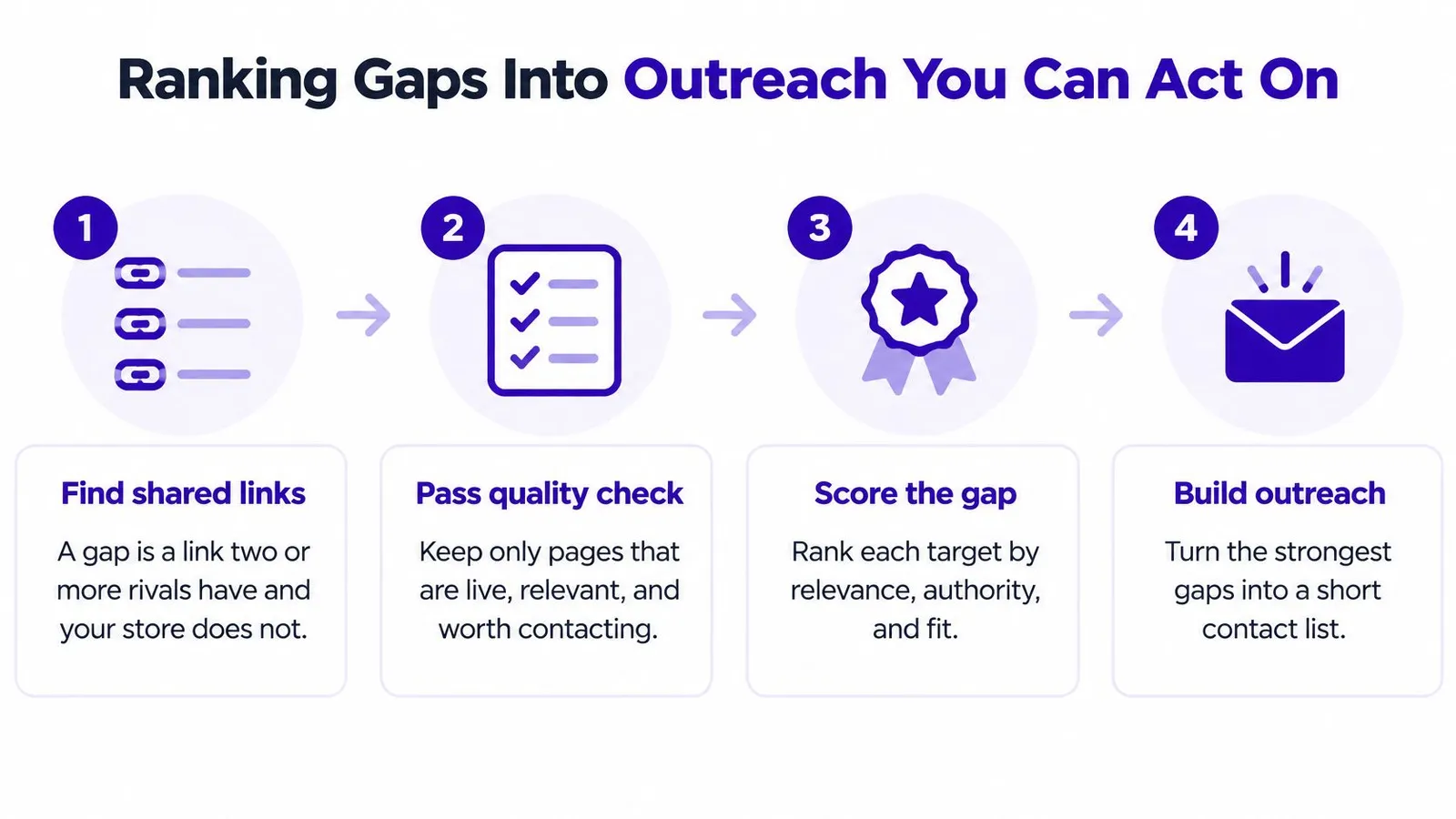
The process below turns evidence into assigned work.
Score realistic access
Remove duplicates and existing links. Keep only missing placements, with live supporting pages and a documented quality decision.
Group by source type. Separate supplier pages, resource roundups, directories, original-data coverage, and community discussions.
Apply a simple internal scale. As a proposed working rubric, score relevance and replicability from one to five. Score ease on the same scale, with five representing the least effort.
Calculate priority. Multiply relevance by replicability, then add ease. This deliberately favors a strong fit and realistic access over a merely convenient submission.
Assign responsibility. Give the leading targets an owner, proposed destination, contact date, and specific reason for inclusion.
These are planning scores, not measured ranking factors. A high total means the opportunity deserves work; it doesn't predict how far a collection page will move.
An independent backlink analysis published by Feedthebot in 2025 notes that backlink databases have different coverage and don't perfectly reproduce Google's classification of valuable, spammy, or irrelevant links. A placement in an export may therefore be historical residue or index noise rather than a useful explanation for ranking success.
Match the opportunity to the store's resources
| Opportunity type | Example for a store | Typical effort | Priority |
|---|---|---|---|
| Supplier or maker mention | A ceramics maker lists its stockists | Low | High |
| Resource or roundup inclusion | A niche gift guide accepts new products | Medium | High |
| Original data or digital PR | A survey of buyer habits in the category | High | High when it fits the brand |
| Directory listing | An industry or local business directory | Low | Low to medium |
| Forum or comment link | A community thread mentions a product | Medium | Low and risky |
These priorities are starting judgments. A supplier page only deserves a high position when the commercial relationship exists. A directory needs an actual audience or useful verification function, not merely an accessible submission form.
Original-data outreach demands more preparation. The merchant needs a defensible method, clear findings, and something publishers can explain to readers. Without those ingredients, the work becomes an expensive exercise in asking for attention.
Community opportunities require particular restraint. A merchant shouldn't enter a discussion solely to insert a product link. Participation must fit community rules and answer the question without disguising commercial involvement.
The accompanying video provides another format for reviewing competitor-link work.
Turn each target into a usable brief
The outreach row should explain why this store belongs on this page. For a gift guide, include the relevant product, price information checked at sending time, shipping area, seasonal availability, and an appropriate image.
For a stockist page, provide the trading name, store URL, location, and evidence that the merchant carries the maker's products. No elaborate pitch is necessary when the request is a factual correction or missing partner listing.
Track replies and earned placements separately. A positive response isn't a live link, and a live link isn't proof of a ranking effect. Referral visits, relevant exposure, and destination-page performance should inform the eventual assessment.
The first outreach slots should usually go to suppliers or partners with a clear, legitimate reason to list the store.
Start Your First Outreach Shortlist This Week
The merchant should take the leading targets and reopen every proposed linking page before sending messages. Editors change roles, guides stop accepting submissions, and pages disappear between export and outreach.
Destination URLs need the same care. Each backlink points to an exact address; renaming an article or collection afterward can leave the mention pointing at a missing page unless a suitable redirect preserves the route.
Confirm destinations and record outcomes
In Rankira, backlink tracking sits under Link Management › External Backlinks. The tab shows earned backlinks, their destination pages, and when they appeared, alongside the credit balance and dated credit history. Stable destination URLs are particularly important for placements acquired through its exchange.
The tracking view provides a place to review earned mentions.
For stores able to produce a genuine news angle, digital PR merits consideration: 48.6% of SEO professionals identified it as the most effective link-building tactic in Editorial.Link's 2025 survey of 518 SEO professionals, as summarized by uSERP. That's a practitioner preference, not a guaranteed outcome for a particular store.
A relevant guest-blogging approach can complement the shortlist when a publication needs expertise the merchant can provide.
Confirm the URLs. Finalize the pages intended for promotion and check that each works.
Send a small opening batch. Use individually relevant messages, not a generic request to exchange links.
Schedule the next audit. Set a quarterly review to record closed gaps, rejected prospects, and newly relevant sources.
Rankira combines Shopify-focused content planning, publishing, and backlink tracking, helping merchants connect outreach destinations with the articles and collections they maintain. Visit Rankira to explore those workflows and keep earned backlink records alongside the store's content work.
Keep reading
All articles
Shopify SEO
Search Engine Optimization Plan for Shopify: 2026 Guide
Build a search engine optimization plan for your Shopify store: set a baseline, pick keywords, publish in batches and measure results.
11 min read

Shopify SEO
10 SEO Software Platform Options for Shopify Stores
Compare 10 SEO software platform options by capabilities, use cases, and Shopify fit, from keyword research to publishing and reporting.
11 min read

Shopify SEO
Keyword Density SEO: How to Calculate and Use It
Keyword density SEO is a percentage, not a ranking target. See the formula, sample counts, and how to place phrases without stuffing.
12 min read
Put your Shopify blog on autopilot
Rankira researches keywords, writes SEO articles, adds internal links, and publishes them to your store — every week. Start with a 7-day free trial.