Off Page SEO Signals That Build Store Authority
Off page SEO explained for Shopify stores: backlinks, brand mentions, page quality, and safer ways to earn authority.
Published 12 min read
In this article
A finished Shopify store can still be invisible. Product photos look sharp, collections read clearly, and a few blog posts answer real customer questions, yet almost nobody outside the store mentions the brand. Off Page SEO addresses that missing reputation. It is not another admin setting. It is the record other sites create when they link, name, review, or cite a store.
Table of Contents
- Why Off Page SEO Matters Beyond Your Store
- How Links Became a Measure of Trust
- How Google Finds Pages Through Links
- Why Page Quality Beats Backlink Volume
- How Brand Mentions Shape Off Page SEO
- Choosing Safer Ways to Earn Mentions
- A Practical Next Step for Your Store
Why Off Page SEO Matters Beyond Your Store
A typical merchant reaches this point after doing the visible work first. Titles sound sensible, prices are set, shipping pages answer common worries, and a helpful guide sits on the blog. Then search traffic stays flat. The store describes itself well, but the wider web has not repeated that story anywhere.
That silence is the problem off page SEO tackles. On a store's own pages, the merchant controls the words. Off the store, other people decide whether the brand deserves a link, a review, a supplier citation, or a spot in a comparison roundup. Those outside signals do not replace good product pages, but they give search engines and shoppers a second opinion.
Reputation works like a neighborhood referral
A new bakery can print a beautiful menu, yet neighbors still ask around before trusting it. One recommendation from a trusted local carries weight because it comes from someone with something to lose. A link or mention from a respected, relevant site plays a similar role online. It tells readers that somebody independent found the store worth naming.
The analogy also explains why volume alone misleads. Fifty strangers paid to praise a bakery would not fool the neighborhood for long. Likewise, a pile of unrelated backlinks does not equal authority. What matters is who mentions the store, why the mention exists, and whether the topic fits.
What a merchant can and cannot control
- Direct control: Product data, guides, and pages worth citing are built on the store itself.
- Indirect influence: Outreach, partnerships, and reviews can be encouraged but never commanded.
- No control: Editors decide whether a mention stays, links, or disappears over time.
Authority is borrowed trust. A store earns it when independent pages spend their own credibility naming the brand.
The practical job, then, is sorting signals. Some links help search engines find a store at all. Some mentions are valuable even without a clickable link, especially as AI answers surface brand names. Others, especially systematic exchanges, create compliance risk. A busy domain is not automatically a good source, and a quiet but relevant page can be worth more. The sections that follow move from the origin of link trust, through discovery and page quality, to brand mentions, safer choices, and one concrete first week of action.
How Links Became a Measure of Trust
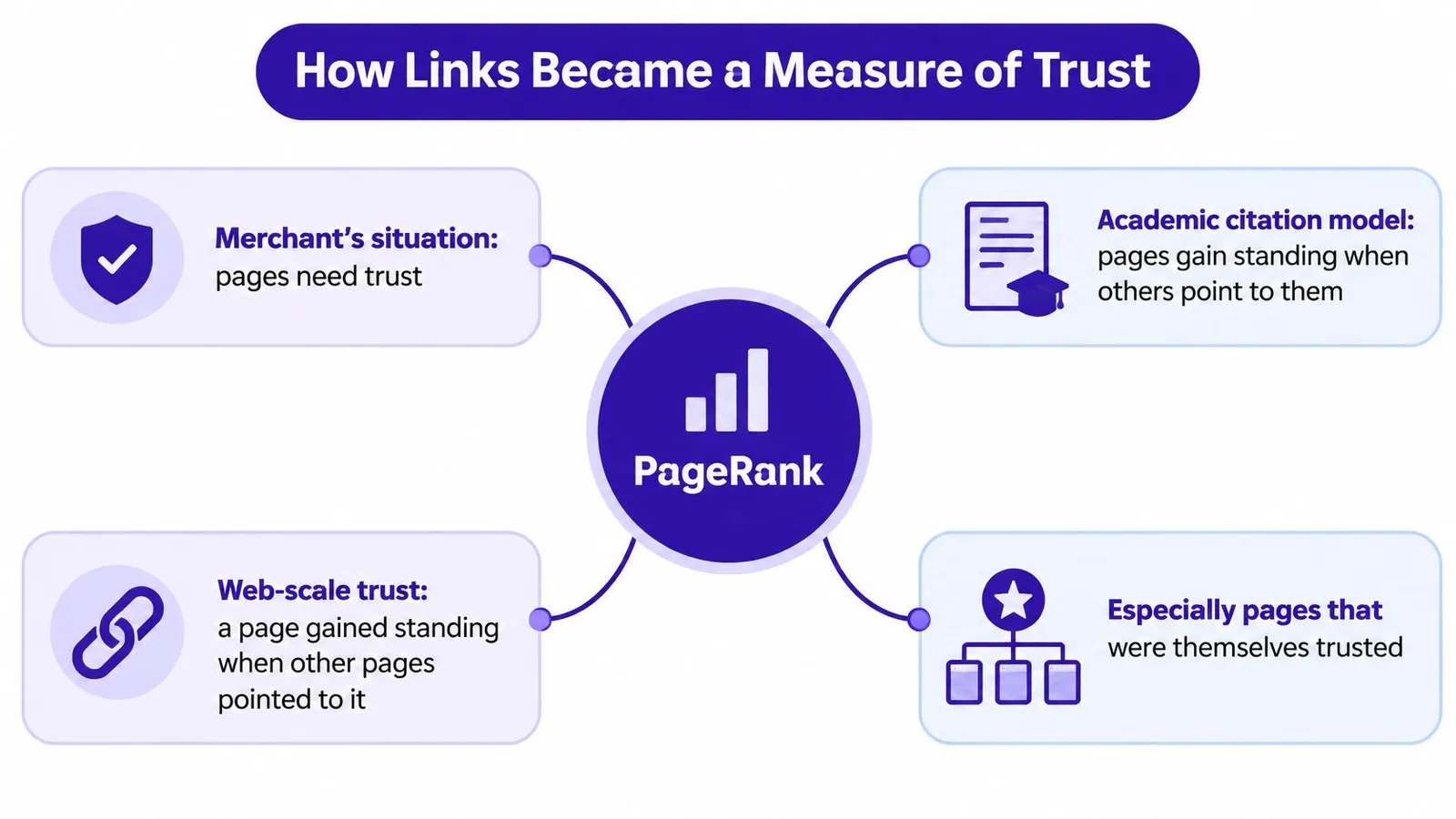
The idea that links signal trust did not start as a marketing tactic. It began as research. In the mid-to-late 1990s, Stanford researchers Larry Page and Sergey Brin developed PageRank, a system that judged a page partly by the pages pointing to it. Google built its early search technology around that model.
Think of academic research. A paper cited by many respected papers gains standing, because each citation reflects a judgment by another scholar. PageRank applied that logic to the web. A page gained authority when other pages linked to it, especially when those linking pages were themselves well regarded. Influence faded as connections became more indirect, much like a recommendation passed through several strangers.
The web-scale test
This was never a small experiment. Google's early PageRank work was tested on a dataset of approximately 24 million web pages, and the U.S. National Science Foundation description of PageRank explains that a page ranks highly when many highly ranked pages link to it. Link analysis was designed for a web-scale environment from the beginning, not added later as a patch.
The diagram below traces that citation logic from academic papers to web pages.
What that history means for a Shopify store
For a merchant, the lesson is concrete. A supplier page listing the store as a stockist, an industry guide citing its sizing research, or a reputable media mention of a distinctive product all act as citations. Each one says an independent page found the store relevant to its own readers. That is the original authority model still echoing in modern Off Page SEO.
There's a boundary, though. History explains why backlinks became foundational, but it doesn't promise that more links automatically win. Modern search systems weigh many additional signals and don't treat every link equally. A link from a trusted, topical page is a citation. A link from an irrelevant directory is closer to a flyer pinned to a random wall. The next question is more basic than rankings. Before a page can earn trust, Google has to find it in the first place.
How Google Finds Pages Through Links
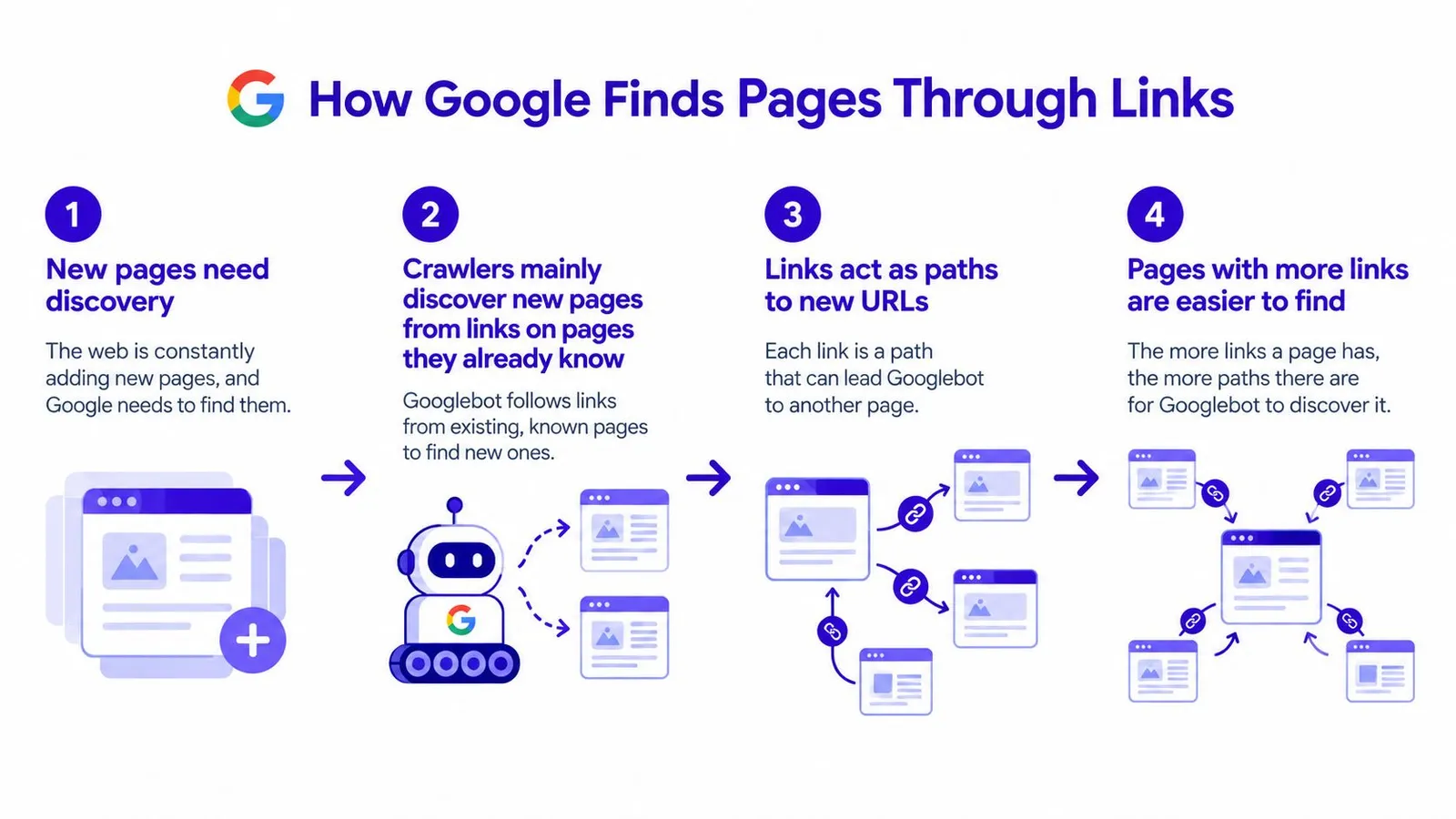
Ranking credit gets most of the attention, but discovery comes first. According to Google's SEO starter guide on how crawlers find pages, its crawlers primarily find new pages through links from pages already discovered, and the vast majority of new pages found each day arrive that way. A crawler, in plain terms, is Google's automated reader. It follows links the way a shopper follows aisle signs.
Crawlable links are the entry points
A link only helps discovery if the crawler can follow it. Google advises that pages should be reachable through crawlable links with relevant anchor text, meaning the clickable words describe the destination, or suitable image alternative text when the link is an image. Vague labels and isolated URLs give the crawler little reason or route to proceed.
The flow below shows how a known page becomes the path to an unknown one.
External links introduce, internal links distribute
External backlinks and internal links do different jobs. A link from another site can introduce Google to a domain or a new guide. Once one page is known, internal links spread that discovery across collections, products, and related posts. A merchant who wants to check those pathways can work through an internal linking audit for Shopify stores before chasing more outside attention.
Consider a store selling trail shoes. A buying guide explains waterproof membranes but never links to the waterproof collection it describes. A new product page sits outside every menu and guide. Both pages may be excellent, yet the crawler has a weak path to them, and shoppers landing on the guide have no route to buy.
Paired checklist: credible outside mentions to open the door, plus crawlable internal links so every important page sits on a path.
One caution keeps expectations honest. Google doesn't publish a fixed ranking percentage for links, and more links don't automatically produce better rankings. Links are a primary discovery mechanism, not a score to inflate. That distinction raises a sharper question. If links aren't all equal, which ones are worth pursuing?
Why Page Quality Beats Backlink Volume
Most link reports push merchants toward a simple target, such as a monthly quota of new backlinks. The evidence points somewhere else. An Ahrefs analysis of 44,589 non-branded keywords with monthly search volume between 2,000 and 5,000 compared the top 10 ranking pages for each keyword and examined what their referring pages had in common. A referring page is the external page containing the link.
The pattern worth noticing
The organic traffic of the referring page itself correlated more strongly with rankings than merely counting referring pages that received some traffic. Traffic at the referring-domain level showed little additional correlation. In plain language, the specific page carrying the link mattered more than the general popularity of the website hosting it.
What the Referring-Page Study Compared
| Signal | What the analysis found | Merchant reading |
|---|---|---|
| Referring-page organic traffic | Correlated more strongly with rankings | Target pages already earning search visits |
| Count of referring pages with traffic | Weaker correlation than page traffic | A quota of links is a poor goal |
| Referring-domain traffic | Little additional correlation | A famous domain alone proves little |
Correlation is not causation, and the study doesn't claim otherwise. Pages that rank well may naturally attract both traffic and links. Even so, the pattern retires a common shortcut. Domain Rating, a third-party score estimating a whole domain's link strength, becomes a weak filter on its own. A relevant page already winning search traffic for a matching topic can outweigh a link buried on a generally popular but unrelated site.
A small selection workflow
- Pick one target page: Start with a single article, product, or collection that deserves attention.
- Map a few candidate sources: List external pages already ranking for the same topic rather than broad directories, then check how that topic sits in a comparison to competitors.
- Judge page-level fit: Assess topical relevance, visible search traffic, editorial credibility, and whether the link would sit naturally in the text.
After a placement lands, monitoring matters more than celebration. A merchant can track whether the linking page stays indexed, watch the anchor-text mix so it doesn't look engineered, and follow impressions and average position for the target page. That record turns Off Page SEO from a counting exercise into a series of deliberate, page-level choices.
How Brand Mentions Shape Off Page SEO
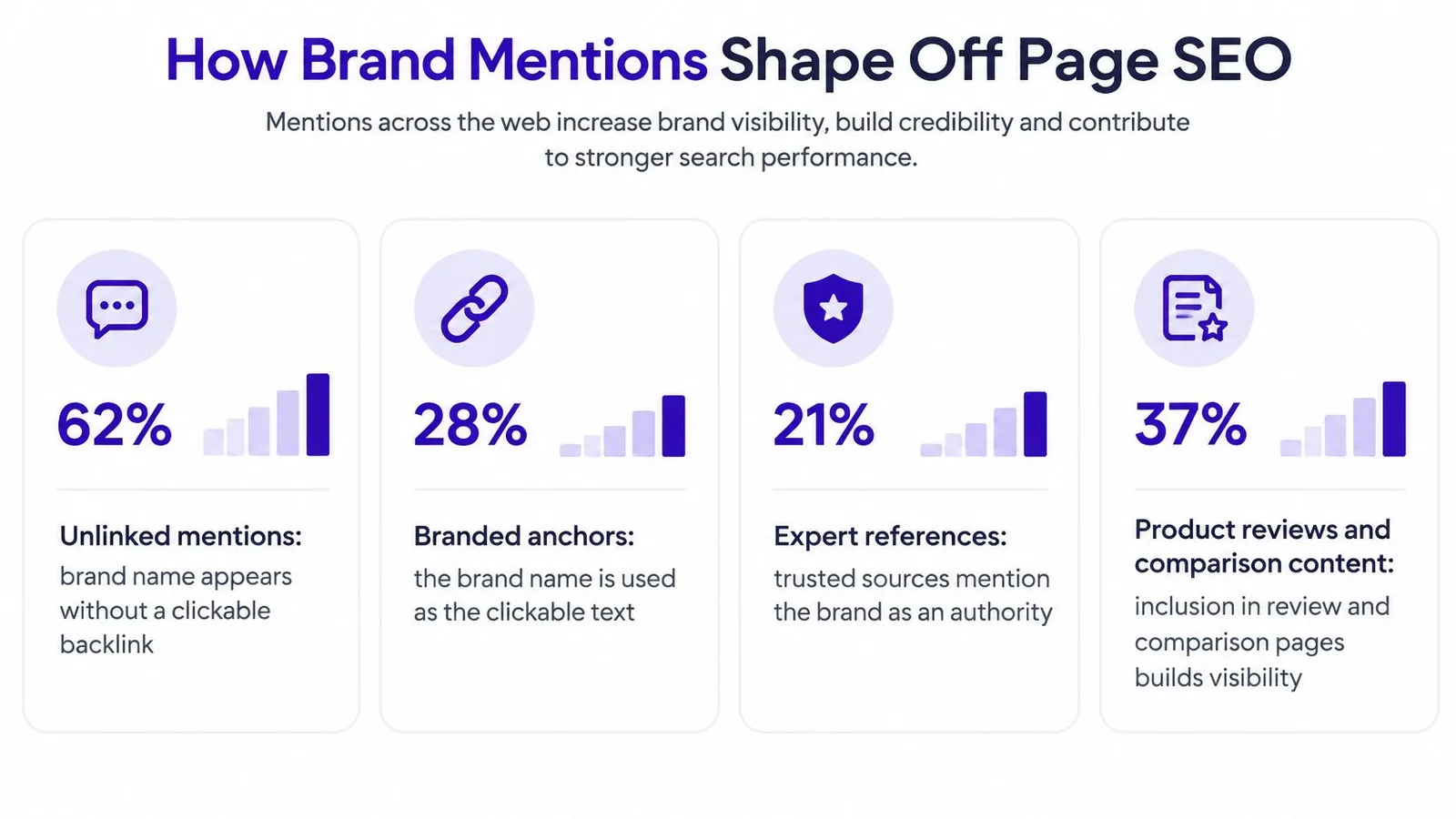
A backlink report counts what clicks. It misses every place a brand gets named without one. An unlinked mention, where the store name appears as plain text, still tells readers and search systems that the brand exists inside a topic. Branded anchors, where the name itself is the clickable text, carry that signal further because the label and the destination agree with each other.
Search engines increasingly treat a store as an entity, a recognized thing with a name, a category, and a reputation, rather than a pile of URLs. Mentions feed that recognition. A saddle brand cited in a cycling comfort guide teaches the system what the brand is and who it serves, even when no link travels with the citation.
Early research into AI-generated answers points the same direction. Brands that get named consistently across relevant pages tend to surface in those answers more often than brands that accumulate links from unrelated sites. The evidence is correlational, so treat it as a nudge rather than a law. Still, it weakens the assumption that one more generic backlink beats being cited by a source that covers your topic.
The dashboard below separates the mention types a merchant should track individually.
How a small store earns mentions without a PR team
Small stores rarely produce newsworthy studies, yet they hold material editors want. Founders know why products fail, which sizing mistakes repeat, and what repairs come back most often, and that grounded detail makes a brand worth naming in someone else's article. Contrast two outcomes. A respected cycling site cites the saddle brand inside a guide its readers trust. An unrelated high-traffic domain links to the same store from a page nobody reads. The first mention moves discovery further because context and credibility travel with it. Merchants measuring that wider footprint can frame it through share of voice in SEO rather than backlink totals alone.
Track mention quality, topical relevance, branded-search lift, referral conversions, and AI-answer inclusion instead of raw counts. Awareness-building mentions behave differently from links engineered to manipulate rankings, and that difference decides which tactics stay safe.
Choosing Safer Ways to Earn Mentions
Four routes sit in front of most Shopify merchants, and they carry very different risk. Original linkable assets come first. Product research, a careful buying guide, a clear data visualization, or distinctive product facts give other pages a reason to cite the store. The asset earns attention because it helps somebody else's reader, not because a deal required it.
Independent reviews and creator demonstrations work when the reviewer stays free to be unimpressed. A creator showing how a bag survives a commute gives shoppers evidence a product description can't fake. Retailer or supplier partnerships follow a similar logic. A stockist listing or co-created guide reflects a real commercial relationship, and the mention makes sense to anyone reading it.
Where the spam line sits
The fourth route, systematic link exchange, needs scrutiny. Under Google's spam policies on link manipulation, link spam includes buying or selling ranking-passing links, trading money, goods, or services for links, excessive reciprocal exchanges, automated link generation, and contract terms that require links without letting publishers qualify them. A technically valid link can still match a prohibited pattern.
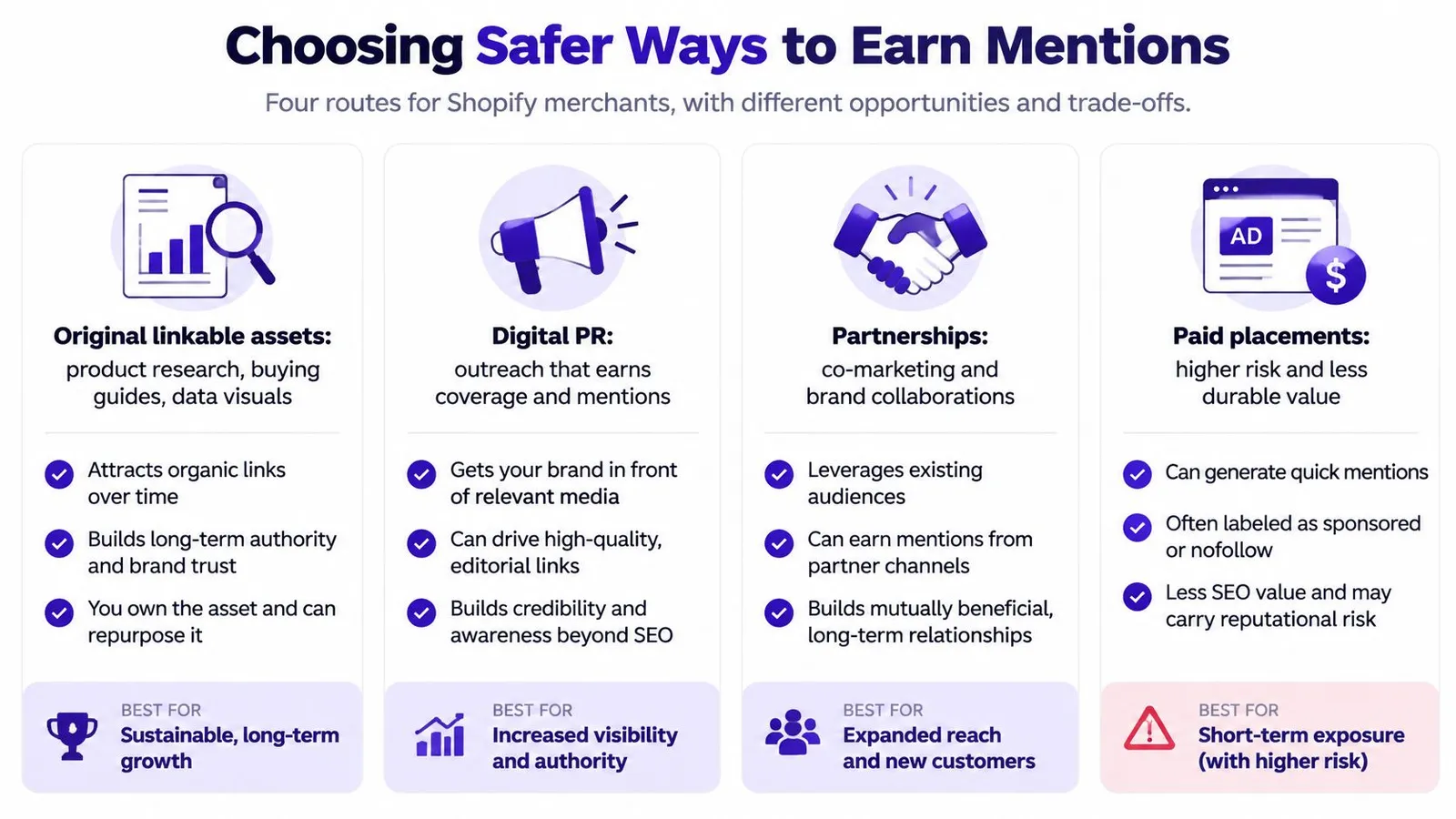
Qualification tools exist, but they're labels, not magic. rel="sponsored" marks paid placements, rel="ugc" marks user-generated links, and rel="nofollow" signals that ranking credit shouldn't pass. Honest labeling supports transparency, though it doesn't convert a manipulative scheme into an editorial mention.
Tools belong in this decision as options, not guarantees. Rankira, for example, runs inside Shopify admin, researches keywords from store, competitor, and Search Console context, generates blog posts with internal links to products, collections, and pages, schedules publishing or saves drafts, and reports clicks, impressions, positions, and Ahrefs Domain Rating. It also offers a credit-based backlink exchange, on a Standard plan at USD 39 monthly with a seven-day trial. A merchant using any such exchange still has to judge editorial merit, because credits that systematically produce reciprocal or commercial links can resemble the patterns Google prohibits. Records of source, relationship, placement context, rel attributes, and removal risk keep that judgment auditable. Stores building the asset side first can align that work with SEO content marketing for Shopify so each article gives external pages something worth citing.
A Practical Next Step for Your Store
One week is enough to start, provided the scope stays narrow. The sequence below fits a merchant with no content team and no appetite for a sprawling campaign.
The one-week sequence
- Pick one product or collection: Choose a page with real margin or a clear customer question behind it.
- List current outside signals: Search the brand name and product name, then record every existing link and mention, noting which mentions carry no link.
- Select three candidate pages: Favor external pages that already match the topic and show page-level search visibility over famous but unrelated domains.
- Publish or revise one supporting article: Give those sources something citable, such as original sizing data or a tested comparison, and add crawlable internal links with relevant anchors to the product or collection.
- Record every new mention: Log the source, relationship, placement context, and rel attributes at the moment it appears.
Stores wanting the research, drafting, internal linking, scheduling, and reporting handled inside Shopify admin can keep the first generated articles as drafts, then check links and claims before anything goes live. That draft review protects editorial quality while the workflow stays manageable, and the traffic side of the routine connects naturally with guidance on how to increase blog traffic.
What to watch afterward
Expect evidence, not a fixed ranking lift. A sensible watchlist covers whether the referring page stays indexed, whether branded-search queries grow, and whether referrals convert into orders. Impressions and average position for the target page show whether visibility moves at all. If a mention brings engaged readers but no position change, it may still be doing brand work that a backlink count would miss.
Start with one page, three relevant sources, and a clean record of why each mention exists.
That restraint is the point. Off Page SEO rewards stores that other pages choose to name for genuine reasons. A merchant who builds one citable asset, earns a few fitting mentions, and measures carefully has a foundation that volume tactics can't imitate.
Rankira brings keyword research, article generation with internal links, scheduled publishing, and search performance reporting into Shopify admin, so a small store can build the citable content that earns genuine mentions. Merchants ready to turn one product page into a steady source of outside visibility can start at Rankira and keep early drafts under review until every claim reads sound.
Keep reading
All articles
Shopify SEO
SEO Content Writing Principles for Readers and Search
Learn the principles of SEO content writing that balance search relevance, clear structure, and real reader value, with examples for online stores.
10 min read
Shopify SEO
Internal Linking Audit That Actually Improves Rankings
Run a practical internal linking audit to find orphan pages, fix broken links, and prioritize fixes that move revenue on your Shopify store.
10 min read
Shopify SEO
Share of Voice SEO: A Practical Measurement Guide
Learn how share of voice SEO works, how to calculate it, and how to use intent-based metrics to assess search visibility and business impact.
12 min read
Put your Shopify blog on autopilot
Rankira researches keywords, writes SEO articles, adds internal links, and publishes them to your store — every week. Start with a 7-day free trial.