Guest Blogging SEO: Benefits, Risks and Safe Outreach
Guest Blogging SEO explained: where the benefits lie, which risks to avoid, and how to run responsible outreach that builds trust and traffic.
Published 12 min read

In this article
The most popular guest blogging SEO advice starts with the wrong question: whether a publisher will provide a followed backlink. A better question is whether the publication reaches people who might benefit from the contributor's expertise. A link isn't a guaranteed ranking boost, and a placement shouldn't become worthless just because the publisher qualifies it.
For Shopify merchants, the useful distinction is between earning an audience's attention and arranging links mainly to influence rankings. Responsible guest blogging starts with editorial fit, documents the commercial relationship, and measures what readers do.
Table of Contents
- Guest Blogging SEO at a Glance
- How a Guest Post Creates Search Value
- Google's Rules for Guest Post Links
- Quality Checks for Editorial Guest Posts
- Measuring Guest Post Results Beyond Link Count
- How to Run Responsible Guest Post Outreach
- Confirm Your Outreach Plan Before You Pitch
Guest Blogging SEO at a Glance
Guest blogging helps through relevant exposure, referral visits, and brand recognition, not automatic ranking power. It means contributing an article to another publication, usually one whose readers overlap with the contributor's potential customers. Any search benefit needs to be assessed separately from the fact that an article went live.
Adoption remains substantial: RankStudio's guest blogging overview cites a survey of 755 link builders in which 64.9% used guest posting as a primary tactic, alongside a compilation citing Aira's State of Link Building that placed it at 47% of SEO professionals and third among methods. The samples and definitions differ, so those figures aren't interchangeable measures of the whole industry.
Popularity also isn't proof of effectiveness. A widely used tactic can produce excellent placements, irrelevant mentions, and everything between them.
Outcome layers a guest post can produce
| Outcome Layer | What It Looks Like | Metric to Track |
|---|---|---|
| Editorial inclusion | An article accepted and live on a relevant site | Live placements logged per quarter |
| Qualified referral traffic | Host readers click through to the store | Referral sessions by landing page |
| Branded search demand | Readers later search the brand name | Branded queries in Search Console |
| Assisted conversions | Referral visitors buy later through another channel | Assisted conversions in analytics |
| Ranking link equity | Possible from an independently earned editorial link, never guaranteed | Referring-domain quality and ranking movement |
These outcomes shouldn't be collapsed into a single success label. Editorial acceptance confirms publication, not customer interest. Referral sessions demonstrate visits, not necessarily purchases. Ranking movement is an observation, not proof that a particular backlink caused it.
Say a skincare store contributes a routine guide to a beauty blog. The publisher includes a nofollow link to a detailed ingredient guide, and readers explore related products after arriving. That hypothetical placement could deliver useful referral engagement even without a measurable ranking gain.
Planning rule: A placement needs a business purpose that still makes sense without promised ranking credit.
Before outreach begins, the merchant should choose a primary outcome and supporting measures. That decision determines which publications, topics, and destination pages deserve attention.
How a Guest Post Creates Search Value
A guest post is like being introduced at a neighbour's dinner party. The host's guests already care about the conversation, so a thoughtful introduction can earn attention. It doesn't make the visitor the host, guarantee another invitation, or establish expertise without a useful contribution.
The same distinction applies online. Publication creates an opportunity to demonstrate knowledge, but the article still has to reward the reader's attention.
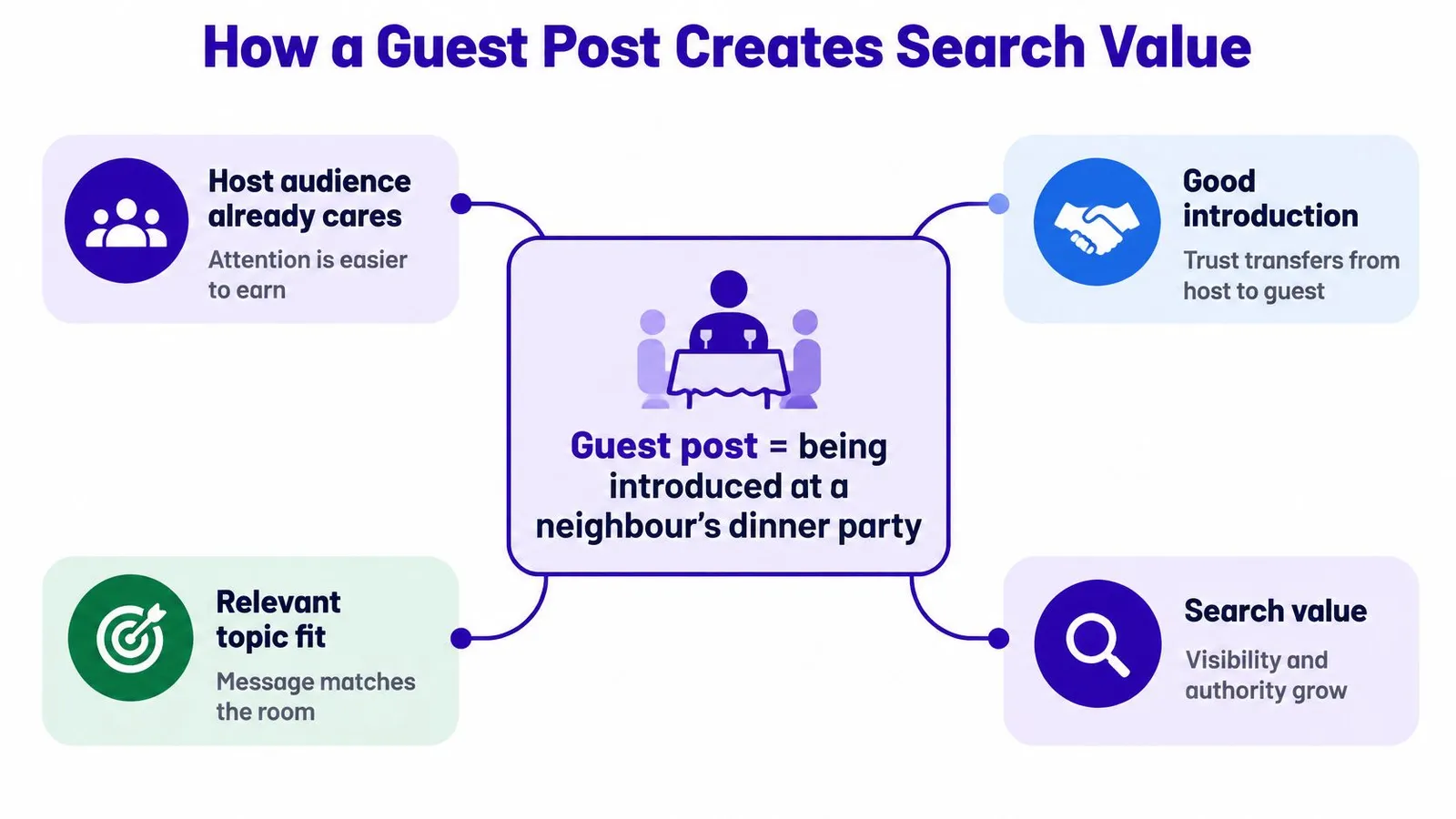
Relevance earns attention
Topical relevance means the contribution answers a question the host's readers already have. A pet-food store could contribute a clearly scoped explanation of feeding-label terminology to a veterinary publication, with appropriate professional review for health-related claims.
A fashion store placing an unrelated personal-finance article on a general blog has a weaker connection. Even polished writing won't explain why those readers should care about the store's products.
Referral usefulness and brand memory
Referral value comes from the next page, not merely the clickable text. A feeding article might lead naturally to a guide that explains portion calculations. Sending the same reader to a homepage with no relevant explanation creates unnecessary work.
Brand exposure is different. Readers may remember a useful contributor without clicking immediately, whereas a promotional biography attached to generic advice gives them little reason to remember the name. Neither behaviour should be confused with guaranteed search authority.
This makes guest contributions part of a broader off-page SEO approach, rather than a standalone mechanism for transferring rankings. The host provides access to an audience; the contributor must provide something worth discovering.
Google's spam policies distinguish legitimate publishing from links created primarily to manipulate rankings, including compensated arrangements that pass ranking credit. A payment, product gift, or service exchange therefore changes how a placement must be handled, even when the topic fits.
Would the host's audience want the article if the contributing store didn't exist?
That test removes the promotional scaffolding. If the remaining article still solves a recognisable problem, the pitch has a defensible editorial foundation.
Google's Rules for Guest Post Links
Links created mainly to manipulate rankings fall within link-spam risk. Payment isn't the only issue. Product exchanges, deliberately optimised anchors, and reciprocal arrangements can also indicate that the primary goal is acquiring ranking signals rather than helping readers.
The historical turning point came in January 2014, when Matt Cutts, then head of Google's webspam team, criticised guest blogging's use for manipulative link acquisition, as documented in RankStudio's guest blogging history. The distinction wasn't between all guest articles and no guest articles. It was between contributions written for readers and campaigns built primarily to pass PageRank.
Placement types and the attribute each needs
| Placement Type | When It Applies | Attribute to Use | Ranking Expectation |
|---|---|---|---|
| Independent editorial contribution | Publisher chose the topic, no payment | Standard link if the publisher independently adds one | Possible, never promised |
| Paid or compensated guest post | Money, free product, or other value exchanged | rel="sponsored", with nofollow where appropriate | Treat as a referral asset; hint only |
| Mention the publisher will not vouch for | Publisher doesn't want to endorse the linked destination | rel="nofollow" | Not a ranking tool |
| Reciprocal exchange for rankings | Stores swap links to lift rankings | Avoid; treat as scheme risk | High spam risk |
A standard link doesn't need a special “dofollow” attribute. That term generally describes a link without a qualifying relationship attribute, not an extra instruction that forces ranking credit.
The attributes sponsored, ugc, and nofollow describe link relationships and are processed as hints. They aren't commands that guarantee crawling, indexing, exclusion, or ranking treatment. ugc relates to user-generated content, such as comments and forum contributions, rather than automatically applying to every article written by an outside author.
Intent matters beyond the article
Suppose stores agree to publish each other's articles using exact-match commercial anchors. The articles might read well, but the agreement still creates scheme risk when its purpose is exchanging ranking signals.
A white-hat search engine optimization strategy therefore needs more than polished copy. Editorial independence, transparent compensation, and appropriate link treatment belong in the placement decision.
Before publication, the responsible editor should classify the arrangement against the table and record the decision. A disagreement about attributes is a reason to resolve the terms, not a reason to hide the commercial relationship.
Quality Checks for Editorial Guest Posts
An editorial quality check should leave a record another team member can inspect. A spreadsheet verdict such as “good domain” says little about the actual article, the readership, or the reason for including a link.
Google's link-spam policies specifically identify problematic links with optimised anchor text in distributed articles and guest posts. The practical response is an evidence-based approval process, not a blanket assumption that guest posting is either safe or unsafe.
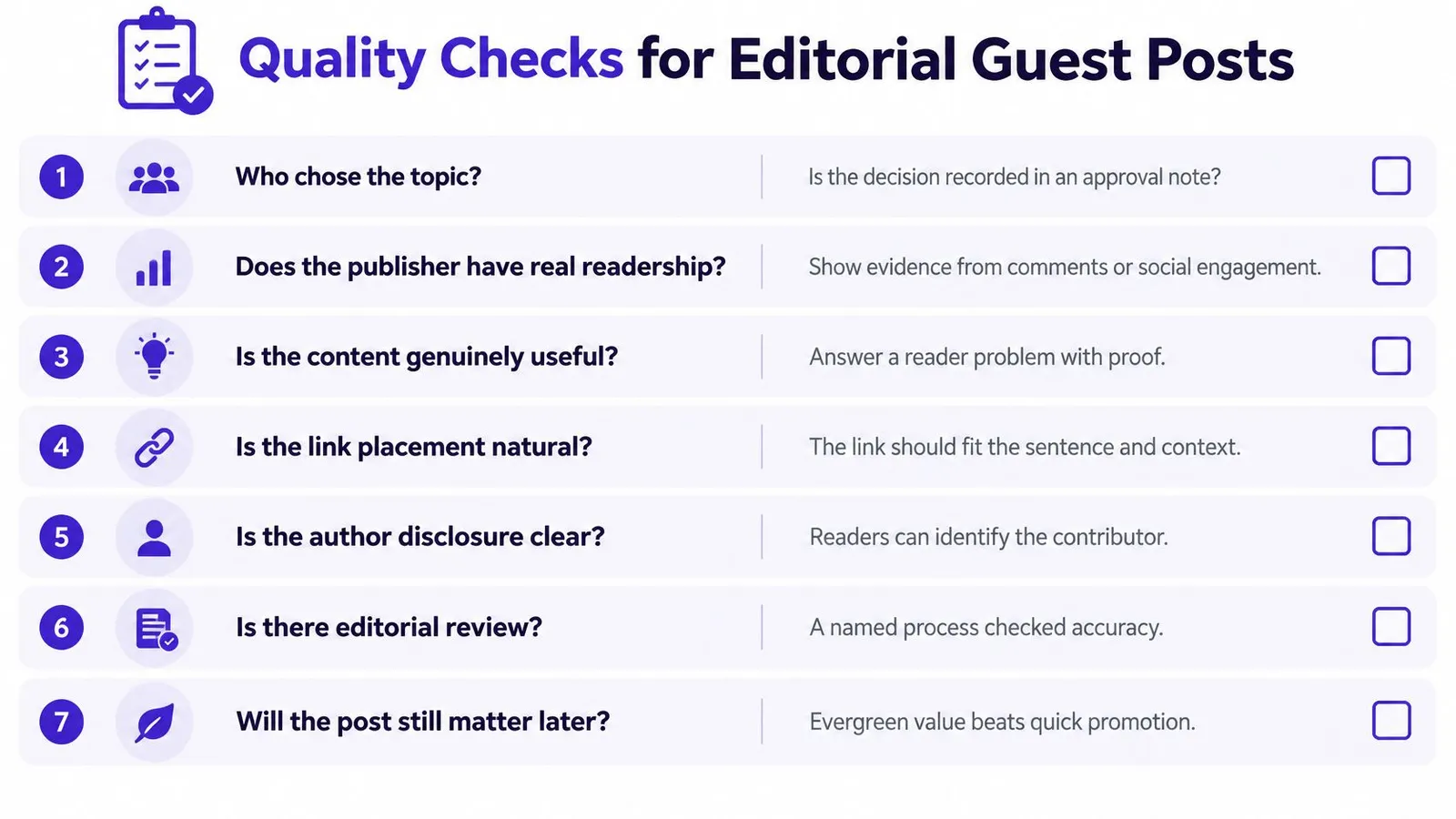
Pre-publication evidence checklist
Who selected the topic, and is the approval recorded?
Save the editor's approval and the proposed reader problem. This distinguishes an accepted contribution from an article assembled around a required backlink.Does the publisher show evidence of topical readership?
Record relevant discussions, substantive comments, or social engagement. A free traffic-estimation tool can support the assessment, but estimates aren't proof of an engaged audience.Does the article contain original evidence or practical expertise?
A documented process, clearly explained product test, or appropriately anonymised store data can justify publication. Rewording existing advice doesn't establish an original contribution.Does the destination answer a question raised in the article?
The reviewer should identify the precise reader need the linked page serves. A buying guide may fit; an unrelated collection page inserted for commercial convenience may not.Is compensation or exchange disclosed and correctly qualified?
Record gifts, payments, services, and other consideration. Readers need a clear commercial disclosure where applicable, while the publisher needs the appropriate link relationship attribute.Is the anchor descriptive or branded rather than forced?
The sentence should sound natural when spoken aloud. Repeated commercial keywords are a warning sign when they reflect campaign instructions rather than editorial wording.Does the campaign avoid mechanically repeated placements?
Review article templates, bios, anchors, and destination pages across the placement log. Consistent author credentials are reasonable; manufactured variation or repeated promotional scaffolding isn't editorial independence.
Turning checks into a decision
A hypothetical article explaining a store's return-rate analysis could pass when its method, limitations, audience fit, and editorial approval are documented. Publishing near-identical versions across unrelated blogs with the same commercial anchor would undermine that decision.
Good SEO content writing requires a useful answer before link placement enters the discussion. A reviewer should return incomplete submissions for revision and reject arrangements that depend on manipulating ranking signals.
A qualifying attribute doesn't rescue thin content. Marking a mass-produced article nofollow or sponsored addresses a link relationship, not whether the contribution deserves a reader's time.
Measuring Guest Post Results Beyond Link Count
Low referral clicks don't automatically mean a guest post failed. A contribution may reach a tightly matched audience, prompt later brand searches, or support a purchase journey without producing an immediate click. Those possibilities still need evidence rather than a convenient story attached to disappointing traffic.
Google's discussion of AI search behaviour describes longer, more complex searches and additional links in AI search experiences. That context supports measuring discovery beyond immediate visits, but it doesn't prove that any particular guest contribution earned visibility or influenced a purchase.

Guest post scorecard by outcome layer
| Layer | Metric | Where to Check | Healthy Signal |
|---|---|---|---|
| Editorial inclusion | Accepted and live placements | Placement log | Live on relevant hosts |
| Qualified referral behaviour | Referral sessions and pages per session | Analytics referral report or exploration | Visitors reach product or guide pages |
| Branded and search demand | Branded query impressions and clicks | Search Console | Branded queries rise after launch |
| Assisted conversions | Conversions with a referral in the path | Analytics attribution-path reports | Relevant referrals appear in purchase paths |
| Link qualification | Attribute and anchor audit | Placement log and live-page check | Attributes match the deal and anchors read naturally |
Editorial inclusion needs a live-page check: the agreed article should be accessible, attributed correctly, and published in the expected context. Referral assessment then asks whether visitors move beyond the landing page to meaningful guides, product details, or configured key events.
Branded demand requires a different comparison. Search Console can show changes in brand-related queries, while broader share-of-voice SEO measurement can help organise visibility monitoring. A simultaneous promotion or seasonal campaign must be noted before assigning the change to guest blogging.
Attribution without false certainty
Assisted conversions concern the recorded customer journey. In Google Analytics, attribution-path reporting can help identify referrals that preceded purchases, subject to tracking configuration, consent, and available data. There's no universal conversion benchmark for guest placements.
Rankira recommends allowing two to three months of consistent publishing before judging results because SEO compounds slowly. That's a review window, not a promise that rankings will change by its end.
A change after publication is an observation. A claim that the guest post caused it needs supporting evidence.
Consider a hypothetical product-care contribution with few direct visits. If relevant referral paths include purchases and branded queries rise without an obvious competing explanation, the placement merits continued evaluation. Without those signals, assumed trust or exposure shouldn't substitute for measurable results.
How to Run Responsible Guest Post Outreach
Responsible outreach begins with publisher selection and continues after publication. A shared placement sheet should connect the pitch, editorial approval, commercial terms, live article, and measured outcomes so that an agency handover doesn't erase the reasoning.
The workflow also needs realistic expectations. Google's outbound-link qualification guidance explains how relationship attributes should be used; none should be sold as a guarantee that a link will be followed or credited.
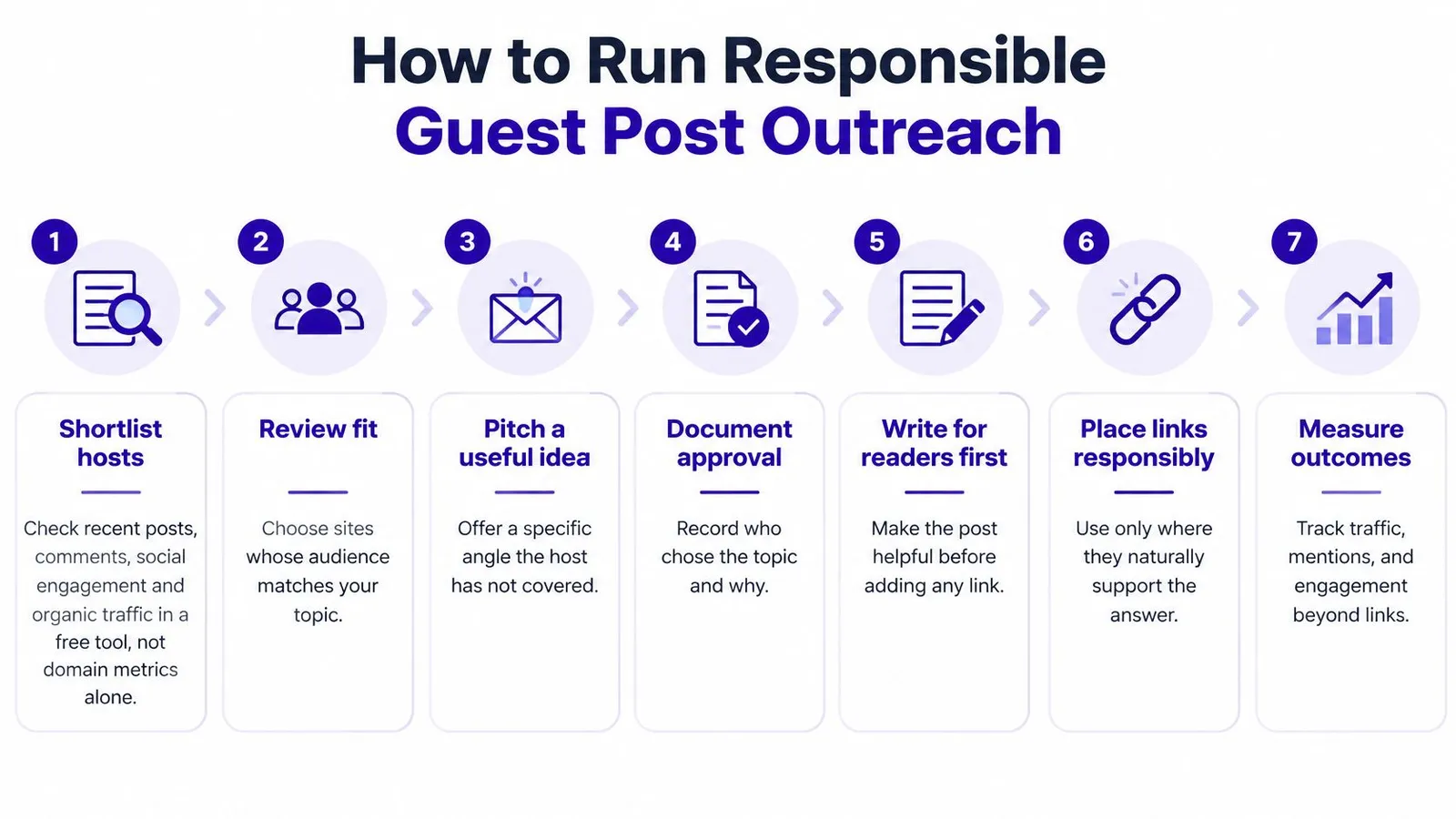
From shortlist to publication
Shortlist publications by readership and subject fit.
Review recent articles, contributor standards, comments, and social discussions. Use a free tool's traffic estimate as supporting evidence, not a substitute for inspection, and reject sites selling ranking-credit links or showing no credible readership.Pitch a specific editorial angle with a short outline.
Reference a relevant article and identify the unanswered question the proposed contribution would address. A clear audience problem gives the editor something concrete to evaluate, unlike a generic offer to supply content.Agree terms in writing before drafting.
Record the approving editor, scope, review process, compensation, disclosure, and link treatment. Clarifying these details early prevents a completed article from becoming bargaining power in a backlink negotiation.Write for the publication's readers.
A sensible starting constraint is a single contextual store link, included only when its destination helps answer the reader's question. This is an editorial restraint, not a Google limit; an unnecessary link should be removed altogether.Use an accountable author identity.
The byline should identify the actual contributor and describe relevant experience without inflated credentials. For Rankira-managed publishing, the author name is set in Settings › Website & Blog, and a real person's name reads as more trustworthy than a brand name.Confirm compensated-link qualification on the live page.
Requestrel="sponsored"for compensated placements, withnofollowadded where appropriate. Checking the published HTML matters because an agreed attribute can be missed during editing or uploading.Complete the placement record.
Log the publisher, publication date, topic, destination URL, anchor, relationship attribute, compensation, and approval evidence. This creates a practical foundation for responsible backlink work and subsequent performance review.Preserve published destinations.
Rankira advises treating a live article's web address as permanent. Changing its URL without a working redirect leaves existing links pointing to a missing page and can interrupt any ranking value those links conveyed.
The mistake that weakens both pitch and article
A pitch requesting a keyword-rich anchor shifts the discussion from reader usefulness to ranking manipulation. The matching writing mistake is adding a commercial destination after the article is finished, regardless of whether it helps.
Editors should receive a useful idea, not an anchor-text order. Readers should reach a page that fulfils the promise of the sentence they clicked.
Confirm Your Outreach Plan Before You Pitch
A workable outreach plan connects editorial purpose, accountable approval, and transparent commercial terms. A relevant publication alone isn't enough if the contribution has no distinctive value or the arrangement depends on hidden link trading.
Before a pitch leaves the queue, the merchant or agency should answer these go-or-no-go questions:
- Audience value: Would the host's readers want this article even if the contributing store didn't exist?
- Accountability: Can the team identify the editorial approver and record the planned placement before publication?
- Commercial clarity: If compensation or exchange is involved, will it be disclosed and will the links carry the appropriate attributes?
Affirmative answers support sending the pitch, not declaring the placement successful. A negative answer calls for a revised angle, clarified terms, or removal from the shortlist. Commercial clarity can be marked not applicable only when the absence of compensation or exchange has been confirmed.
Prepare the destination before seeking attention
The receiving page should continue the explanation rather than force an abrupt sales pitch. A product-care contribution, for example, needs a useful care guide or relevant product-information page at its destination.
For merchants maintaining owned content, Rankira is a Shopify app that uses product, collection, and page context to draft SEO articles. It generates scheduled articles with AI images, internal links, and meta tags, then either publishes them to the Shopify blog or saves them as drafts for manual review and publishing.
The strongest guest contributions serve the host's readers first. The measurement sheet, destination-page review, and approval record should be ready before outreach begins, so publication starts an evaluation rather than ending one.
Rankira offers scheduled Shopify blog content with internal links and a draft-review option, helping merchants prepare relevant pages for guest-post readers. Visit Rankira to explore an owned-content workflow that can support responsible outreach and useful next steps for arriving visitors.
Keep reading
All articles
Shopify SEO
Search Engine Optimization Plan for Shopify: 2026 Guide
Build a search engine optimization plan for your Shopify store: set a baseline, pick keywords, publish in batches and measure results.
11 min read

Shopify SEO
10 SEO Software Platform Options for Shopify Stores
Compare 10 SEO software platform options by capabilities, use cases, and Shopify fit, from keyword research to publishing and reporting.
11 min read

Shopify SEO
Keyword Density SEO: How to Calculate and Use It
Keyword density SEO is a percentage, not a ranking target. See the formula, sample counts, and how to place phrases without stuffing.
12 min read
Put your Shopify blog on autopilot
Rankira researches keywords, writes SEO articles, adds internal links, and publishes them to your store — every week. Start with a 7-day free trial.