White Hat Search Engine Optimization for Shopify in 2026
White hat search engine optimization for Shopify: principles, safe techniques, risky practices to avoid, and how to measure results that last.
Published 11 min read

In this article
- Table of Contents
- What White Hat SEO Means and Why It Still Pays
- White Hat Versus Grey and Black Hat Tactics
- Four Principles Behind Every Lasting Ranking Gain
- How to Build White Hat Foundations on a Shopify Store
- Risky Publishing Practices and the Quality Gates That Prevent Them
- Measuring Results That Show Sustainable Growth
- Run a White Hat Audit on Your Store This Month
83% of 439 surveyed UK small and medium-sized businesses said they preferred white-hat SEO practices, according to SEO Caddy's UK Small Business SEO Impact Report. White hat search engine optimization is optimization that follows search engine guidelines and earns rankings through useful content, crawlable structure, and genuine editorial links.
That preference undercuts the advice most stores still follow. Publish more pages, hit the keyword, and treat a number-one listing as proof the method worked. A first-place result can sit under an AI summary that answers the question before anyone clicks. A rank with no citation, no visit, and no sale hasn't paid for the page. Grey and black hat methods chase the same positions. The split is the method, and a Shopify owner can test every page, link, and AI-assisted draft by whether it would still help a shopper if rankings never moved.
Table of Contents
- What White Hat SEO Means and Why It Still Pays
- White Hat Versus Grey and Black Hat Tactics
- Four Principles Behind Every Lasting Ranking Gain
- How to Build White Hat Foundations on a Shopify Store
- Risky Publishing Practices and the Quality Gates That Prevent Them
- Measuring Results That Show Sustainable Growth
- Run a White Hat Audit on Your Store This Month
What White Hat SEO Means and Why It Still Pays
A white hat store is the one customers recommend to friends. A black hat store pays for fake recommendations those customers never see. Both want the same foot traffic. Only one earns it.
A grey hat method sits between the two, and the difference is intent. A link between two related shops can help a reader find a real supplier. The same swap, repeated across unrelated sites to lift a collection page, is manipulation. The goal never changes. The method does.

In one dataset tracked by BrightEdge research, organic search generated 53% of trackable website traffic, paid search generated 15%, and the two together accounted for 68%. Those are shares inside that dataset, not a promise for any single candle shop or apparel store. What they do show is that organic search carries enough traffic to be worth earning in a way that lasts.
White hat SEO runs like quality control on a packing line. Before anything ships, it passes a check: does the article answer a real question, does the link send the reader somewhere useful, does the AI-assisted draft read like a person reviewed it? Success then shows up in citations inside AI answers, clicks that reach your catalog, and orders that trace back to a search visit. A position number alone proves none of that.
Rankings built this way compound over months, because each reviewed article and genuine mention keeps earning after the publish date. Rankings bought through shortcuts can disappear in a single core update. One approach builds an asset. The other rents a position.
White Hat Versus Grey and Black Hat Tactics
Seven everyday tactics show the split between a risky version, a white hat alternative, and the outcome each tends to produce.
| Tactic | Risky version | White hat alternative | Likely outcome |
|---|---|---|---|
| Link building | Buying links from link farms or private blog networks | Earning mentions from suppliers, partners, press, and resource pages | Manual action and lost link equity |
| Content production | Hundreds of near-identical location or keyword pages | One reviewed article per search intent, linked to real catalog pages | Scaled content abuse demotion |
| Keyword use | Repeating a phrase in titles, alt text, and hidden text | Natural titles and descriptions written for the shopper | Weaker relevance signals and a lower click-through rate |
| Redirects and cloaking | Showing crawlers different content or using doorway pages | The same content for people and crawlers, with redirects that keep the real page | Removal from search results |
| Reviews and markup | Fake reviews or schema describing content that isn't on the page | Real reviews and markup that matches visible content | Lost rich results or a manual action |
| Reciprocal link swaps | Mass link exchanges with unrelated sites | Occasional links to relevant stores where they help the reader | Reduced trust and a possible demotion |
| Paid placements | Undisclosed sponsored posts | Disclosed sponsorships marked with rel="sponsored" | Penalty risk and a loss of reader trust |
The two rows people argue about
Reciprocal swaps and paid placements are the grey zone. Search engines don't ban every link between two stores, and they don't ban sponsorship. Google classifies links created mainly to manipulate rankings as link spam. A ceramic studio linking once to a glaze supplier, because that page helps a buyer, is editorial. Fifty unrelated blogs swapping homepage links on a schedule is a scheme. A disclosed gift-guide mention marked rel="sponsored" tells both readers and crawlers what the relationship is. An undisclosed paid post pretends the mention was earned.
Penalties aren't all the same size. A demotion on one thin page can lift after the store cleans or removes that page. A manual action, or removal from results, can take weeks to clear after a reconsideration request, and only if the underlying pattern is actually gone.
A practical guide to how to earn backlinks without buying them starts from the same test as this table. Would the tactic still be worth doing if search engines didn't exist? If the honest answer is no, it belongs in the risky column.
Four Principles Behind Every Lasting Ranking Gain
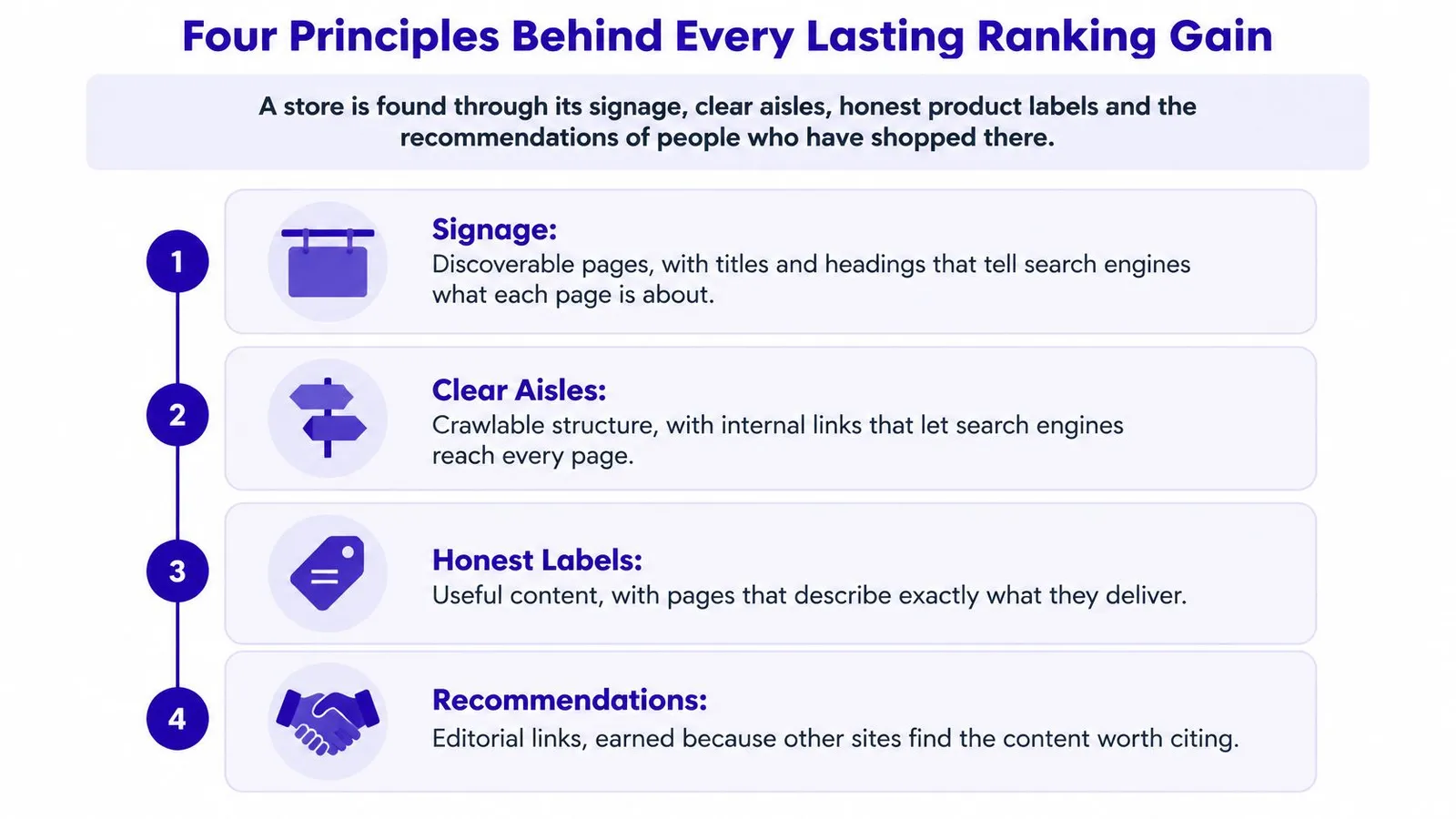
Think of the storefront, not the algorithm. Shoppers find a shop through its signage, clear aisles, honest product labels, and recommendations from people who have already bought there. Lasting rankings rest on the same four supports. Pull one out and the others carry less weight.
Usefulness for one query
Each page should answer one search intent better than the alternatives. A "wool sock care" article that also tries to rank for "merino vs cotton," "best gifts for hikers," and "sock subscription" answers none of them well. One clear job, written with real product knowledge, beats four muddy ones. Strong SEO content writing starts by deciding that job before a draft exists.
Discoverability
Crawlable structure means every important product, collection, and article can be reached from another findable page. Orphaned lookbooks and JavaScript-only menus hide inventory the same way a stockroom with no aisle does.
Earned authority
Google's link analysis began as PageRank, developed in Larry Page and Sergey Brin's Stanford research and used when Google launched. Google states that PageRank evaluates how pages link to one another to judge what pages are about and which may be most useful, and that it remains part of core ranking systems even after years of change. Links count when they're earned through useful pages and real relationships. Bought or manufactured links imitate the handshake without the purchase.
Honest signals
Titles, descriptions, structured data, and reviews should match what a shopper sees. Markup that claims a five-star rating the page doesn't show, or a title that promises a buying guide the article never delivers, is a false label on the shelf.
Usefulness gives the other three something worth finding. Discoverability lets crawlers reach it. Earned links tell other sites it was worth citing. Honest signals keep the listing from overselling the page. A failure in any one weakens the rest. A brilliant care guide that nothing links to, internally or externally, stays in the stockroom.
How to Build White Hat Foundations on a Shopify Store
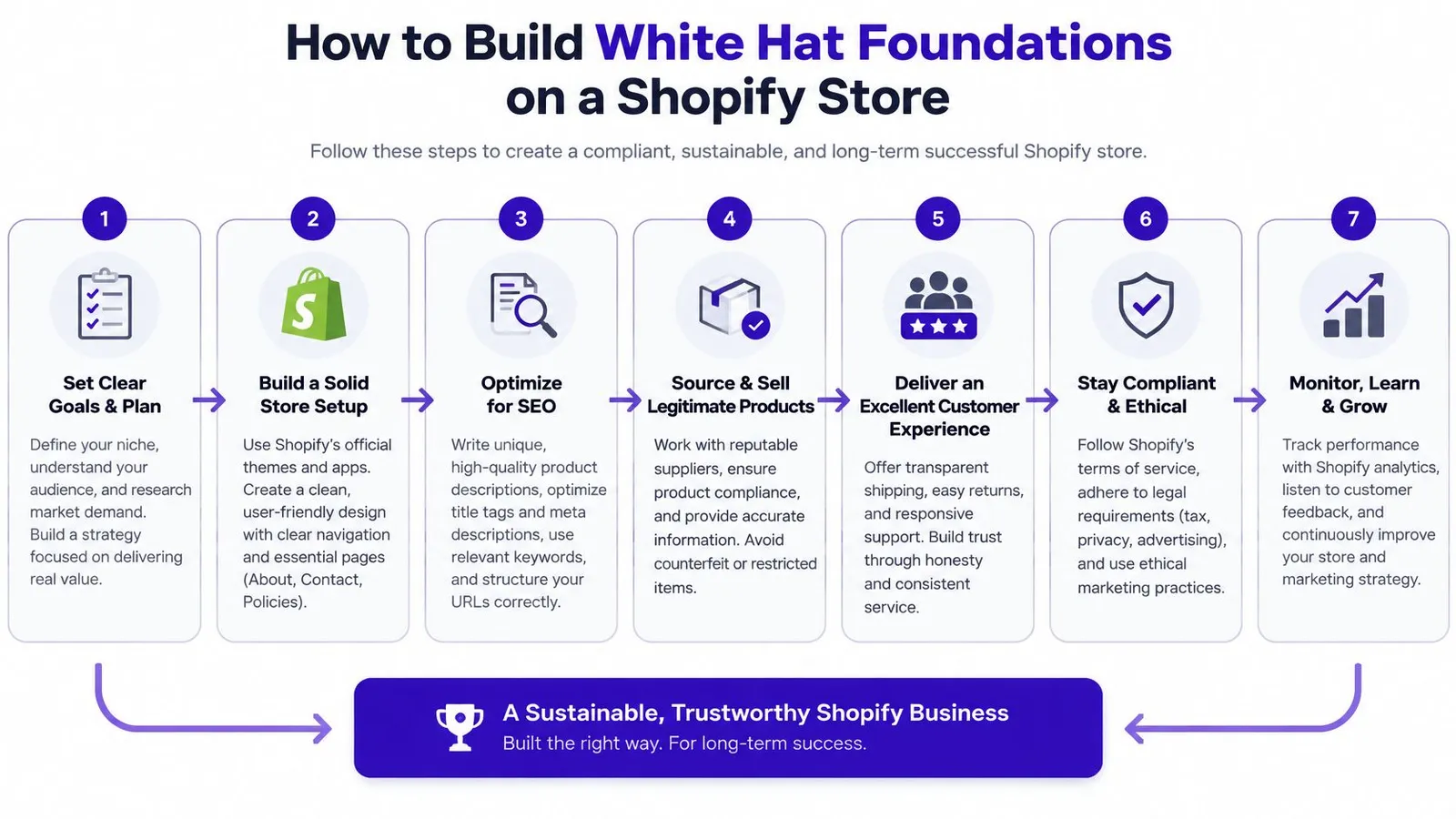
Foundations are boring on purpose. They're the aisles. The flow below is the order a merchant can finish without a developer on retainer.
- Verify the domain in Google Search Console and submit the sitemap. Shopify generates one at
/sitemap.xml. Search Console is how the store learns which URLs Google has fetched. Connecting it to a tool such as Rankira links the Google account so performance can be read. That connection is read-only and can be disconnected at any time, so setup doesn't require write access. - Confirm the primary domain is the one customers see, with HTTP sent to HTTPS. Split hosts divide links and analytics across two versions of the same shop. A common slip is leaving the
myshopify.comhost indexable after the custom domain goes live. - Keep product and collection handles descriptive, and don't reuse an old handle for a different page. When a handle changes, let Shopify create the redirect. Reusing
/collections/salefor a new category sends old links to the wrong products. - Write a unique title and meta description for each product, collection, and page. Repeating one description across color variants makes those URLs compete with each other. Titles should say what the item is, not stuff every synonym into the tag.
- Link each blog article to two or three relevant collections or products with descriptive anchor text. Google states that Googlebot discovers URLs by fetching links, sitemaps, and redirects, and recommends that every important page be reachable through standard link elements. "Wool hiking socks" beats "click here." Deeper on-page optimization covers titles and headings. This step is about the path between article and catalog.
- Match product and article structured data to visible content, and canonicalize filtered collection URLs to the main collection. Structured data can qualify a page for richer results. It doesn't replace crawlability or a good page. A theme app plus an SEO app often injects a second copy of product schema. That's the usual slip, and it confuses the rating and price Google reads.
- Inspect key URLs with URL Inspection after publishing, and fix anything reported as not indexed. A page can be linked and still be blocked by a noindex tag, a bad canonical, or a soft 404.
The short walkthrough below shows the same Search Console checks on a live store, from property setup through a single URL inspection.
None of these steps manufactures a ranking. They make the pages a merchant already cares about possible to find, possible to understand, and possible to measure.
Risky Publishing Practices and the Quality Gates That Prevent Them
Google defines scaled content abuse as generating many pages mainly to manipulate rankings instead of helping users, and says violations can bring lower rankings or removal from results. The policy judges the page by value, not by whether a person or a model typed the first draft. An AI-assisted article isn't penalized for being AI-assisted. The risk is automated volume plus thin, repetitive, or interchangeable pages.
Gates before a draft goes live
Apply these four checks to every article, including translations. Localizing one master post into ten regions can multiply near-duplicates unless terminology, units, availability, and claims are checked for each market.
- One intent per URL: Consolidate overlapping keyword targets before writing, so a single page owns the query. Two articles on "how to wash merino" will split impressions and neither will look complete.
- No near-duplicates: Don't spin the same copy across color variants, filtered collections, or city names. Forty pages titled "Best boots in {city}" fail. One comparison that uses real stock, a sizing note, and a clear recommendation can stand on its own.
- Verified claims plus first-party detail: Check every fact. Add something only the merchant knows, such as a material limit, a fit note, or a shipping cutoff. Unsupported claims are how an automated draft becomes a liability.
- Human approval on commercial pages: A person should sign off on anything that recommends a product or states a price, a policy, or a comparison. Draft review beats automatic publication for those URLs.
If a shopper wouldn't miss the page when it disappeared, it wasn't worth indexing.
Links follow the same standard. Internal links should help navigation, not stuff anchor text. External mentions should be genuine. Stores that trade mentions through a backlink exchange need a proper custom domain, because links from .myshopify.com addresses are excluded and carry no SEO value. After publishing, watch impressions, clicks, indexing, and position for signs the page satisfies searchers, not merely that the blog got longer.
Measuring Results That Show Sustainable Growth
Seven metrics separate a page that's merely ranking from one that's earning citations, visits, and sales.
| Metric | Where to find it | Healthy sign | What it tells you |
|---|---|---|---|
| Impressions | Search Console performance report | Steady rise for target queries over two to three months | Whether pages are visible in results |
| Clicks | Search Console performance report | Growth in non-branded clicks to articles | Whether visibility turns into visits |
| Average position | Search Console performance report | Movement from page three toward the top ten | Ranking progress, not revenue |
| Indexed pages | Search Console page indexing report | New articles and products indexed without errors | Whether content is discoverable |
| Branded searches | Search Console query filter or analytics | Gradual rise after articles and genuine mentions | Growing awareness of the store |
| Assisted conversions | Shopify analytics or GA4 | Articles appear earlier in purchase paths | Business value beyond the click |
| AI answer citations | Manual checks of target queries | Store referenced in generated answers | Visibility where answers replace clicks |
Why clicks alone mislead
A page can rank first and still lose the click. An Ahrefs analysis of 300,000 keywords found that position-one click-through rates were 58% lower for informational queries with an AI Overview than for comparable queries without one. Separate browsing research from Pew, reported in that same analysis, found users clicked a traditional result in 8% of visits when an AI summary appeared, versus 15% without one.
Read three outcomes separately. Citation means the store is named or linked inside the generated answer. Click means someone still chose the site. Conversion means the session did something useful, such as a product view, an email signup, or a sale in which the article appeared earlier in the path. Publishing more generic explainers can raise impressions while citations and assisted conversions stay flat, because the page restates facts the summary already has.
Rankira recommends two to three months of consistent publishing before judging results, because SEO compounds slowly. Once an article starts collecting impressions, it shows up on the Home dashboard, provided Google Search Console is connected. Learning to check ranking on Google is useful, and it isn't the whole scorecard. Position moving from page three into the top ten is progress. It isn't revenue until clicks, branded searches, or assisted conversions move with it.
Run a White Hat Audit on Your Store This Month
A white hat audit works like a quality-control pass on a production line. Each question tests one station, and a failure at any station pauses output until it's fixed. Six yes-or-no questions fit in an afternoon. A "no" means a publishing pause, not a new project.
- Is Search Console connected, with the sitemap free of errors? If the sitemap fails or the property sits on the wrong host, every metric after this point is unreliable.
- Can every important product, collection, and article be reached through a standard link? Orphaned URLs fail discoverability even when the copy is good. A focused internal linking audit maps where those paths break.
- Do the last ten articles pass the quality gates? One search intent, verified claims, a first-party detail, and a human review. If software drafts the articles, a person still reads each one, before it publishes when the workflow allows it and right after when the tool publishes automatically.
- Are near-duplicate product or collection descriptions merged or differentiated? Filtered pages and variants shouldn't compete as copies of the same pitch.
- Do outbound links point to relevant pages, and do reviews and markup match what's visible? A link that doesn't fit the topic and schema that overclaims both belong in the risky column.
- Do impressions, clicks, and indexed pages follow a healthy trend? Flat indexing while the page count climbs means new URLs aren't entering the results.
Six yeses means the cadence can stay.
Any no means slow publishing until that gap closes, then recheck in two weeks. Adding pages on top of a broken aisle only makes the next audit longer.
Rankira can run parts of this audit for a Shopify store. Its keyword research studies the store's products, competitors, and Google Search Console data to surface keywords with search volume and difficulty scores, and generated articles carry internal links to products and collections, which covers question two as articles publish. Once the read-only Search Console connection is in place, the dashboard reports clicks, impressions, and positions, feeding question six. A practical first step is connecting Search Console from Settings and running a first keyword research pass, then checking what it finds against this list.
Keep reading
All articles
Shopify SEO
Search Engine Optimization Plan for Shopify: 2026 Guide
Build a search engine optimization plan for your Shopify store: set a baseline, pick keywords, publish in batches and measure results.
11 min read
Shopify SEO
10 SEO Software Platform Options for Shopify Stores
Compare 10 SEO software platform options by capabilities, use cases, and Shopify fit, from keyword research to publishing and reporting.
11 min read
Shopify SEO
Keyword Density SEO: How to Calculate and Use It
Keyword density SEO is a percentage, not a ranking target. See the formula, sample counts, and how to place phrases without stuffing.
12 min read
Put your Shopify blog on autopilot
Rankira researches keywords, writes SEO articles, adds internal links, and publishes them to your store — every week. Start with a 7-day free trial.