Keyword Density SEO: How to Calculate and Use It
Keyword density SEO is a percentage, not a ranking target. See the formula, sample counts, and how to place phrases without stuffing.
Published 12 min read

In this article
There is no official Google keyword-density percentage. Keyword density is calculated as exact phrase count divided by total words, times 100.
That makes it a measurement, not a prescription. A writer can calculate it perfectly and still produce a page that doesn't answer the shopper's question.
The familiar advice to keep adding a phrase until an SEO plugin turns green reverses the editorial process. A useful article starts with an answer, supporting details, and clear product context. The counter belongs near the end, where it can flag repetition that deserves a closer look.
Table of Contents
- What Keyword Density Measures on a Page
- How to Calculate Keyword Density from a Draft
- Why Percentage Targets Do Not Rank Content
- Where to Place the Phrase Without Repeating It
- A Product Article Written at a Natural Rate
- Review Each Repeat and Publish Without a Quota
What Keyword Density Measures on a Page
There's no missing official percentage that an editor needs to discover. Keyword density measures the frequency of an exact word or phrase relative to a defined word count, expressed as a percentage.
Suppose a Shopify merchant is drafting a guide about wool running socks. The editor searches the draft for that exact phrase, counts the matches, and compares that count with the draft's total words. The result describes how often that particular wording appears, not how thoroughly the guide explains running socks.
A salt measurement, not a recipe
Density works like measuring salt added to a dish. The measurement records an ingredient, but it doesn't establish whether the dish tastes good. The same amount can suit one recipe and overwhelm another.
An exact-match counter has similarly narrow vision. It can find wool running socks, but it won't necessarily count merino fibers, running hosiery, or socks for wet-weather training as related language. Those expressions may contribute useful context while remaining invisible to the calculation.
The metric also ignores whether a sentence helps anyone. A repeated product phrase in a meaningful comparison and the same phrase inserted into an empty sales sentence can each register as another match.
- It measures repetition: The counter records matching wording within the selected text.
- It misses explanation: Materials, fit, limitations, and care instructions require editorial judgment.
- It doesn't assess intent: A buying guide can name the product repeatedly without helping a shopper choose.
Why tools can disagree
A plugin analyzing an article's body may return a different result from a crawler analyzing the rendered page. Navigation, footers, related-product cards, and shipping banners can change both the word total and the number of matches.
That disagreement isn't necessarily a calculation error. The tools may be measuring different text. A useful on-page optimization process therefore defines what belongs to the article before interpreting a score.
Traffic-light interfaces can make a descriptive metric feel like an acceptance test. Once the green zone becomes the assignment, writers may add wording that contributes nothing except another match.
For broader planning, VeloCMS's guidance on how to improve blog visibility in AI search offers a companion resource beyond phrase counting. The editorial distinction remains straightforward: calculate density to notice forced repetition, then evaluate whether the page answers the query in readable language.
How to Calculate Keyword Density from a Draft
Consider a hypothetical buying guide containing 1,200 words and 9 exact uses of its target phrase. These are sample drafting numbers, not recommended publishing targets.
The arithmetic follows a short sequence:
- Count exact matches: The draft contains 9 occurrences of the complete phrase.
- Divide by total words: 9 ÷ 1,200 = 0.0075.
- Convert to a percentage: 0.0075 × 100 = 0.75%.
The result says nothing about whether another occurrence would help. An editor still needs to inspect the sentences, the subject matter, and the purpose of each mention.
Keyword density from sample draft counts
Every row below is a hypothetical editorial example. The resulting density appears alongside the action so the calculation never becomes a verdict by itself.
| Draft | Total words | Exact phrase uses | Editorial action |
|---|---|---|---|
| Short product blurb | 200 | 6 | 6 ÷ 200 × 100 = 3.0%. Review closely and rewrite stacked mentions. |
| Worked buying guide | 1,200 | 9 | 9 ÷ 1,200 × 100 = 0.75%. Keep uses that identify the topic clearly. |
| Standard article | 1,000 | 8 | 8 ÷ 1,000 × 100 = 0.8%. Don't add mentions merely to reach a quota. |
| Long guide | 2,000 | 12 | 12 ÷ 2,000 × 100 = 0.6%. Check that subtopics receive useful explanations in related language. |
| Stuffed draft | 1,000 | 35 | 35 ÷ 1,000 × 100 = 3.5%. Cut empty repeated sentences and keyword lists. |
| Title, heading, and opener only | 1,500 | 3 | 3 ÷ 1,500 × 100 = 0.2%. Keep if the body explains the subject clearly. |
The labels describe the imagined drafts, not universal thresholds. A short technical specification might legitimately repeat a component name, while a much lower-density article could still contain an obviously manipulative keyword list.
Set counting rules before comparing drafts
Count the complete phrase as a single occurrence. For waterproof hiking boots, a matching phrase adds one to the numerator, not separate matches for waterproof, hiking, and boots. The denominator remains the total number of individual words.
The numerator also isn't the number of words occupied by the phrase. Multiplying occurrences by phrase length would produce a different measurement, so tools using different conventions shouldn't be compared without checking their methods.
Define the text boundary. An article-only review should use article-only matches and article-only words. A page-wide count should include the same page elements in both parts of the calculation.
A brief can record the tool, the selected phrase, and whether headings, product cards, navigation, and boilerplate are included. That makes successive revisions comparable and keeps disagreements about counting separate from decisions about writing.
A practical SEO keyword optimization workflow should connect those measurements to specific edits, rather than instructing a writer to increase a score.
Deletion test: If half the repeats disappeared, would a new reader still recognize the subject from the title, main heading, and opening paragraph?
Why Percentage Targets Do Not Rank Content
Density claims versus Google's published guidance
| Common claim | Documented position | Practical response |
|---|---|---|
| 1% to 3% is the safe zone | Google publishes no density percentage | Don't tune a draft to hit a band. |
| More repeats mean a higher rank | Repetition that sounds unnatural can hurt the reader's experience | Remove repeats that add no meaning. |
| The meta keywords tag still counts | Google Search doesn't use that tag | Leave it out of editorial decisions. |
| Hidden or tiny keyword lists help | Hidden lists don't help readers understand a page | Write visible, readable text. |
| The exact phrase must appear constantly | Repeating an exact phrase doesn't replace useful topic coverage | Answer related questions in natural language. |
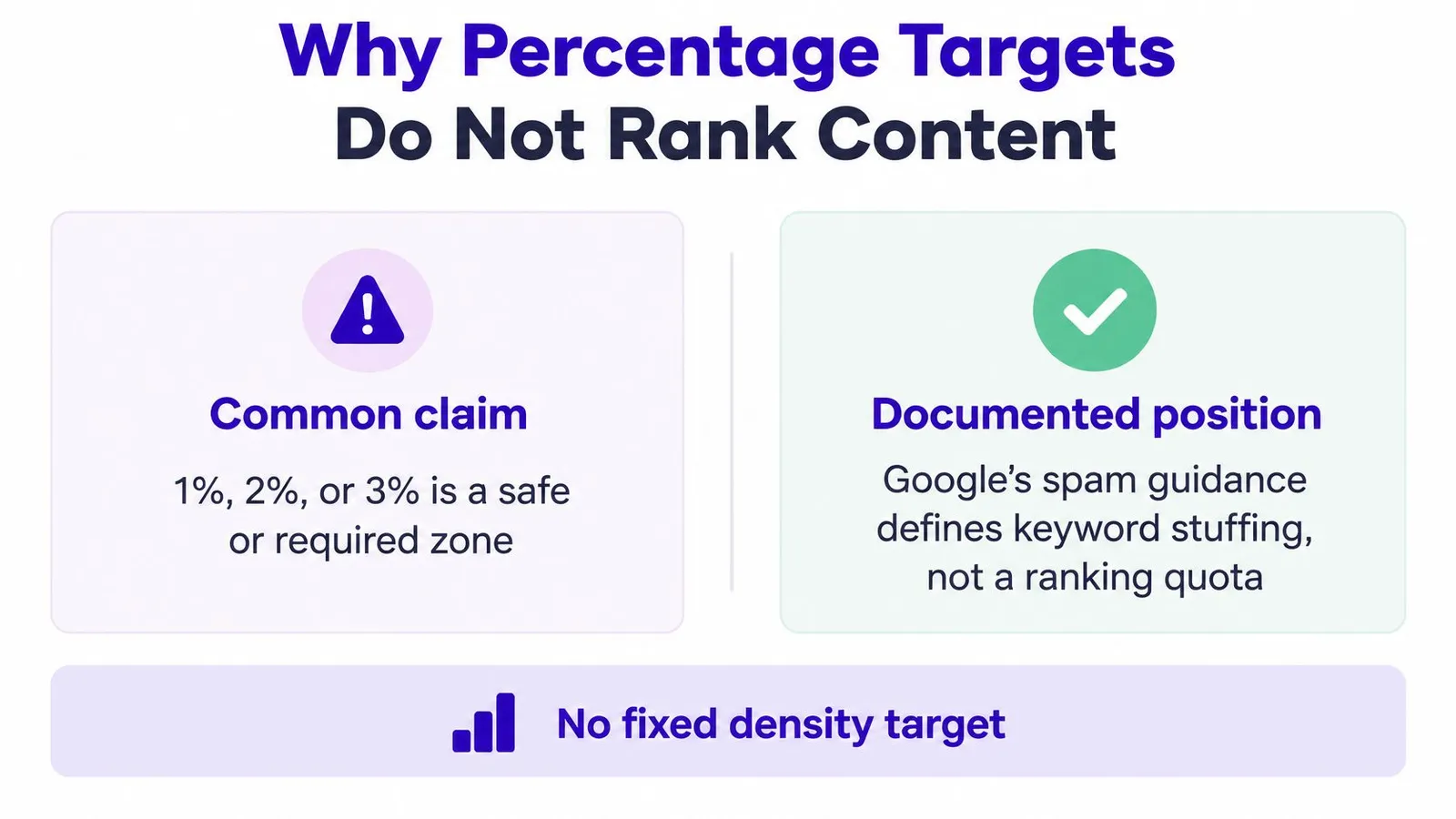
A density percentage is a measurement, not a ranking dial. Google's SEO Starter Guide does not set a 1%, 2%, or 3% target. It explains that Google Search doesn't use the meta keywords tag and warns against excessive repetition that tires readers. The useful editorial signal is whether a phrase feels forced, not whether a plugin marks the draft green.
The historical boundary was already clear
Google's keyword-stuffing guidance describes stuffing as placing keywords mainly to manipulate rankings. Its examples include hidden text and keyword lists. The guidance points toward content written for people, rather than a page assembled to repeat terms.
A page might mention hiking boots many times without explaining fit, terrain, weather protection, or trade-offs. Another can cover those needs with product details and related language, using the exact phrase only where it reads naturally.
That distinction matters when assessing keyword density SEO advice. A percentage is easy to calculate, but it cannot show whether an article answers the reader's question or helps with a decision. A step-by-step keyword research process can help identify the subject and reader need before an editor assigns subtopics.
For practical guidance on writing, Lumi Humanizer's SEO writing guide offers another resource for shaping clear, reader-focused copy. A useful brief names the reader, the question, relevant product information, and the decision the article should support. A green-zone percentage supplies none of those instructions.
Where to Place the Phrase Without Repeating It
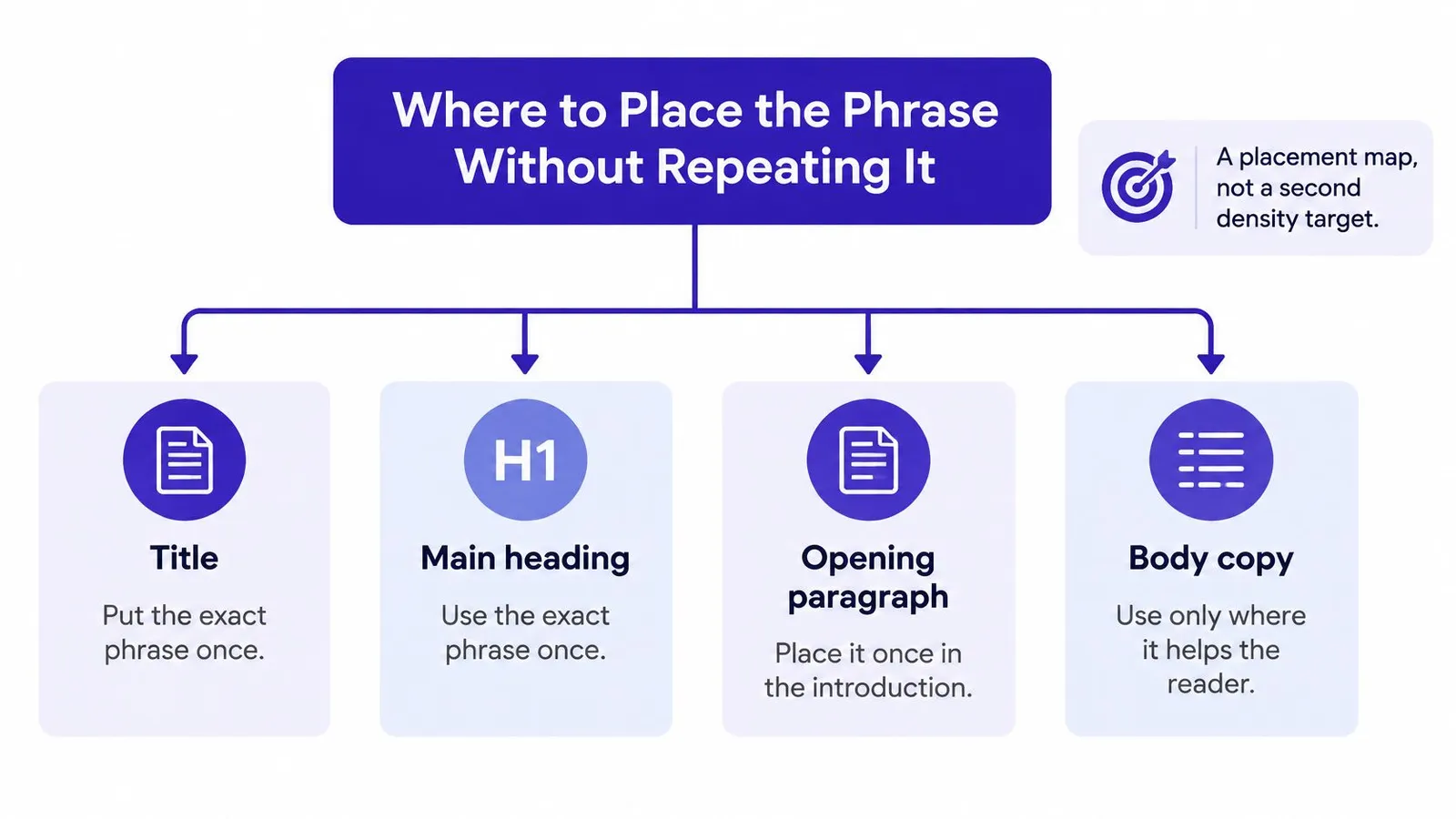
A phrase should identify a page where identification helps. Placement is an editorial map, not another quota.
The map below separates prominent descriptive locations from body copy, where each occurrence needs a reason.
Move from the page title into the answer
- Title: Include the primary phrase naturally when it accurately describes the page. A useful title also indicates the question or benefit.
- Main heading: Make the subject unmistakable. It can resemble the title without becoming a string of keyword variations.
- Opening paragraph: Name the subject while beginning the answer, rather than delaying useful information with an SEO introduction.
- Meta description: Include the wording when it helps summarize the page for searchers. Treat this as descriptive copy, not another occurrence required for a body-text calculation.
A subheading can use the phrase when its section needs that label. Otherwise, a direct question or attribute-based heading usually tells the reader more.
Consider an informational article about wool running socks. The title and introduction can identify the product category, while subsequent sections address cuff height, fit inside running shoes, blister concerns, and the garment's stated washing instructions.
Let attributes supply the detail
The body should distinguish materials, intended conditions, sizing considerations, care requirements, and unsuitable uses. Specific entities, such as a fiber type or a product model, belong where they clarify those explanations.
A heading about washing needn't become How to Wash Wool Running Socks for Wool Running Socks Care. A straightforward heading about washing and drying allows the paragraph to focus on the actual care label.
The accompanying video provides another format for considering keyword use in content.
Image descriptions, captions, and links deserve the same restraint. Alt text should describe the relevant image; anchor text should identify the destination. Repeating the target phrase in these smaller fields merely to raise a count doesn't make those fields more useful.
An effective SEO content writing approach connects the shopper's question to the product's relevant characteristics without turning every sentence into a category label.
If the title and first paragraph already name the topic, further exact repeats have to earn their place by making a sentence clearer.
A Product Article Written at a Natural Rate
Consider a hypothetical store article about waterproof hiking boots. The following deliberately stuffed passage contains 80 words and 7 exact uses, producing 8.75%, approximately 9%, under the occurrence-based calculation.
Stuffed version
Waterproof hiking boots are ideal for shoppers seeking waterproof hiking boots. These waterproof hiking boots bring waterproof hiking boots quality to every outdoor adventure. Shoppers in Denver, Seattle, Portland, Boston, and Austin can discover waterproof hiking boots for their next trip. The waterproof hiking boots selection offers dependable style for exciting trails and memorable weekends outdoors. Browse waterproof hiking boots today for a practical addition to any hiking wardrobe, with appealing choices for everyday explorers planning their next outdoor purchase.
The opening repeats the subject without adding a distinction. The next sentence uses quality without naming a feature, while the city list provides no local information. The remaining sentences could describe almost any outdoor product.
Replace repetition with product information
For comparison, suppose the catalog confirms a waterproof membrane, a rubber rand, and a stiff sole. A useful rewrite can explain those attributes without implying that every boot has them.
Natural version
Waterproof hiking boots suit wet trails, but the membrane cannot stop water entering over the collar. This model pairs that barrier with a rubber rand around the toe. After a creek crossing, remove the insoles and let the lining dry away from direct heat; drying time depends on conditions. The stiff sole suits hikers seeking support on rough ground. Shoppers who prefer flexible footwear should compare alternatives before choosing waterproof hiking boots for their next trip into the backcountry instead.
This hypothetical rewrite also contains 80 words, but uses the exact phrase 2 times, giving 2.5%. Neither result establishes an acceptable band, and a short excerpt can look much denser than the full article containing it.
The editing context matters more than the score.
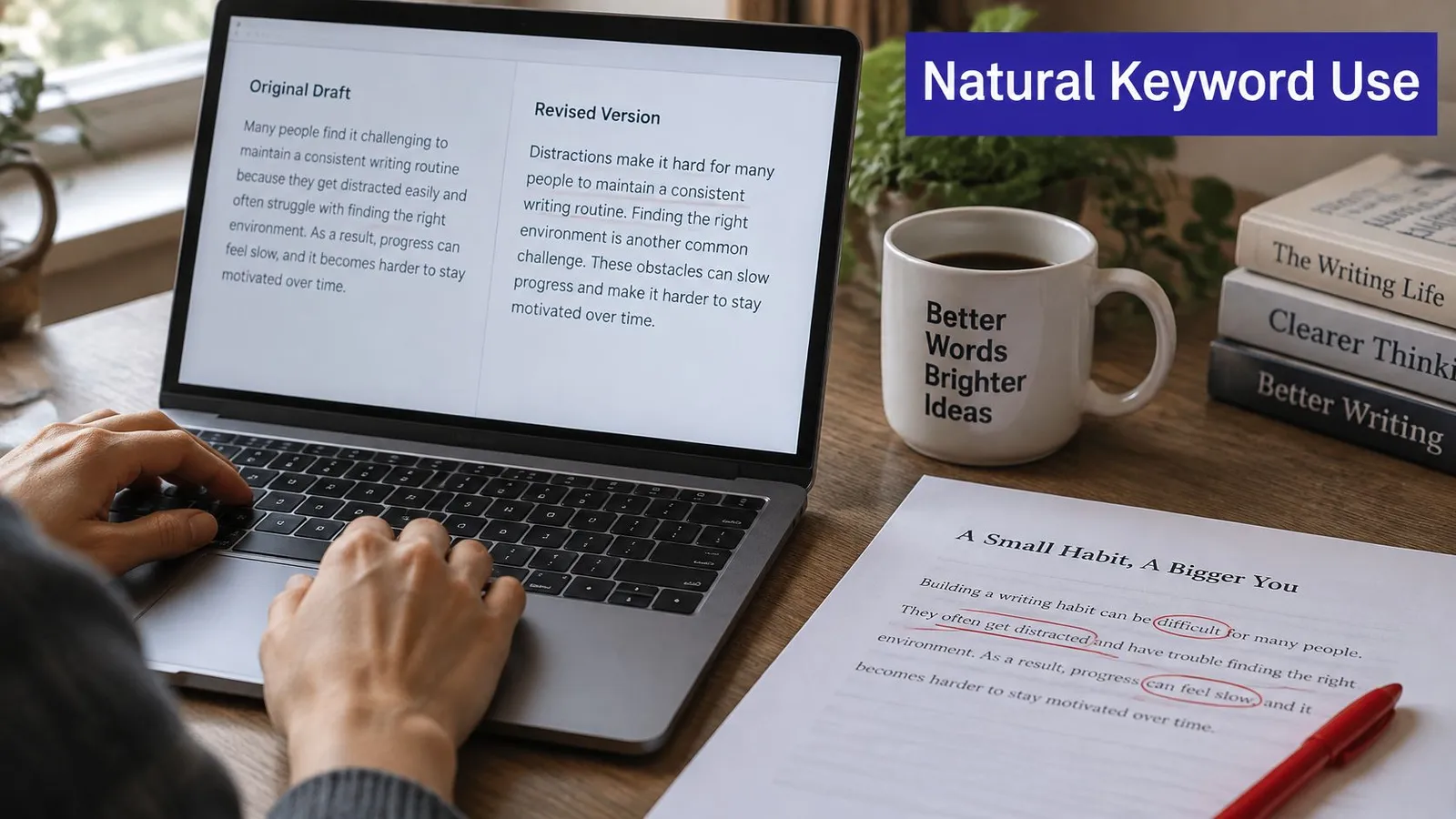
The rewrite adds what the counter can't recognize: a use case, a limitation, and a care step. Before publication, an editor should verify every product attribute and align the drying advice with the manufacturer's instructions.
Answer engines don't create a new quota
In 2024, keyword stuffing reduced visibility in generative-engine results by approximately 10% in experiments attributed to a Princeton, Georgia Tech, Allen Institute for AI, and IIT Delhi research team, according to TryRes's account of the experiments. That finding is a warning about the tested answer-engine setting, not a universal forecast for a Shopify article.
It also doesn't supply a replacement density target. The useful response is editorial: organize evidence and explanations so the passage contributes something worth reading or citing.
A deliberate article structure gives features, limitations, comparisons, and care instructions appropriate space. During a read-aloud pass, any sentence that exists only to introduce the phrase again should be cut or rewritten.
Review Each Repeat and Publish Without a Quota
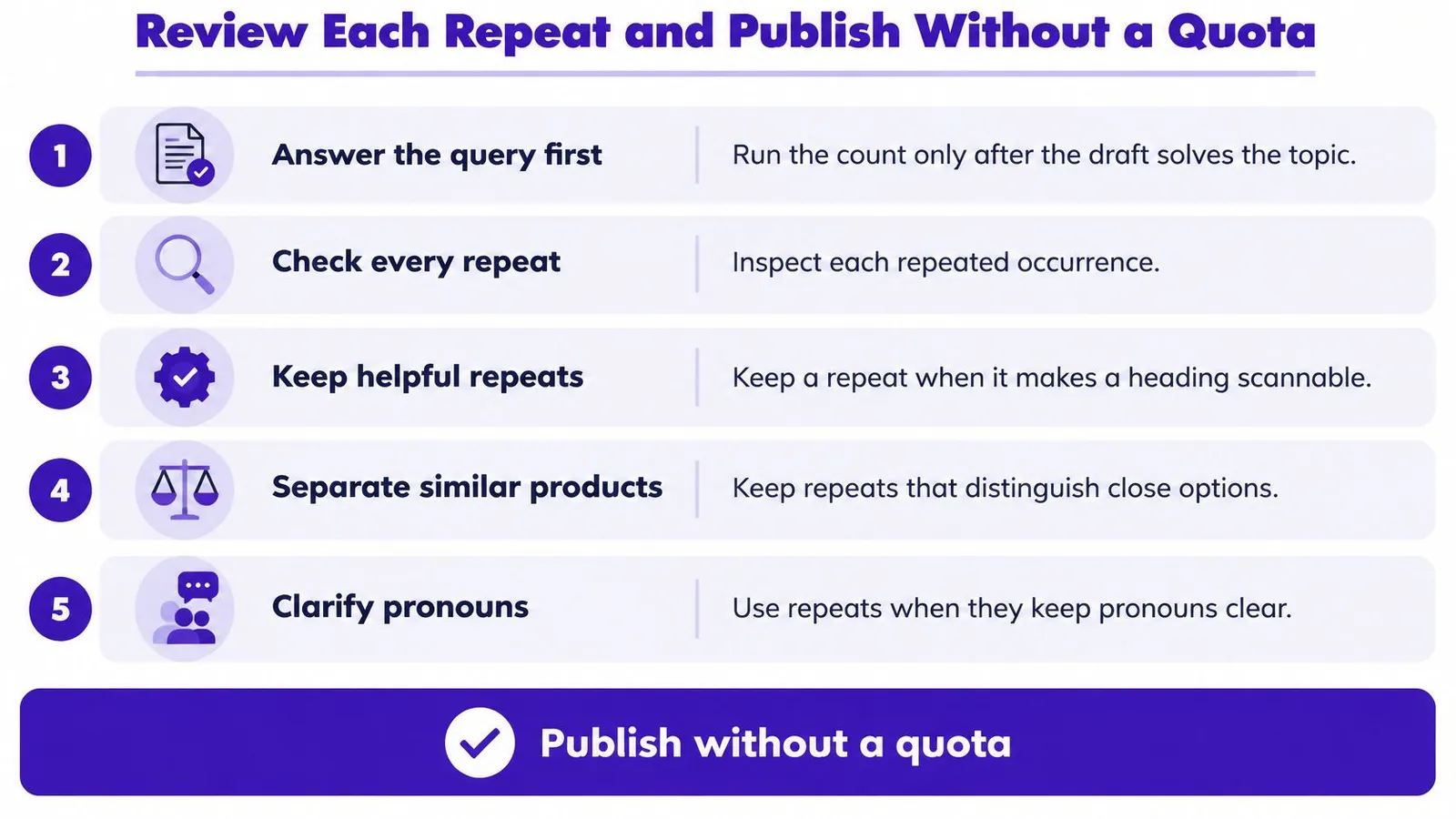
A repetition review belongs after the draft answers the query. Running it during the first paragraph encourages the writer to solve the counter's problem before solving the reader's problem.
Google's guidance on readable, organized content recommends natural writing and warns against excessive keyword repetition rather than establishing a validated density target. The operational consequence is semantic coverage, meaning the attributes, concepts, questions, and destinations that make the subject understandable.
The checklist below keeps the review focused on the function of each occurrence.
Give each occurrence a job
A retained phrase should improve precision, navigation, or comprehension. A deleted phrase should leave the sentence's useful meaning intact.
| Editorial situation | Keep or cut decision |
|---|---|
| A heading needs to identify its subject when scanned alone | Keep the product or topic name. |
| A comparison moves between similar products | Keep names where pronouns could cause confusion. |
| Consecutive sentences repeat a category unnecessarily | Replace a mention with a feature, a clear pronoun, or a more direct sentence. |
| A sentence restates the previous sentence without adding detail | Delete the sentence rather than merely replacing the keyword. |
| A link identifies a relevant collection or product | Keep descriptive wording that accurately names the destination. |
This review should distinguish helpful redundancy from empty repetition. Product names sometimes need repeating because it could refer to either item. Conversely, replacing every occurrence with a synonym can create awkward or inaccurate wording.
Handle edge cases by purpose
A comparison table may repeat a product name because readers inspect rows independently. Where the layout makes the product unmistakable, a column heading may remove the need for repeated names inside every cell.
A FAQ may repeat wording because each question needs to stand alone. The answer can then move directly into the explanation instead of copying the whole question again.
A city-only location list requires a different response. If the locations add no useful service details, a moderate overall percentage doesn't justify keeping the list. The editor should assess what the location information helps a shopper do.
Boilerplate belongs outside an article-only calculation. A shipping banner may be relevant to the store, but it isn't part of the writer's explanation; when a plugin includes it, the editor should separate that page-wide result from the draft review.
For Shopify merchants, Rankira researches keywords around the store's products, writes articles, and automatically publishes them to the Shopify blog, with internal links to relevant products, collections, and pages. That workflow still benefits from an acceptance checklist centered on accurate product information and readable answers.
Make the publishing decision in order
- Topic identification: Do the title and opening name the subject plainly, without an unnecessary string of variations?
- Question coverage: Does the body answer the shopper's subquestions through relevant attributes, explanations, and comparisons?
- Read-aloud review: Has the editor removed sentences whose only purpose was to repeat the target phrase?
When those checks pass and the product details are accurate, the draft can be published or scheduled. A green counter shouldn't rescue a vague article, and a missed percentage shouldn't block a useful one.
The next practical task is small: select a product question, draft the useful answer, and apply the keep-or-cut pass. Leave the percentage off the acceptance checklist.
Rankira offers product-based keyword research, article generation, and automatic Shopify blog publishing with links to relevant products and collections. Merchants seeking a repeatable workflow can visit Rankira, start with a catalog-related question, and review the resulting article for clarity and useful coverage rather than a keyword-density quota.
Keep reading
All articles
Shopify SEO
Search Engine Optimization Plan for Shopify: 2026 Guide
Build a search engine optimization plan for your Shopify store: set a baseline, pick keywords, publish in batches and measure results.
11 min read

Shopify SEO
10 SEO Software Platform Options for Shopify Stores
Compare 10 SEO software platform options by capabilities, use cases, and Shopify fit, from keyword research to publishing and reporting.
11 min read

Shopify SEO
10 Website SEO Software Tools Compared for Shopify in 2026
Compare the best website SEO software in 2026, from Shopify-native apps to full SEO suites. See pricing, free options, and which tool fits your store.
12 min read
Put your Shopify blog on autopilot
Rankira researches keywords, writes SEO articles, adds internal links, and publishes them to your store — every week. Start with a 7-day free trial.