SEO Competitor Analysis for Shopify Stores
SEO competitor analysis for Shopify stores: compare keywords, content, and links, then drop gaps you cannot verify.
Published 14 min read
In this article
- Table of Contents
- Start SEO Competitor Analysis with Your Own Results
- Why Competitor Authority Is More Than a Link Count
- Turn Competitor Rankings into Catalog Keyword Gaps
- Compare Rival Pages and the Sites That Cite Them
- See Which Competitor Pages AI Answers Cite
- Decide Which Gaps Are Real Enough to Publish
- Publish One Verified Gap on Your Shopify Blog
A Shopify merchant has the store admin open, a product description half-edited, and a search result in another tab. A rival's collection page sits above the store for a query that matters to the business. The temptation is to copy the rival's headings or buy a tool that promises to reveal its traffic.
A better starting point is smaller and more useful: identify which apparent advantages deserve attention. SEO competitor analysis should produce an opportunity map, not a publishing obligation. For a merchant without a content team, the valuable outcome is a short list of topics connected to actual merchandise and supported by credible evidence.
Table of Contents
- Start SEO Competitor Analysis with Your Own Results
- Why Competitor Authority Is More Than a Link Count
- Turn Competitor Rankings into Catalog Keyword Gaps
- Compare Rival Pages and the Sites That Cite Them
- See Which Competitor Pages AI Answers Cite
- Decide Which Gaps Are Real Enough to Publish
- Publish One Verified Gap on Your Shopify Blog
Start SEO Competitor Analysis with Your Own Results
A shopkeeper who counts foot traffic through the door learns more than one who only watches the queue across the street. Search data works the same way. Before examining any rival, the merchant needs a record of how the store already performs, because competitor rankings only mean something when compared against a known baseline.
SEO competitor analysis compares competitors' public search visibility with the store's own search performance. Everything in that comparison comes from observable results and first-party data. No tool can show a rival's private analytics, and every rival ranking stays an estimate until the store's own evidence supports treating it as an opportunity.
Google Search Console supplies the baseline measurements:
- Clicks record selections of the store's search results.
- Impressions record how often those results appeared.
- Click-through rate describes clicks relative to impressions.
- Average position summarizes where results tended to appear during the selected period.
Each measurement can be examined by query, page, country, device, and date range, as explained in Google's Search Console performance documentation. Search Console reports on the connected store alone, which is why it anchors the analysis: every later judgment about competitors gets tested against numbers the merchant owns.
Build a baseline by search purpose
A candle store offers a workable example. Its merchant could sort queries into product searches for specific candles, collection searches for scented candles, and informational searches about candle care. Separating those groups keeps the export readable and shows which type of visibility the store already earns.
For each group, record the relevant store URL and the domains that appear prominently in public results. One caution applies here: a rival selling furniture is noise for a candle merchant, since rankings only matter where the catalogs overlap. Queries with substantial impressions but weak clicks deserve a closer look, as do pages sitting near the first page of results. Label these investigation candidates, because deciding whether they justify new content comes later.
Practical rule: Record what happened before deciding why it happened.
A simple sheet holds the query, store page, search-purpose group, market, date range, observed competitor, and Search Console figures. Estimated rival traffic adds nothing at this stage. Modeled numbers get filtered out later anyway, alongside seasonal spikes and brand-driven queries.
For wider context, Cyndra's resource on competitive intelligence for SEO pairs well with this process, and merchants comparing visibility across a fixed query set can use the explanation of SEO share of voice to quantify their slice of results.
The deliverable stays deliberately small: an opportunity map of where the store stands and which credible rivals stand beside it. Filtering, page decisions, and outreach all happen after that map exists.
Why Competitor Authority Is More Than a Link Count
Competitor Authority is easier to understand through references than through scores. An academic paper gains credibility partly from the work that cites it. Similarly, a web page's links become more meaningful when the merchant considers who supplied them and why.
The historical foundation is PageRank. Google's 1998 Stanford paper introduced its link-based approach, and Google later confirmed PageRank's role among its original ranking systems while documenting the continued use of link analysis in its guide to Google Search ranking systems. That history explains why competitor research includes references between websites rather than examining page wording alone.
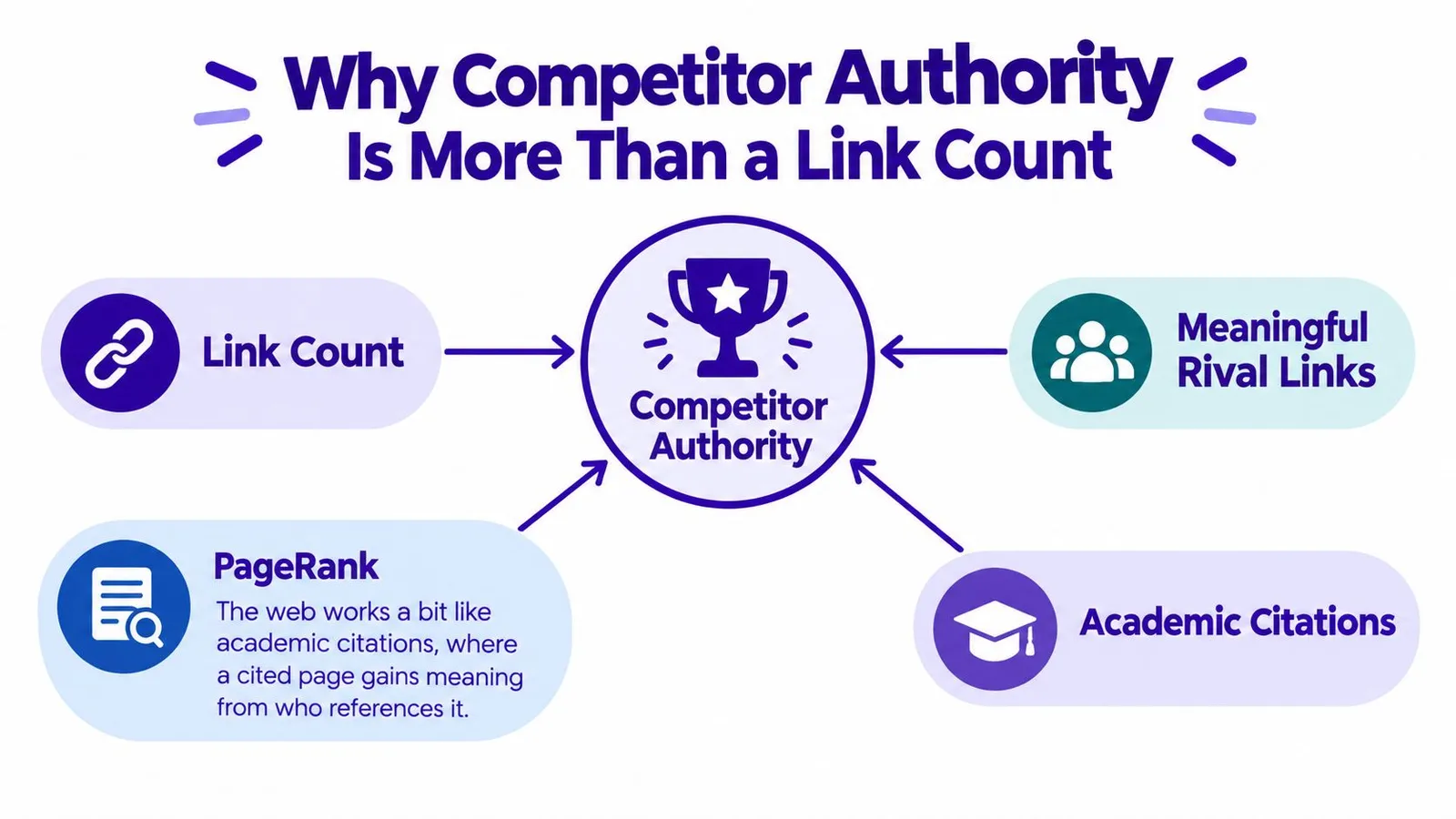
The relationship between the concepts can be pictured as a network rather than a scoreboard.
Read the relationships behind the links
The web works a bit like academic citations, where a cited page gains meaning from who references it. Academic Citations provide the analogy, but modern link analysis isn't reducible to a visible score. Relevance, context, popularity, and reliability matter to the interpretation of a reference.
For the candle merchant, a pile of unrelated directory listings offers less useful competitive insight than recurring mentions from home-decor publishers, wax suppliers, or candle-making communities. That comparison doesn't establish a guaranteed ranking outcome. It identifies relationships worth understanding.
A practical review asks:
- Relevance: Does the referring site discuss subjects connected to the store's products?
- Context: Is the reference part of an explanation, recommendation, supplier listing, or unrelated page?
- Structure: Do references concentrate on a particular guide or appear throughout a wider commercial relationship?
- Reliability: Does the referring organization provide a credible reason for readers to trust its recommendation?
Link Count remains a description of quantity. Meaningful Rival Links provide clues about competitive position.
A supplier mention might suggest a legitimate stockist relationship. A publisher's reference might reveal demand for a clear materials guide. A community discussion might expose a practical question that merchants haven't answered well.
The useful takeaway isn't that the smaller store must reproduce every rival backlink. It's that backlinks can identify relevant organizations, realistic outreach possibilities, and subjects worth explaining. A merchant who understands the relationship has a more actionable finding than a merchant who records only a total.
Turn Competitor Rankings into Catalog Keyword Gaps
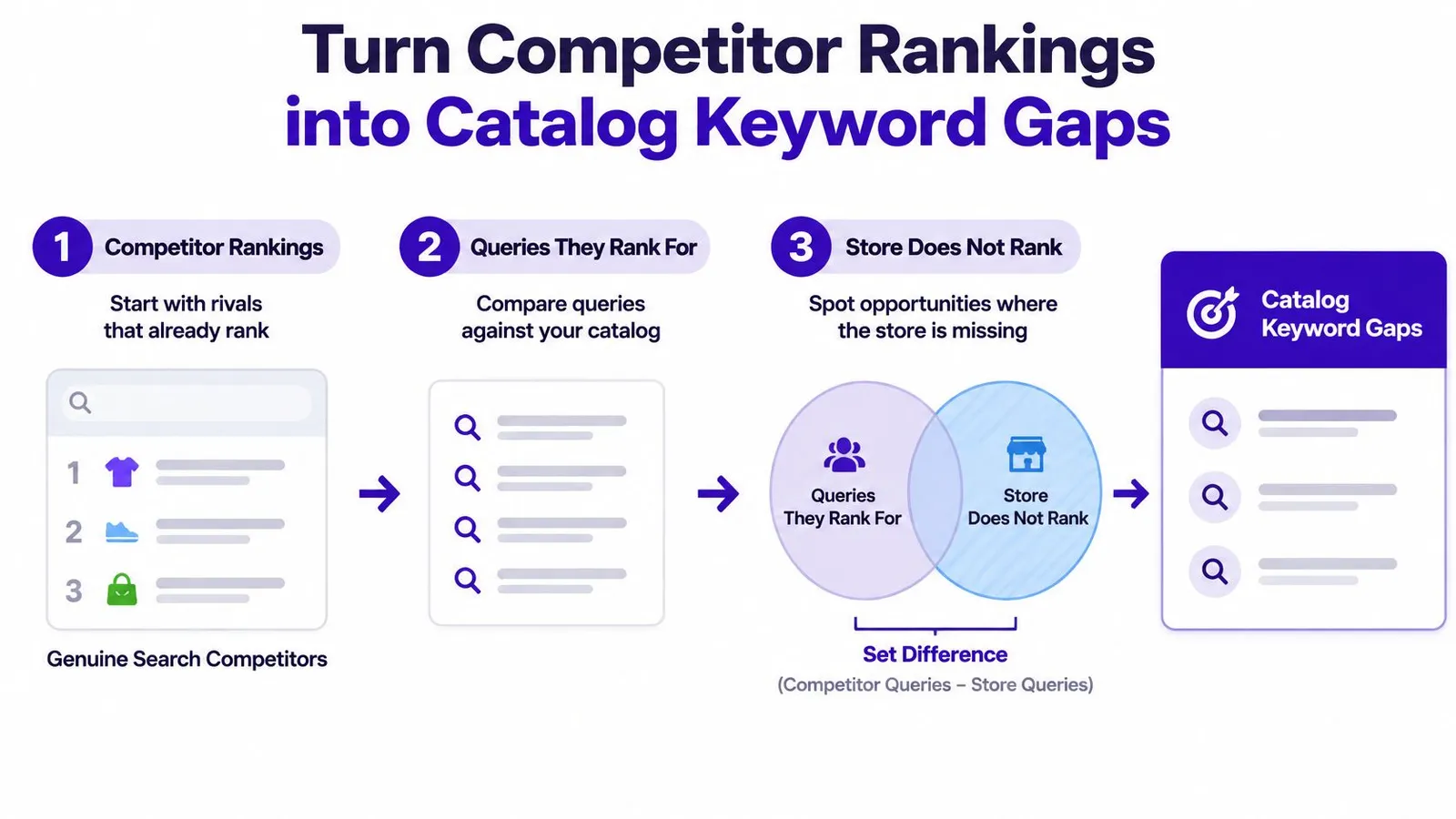
A keyword gap works like a store map with missing shelves: it shows queries competing domains rank for while your store stays absent. A domain earns a place in that comparison when it surfaces for searches your shoppers make, even if its catalog is broader or narrower than yours.
Start with genuine search competitors, list the queries they rank for, then mark where your store has no ranking page. The diagram shows the narrowing path from broad competitor rankings to catalog keyword gaps.
Keep the query only when the catalog can support it
A practical pass keeps terms where a relevant competitor ranks near the top, then reviews position, estimated demand, and difficulty using the workflow described in Ahrefs' content-gap tutorial. Treat those numbers as evidence for investigation, not proof that the topic belongs in your store.
Before a query survives, run four checks: catalog fit, first-party Search Console impressions or clicks on close variants, the kind of sites that refer readers to the rival, and whether AI answers already cite pages on that theme. Set aside gaps that look modeled only, spike with a season, or depend on a competitor's brand name.
A hypothetical fragrance-free skincare store shows the filter in action. A rival may rank for an ingredient query with strong estimated demand, yet the merchant stocks no related product and has no reliable ingredient guidance to offer. The safer candidate is an informational query about choosing a fragrance-free moisturizer, because the merchant can explain selection criteria and route readers to a suitable collection.
Give each survivor a destination:
- Product page: A specific item directly answers the search.
- Collection page: Shoppers need to compare relevant products.
- Existing blog URL: The store already has a suitable explanation that needs improvement.
- New article: An unanswered informational need has a credible route to merchandise.
A query with no honest destination should move down the list, even when estimated demand looks impressive.
Separate discovery from imitation
A rival page is a clue, not a stencil. Your page should answer the shopper's question with accurate product details, clear limits, and examples from your own catalog. Copying a competitor's outline adds little for a reader and gives search engines no fresh reason to choose your store.
The walkthrough below shows the comparison in motion.
For a repeatable selection process, this step-by-step keyword research guide can help document decisions. The finished shortlist should explain why the query matters, where the store can satisfy it, and which checks were still estimates.
Compare Rival Pages and the Sites That Cite Them
A keyword spreadsheet tells you a rival ranks. It tells you nothing about what a shopper finds when they click through. Open the page itself and ask a simpler question: what job is this page doing? Answering a question, comparing alternatives, or presenting products for purchase each call for a different response from your store.
Separate what you can see from what you can only guess. Headings, product details, navigation, and links are observable. Which of those features caused the ranking is not, and no tool can confirm it. Read the page as evidence, not as a formula.
A worked collection-page comparison
A Shopify store selling linen bedding runs a collection page with a short description, product tiles, and a general line about comfort. A rival's competing page covers available sizes, fabric composition, care requirements, and the difference between buying items individually and as sets. That rival also links its collection to a care guide and to specific product pages, so shoppers always have a next step instead of a dead end.
| Review point | Store collection | Rival collection |
|---|---|---|
| Main purpose | Displays available products | Displays products and supports selection |
| Buyer information | General comfort description | Sizes, materials, set contents, and care |
| Related navigation | Product tiles | Product tiles plus relevant guidance |
| Drafting implication | Verify missing catalog facts | Study the questions, not the wording |
The task that falls out of this comparison is make the page more useful using facts the store can verify. If your catalog can't support a claim the rival makes, that claim doesn't belong in your revision. Catalog fit filters the opportunity before drafting starts.
Turn referring sites into a page brief
Next, look at which publications, suppliers, and communities reference the rival page. The link relationships discussed earlier now serve a different purpose: they reveal what kind of resource earns citations in your niche. A home-textile publication citing a competitor's linen care explanation suggests your accurate care guidance could be relevant. A supplier's stockist link points to a relationship, not a blog post, so it calls for outreach rather than content.
A compact page brief records:
- Page purpose: The shopper's task the page should support.
- Supported facts: Product details, care instructions, or comparisons you can substantiate.
- Navigation: Products and collections that belong in the reader's next steps.
- Reference opportunity: A named referring site and a plausible reason it might value the subject.
This guide to finding backlinks to a site can help organize the reference review. What you want at the end is a factual brief grounded in what your store sells, not a copy of the rival's page.
See Which Competitor Pages AI Answers Cite
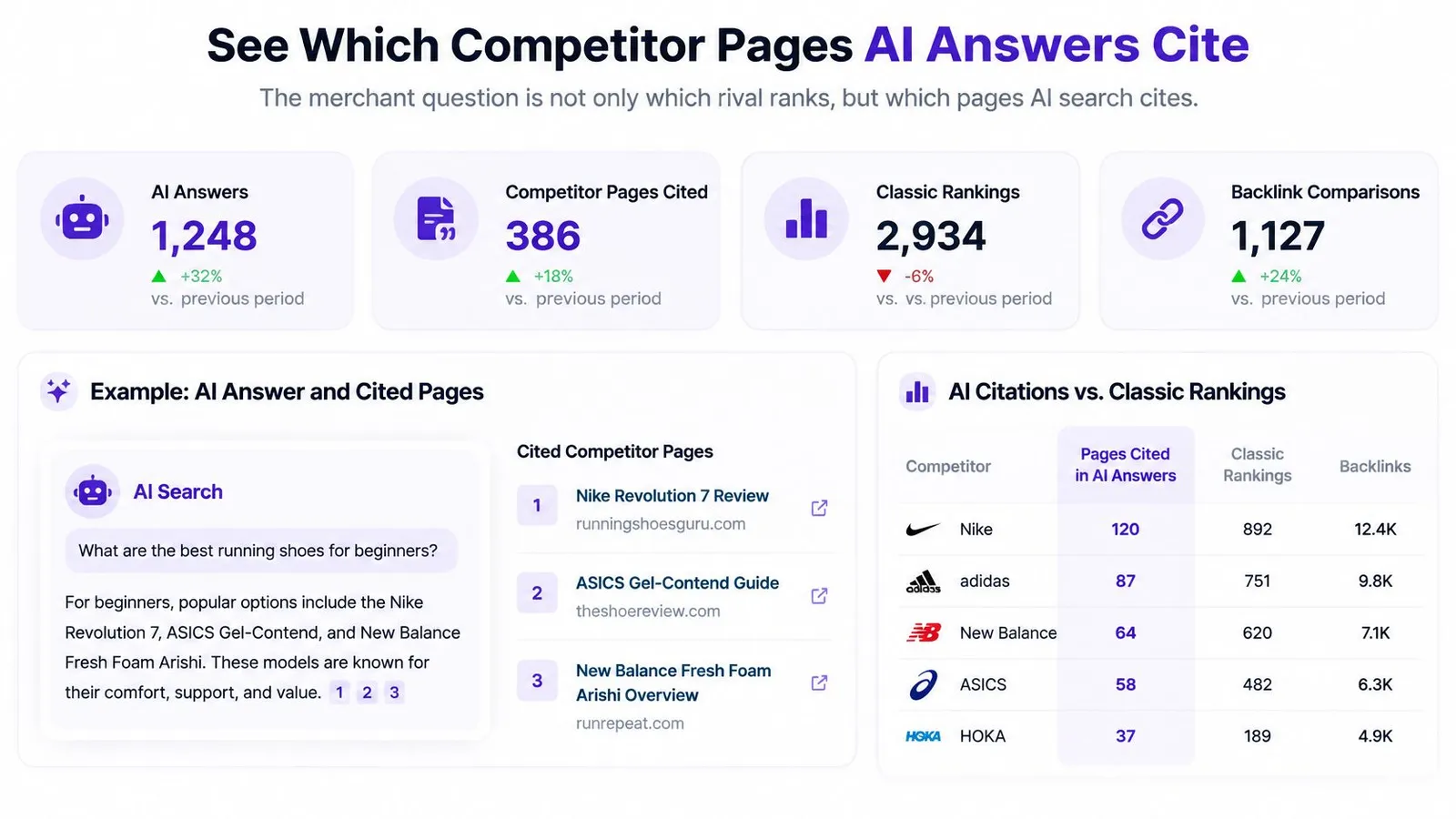
A merchant selling insulated bottles asks an AI assistant which bottle stays coldest on long hikes. The answer quotes a rival's care guide, a page that never appears beside her store in the regular results. That is a different kind of competition, and it needs its own record. AI Answers, Competitor Pages Cited, Classic Rankings, and Backlink Comparisons belong in separate research fields, because merging them into one visibility score would blur signals that call for different responses.
The early evidence justifies watching this channel, though it also warns against overreading it. In 2025, Pew found that people shown Google AI summaries were significantly less likely to click traditional results; Seer reported organic click-through rate falling from 1.41% to 0.64% when AI Overviews appeared in January 2025; and a separate benchmark reported that only about 20% of cited pages also ranked in the conventional top 10, as covered in Digital Commerce 360's discussion of AI search and ecommerce.
An AI citation works more like a quoted line in a buyer's guide than a position on a results page. The assistant selected specific facts, not the whole store. That selection is what the merchant needs to study.
Inspect the cited evidence
The merchant opens the cited URL and records the exact material the answer used: material details, cleaning steps, or a comparison of attributes. She is cataloging what the answer borrowed, not guessing why it was chosen.
The review should capture:
- Cited page type: Product, collection, guide, review, or another resource.
- Selected facts: The product attributes or explanations included in the answer.
- Coverage gaps: Relevant facts absent from the store's own pages.
- Search context: Branded or non-branded wording, market, language, and observation date.
That last field does the filtering. A citation triggered by a query containing the rival's brand name is brand-driven and offers nothing actionable. A citation that appears only during a seasonal spike deserves a note rather than a publishing slot. The candidates worth keeping are non-branded, stable citations where the store's catalog can support equal or better facts.
Structured details and reviews belong in the inspection, but their presence doesn't prove they caused the citation. Record what appeared.
A citation establishes visibility in an observed answer. It doesn't establish a sale.
Current studies don't consistently connect these citations with clicks, assisted conversions, or revenue, so commercial impact remains a separate measurement task.
A routine Google ranking check still tracks where the store stands in conventional results, and the citation record adds a second view alongside it.
Decide Which Gaps Are Real Enough to Publish
A merchant exports a competitor keyword list and sees columns of numbers: traffic, volume, difficulty, positions. It reads like a lab report. In practice, it works more like a weather forecast, a model built from sampled data rather than a thermometer reading taken inside the rival's store. Competitor traffic and ranking coverage come from tool estimates, and exports can miss long-tail searches, localized results, personalized results, and anything that changed between crawls.
Each tool also samples differently and draws its own coverage boundaries. The practical use is directional comparison, a reliability issue discussed in Growth Hasten's competitor-analysis guidance.
Observed Search Data Versus Modeled Competitor Estimates
| Signal | Source type | Safe use in a content decision |
|---|---|---|
| Store clicks and impressions | First-party Search Console data | Confirm existing exposure and response |
| Competitor traffic | Third-party model | Compare approximate patterns, not actual visits |
| Search volume and difficulty | Tool-derived estimates | Organize candidates for further review |
| Rival page content | Publicly observed evidence | Identify purpose and supported factual coverage |
| AI citation | Observed answer snapshot | Record cited material and search context |
| Competitor ranking export | Tool snapshot | Locate candidates and verify current results |
Label every finding observed or modeled, then attach a freshness date, a target region, and a confidence note. A gap backed by real impressions in the merchant's own Search Console, a product that could plausibly rank, and a cited rival page deserves more weight than a keyword that exists only inside an export.
Three categories deserve automatic suspicion. Brand demand belongs to the rival, so a competitor's branded query rarely transfers. Seasonal surges justify a timed campaign rather than an evergreen article. Temporary spikes, from a viral mention or a fresh backlink, may already be fading by the time a post publishes.
Editorial filter: Ignoring an uncertain gap is a valid content decision.
Choose a workflow that preserves judgment
A manual workflow combines Search Console, public search results, page inspection, and a spreadsheet. It costs more organizational effort but keeps every piece of evidence visible. Third-party platforms widen discovery, and their estimates still need the same validation.
An in-Shopify option is Rankira, which combines store information, competitor analysis, and Search Console data for keyword research, with volume and difficulty scores. Its calendar assigns a keyword to each publishing day, article generation supplies meta descriptions, tags, featured images, clean URLs, and links to products, collections, and pages, and reporting covers clicks, impressions, positions, and Ahrefs Domain Rating. Those outputs still pass through the same filter: a suggested keyword with no store impressions and no matching product stays on the reject pile.
The choice follows the merchant's constraint. A spreadsheet suits occasional research. Integrated planning suits a merchant whose research keeps stalling before publication. Neither replaces the habit of saying no.
For a store publishing a handful of posts per month, three well-supported gaps beat a year-long calendar built on modeled numbers.
Publish One Verified Gap on Your Shopify Blog
A candle merchant finishes the review with three candidate queries. Two fall away quickly: one turned out to depend on a competitor's brand name, and the other only spiked during a short holiday window. The third survives every filter, so it becomes the next article.
That survivor should meet a clear standard before anyone writes a word. Its record shows a relevant competitor holding a strong position, real impressions in the store's own Search Console data, and a product or collection the article can point toward. Nothing in the evidence suggests the demand belongs to another brand or a moment that has already passed.
The writing outline stays short on purpose. It names the reader's question, the catalog facts needed to answer it, and the merchandise destination. That is enough to draft a focused post without turning one keyword into a sprawling content project.
Move from evidence to a reviewable draft
In the in-admin workflow described earlier, the merchant places the selected keyword on the calendar and generates the article. Before anything goes live, the merchant reviews the meta description, tags, featured image, URL, and internal links, then schedules the post or saves it as a draft.
The output is an ordinary Shopify blog post, with images stored in Shopify Files. The application runs inside Shopify administration and does not request customer, order, or payment data.
A manual workflow reaches the same result through a short checklist:
- Draft: Answer the question using verified store knowledge rather than rival wording.
- Check the buying path: Confirm that product and collection links lead to relevant destinations.
- Review every claim: Remove unsupported product benefits, comparisons, and implied guarantees.
- Record the expectation: Note what evidence justified the topic and set a date for review.
Treat publication as a test
Publishing one verified gap works like placing a small test order before committing to a full inventory buy. The merchant has reasoned grounds for confidence, and the market still gets the final vote.
After publication, Search Console clicks, impressions, and average position supply that verdict. The review asks two plain questions: did the article surface for the intended query group, and did searchers choose it when it appeared? A broader SEO content marketing workflow keeps that review connected to the next editorial decision instead of letting it sit in a forgotten report.
The outcome stays manageable either way. The store gains a published or drafted article tied to merchandise, a documented reason the topic deserved attention, and a scheduled check on whether the evidence held up. Rankira, the in-Shopify option described earlier, covers each step of that cycle, from keyword research and competitor analysis through generation, scheduling, and search-performance reporting, so merchants can judge it against the manual checklist above.
Keep reading
All articles
Shopify SEO
SEO Content Writing Principles for Readers and Search
Learn the principles of SEO content writing that balance search relevance, clear structure, and real reader value, with examples for online stores.
10 min read
Shopify SEO
Internal Linking Audit That Actually Improves Rankings
Run a practical internal linking audit to find orphan pages, fix broken links, and prioritize fixes that move revenue on your Shopify store.
10 min read
Shopify SEO
Share of Voice SEO: A Practical Measurement Guide
Learn how share of voice SEO works, how to calculate it, and how to use intent-based metrics to assess search visibility and business impact.
12 min read
Put your Shopify blog on autopilot
Rankira researches keywords, writes SEO articles, adds internal links, and publishes them to your store — every week. Start with a 7-day free trial.