Analysis of Keywords: How to Prioritize Topics That Rank
Analysis of keywords explained: read search intent, relevance, volume and difficulty, then rank topics by Search Console evidence for your store.
Published 13 min read
In this article
- Table of Contents
- What Keyword Analysis Tells You Before You Publish
- Find Candidate Keywords Before Scoring Them
- The Signals Behind Every Keyword Analysis
- Matching the Page to the Query
- Keeping Topics Your Store Can Answer
- Reading Volume and Difficulty as a Pair
- How to Prioritize Topics From Search Console Data
- Turn the Analysis Into a Publishing Order
Publishing more blog posts doesn't necessarily bring more search traffic to a Shopify store. The problem may be the keywords, the topics chosen, or how closely the content matches what potential customers are searching for. A proper analysis of keywords helps identify which search terms are worth targeting, how they relate to the products in your catalog, and which articles should be published first. Instead of filling the content calendar with random topics, you can build it around actual search demand and buyer intent.
Table of Contents
- What Keyword Analysis Tells You Before You Publish
- Find Candidate Keywords Before Scoring Them
- The Signals Behind Every Keyword Analysis
- Matching the Page to the Query
- Keeping Topics Your Store Can Answer
- Reading Volume and Difficulty as a Pair
- How to Prioritize Topics From Search Console Data
- Turn the Analysis Into a Publishing Order
What Keyword Analysis Tells You Before You Publish
Say a running-shoe merchant publishes by gut feeling for months. Articles cover fitness motivation, popular running destinations, and shoe trends, but few connect directly to the products available. The problem isn't necessarily writing quality. The merchant hasn't checked whether those topics offer a realistic route from a search to the store.
Keyword analysis works like checking traffic before choosing a route. It helps a merchant judge where searchers are heading, how crowded the route looks, and whether the store can serve the people arriving.
The planning work starts with the relationship between content and merchandise.

For each candidate, the merchant needs answers to these questions:
Searcher need: What does the person want to learn, compare, or buy?
Store credibility: Can the business provide a useful answer grounded in its products?
Estimated demand: What monthly search activity does a keyword tool suggest?
Competitive effort: What would make the store's page more useful than the existing results?
Consider running shoes and running shoes for flat feet. The broader phrase leaves the shopper's needs unclear; the narrower phrase introduces a specific selection problem. Neither deserves priority until the merchant checks the results, tool estimates, and available catalog.
Practical rule: A keyword list contains phrases. Keyword analysis contains decisions about those phrases.
Sorting only by volume skips those decisions. A large estimate doesn't establish that the store can answer the query or attract a suitable customer.
For merchants also considering answer-based discovery, Stimulead's AI search guidance for B2B marketers offers a complementary planning resource, although its audience differs from retail.
The useful deliverable is a ranked topic sheet containing intent, relevance, volume, difficulty, and a short reason for each topic's position.
Find Candidate Keywords Before Scoring Them
Candidate collection should begin with the store's own vocabulary, then expand into the language shoppers use. Scoring too early can eliminate useful questions just because they don't resemble familiar product names.
Start With Catalog and Customer Language
Extract catalog seeds. Record product types, materials, applications, and collection names. A bedding merchant might begin with linen bedding, oak bed frame, and bed frame height.
Collect existing queries. Export Search Console terms associated with the store, including unexpected phrases. Keep the landing page beside each query so its current context remains visible.
Read customer questions. Support emails, reviews, and returns notes can reveal concerns about fit, assembly, washing, or compatibility that product descriptions overlook.
A customer asking whether sheets feel scratchy is describing a need, even if the catalog calls the material textured linen. Preserving that wording makes the candidate list more useful.
Expand Beyond Existing Pages
Search autocomplete and related searches can suggest questions, comparisons, and problems attached to each seed. Record the wording without assuming that a suggestion proves substantial search demand.
Competitor titles, headings, and FAQ sections offer another discovery route. A content gap analysis helps distinguish missing coverage from topics that merely look attractive on another store.
For merchants serving specific locations, the local keyword targeting tips from Transactional, published by Transactional LLC, provide additional context for collecting geographically relevant phrases.
Merge exact duplicates, but preserve meaningful distinctions such as material, size, and use case. Tag every candidate with its seed and discovery source. Collection comes before judgment; a candidate isn't a publishing commitment.
The Signals Behind Every Keyword Analysis
Keyword analysis combines estimated signals with observed signals. Keyword tools forecast demand and competitive effort; Search Console records how the store appeared and performed.
According to Google's Search Console performance documentation, reports organize performance by queries, pages, countries, devices, and search types; an impression records a displayed link, a click records its selection, and click-through rate is clicks divided by impressions. This allows a merchant to validate a topic after publication rather than relying exclusively on forecasts.
The reporting isn't an exhaustive record: Google says performance data normally appears after approximately 2–3 days, the Search Analytics API exposes up to 50,000 rows per day for each search type, and some low-volume, personal, or sensitive queries are omitted. Results emphasize top rows rather than every query, so an absent phrase doesn't establish that nobody searched for it.
Keep Forecasts Separate From Evidence
A tool estimate answers a market-level question. Search Console answers a site-specific question. Confusing the two leads to statements such as “this keyword should bring that much traffic,” even though search activity, impressions, and visits measure different things.
Intent and relevance require another kind of work: human judgment. A tool can suggest a classification, but the merchant still needs to inspect the results and catalog.
When comparable observations conflict with forecasts, prioritize the observations, while checking reporting completeness, market settings, and page eligibility first.
The Five Signals in a Keyword Analysis
The reference table includes average position separately because it helps explain changes in visibility and clicks.
| Signal | What it tells you | Source | Limitation |
|---|---|---|---|
| Search intent | What the searcher wants to do | Review of leading results | A phrase can mix several intents |
| Relevance | Whether the store can answer credibly | Store catalog and existing pages | Popular topics may sit outside the catalog |
| Search volume | Estimated average monthly searches | Keyword tools, selected market | An estimate, not the store's own traffic |
| Keyword difficulty | Estimated effort to enter leading results | Keyword tools | Scores differ between tools |
| Impressions and clicks | Observed visibility and demand captured | Google Search Console | Reporting delay and omitted queries |
| Average position | Observed average ranking | Google Search Console | Averages can hide page-level variation |
A spreadsheet should label the origin of each value. That small distinction prevents a forecast from being presented as a measured outcome.
Matching the Page to the Query
Search intent is the reason behind a query. Before commissioning content, the merchant should examine the search results for the intended market and identify the kind of page that would satisfy the shopper.
Guides suggest a learning task. Product grids suggest shopping. Reviews and comparison lists suggest evaluation before purchase. These patterns provide a working interpretation, not a permanent classification.
Compare the Shopper's Task With the Page Format
Consider best bed frames for small rooms. Suppose the results contain buying guides alongside compact-frame collections. A useful response could be a buying guide that compares footprint, storage clearance, and assembly constraints, then links to suitable frames.
A generic article about bedroom decoration wouldn't satisfy that task. Neither would an unexplained product grid if shoppers need help understanding which dimensions matter.
By contrast, oak bed frame queen names a material, product, and size. A collection or product page can make availability, dimensions, delivery information, and purchase options easy to find. Adding a long introductory essay would place extra work between the shopper and the likely goal.
The page must satisfy the searcher's task before a keyword score can justify producing it.
Mixed results require judgment. The merchant should choose the dominant useful format, then accommodate secondary needs without turning the page into an unfocused combination of guide, category, and sales pitch.
Record What the Results Actually Show
A concise results-page note should capture:
Dominant format: Guides, comparisons, product pages, collections, or a meaningful mixture.
Visible competitors: Specialist retailers, manufacturers, publishers, or established brands.
On-page answers: Summaries, shopping features, videos, or other elements that may satisfy the query before a visit.
These notes also expose the level of specificity required. If existing comparisons include dimensions and practical constraints, a replacement page needs more than rewritten product descriptions.
Search Intent Types and the Page That Fits Each
| Intent | What the searcher wants | Example query | Fitting page format |
|---|---|---|---|
| Informational | Learn or understand something | how to choose bed frame height | Blog guide or how-to article |
| Commercial investigation | Compare options before buying | best bed frames for small rooms | Buying guide or product roundup |
| Transactional | Buy or act now | oak bed frame queen | Product or collection page |
| Navigational | Reach a specific brand or site | brand name plus login | Brand or home page; rarely a new-content target |
Navigational searches for another brand rarely justify a new article. A merchant shouldn't mistake someone else's existing customer demand for an open invitation to attract that visitor.
Keeping Topics Your Store Can Answer
A popular topic can still be a poor commercial choice. Relevance asks whether the store has a legitimate role in helping the searcher, not whether an editor can squeeze a product mention into the conclusion.
For a candle store selling melt warmers, how to clean wax melts creates room for care instructions, compatible equipment, and material-specific cautions. History of candles in ancient Rome could attract interested readers, but it offers a much weaker connection to choosing or maintaining the merchandise.
Use a Catalog-Fit Checklist
A practical worksheet can assess each question as no, partly, or yes:
Direct solution: Does an available product or collection address the underlying need?
Distinctive detail: Can the store contribute materials information, measurements, care guidance, or documented product knowledge?
Buyer match: Does the likely searcher resemble someone the store is equipped to serve?
Natural next step: Would a product or collection link help the reader complete the task?
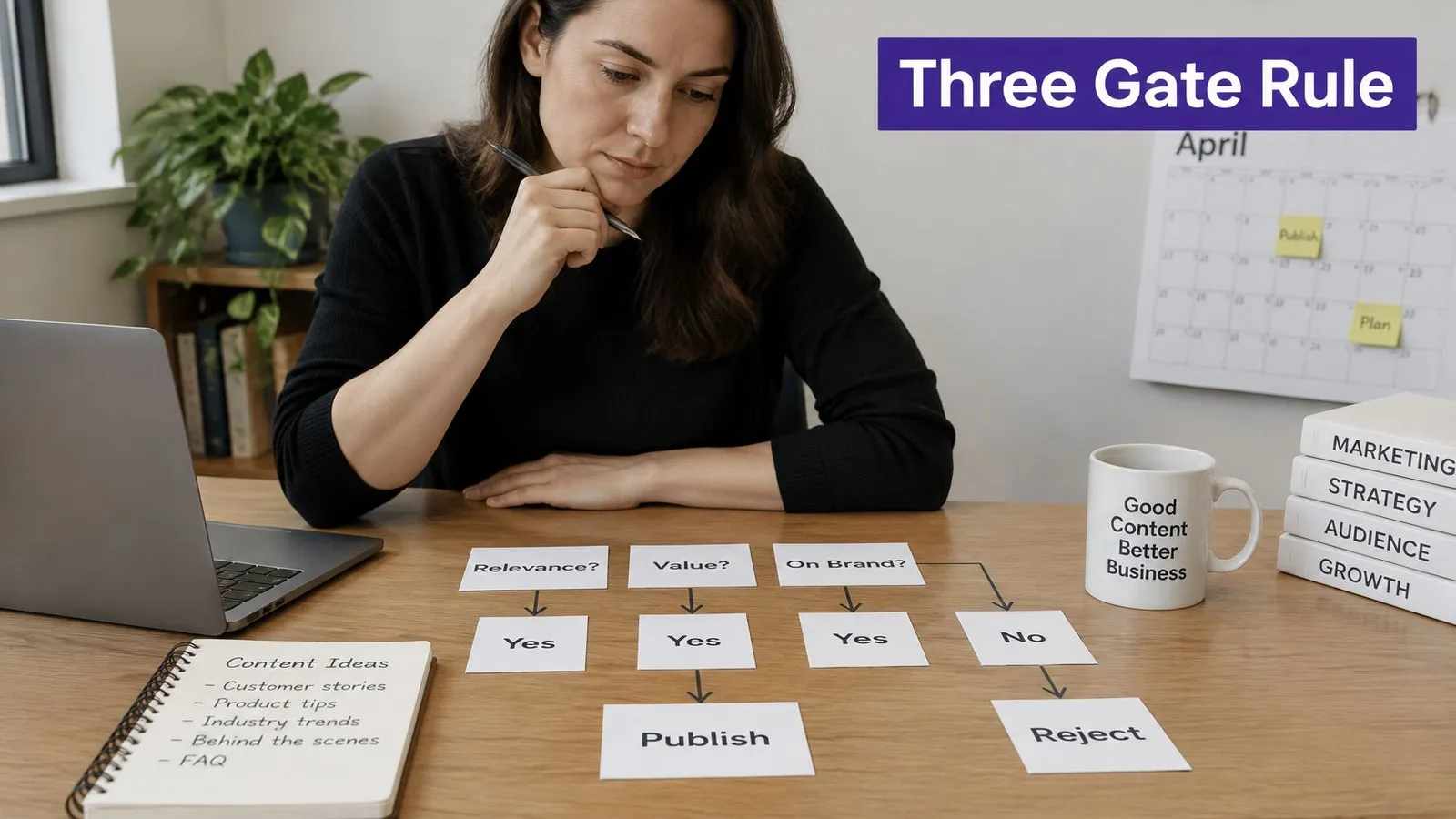
Treat these as editorial gates rather than a scientifically validated score. Topics with clear positive answers belong in consideration; partial matches need a narrower angle; topics with little catalog connection belong outside the publishing queue.
Rewrite Borderline Ideas
A broad topic such as bedroom comfort may become more useful when narrowed to choosing linen bedding for a particular sleeping preference. The revised angle should change the substance of the article, not merely add a merchandise reference.
The same principle applies to long-tailed keywords: specificity helps clarify the need, but a longer phrase isn't automatically relevant. A detailed question about a product the store doesn't sell remains a weak fit.
First-hand detail also needs boundaries. A merchant can explain the dimensions of its bed frames without claiming to have tested every competing model. Product knowledge should strengthen the answer without creating unsupported comparisons.
Catalog test: If removing the product link leaves an article unrelated to the store's expertise, the original connection was probably forced.
Strong estimated demand and apparently manageable competition shouldn't override a poor relevance assessment.
Reading Volume and Difficulty as a Pair
Search volume estimates average monthly searches for a phrase in a selected market. It doesn't count the customers a store will acquire, and a tool may group close variants rather than measure only an exact string.
Keyword difficulty estimates competitive effort. Tool providers use different methods, often incorporating link-related strength among ranking pages, so the score isn't a universal measurement of content quality or ranking probability.
Compare candidates within the same tool and market settings. Mixing one provider's volume with another provider's difficulty can create a ranking order based on incompatible assumptions.
Turn the Pair Into an Action
The following bands are qualitative planning categories, not industry standards. A merchant should define their boundaries consistently within the chosen tool and adjust them to the store's demonstrated ability to compete.
Volume and Difficulty Bands With the Action Each Implies
| Volume band | Difficulty band | Reading | Action |
|---|---|---|---|
| Low | Low | Potential focused opportunity | Publish if relevant; evaluate the actual results |
| Low | Medium | Modest payoff | Publish as useful support for a product page |
| Low | High | Thin payoff for the effort | Skip unless strategically necessary |
| Medium | Low | Strong candidate | Prioritize after intent and relevance checks |
| Medium | Medium | Solid but competitive | Create a thorough page with relevant internal links |
| Medium | High | Harder to justify | Defer while developing useful related coverage |
| High | Low | Requires careful verification | Check intent, relevance, and estimate quality |
| High | Medium | Large opportunity with competition | Consider a substantial central resource |
| High | High | Large but contested | Develop supporting coverage before committing |
Suppose a tool describes linen bedding as high-volume and highly competitive, while linen sheet care has more modest demand and lower difficulty. The care topic may deserve earlier attention if the store can provide precise washing guidance and relevant product links.
That doesn't establish that it will rank quickly. A useful assessment of low-competition keywords still requires inspection of competing pages, missing information, and the store's ability to contribute something better.
Account for Visibility Without a Visit
Volume and difficulty also miss part of answer-based discovery. Google's guidance on AI search features says AI Overviews and AI Mode are included in Search Console reporting, but that reporting doesn't provide a complete query-to-revenue attribution path.
An informational topic may introduce a category even when the shopper doesn't immediately visit the article. That possibility warrants measurement, not an assumption that every impression creates commercial value.
Build an assisted-demand view around the article, related collection, product, market, and buying stage. Include measurable product-page visits, add-to-cart activity, email signups, and assisted conversions where analytics supports them.
Label Search Console visibility as observed, tool demand as estimated, and inferred influence as uncertain. A later sale or increase in branded searching shouldn't be attributed to an AI appearance without evidence connecting those events.
How to Prioritize Topics From Search Console Data
Search demand is a portfolio of related queries, not a contest between isolated phrases. A bed-frame-height page may appear for questions about mattress clearance, comfortable sitting height, and low-profile frames, all connected to a shared decision.
Google's Search Console Insights documentation supports reviewing queries through clicks, impressions, and CTR to identify relevant performance patterns. The useful planning unit is the topic cluster linked to its landing page, not the most prominent phrase in an export.
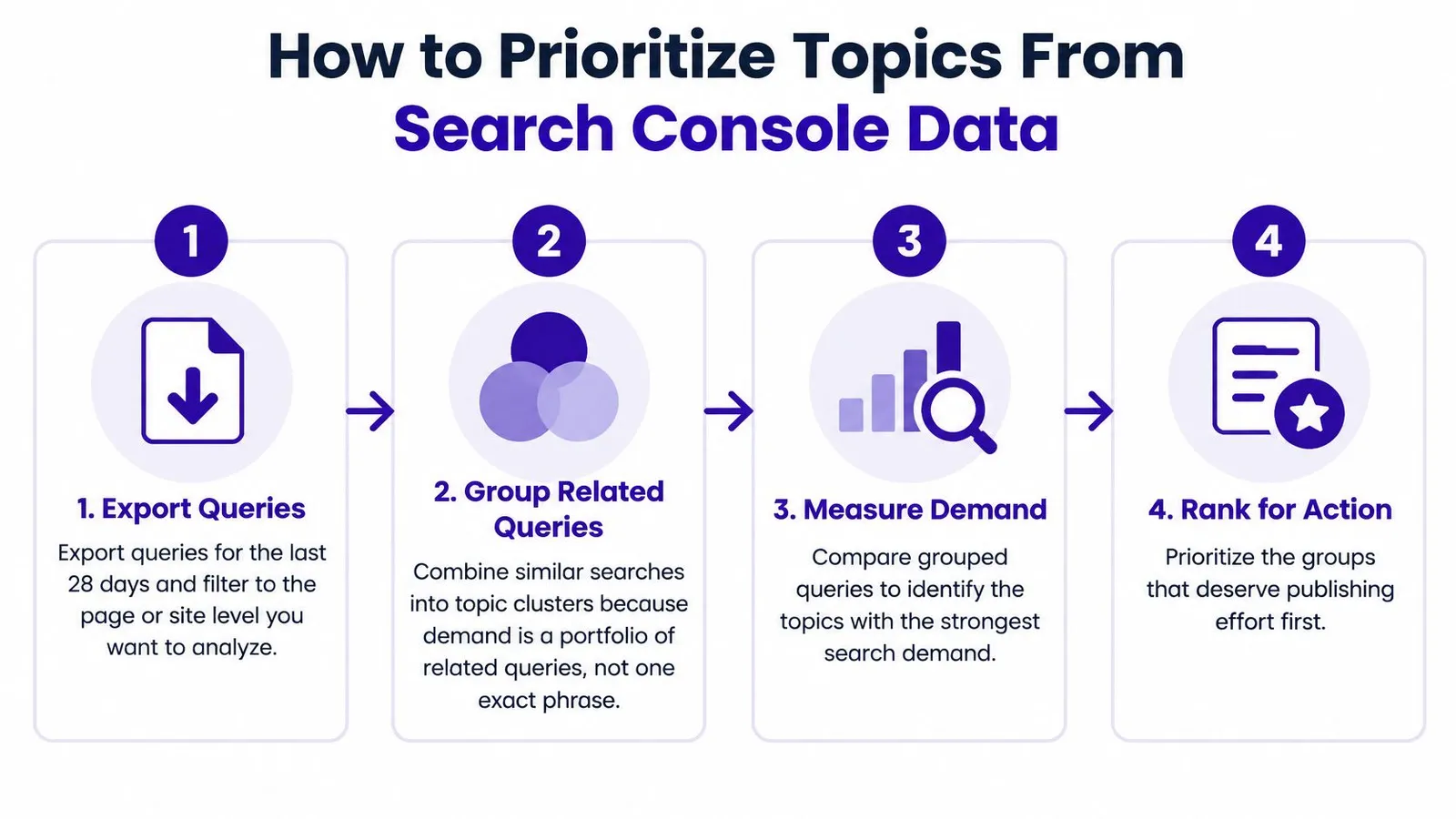
The workflow turns those patterns into publishing decisions.
Build a Repeatable Review
Export a consistent comparison window. Filter the report to the intended country, device, and search type, then compare equivalent periods. Consistency helps separate a genuine change from a different reporting setup.
Group by shared need. Keep bed-frame-height questions together, but separate sizing questions when they require a different answer. Preserve query-to-page relationships so the merchant can identify overlapping or unsuitable landing pages.
Assess visibility, outcomes, and ranking. Review impressions alongside clicks, CTR, and average position. A cluster summary should retain the individual pages underneath it rather than conceal them.
Assign an action to the pattern. Strong impressions with weak CTR warrant an intent and snippet review before expansion; rising impressions with few clicks can justify a focused refresh. Clicks landing on commercially disconnected content suggest a need for useful product or collection links.
Add catalog fit and competitive context. Combine the observed pattern with relevance and the volume-difficulty assessment. Use plain decisions such as refresh, create, investigate, or defer rather than adding incompatible metrics into an unexplained total.
Order work by evidence and usefulness. Place clear catalog matches with actionable observations ahead of speculative topics. Keep new topics eligible when forecasts and customer questions support them, even if no existing page has earned visibility.
Schedule another review. Record the change, intended outcome, and review date. Reassess after enough complete reporting periods have passed to distinguish a pattern from ordinary fluctuation.
Segment Before Drawing Conclusions
International merchants should examine country-level patterns before combining performance. Regional vocabulary can change which page best answers a query, while mobile results may expose a snippet or usability problem that isn't apparent on desktop.
A practical website keyword checking workflow helps preserve this query-to-page context during recurring reviews. A shared spreadsheet should also record whether the recommendation concerns a new article, an existing guide, or a collection page.
Avoid averaging CTR percentages across query rows. Calculate cluster CTR from total clicks divided by total impressions, and interpret position changes alongside the mix of queries contributing to the cluster.
Turn the Analysis Into a Publishing Order
A defensible calendar needs explicit entry rules. A topic should pass the intent and relevance checks, then show either a useful observed signal or a credible estimated opportunity.
The decision flow makes rejected ideas easier to explain.
Keep the Decision Visible
Maintain a sheet with intent, relevance, volume, difficulty, observed signal, decision, and reason. Add the intended landing page so a new writing assignment doesn't duplicate an existing answer.
A rejected topic belongs in a labeled backlog, not an unexplained pile. “Wrong page format,” “outside catalog,” and “competition exceeds current capacity” provide useful reasons for revisiting or retiring an idea.
A broader approach to developing a content strategy can connect that publishing order to editorial ownership, product priorities, and measurement. For a perspective outside retail, Big Moves Marketing's SEO content planning for B2B SaaS offers a useful comparison when organizing a sustained content program.
The accompanying video provides another format for considering the planning process.
Apply Judgment Before Automation
Rankira researches keywords using the store's products, competitors, and Google Search Console data, then provides a calendar with volume and difficulty scores. Merchants can drag, swap, or lock scheduled days, or accept the prepared arrangement.
The merchant should inspect the initial batch by hand before enabling automatic publication. Automation can apply a chosen workflow consistently, but it can't make an irrelevant topic suitable for the catalog.
Before publication, the editor should confirm:
Query answered: The title and opening address the actual search task.
Format matched: The page delivers the type of answer shoppers expect.
Useful destination: Relevant product or collection links support the reader's next step.
Claims supported: Factual assertions have appropriate sources, and examples aren't presented as measured results.
The final publishing order should reflect decisions the merchant can defend, not just a descending column of tool scores.
Rankira combines product-based keyword research, Search Console evidence, and an adjustable content calendar to help Shopify merchants turn analysis into scheduled articles. Visit Rankira to build a researched topic queue, review its fit with the catalog, and begin with draft approval before moving to automatic publishing.
Keep reading
All articles
Keyword Research
How to Check Keywords of a Website: A 2026 Guide
Learn how to check keywords of a website with Google Search Console and SEO tools, read the data correctly, and turn it into a clear content plan.
10 min read

Shopify SEO
Search Engine Optimization Plan for Shopify: 2026 Guide
Build a search engine optimization plan for your Shopify store: set a baseline, pick keywords, publish in batches and measure results.
11 min read

Shopify SEO
Keyword Density SEO: How to Calculate and Use It
Keyword density SEO is a percentage, not a ranking target. See the formula, sample counts, and how to place phrases without stuffing.
12 min read
Put your Shopify blog on autopilot
Rankira researches keywords, writes SEO articles, adds internal links, and publishes them to your store — every week. Start with a 7-day free trial.