Long Tailed Keywords for a Shopify Content Plan
Learn what long tailed keywords are, why niche queries add up, and how to score them for a Shopify content plan.
Published 12 min read

In this article
A Shopify merchant opens a keyword export on Monday morning and sees two disappointing lists. The familiar category phrases look crowded with large retailers, while the specific phrases look too small to justify an article. The blog still needs a useful post, and neither list answers what to publish next.
Table of Contents
- Why Head Terms Leave a Store Blog Thin
- The Long Tail Idea Behind Search Demand
- What Long Tailed Keywords Look Like in Data
- When Specific Queries Stop Sending Clicks
- How to Score Long Tailed Keywords Together
- Shopify Examples and a Practical Workflow
- Start With One Catalog Theme This Week
Why Head Terms Leave a Store Blog Thin
The usual false choice is easy to spot. One option chases a broad term such as "running shoes" or "skincare" and hopes a small store can outrank established category pages. The other option rejects every phrase with low reported volume, even when those phrases describe the merchant's actual sizes, materials, customers, or problems. Both choices leave the publishing calendar thin because both judge a topic by one number.
A store aisle analogy helps. A busy main aisle gets plenty of foot traffic, but a store doesn't stay useful by stocking only that aisle. Shoppers also move through many narrower aisles, each serving a specific need. Together, those aisles can fill the store. Search behaves in a similar way when a catalog answers many precise needs instead of relying on one generic phrase.
The decision a merchant needs to make
The useful skill isn't finding the longest phrase in a spreadsheet. It's judging whether a phrase represents a real buying or learning need, whether a searcher still has a reason to click, and whether several wordings belong on one page. That judgment matters for solo merchants, agencies running several stores, and international retailers whose customers phrase the same need differently by language or region.
- Head term first: Broad phrases may bring visibility, but intent is vague and competition is usually heaviest.
- Tiny phrase first: A specific phrase may fit the catalog, but a separate article for every wording creates repetition.
- Portfolio first: Related phrases get judged together, which leads to fewer, stronger pages tied to merchandise.
The path ahead moves from the original long-tail idea to the shape of search demand, then to the clickability problem created by answers on the results page. A scoring method follows, then catalog examples show how the method works in practice. Merchants looking for background on ways to increase blog traffic for a store can keep one principle in mind throughout. A useful long tailed keyword isn't just long. It's specific, relevant to products, and worth a visit.
The Long Tail Idea Behind Search Demand
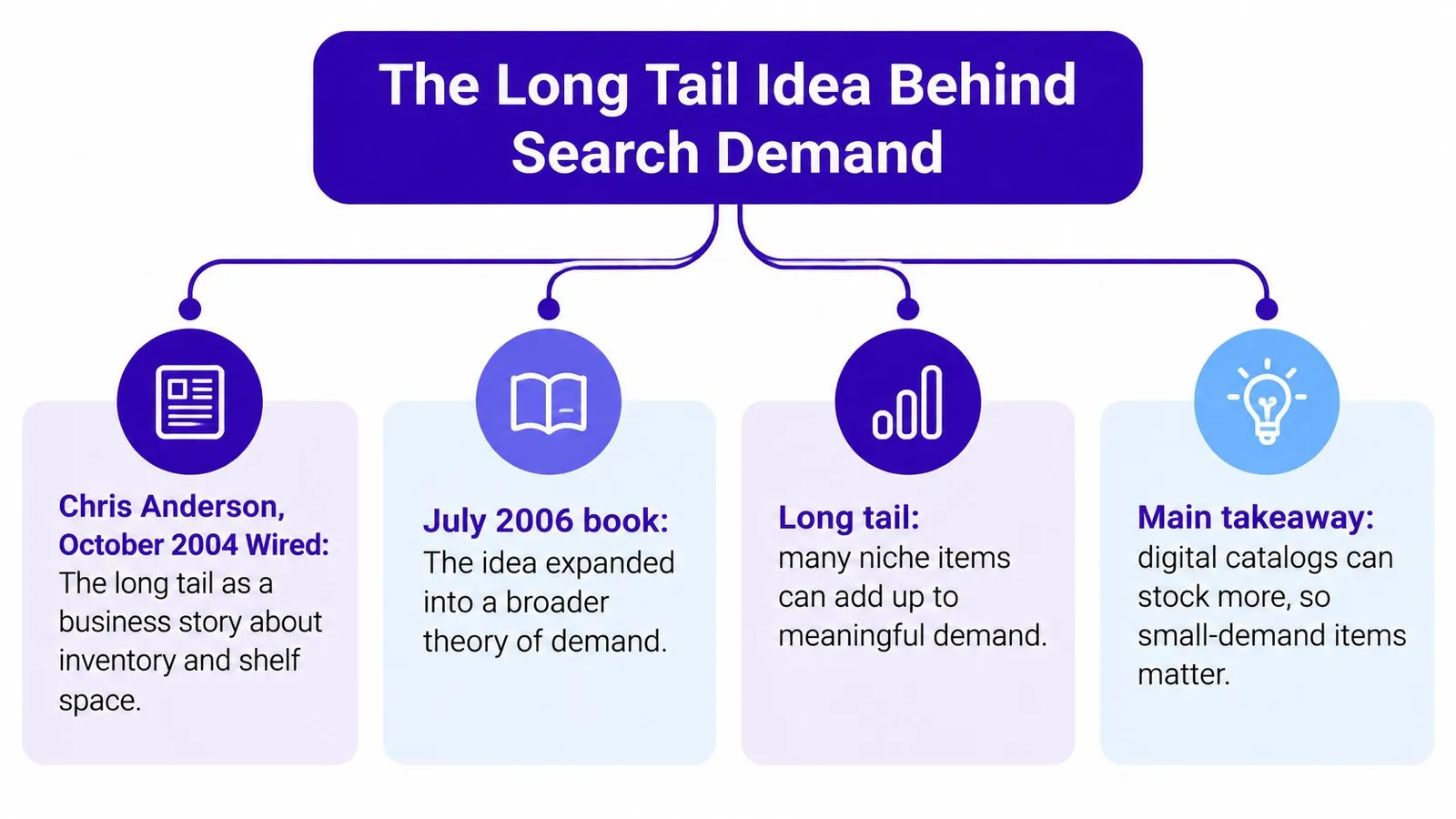
The modern business meaning of the long tail comes from digital shelves, not from SEO software. Chris Anderson set out the idea in an October 2004 Wired article and expanded it in The Long Tail in July 2006, describing demand shifting from blockbusters toward many niche items when distribution and storage get cheaper, as detailed in Anderson's original Wired account of the long tail. A physical shop has limited shelf space and favors proven sellers. A digital catalog can keep far more niche items available, so rare purchases stop being invisible.
The statistical shape is simple to picture. A small head contains a few items with very high demand. A long tail stretches behind that head and contains many items, each attracting modest demand. One item deep in the tail looks unimportant by itself. Thousands of those items together can rival the head.
The infographic below maps that move from inventory history to search planning.
The observation that challenged the usual rule
Anderson reported that roughly 98% of inventory across several digital-media services generated at least one sale each month. That observation challenged the familiar assumption that only the most popular 20% of offerings matter. The point wasn't that every niche item sells well. The point was that almost everything sells occasionally when customers can find it, and occasional sales accumulate.
One niche item looks minor in isolation, while a large catalog of niche items can carry meaningful demand in total.
Search phrases follow a comparable logic. A single specific query about fit, material, or compatibility may look too small to deserve attention. A store with many well-organized pages can address a broad set of those intents and collect visibility across the whole set. Paid search teams face a similar sorting problem, and keyword research guidance for PPC teams from Keywordme offers a useful companion view on separating specific intent from generic demand. For a Shopify blog, the lesson is restraint. Head-term volume shouldn't be the only scoreboard, because cumulative demand often hides in precise catalog language.
What Long Tailed Keywords Look Like in Data
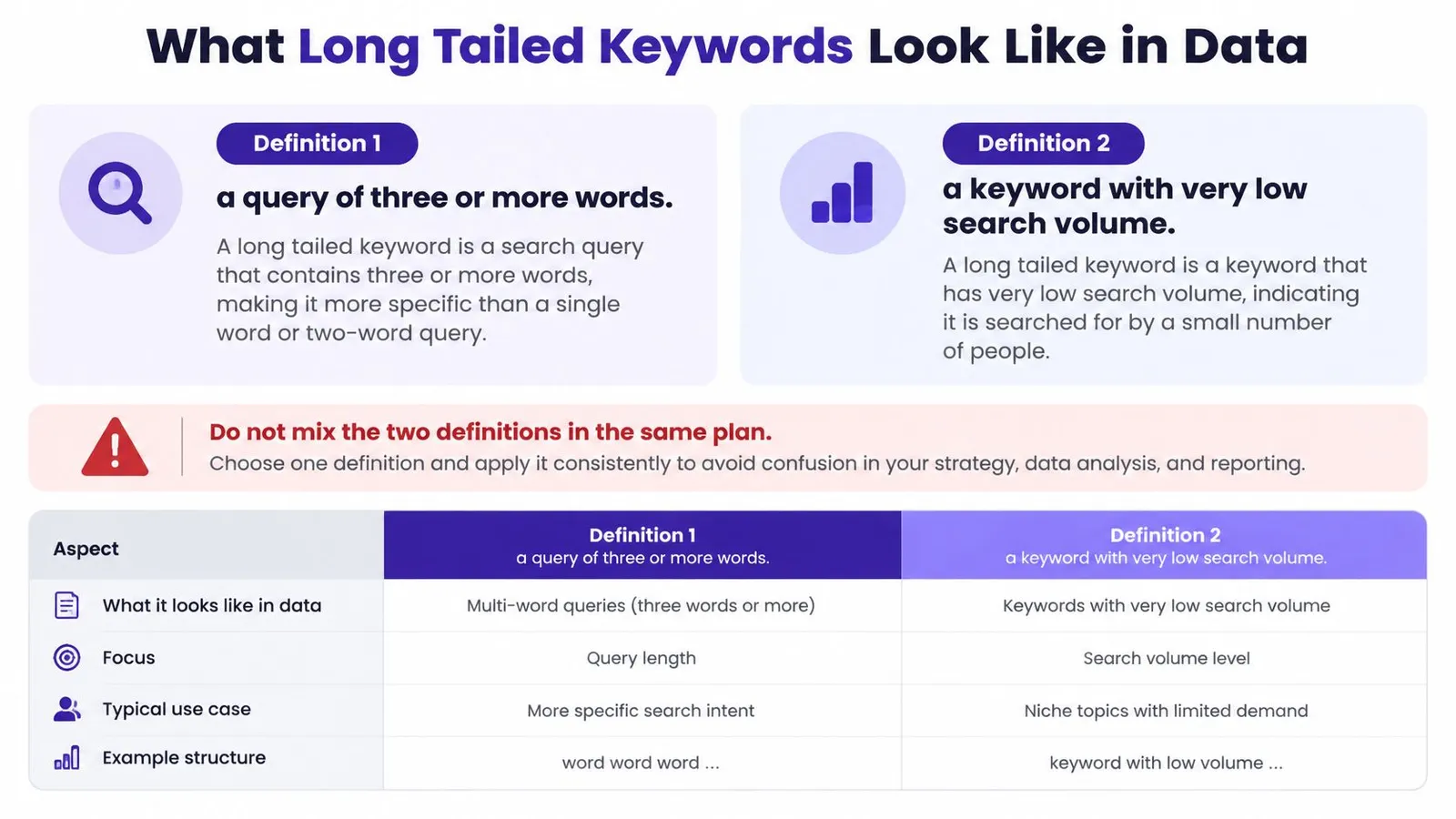
Two definitions get mixed together in keyword plans, and the confusion causes real publishing mistakes. One definition counts words and calls any query of three or more words long-tail. The other definition counts demand and calls a keyword long-tail when monthly volume is very low. A phrase can fit one definition without fitting the other, so a plan needs to state which test it's using.
The comparison below keeps those definitions apart before any topic gets approved.
What the query numbers actually show
A large-scale analysis of 306 million U.S. search queries found that 91.8% contained three or more words, and related keyword-distribution research reports that approximately 94.74% of keywords receive 10 or fewer searches per month, according to search engine statistics summarizing query length and keyword volume. Most searches therefore aren't short labels such as "shoes" or "insurance." They're combinations that add an attribute, place, audience, or problem. Most individual keywords are also small, which is normal rather than a sign of failure.
A retail contrast makes the point concrete. "Boots" names a category and little else. "Waterproof leather boots for wide feet" names a product type, a material, a performance need, and a fit constraint. The second phrase gives a merchant something to write about and something to link to, even when a tool reports low volume.
What the numbers don't prove
Those figures are market-study estimates, not universal constants. The query-length result comes from a U.S. dataset, so it shouldn't be treated as a rule for every country or language. Word count alone also doesn't make a topic valuable. A long phrase can be irrelevant to the catalog, impossible to answer well, or fully answered on the results page.
- Length test: Word count shows specificity of wording, not buying intent or page value.
- Volume test: Low volume shows limited measured demand, not zero demand.
- Planning test: Relevance to products, shared intent, and click reasons decide whether a page should exist.
The takeaway is a cleaner filter. Query variety is structurally normal, and small keywords dominate the keyword universe. Length alone doesn't assign a page, and low volume alone doesn't disqualify one.
When Specific Queries Stop Sending Clicks
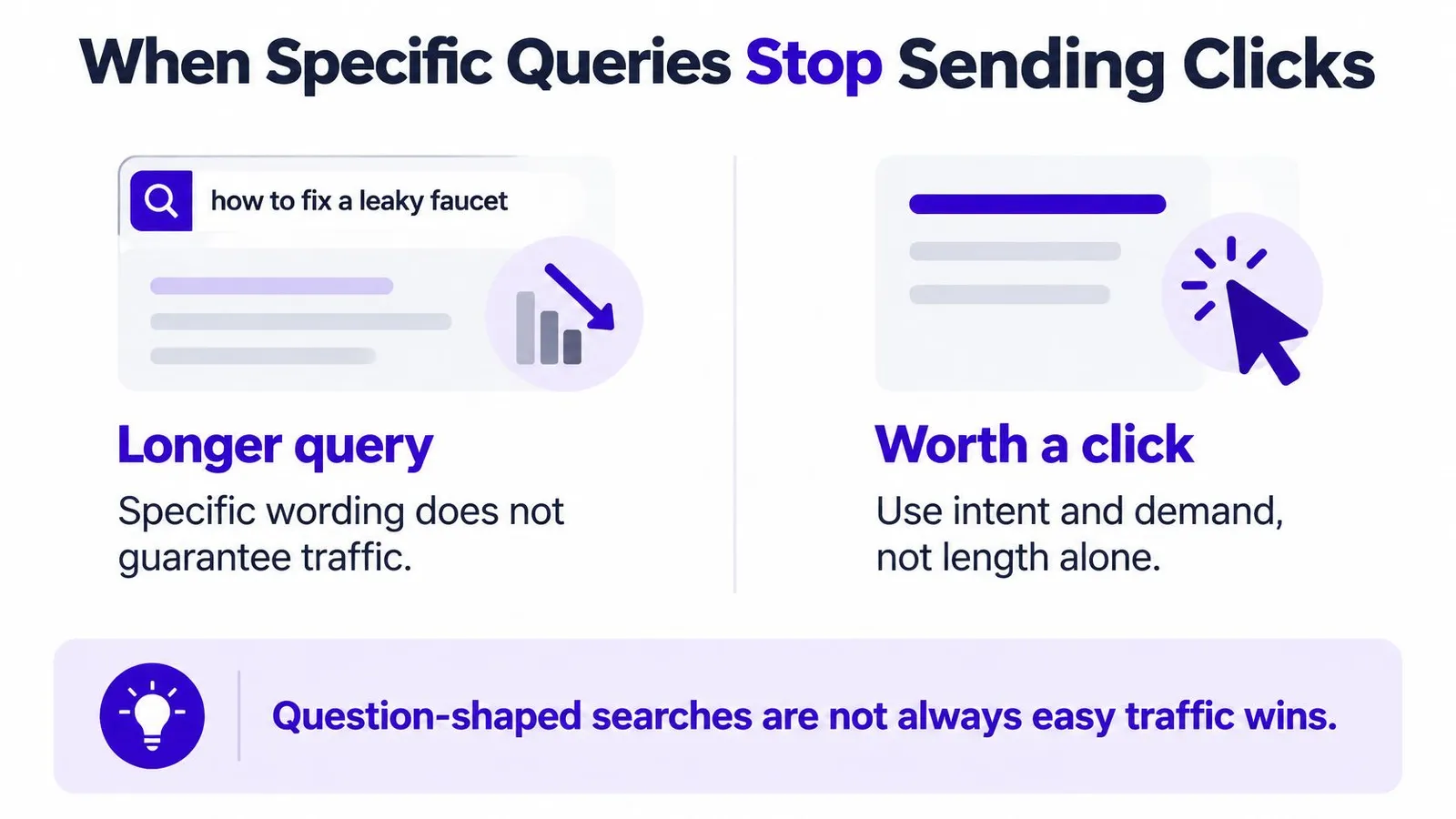
A longer, question-shaped query isn't automatically an easy traffic win. That assumption made sense when a search result mainly offered a list of links. A results page can now answer some specific questions directly, which changes the value of ranking for them. Easier competition doesn't help much if the searcher never needs to visit the store.
The graphic below separates a longer query from a query that still gives a searcher a reason to click.
How AI answers changed the trade-off
Semrush's analysis of more than 10 million keywords found AI Overviews initially appeared mainly for long-tail informational searches, with coverage rising from 6.49% of keywords in January 2025 to nearly 25% in July before falling to 15.69% in November, as reported in Search Engine Land's summary of the AI Overviews surge and pullback. Queries showing AI Overviews had higher zero-click rates overall, yet zero-click behavior for comparable keywords declined from 33.75% to 31.53% after AI Overviews appeared. The picture isn't a simple story of every click disappearing. It's a sorting problem.
The short video below gives a practical view of how search visibility gets checked once a page is live, which matters when rankings and clicks stop moving together.
A two-way split merchants can reuse
Snippet-satisfiable questions can be finished in a short result. A definition, a single measurement conversion, or a basic care instruction often fits that group. Experience- or product-dependent questions need more than a summary. They need a comparison, a demonstration, store-specific evidence, or a recommendation tied to actual merchandise.
- Snippet-satisfiable example: A general question about what a fabric name means rarely needs a store visit.
- Product-dependent example: A question about which jacket fits a tall cyclist in wet weather needs sizing evidence, photos, and product choices.
- Measurement shift: Product-page visits and assisted conversions reveal more value than rank alone.
Store content should favor the second group. Original product data, clear images, and internal links to relevant collections give searchers a reason to continue. Merchants learning to check ranking on Google for store pages should read position next to clicks, not as a substitute for clicks. A page can rank and still fail commercially if the answer ends on Google.
Practical rule: Specificity helps only when the page offers something a short results-page summary can't provide.
How to Score Long Tailed Keywords Together
The working unit should be a portfolio of low-volume queries, not one exact phrase. About 93% of keywords in a large U.S. keyword database receive fewer than 10 monthly searches, while fewer than 18,000 terms exceed 100,000 monthly searches, according to long-tail keyword statistics on keyword volume distribution. A merchant who judges each wording alone will reject most of the keyword universe. A merchant who publishes a thin article for each wording creates a different problem, repetition.
Clustering solves both problems when it's done by intent. Phrases belong together when they ask for the same outcome, point to the same products, and produce a similar results page. Useful combinations often join a problem, a product, an audience, and a constraint. A sizing cluster, for example, can cover several ways customers ask whether a boot fits wide calves, as long as one evidence-rich page answers all of them.
Score a Long Tailed Keyword Cluster
| Cluster | Shared intent | Answerability | Page decision | Success signal |
|---|---|---|---|---|
| Wide-calf boot sizing | Find a boot that fits comfortably | Product-dependent | Combine into one guide linked to boots | Aggregate clicks and product visits |
| Leather care basics | Learn a simple definition or step | Snippet-satisfiable | Skip or add a short section | Impressions without expecting many visits |
| Waterproof trail shoes for flat feet | Choose suitable footwear for a use case | Product-dependent | Keep as its own page | Cluster impressions, clicks, and conversions |
| Regional delivery wording variants | Confirm purchase feasibility | Mixed | Combine unless policy differs | Assisted conversions across variants |
The decision at the end should be plain. Keep means the cluster deserves a dedicated page. Combine means variants share one URL because a separate page would repeat the same advice. Skip means the query is irrelevant, fully answerable in a snippet, or impossible to support with store evidence.
Cannibalization becomes concrete with a sizing example. Two near-duplicate posts about whether the same boots fit wide calves split internal links, confuse readers, and make performance harder to read. One stronger page with measurements, fit notes, and product links serves the intent better.
Search Console should replace estimated volume once pages are live. Aggregate impressions and clicks across the cluster show whether the page covers the wordings customers use. Conversions and onward product visits show whether coverage matters commercially. A structured approach to keyword research step by step helps merchants record that evidence consistently. The score isn't the volume of one phrase. It's the combined behavior of an intent cluster tied to products.
Shopify Examples and a Practical Workflow
Catalog language creates long tailed keywords naturally. Sizes, materials, compatibility, ingredients, use cases, and regions multiply the ways customers describe one need. The scoring question stays the same for each theme. Does the searcher need the store's evidence, or can a short answer finish the job?
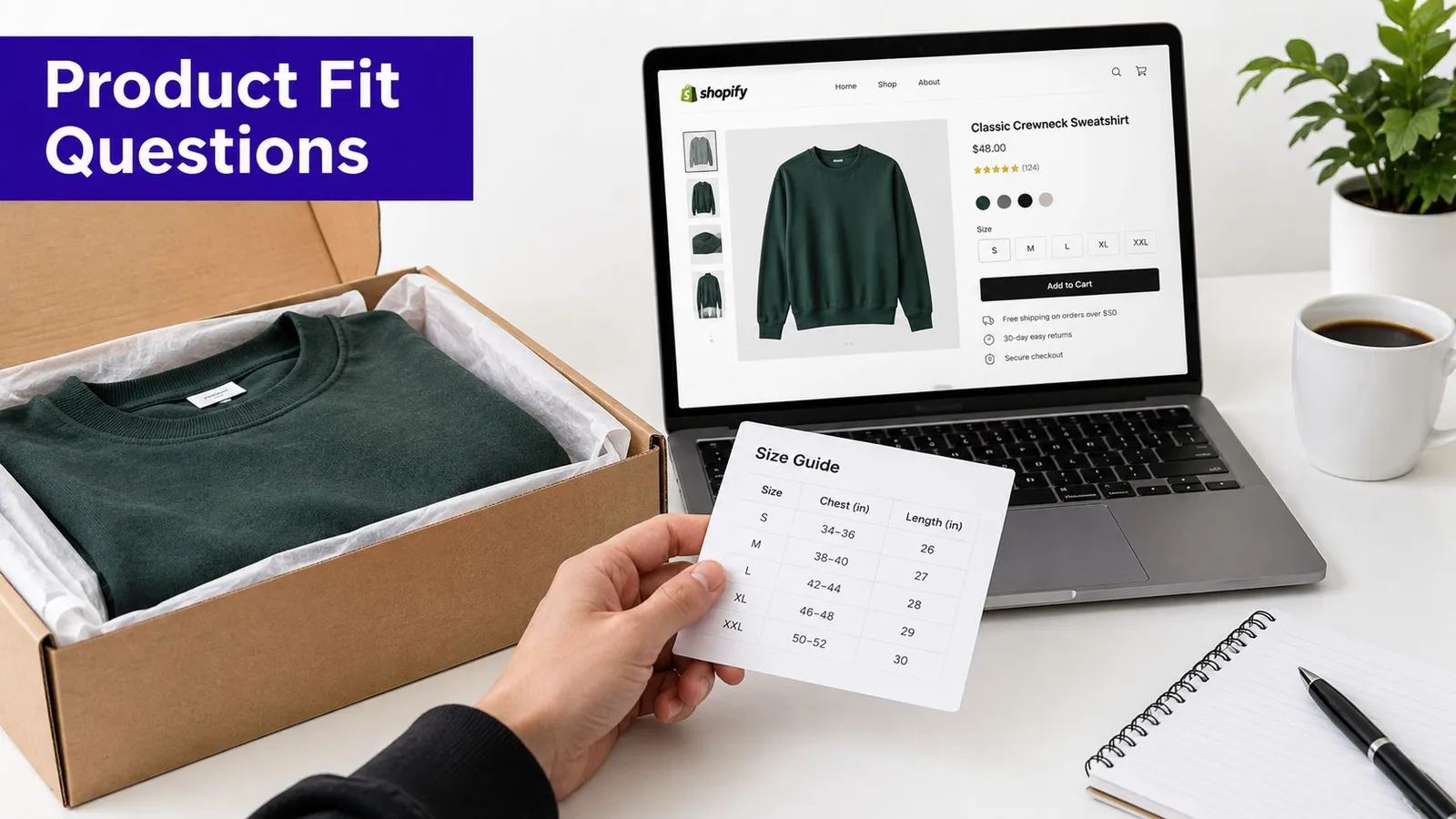
The photo below shows the kind of fit evidence that turns a generic sizing question into a page worth visiting.
Three catalog situations
A sizing or compatibility question belongs close to the product. A guide explaining whether a case fits a specific phone model, or whether a jacket suits a tall frame, should show measurements and link directly to the item. A material or ingredient question needs store evidence rather than a generic definition. Fiber content, care limits, sourcing notes, or ingredient restrictions become useful when they're tied to named products. A regional or language variant often repeats the same buying problem in different words, so separate thin articles for every synonym usually waste effort.
Commercial intent doesn't guarantee protection from on-result answers. Similarweb reported zero-click news searches rising from 56% in May 2024 to almost 69% in May 2025, while Semrush found AI Overview coverage of commercial queries increasing from 8.15% to 18.57% and transactional coverage from 1.98% to 13.94%, as covered in Press Gazette reporting on AI Overviews and zero-click searches. International wording can fragment the same buying intent, so variants are better measured as a cluster.
Manual tools compared with an in-admin workflow
A manual workflow usually spreads the job across spreadsheets and separate research, writing, image, and reporting tools. That approach offers control, but it adds handoffs and makes internal linking easier to forget. An in-admin workflow keeps planning closer to products and collections, which suits merchants without a content team.
Rankira is one in-admin option for Shopify stores. It researches keywords using store data, competitors, and Search Console with volume and difficulty, then supports a calendar for one keyword a day up to seven days a week with drafts or scheduled posts. Articles can include meta descriptions, tags, images, clean URLs, and links to products, collections, and pages, with 12 tones, more than 150 languages, and over 190 regions. Reporting covers clicks, impressions, positions, and Ahrefs Domain Rating, editing includes five image styles, and a backlink exchange uses credits. The Standard plan costs USD 39 a month with a seven-day trial. Posts and files remain in the store after uninstall, and customer, order, and payment data aren't requested. Merchants comparing approaches to SEO content marketing for commerce should judge any workflow by whether cluster decisions stay visible from research through reporting.
Start With One Catalog Theme This Week
One product family that already creates repeated customer questions is enough for a first pass. The theme could be trail footwear, refillable skincare, dog harnesses, or replacement parts. The important feature isn't the category. It's the repeated modifiers customers already use in messages, reviews, search terms, and product questions.
A one-theme exercise
- List real modifiers: Size, material, compatibility, use, audience, and region come first because they reflect how customers narrow a choice.
- Group shared intent: Wordings asking for the same outcome go into one cluster, even when phrasing differs by language or region.
- Mark answerability: Snippet-satisfiable questions get skipped or folded into a short section, while product-dependent questions stay in contention.
- Name the evidence: Each kept cluster needs measurements, photos, comparisons, care limits, or product data that a summary can't replace.
- Set the success signal: Impressions and clicks across the cluster matter, along with visits onward to products or collections.
The outcome should be one cluster article, internally linked to the relevant product or collection and scheduled on a chosen publishing day. That page gives Search Console something real to measure. Later impressions reveal which wordings the page already covers and which related questions still lack a home.
Agencies can repeat the same sheet for each client store rather than building a new theory each time. The columns stay stable while products, languages, and customer constraints change. That consistency makes keep, combine, or skip decisions easier to explain to a merchant who doesn't track SEO terminology.
A merchant who wants research, drafting, internal links, and the calendar inside Shopify admin can start the same one-theme exercise there, including a seven-day trial where available. A merchant using another stack can still run the exercise with a spreadsheet and Search Console. Background on developing a content strategy supports the same sequence. The decision for the week is modest and concrete. Publish one evidence-rich page for a real catalog cluster instead of a pile of near-duplicate posts chasing separate wordings.
Rankira helps a Shopify merchant turn one catalog theme into researched, scheduled blog articles with product links, images, and performance reporting inside Shopify admin. A store without an in-house content team can use that workflow to publish product-dependent cluster pages consistently instead of sorting tiny keyword exports by hand. Visit Rankira to start building a long tailed keyword plan around actual merchandise.
Keep reading
All articles
Shopify SEO
SEO Content Writing Principles for Readers and Search
Learn the principles of SEO content writing that balance search relevance, clear structure, and real reader value, with examples for online stores.
10 min read

Shopify SEO
Internal Linking Audit That Actually Improves Rankings
Run a practical internal linking audit to find orphan pages, fix broken links, and prioritize fixes that move revenue on your Shopify store.
10 min read
Shopify SEO
Share of Voice SEO: A Practical Measurement Guide
Learn how share of voice SEO works, how to calculate it, and how to use intent-based metrics to assess search visibility and business impact.
12 min read
Put your Shopify blog on autopilot
Rankira researches keywords, writes SEO articles, adds internal links, and publishes them to your store — every week. Start with a 7-day free trial.