Content Gap Analysis: How to Find and Fill Missing Topics
Learn what content gap analysis is, how to find missing topics competitors rank for, and how to turn the findings into a focused content plan for your store.
Published 12 min read

In this article
- Table of Contents
- What Content Gap Analysis Actually Means
- Why Most Published Pages Never Earn Traffic
- How to Run a Content Gap Analysis
- How to Score and Prioritize the Gaps You Find
- Turning Gap Findings Into a Content Plan
- A Content Gap Analysis Example for a Shopify Store
- Key Takeaways and Your Next Step
Content gap analysis is an audit that compares 3 inventories, existing pages, audience search queries, and topics competitors cover, to find missing or weak coverage worth improving or turning into content. For a Shopify merchant, the useful result isn't a longer keyword list, but a clearer decision about which buyer questions deserve attention.
A store might already publish brewing guides while leaving shoppers unsure which grinder fits their espresso machine. Another article about coffee won't necessarily solve that problem. A focused compatibility explanation might.
The difference matters because publishing and helping aren't the same activity. A useful audit checks whether the store answers relevant questions clearly, supports those answers with evidence, and gives interested readers a sensible route to its catalog.
Table of Contents
- What Content Gap Analysis Actually Means
- Why Most Published Pages Never Earn Traffic
- How to Run a Content Gap Analysis
- How to Score and Prioritize the Gaps You Find
- Turning Gap Findings Into a Content Plan
- A Content Gap Analysis Example for a Shopify Store
- Key Takeaways and Your Next Step
What Content Gap Analysis Actually Means
A merchant checking shelves doesn't copy the neighboring store's inventory. The merchant compares available stock with customer requests, then decides which missing products belong in the business.
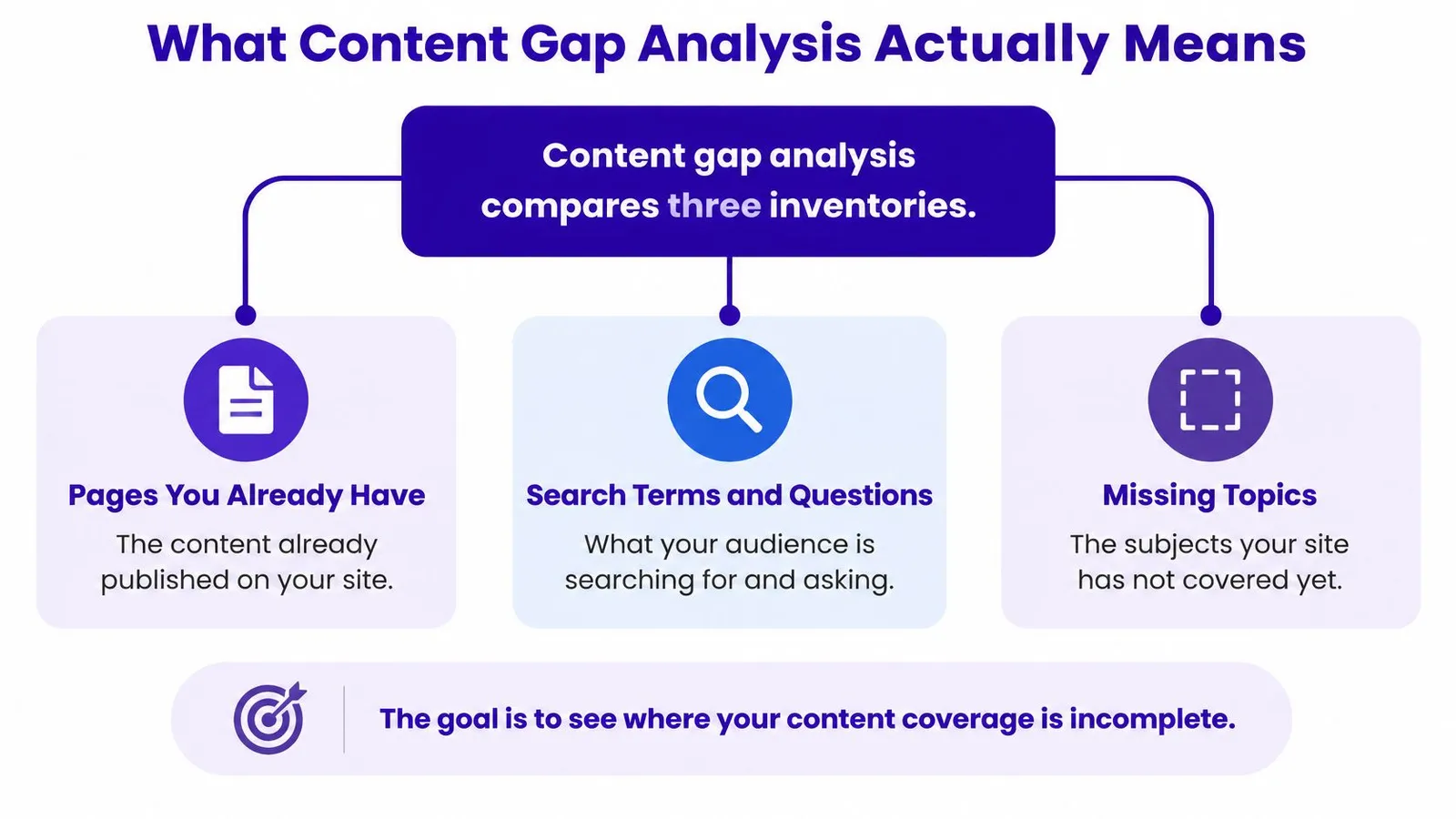
Content gap analysis applies similar judgment to information. The store's pages represent current coverage. Audience queries reveal expressed needs. Competing search results show how other publishers address those needs.
The relationship is illustrated below.
A missing keyword isn't always a missing page
Consider a Shopify store selling hiking backpacks. Its collection page might mention waterproof materials without explaining whether the seams resist prolonged rain. The keyword appears, but the shopper's practical question remains unanswered.
Google's August 2022 Helpful Content Update announcement emphasized helping people rather than producing content primarily for search performance. For an ecommerce audit, that supports a broader definition of a gap: inadequate answers matter alongside absent topics.
Useful distinctions include:
- Missing coverage: No page explains how to choose a backpack for an overnight trip.
- Incomplete coverage: A buying guide discusses capacity but omits fit and torso measurements.
- Outdated coverage: An article recommends products the store no longer carries.
- Misaligned coverage: A shopper seeking a comparison reaches a general brand story instead.
- Weak evidence: A durability claim appears without supporting product details or firsthand observations.
These distinctions prevent a common mistake: commissioning an article whenever a keyword doesn't appear in the content inventory. Sometimes the better action is updating a product description, expanding a buying guide, or combining overlapping pages.
The deliverable is an editorial decision
An actionable audit ends with a prioritized editorial plan. Each recommendation identifies the unanswered need, the page that should address it, the evidence required, and the appropriate next step.
Practical rule: A gap is worth considering when filling it helps a relevant shopper understand something the store currently leaves unclear.
Competitor coverage provides clues, not instructions. A rival's article can reveal an overlooked question without making that question commercially relevant to every store.
Why Most Published Pages Never Earn Traffic
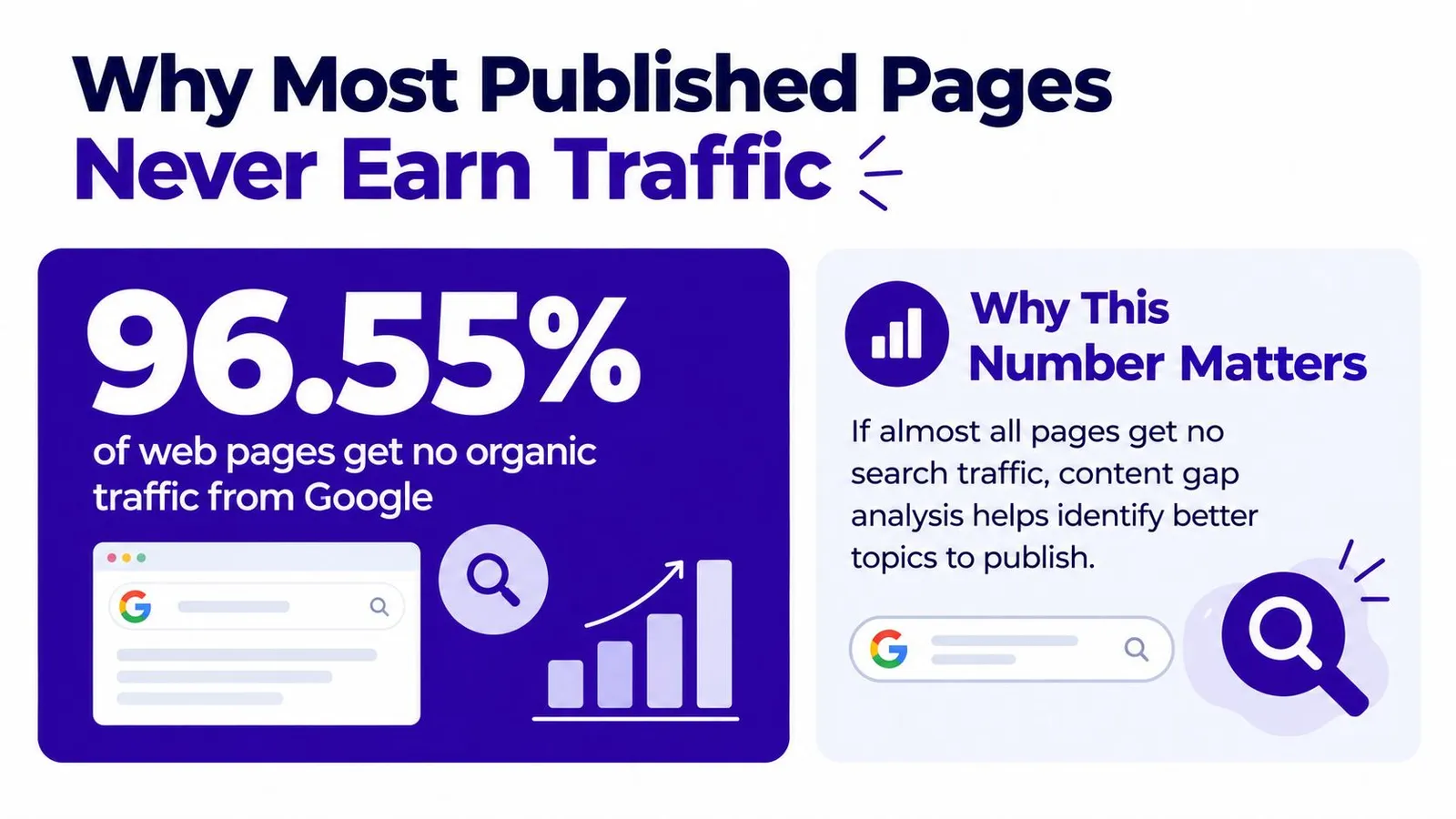
Approximately 96.55% of web pages receive no organic traffic from Google, according to the widely cited Ahrefs finding discussed in this technical guide to content gap analysis. That figure describes a discoverability problem, not a universal need for longer articles.
The scale of the finding is shown below.
Several different problems can produce the same outcome. A page may have indexing problems, weak backlinks, little search demand, or poor rankings. Adding paragraphs doesn't automatically address any of those causes.
Diagnose the problem before choosing the remedy
A Shopify merchant should distinguish a discovery problem from a coverage problem. An inaccessible page requires a different response from an accessible page that answers the wrong question.
| Observed problem | Sensible investigation |
|---|---|
| A published page isn't appearing in search | Check indexing and technical accessibility |
| An article targets an obscure topic | Validate whether relevant demand exists |
| Visitors seek a comparison but find a tutorial | Reassess search intent and page format |
| A useful article has no clear catalog connection | Review relevant product and collection links |
| Several pages offer nearly identical advice | Examine overlap before adding another article |
The controllable editorial question is whether the proposed content deserves publication in the first place. Does a relevant audience need the answer? Can the store provide it credibly? Does an existing page already serve that need?
For example, a cookware merchant might consider publishing a broad history of cooking. That topic could interest readers without helping anyone evaluate the store's pans. A guide explaining which available pans work with induction cooktops has a clearer relationship to the catalog.
That doesn't make informational content worthless. It means demand and intent should be validated before production, rather than inferred from a vaguely related keyword.
The accompanying video offers another way to approach the audit process.
Make published content traceable
A validated article should have a defined destination and measurement plan. Relevant product and collection links help readers continue their research, while impressions, clicks, and search positions provide a way to evaluate discoverability.
An internal linking audit can help identify articles that lack useful connections to the catalog. The merchant can then distinguish content that nobody discovers from content that readers find but can't easily act on.
How to Run a Content Gap Analysis
The audit works best as a continuous investigation, not a keyword export followed immediately by article generation. A spreadsheet is sufficient when each entry connects a searcher's question to an existing page or a justified publishing action.
Inventory pages and collect questions
Start with product pages, collections, buying guides, tutorials, and existing blog posts. Record each page's main purpose and the query or question it is supposed to answer.
Then collect audience language from Google Search Console, keyword research, customer questions, and relevant search results. Search Console queries describe existing visibility; keyword research helps investigate needs the store may not yet cover.
A step-by-step keyword research process can support this collection stage. The important distinction is that a keyword is an input, not an automatic article assignment.
For a bedding store, related queries about linen care, shrinkage, and washing temperature might belong in the same care guide. Creating separate articles without reviewing intent could produce redundant coverage.
Compare answers, not just terms
Inspect the competing pages that rank for relevant queries. Note the task each page helps readers complete, the format it uses, the questions it answers, and the supporting evidence it provides.
Google's helpful content guidance supports reviewing usefulness rather than merely checking keyword presence. A merchant should ask whether the store's page completes the shopper's task and contributes something beyond repeated general advice.
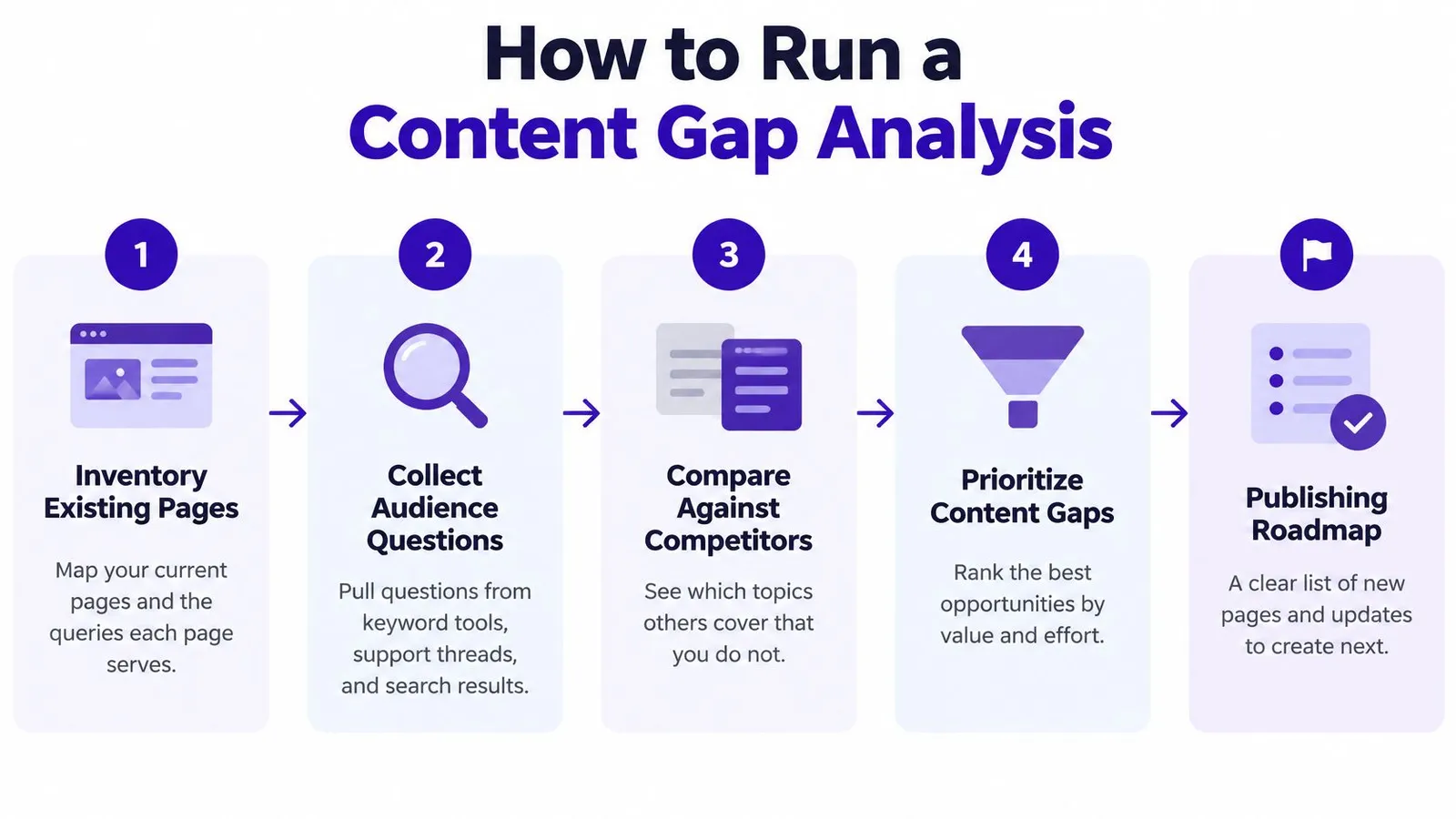
The workflow can be organized as follows.
A competitor's mattress guide might discuss firmness while omitting whether the product works with an adjustable bed. A store with verified compatibility information has a potential answer-level gap to address.
For AI-generated search experiences, the audit can also inspect which questions summaries answer and which supporting pages they cite. The useful comparison concerns factual completeness, product attributes, and source transparency, not an assumption that copying a cited page will earn inclusion.
Create a usable gap record
Each candidate should have enough detail for another person to understand the proposed work:
- Query: The audience's search phrase or question.
- Intent: The task the searcher wants to complete.
- Current URL: The existing page, or a note that no suitable page exists.
- Ranking-page format: The comparison, tutorial, category page, or other format observed.
- Uncovered questions: The specific information still missing.
- Commercial relevance: The relationship to available products or collections.
- Internal-link destination: The appropriate catalog page.
- Recommended action: Update, consolidate, create, or reject.
This record prevents a writer from receiving only a keyword and guessing at the assignment. It also exposes proposals that duplicate an existing page.
For merchants developing their editorial skills alongside the audit, SimpleLab Digital offers a place to browse blog content SEO tips. Such resources can support execution, while the store's own gap records should determine what gets written.
How to Score and Prioritize the Gaps You Find
A large opportunity list isn't a publishing strategy. Merchants need a consistent way to compare an attractive broad topic with a narrower question that directly supports a purchase.
A practical approach assigns a 0–5 score to search opportunity, catalog relevance, content deficiency, proprietary insight, and conversion pathway, then subtracts a duplication penalty. This is an editorial decision model, not a prediction of traffic; the emphasis on differentiated usefulness aligns with Google's guidance for search and generative features.
Gap Prioritization Scoring Model
| Scoring Factor | What It Measures | Strong-Score Signal |
|---|---|---|
| Search opportunity | Evidence of relevant audience demand | Queries closely match the intended audience's needs |
| Catalog relevance | Connection to merchandise the store actually sells | The answer naturally involves available products |
| Content deficiency | How poorly the current page serves the task | Important decision-making information is absent |
| Proprietary insight | Access to firsthand knowledge or evidence | The store can supply verified details competitors lack |
| Conversion pathway | A useful next step after the answer | Readers can reach a relevant collection or product |
| Duplication penalty | Overlap with an existing page serving the same intent | Subtract priority when another page already answers the need |
The scoring definitions should remain consistent across the audit. Search opportunity shouldn't mean search volume for one candidate and personal enthusiasm for another.
Proprietary insight deserves particular attention. A merchant may have access to fit checks, installation observations, material specifications, or recurring customer questions. Those inputs can justify a focused page more convincingly than another generic explanation of a familiar topic.
A large keyword isn't automatically a strong opportunity. A smaller question may deserve priority when the store can answer it better and connect it to a relevant buying decision.
Competitor rankings can inform the opportunity assessment without becoming the entire score. A structured comparison with competitors helps separate meaningful coverage differences from superficial differences in headings.
Validate the shortlist against existing visibility
Search Console then helps divide candidates into different work queues.
- Improve existing coverage: Pages with substantial impressions but weak click-through deserve investigation into titles, snippets, format, and intent alignment. A new article isn't the default remedy.
- Investigate absent coverage: Relevant topics with no existing visibility may justify new content, provided demand and catalog fit have been checked.
- Resolve overlap: Queries associated with several similar pages require a closer look before another page joins the competition.
Scores should guide judgment rather than conceal uncertainty. When evidence is weak, the gap record should say so. A provisional opportunity with missing demand data shouldn't receive the same confidence as a clearly documented buyer question.
Turning Gap Findings Into a Content Plan
A prioritized gap becomes useful when someone can execute it without reopening the entire audit. The content brief should translate the decision into a specific page, format, evidence requirement, and publication slot.
For a store selling outdoor clothing, a waterproof-jacket question might call for an update to an existing buying guide. A comparison between available jacket types might justify a dedicated article. A missing delivery restriction belongs on the relevant product or policy page, not necessarily in the blog.
Assign the right publishing action
Each approved item should include:
- Target page: The existing URL to improve or the proposed new page.
- Format decision: A guide, comparison, product explanation, or collection update.
- Evidence requirement: Product specifications, firsthand observations, or policy details that need verification.
- Catalog destination: The product, collection, or supporting page readers should reach.
- Publication slot: A realistic place in the editorial calendar.
- Review responsibility: The person who checks factual accuracy before publication.
A content strategy should connect these assignments to the store's commercial priorities. Scheduling every discovered keyword would remove the judgment the audit was designed to provide.
Treat local usefulness as a publishing requirement
International content requires more than translating a successful article. A locally useful page must reflect the terminology, products, pricing context, delivery conditions, and buyer concerns of its intended market.
The practical distinction is between a language gap and a market gap. A translated guide may read naturally while recommending unavailable items or leaving duties and local sizing conventions unexplained. Shopify's guidance on opening an online store provides relevant context for merchants dealing with marketing and customer-acquisition challenges; the editorial response should remain grounded in each store's actual operating conditions.
Consider a bedding guide published for different countries. The editorial team should verify local size names, available variants, correct collection destinations, and shipping promises before approving either version.
| Planning question | Editorial consequence |
|---|---|
| Is the recommended product available locally? | Replace unsuitable recommendations or postpone publication |
| Do shoppers use different terminology? | Adapt queries, headings, and explanations |
| Are delivery or return conditions different? | Add verified market-specific details |
| Does the local collection have a different destination? | Use the correct regional internal links |
Editorial checkpoint: A fluent translation doesn't make an unavailable product a useful recommendation.
Automate repetition, retain judgment
Automation can help organize research inputs, maintain a calendar, draft articles, and insert relevant catalog links. It should accelerate approved work rather than decide that every keyword deserves publication.
A merchant still needs to verify claims, review product suitability, and confirm that the page resolves the identified question. Draft approval is especially useful when an article contains compatibility, ingredients, dimensions, or delivery information.
The calendar should also include updates, not only new articles. Otherwise, an audit that identifies weak existing pages can turn into a publishing workflow that never repairs them.
A Content Gap Analysis Example for a Shopify Store
Consider a fictional Shopify merchant selling specialty coffee equipment. The following candidates illustrate the method, not measured search volumes, actual scores, or a reported business outcome.
The merchant compares existing brewing content with competing pages and identifies several possible assignments. The opportunities differ in apparent reach, catalog connection, and available firsthand knowledge.
Compare the candidates
| Candidate gap | Search opportunity | Catalog relevance | Content deficiency | Proprietary insight | Conversion pathway |
|---|---|---|---|---|---|
| A broad history of coffee | Broad informational interest | Weak | No existing article | Limited distinctive evidence | Unclear |
| Choosing a grinder for espresso | Focused buying interest | Strong | Existing advice lacks selection detail | Product knowledge available | Relevant grinder collection |
| Comparing available grinders for a small kitchen | Narrow purchase-focused interest | Strong | Footprint and workflow questions unanswered | Verified dimensions and firsthand observations available | Directly relevant product choices |
The broad history topic initially looks attractive because it appears to offer the widest audience. Under the scoring model, however, its weak catalog connection and limited distinctive evidence reduce its priority.
The espresso buying guide is more promising, but the merchant discovers an existing article serving much of that intent. Its duplication penalty favors improving that page rather than commissioning another.
Choose the work with the clearest value
The compact-kitchen comparison becomes the preferred new assignment. The merchant can verify product dimensions, explain counter-space trade-offs, and compare the available grinders without inventing claims about performance.
The brief calls for a comparison article linked to the relevant grinder collection. It also requires checking whether each recommended product is available in the intended market.
After publication, the merchant reviews impressions, clicks, and average position in Search Console. A separate analytics review can investigate whether visitors continue toward product pages; search visibility alone doesn't establish revenue.
A guide to increasing blog traffic can support later optimization, but it shouldn't replace the original decision criteria. The example's lesson is straightforward: publishing order follows assessed usefulness and commercial fit, not apparent audience size alone.
Key Takeaways and Your Next Step
A useful content audit produces decisions, not just discoveries. Some opportunities deserve new articles, some need improvements to existing pages, and others should be rejected because the store can't answer them credibly or serve the resulting demand.
A practical starting checklist
- Inventory existing pages: Record each page's purpose and catalog connection.
- Collect audience queries: Combine Search Console evidence with relevant buyer questions.
- Inspect competing answers: Identify meaningful omissions without copying their outlines.
- Score candidate work: Apply consistent criteria and document uncertainty.
- Schedule the strongest assignment: Include its evidence requirements, destination links, and review owner.
For a merchant's first audit, a spreadsheet and a manageable catalog area are enough. This week's practical task is to complete a gap record for a promising buyer question, check for overlapping coverage, and assign either an update or a new page.
The standard for success isn't how much content gets published. It's whether the store resolves a relevant question more clearly and can measure what happens afterward.
Rankira combines store information, competitor analysis, and Search Console data to support keyword research, article generation, internal linking, and scheduling inside Shopify admin. Merchants ready to turn an approved gap list into a publishing calendar can visit Rankira and use its workflow to prepare drafts connected to relevant products and collections.
Keep reading
All articles
Shopify SEO
SEO Content Writing Principles for Readers and Search
Learn the principles of SEO content writing that balance search relevance, clear structure, and real reader value, with examples for online stores.
10 min read
Shopify SEO
Internal Linking Audit That Actually Improves Rankings
Run a practical internal linking audit to find orphan pages, fix broken links, and prioritize fixes that move revenue on your Shopify store.
10 min read
Shopify SEO
Share of Voice SEO: A Practical Measurement Guide
Learn how share of voice SEO works, how to calculate it, and how to use intent-based metrics to assess search visibility and business impact.
12 min read
Put your Shopify blog on autopilot
Rankira researches keywords, writes SEO articles, adds internal links, and publishes them to your store — every week. Start with a 7-day free trial.