SEO Small Business Priorities That Actually Work
A practical SEO small business guide covering local visibility, keywords, content, site fixes, and how to measure clicks and sales.
Published 12 min read
In this article
The packing table is full, the ad account still needs a check, and the blog has not changed since the last product drop. Nobody on the team owns search, so the question of whether organic visits sell anything keeps sliding to next week. That week is familiar for a Shopify store without a content hire. Small-business SEO usually stalls because attention is split, not because customers have stopped looking.
Table of Contents
- Why SEO Small Business Efforts Stall
- How Search Visibility Works for a Store
- The SEO Priorities Worth Your Time
- Fix the Site Before Publishing More
- Connect Articles to Products and Local Pages
- Measure Clicks Sales and AI Referrals
- Choose a Workflow and Take the Next Step
Why SEO Small Business Efforts Stall
A store owner publishes a post when a quiet afternoon appears, then spends the next month on orders, supplier emails, and a sale that needs a banner. Search Console sits open in a tab. There is no habit for reading it. The posts that do go live are useful, but they are not tied to a collection, and nobody checks whether they brought a qualified visit.
Adoption is wider than it used to be, and still uneven. A 2020 U.S. survey of 500 small-business owners and managers found that only 30% used search engine optimization, so 70% had no established SEO strategy. 53% of respondents had started within the previous three years. Among businesses that did use SEO, 62% relied on employees rather than outside experts, and 77% of those in-house staff handled SEO beside other jobs, according to the PR Newswire summary of that small-business survey. A later survey of 1,003 owners and managers, taken in December 2021, found 47% were not investing, while 27% had started during 2021 and 25% planned to invest in 2022.
The constraint is hours, not demand
The same person who writes the post also answers customers and packs boxes. Specialist knowledge is thin because the role was never a role. Stores in that spot do not need a crash course in becoming an agency. They need a short sequence that fits a few hours: decide what search should do, pick a few jobs, repair what blocks existing pages, connect writing to products, and judge the work by sales-related actions.
Practical rule: If SEO lives in leftover time, the plan has to be small enough to finish on a Tuesday, not a program that assumes a dedicated specialist.
Outside help can cover the pieces a packed week will never reach. Shops that want a scoped plan rather than a vague retainer can start with affordable SEO with MD TECH TEAM and still keep the commercial goal in-house.
Work that is worth doing now is narrow. Broader authority projects, extra blog volume, and vanity rank checks can wait until a destination page is reachable and a success measure is chosen.
How Search Visibility Works for a Store
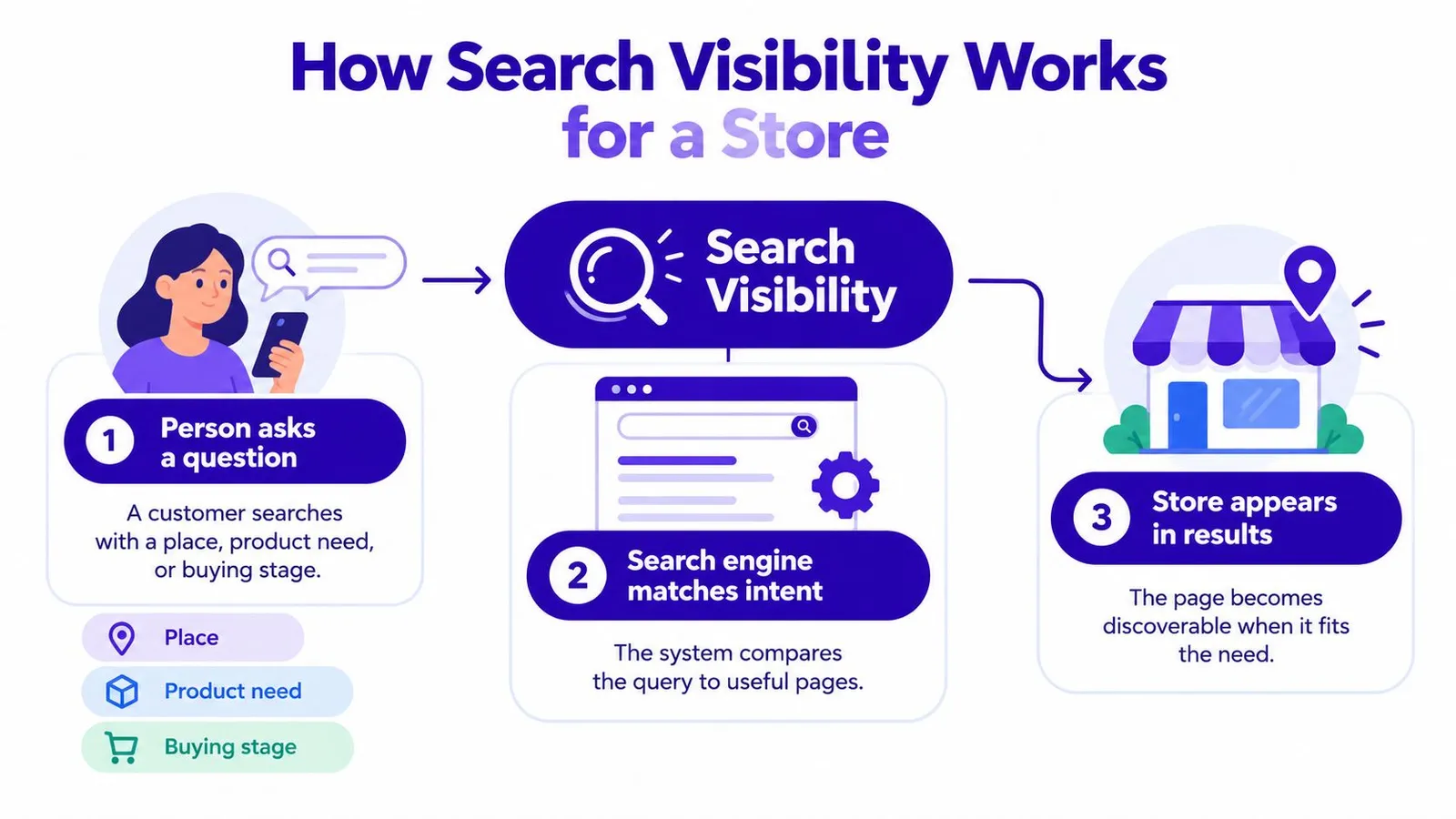
Search is a matching job. A person types a question that already carries a place, a product need, or a buying stage. Google tries to send that person to a page that can answer it. A small store does not win by covering every phrase a national brand ranks for. It wins when the page it offers is one it can fulfill, and that page sits near something the store sells.
Think of the site as a shop floor.
- Front door: The homepage tells a new visitor who the store is. It is a poor place to answer a specific product question.
- Aisles: Collection pages group items the way a shopper already thinks, such as wool throws or gift sets under fifty dollars.
- Shelves: Product pages hold the item, the price, and the way to buy.
- Floor staff: Articles walk someone from a question to the right aisle. They are not a second catalog.
Two kinds of intent
Local intent shows up when someone wants a nearby visit or a service in a place. "Alterations near the train station" is not the same job as a product comparison. The useful page names the area, the hours, and what the visit includes.
Product intent shows up when someone is choosing an item. "Merino throw that won't pill" is closer to a purchase than "history of wool." The useful target is the collection or product that already matches that job, not a broad head term the store cannot satisfy on one URL.
A broad term such as "blankets" pulls in people who want hotel linen, baby swaddles, and moving pads. A small catalog cannot serve all of them. A tighter term that matches one collection can.
The rest of this guide uses three page jobs. Be locally relevant where place matters. Be technically reachable on a phone. Move the reader toward something the store sells.
The SEO Priorities Worth Your Time
A two-person team running a home-goods store might get four hours a week for search work. That constraint writes the priority list before any tool does. Rank the jobs by how close they sit to a sale, not by how often checklists mention them.
Spending is already modest for many firms. In Clutch's 2024 survey of 272 U.S. small- and medium-sized-business marketers, 72% reported some form of search marketing, 23% spent less than USD 1,000 per month on SEO, and 46% spent less than USD 5,000. That survey placed keyword research first among activities at 43%, then technical optimization at 40% and local-search optimization at 37%. A second survey of 529 owners, cited in Clutch's small-business SEO findings, ranked traffic first among success metrics at 25%, ahead of leads and conversions at 19%, backlinks at 14%, and keyword rankings at 13%; the report's 2022 data had 21% naming website engagement their most important metric.
Taken together, those firms spend little, track visits and leads, and research keywords before anything else. Rank position alone is a weak definition of success, and the activity order favors a store that maps its catalog before writing more posts.
Read a keyword as a customer job
A keyword is a job the customer is trying to finish. Two terms can look identical in a research tool and ask for completely different pages.
- What they want. "How to wash a wool throw" is a care question. "Wool throw for a sofa" is a buying question.
- Which page can answer. The care question can live on an article. The buying question belongs on a collection if the store sells that item.
- Whether the term is too wide. If the store has twelve products, a national head term will not pay back the hours.
Pick one commercial theme, one local or product page to strengthen, and one proof that is more useful than a rank. A step-by-step pass through keyword research for a Shopify catalog keeps that list tied to real products. Stores with a street address or a service area can pair that list with small business SEO tips from RecensioAI so the place signals are not an afterthought.
| SEO job | Question it answers | First useful proof |
|---|---|---|
| Keyword research | Which catalog terms match a real customer job? | A short list tied to one collection or product |
| Local optimization | Can a nearby shopper confirm the store is real? | Accurate place details and visits to that local page |
| Technical fixes | Can a phone user and Google reach a stable URL? | Fewer dead paths and a steadier mobile template |
| New articles | Does one question lead to something for sale? | Clicks that continue into a collection or product |
New articles are last on purpose. A post cannot rescue a collection page the store has not made easy to find or easy to use.
Fix the Site Before Publishing More
A quiet blog is easy to misread. The usual reaction is to schedule more posts. For many small stores, the larger opening sits on pages that already exist.
Site audits of small businesses tell the same story. One review across nine competitive U.S. markets found that 74% of sites had at least one critical SEO issue, 58% had broken internal links, 67% failed Google's mobile Core Web Vitals assessment, and only 12% had LocalBusiness schema deployed correctly, according to the 2025 small-business website audit. More articles on top of that pile mostly produce more URLs pointing at weak destinations.
A reliability gate before new drafts
Google measures a page the way a shopper experiences it. At the 75th percentile of real-user loads, Largest Contentful Paint should be 2.5 seconds or less, Interaction to Next Paint should be below 200 milliseconds, and Cumulative Layout Shift should be below 0.1, covering loading, responsiveness, and visual stability as defined in Google's Core Web Vitals guidance.
Those three metrics work like a storefront inspection. LCP asks whether the lights turn on fast. INP asks whether the door opens when someone pushes it. CLS asks whether the floor stays put while they walk in. Oversized hero images, render-blocking apps, and photos without reserved space push a template into "needs improvement" territory on all three.
On Shopify, check the template, not fifty individual products.
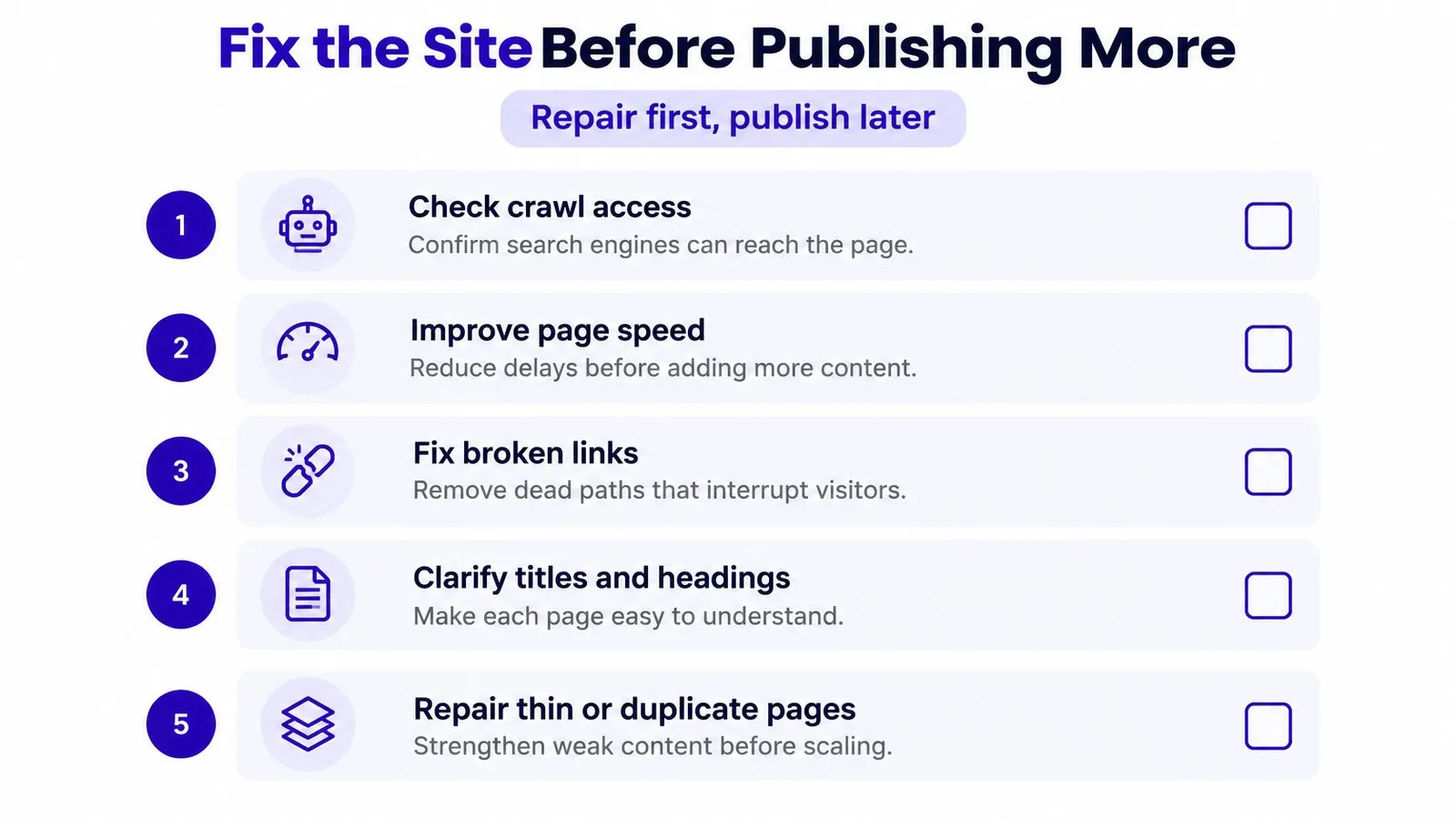
- Crawl paths: Collection URLs should link through to live products. A filter that only exists in a script can hide the shelf.
- Live links: Internal links should land on pages still for sale. A 404 in a navigation menu wastes every post that uses that menu.
- Phone stability: Field data in Search Console matters more than a single lab score. The lab test is a practice run; field data is how real phones fared. Fix the theme or app that repeats the problem.
- One canonical URL: Variant and duplicate product copy should not compete with the page you want found.
Pausing drafts costs a few weeks of publishing, and that is the cheaper side of the trade. Publishing into a site a phone user cannot load or a crawler cannot reach costs qualified visits later. Hold new articles until the crawl paths, the mobile template, and the links from information to merchandise are reliable, then publish in a controlled way. Image markup belongs to that gate: a pass on alt text that describes each product photo fits the template review, since those attributes help search engines read images shoppers already see on the page.
Connect Articles to Products and Local Pages
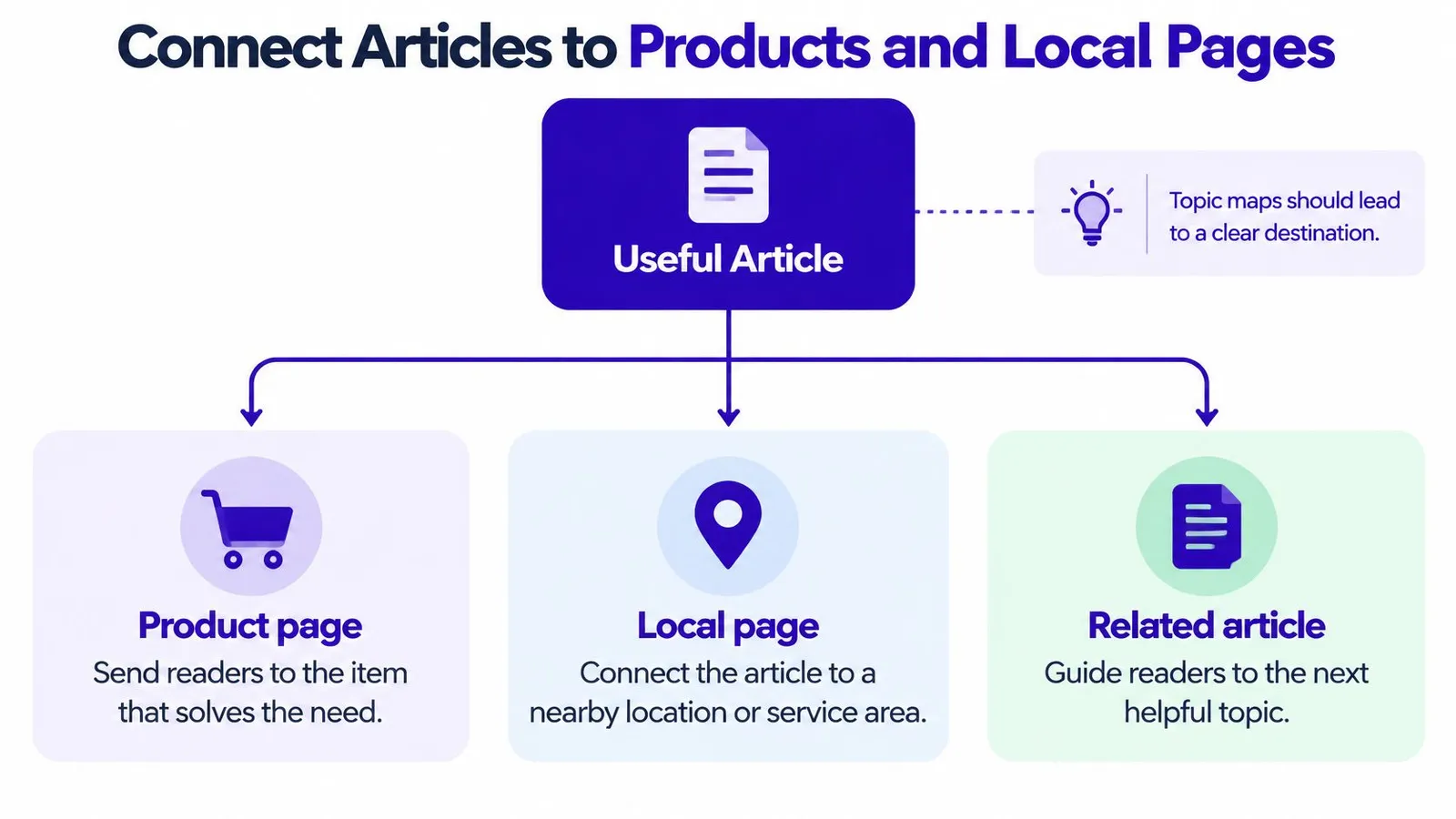
A useful article works like a good sales associate. It answers the question a shopper asked, then walks that shopper to the shelf. A post that answers the question and stops there leaves the reader standing in the aisle.
That is why the destination gets named before the draft starts. The writer picks one page the store can fulfill, a collection, a product, or a location page, and writes toward it. If no such page exists, the article waits. A trending-topic list that pulls in readers with nothing to buy adds visits without sales, and visits only count in this sequence when they are qualified.
One store example and one local example
A wool shop keeps getting the same question about pilling. The article explains how to wash the fiber, then links in plain words to the merino throw collection a reader can buy today. The discontinued colorway stays out of it.
A tailor who visits clients publishes a service-area page for one city, with hours and what the visit includes. A short article on what to expect at a home fitting links to that city page, the one a reader ready to book needs.
Markup that matches the shelf
The handoff continues in the code. Product and Offer markup can make price, availability, ratings, shipping, and return details eligible for richer results, but only when the markup describes what a shopper can already see on the page. Merchant guidance favors JSON-LD in the HTML the server returns, rather than markup that appears only after the page loads. A price in the markup that differs from the price on the page can cost that eligibility. Google also recommends crawlable links from categories through subcategories to products, reinforced by structured data, per its ecommerce structured data documentation.
After a theme or price change, check a few product and variant URLs. Keep SKU or GTIN values consistent between the page and any product feed.
The trade-off with publishing often is drift. Each new post is one more page that can point at stale stock or a dead end. An internal linking audit shows whether new articles strengthen the commercial paths or only add blog volume. The publishing rule stays simple. Every new article names its destination page before anyone writes it.
Measure Clicks Sales and AI Referrals
A store can publish a useful article and still have nothing to show for it. Measure the chain in order: local visibility gets the page seen, a reliable page gets it clicked and kept, product-connected content sends visitors toward a collection or product, and qualified visits become leads, add-to-cart actions, or sales. Rankings sit beside that chain as gauges, the way a thermometer reads a fever without being the illness.

AI referrals without a separate fad
AI search changes what a click can be worth, while Google still sends the dominant share. In one client sample, analysts at Seer Interactive found AI referral traffic grew 113% from May to July 2025 versus the previous three months, Perplexity visits averaged a 15.9% conversion rate against 9.77% for organic search, and only about 7% of AI visits reached homepages, with most landing two or three levels in, according to Seer's study of AI search behavior.
Treat that as a hint about depth, not a reason to stuff posts with generic AI questions. If referrals already arrive at transaction-adjacent pages, the pages that deserve upkeep are care guides, comparisons, sizing explainers, and local pages that sit next to real inventory. A care guide beside a collection can be cited and can also sell. A homepage slogan cannot.
A monthly review needs three outcomes, and one decision for each.
- Keep: The page draws qualified visits and assists a lead, an add-to-cart, or a sale.
- Improve the destination: People arrive, then leave the collection or product. Fix the page they were sent to.
- Stop: Impressions stay flat and on-site actions never appear. Do not add a twin article.
Share of voice can sit beside that review as a diagnostic, the way a share-of-voice check compares visibility without turning a rank into the goal. Count AI referrals when they appear, then ask the same question as every other source: did the visit become qualified traffic, a lead, or revenue?
Choose a Workflow and Take the Next Step
Measurement does not staff the work. A store without a content department has three realistic ways to run the sequence, and each trades money against time at a different rate. Choosing between them works like a restaurant deciding how to get food out: cook in-house, hire a caterer for the nights you cannot cover, or subscribe to a service that handles the repeatable meals. None of the three is wrong. The wrong move is picking one before you know which constraint is binding.
Manual, inside the week you already have. One person picks a commercial theme, confirms the destination URL loads on a phone, and writes or revises a single article that links to it. The cost is hours, and the risk is that the tab gets closed when orders spike. This fits a store with one clear product line and a patient owner.
An agency for the repairs. Hire help when the gate is technical: broken crawl paths, a slow theme, or structured data that does not match the shelf. Hand the agency the destination page and the success measure, so the deliverable is a fixed site rather than a pile of posts. This fits when the site audit shows repeated template problems and nobody in-house can change the theme safely.
An in-admin Shopify workflow for the recurring writing. Rankira researches keywords from store information, competitors, and Search Console data, schedules one keyword per day up to seven days a week, and can publish or save drafts. Generated Shopify blog posts can include meta descriptions, tags, featured images, clean URLs, and links to products, collections, and pages. Settings cover 12 tones, more than 150 languages, and over 190 regions, with editing, image styles, and reporting for clicks, impressions, positions, and Ahrefs Domain Rating. A backlink exchange runs on credits. The Standard plan is USD 39 monthly with a seven-day trial, and articles remain in Shopify if the app is removed. It does not replace the technical gate or the sales review.
Whichever path you pick, a content strategy for the store is the brief the work runs against. The next action is small. Choose one commercial theme, confirm its destination page is reachable on a phone, and either schedule the first article or hand an agency that same destination and the same proof: a qualified visit or a sale.
Rankira helps a Shopify store research catalog-based keywords, draft blog posts that link to products and collections, and schedule that work without a separate content team. That fits a small-business SEO sequence that judges pages by qualified visits and sales rather than rankings alone. Start the seven-day trial and schedule the first article against a destination page you have already checked.
Keep reading
All articles
Shopify SEO
SEO Content Writing Principles for Readers and Search
Learn the principles of SEO content writing that balance search relevance, clear structure, and real reader value, with examples for online stores.
10 min read
Shopify SEO
Internal Linking Audit That Actually Improves Rankings
Run a practical internal linking audit to find orphan pages, fix broken links, and prioritize fixes that move revenue on your Shopify store.
10 min read
Shopify SEO
Share of Voice SEO: A Practical Measurement Guide
Learn how share of voice SEO works, how to calculate it, and how to use intent-based metrics to assess search visibility and business impact.
12 min read
Put your Shopify blog on autopilot
Rankira researches keywords, writes SEO articles, adds internal links, and publishes them to your store — every week. Start with a 7-day free trial.