How to Avoid Keyword Stuffing Without Losing Relevance
See how to avoid keyword stuffing without a density target. Use intent, a paragraph test, and a pre-publish audit on Shopify content.
Published 11 min read
In this article
The most popular advice about how to avoid keyword stuffing is also the most misleading. A merchant is told to keep a phrase under a tidy percentage, hits that target, and assumes the page is safe. That page can still read like a slogan repeated in different orders. It can name the product in every heading, cram the same phrase into image text, and leave a shopper with no clearer reason to buy. A percentage measures frequency. It doesn't measure whether a sentence helps anyone.
Table of Contents
- Why a Keyword Percentage Will Not Protect You
- Build the Page Around One Reader Question
- Test Whether Each Repeat Helps the Reader
- Audit the Draft Before It Goes Live
- Choose a Workflow That Does Not Scale Repetition
- Publish the Next Article on a Cleaner Standard
Why a Keyword Percentage Will Not Protect You
A typical Shopify collection intro shows the problem clearly. The merchant sells washable rugs and has heard that the phrase needs to appear often enough to matter. Soon the title, the first sentence, three headings, and every image caption repeat washable rugs even when the paragraph is about pile height, backing, or room size. The copy hasn't become more informative. It's become harder to trust.
Google treats that pattern as manipulation, not as ordinary optimization. Google's spam policy on keyword stuffing defines the practice as filling a page with keywords or numbers in an attempt to influence rankings, including unnaturally repeated terms, keyword lists or groups, and words placed out of context. That definition focuses on presentation and intent. It doesn't offer a universal safe density that a merchant can chase.
Indexed does not mean effective
Historical testing shows why a count alone is a weak test. A study from 2009 submitted five websites with varying densities to Google, Yahoo!, and Bing and reported that almost all test pages were indexed, including one at 97.3% keyword density in that five-site visibility study. The same study didn't present extreme repetition as good practice. It noted that stuffing could still deter human visitors and reduce a site's value.
A page can be crawled and indexed while still failing to rank well, answer the query, or persuade a shopper to stay.
That distinction matters for a store. Indexing only means a search engine stored the page. It doesn't mean the page earned a strong position, reassured a cautious buyer, or led to a sale. A product guide that repeats a category name instead of explaining sizes and materials wastes the visit it worked to attract.
The alternative isn't to hide the topic. A page about washable rugs should say so plainly in the title, the opening, and places where the name prevents confusion. Readers comparing visibility need a sense of whether the page even competes for attention, which connects naturally to thinking about share of voice in SEO rather than phrase counts alone.
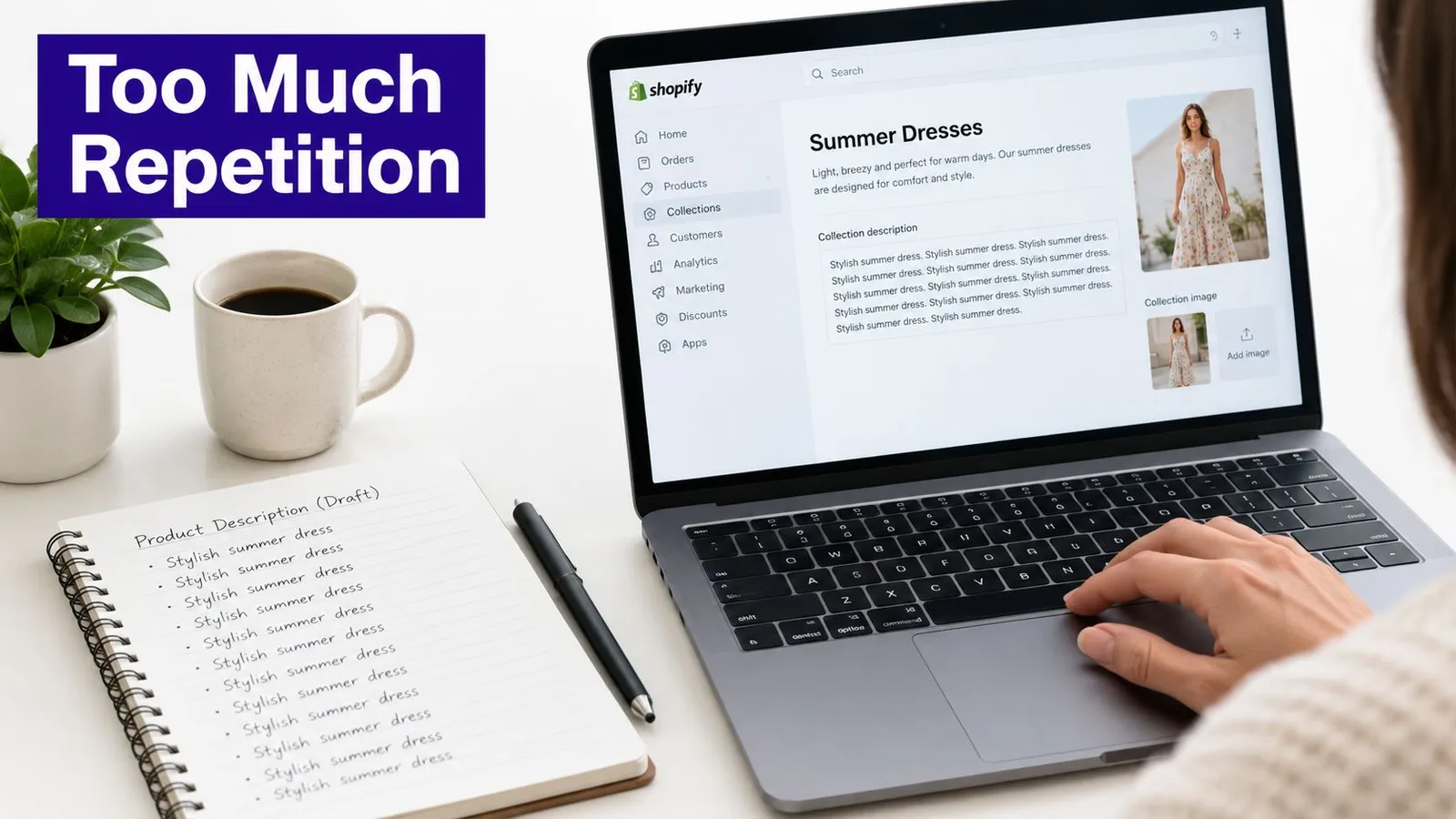
A full-page read catches what a density tool misses. Headings, body copy, image text, the URL, and anchor text shouldn't be treated as separate slots that each need the same phrase. Together they form one experience. If that experience sounds like a list, the percentage is beside the point.
Build the Page Around One Reader Question
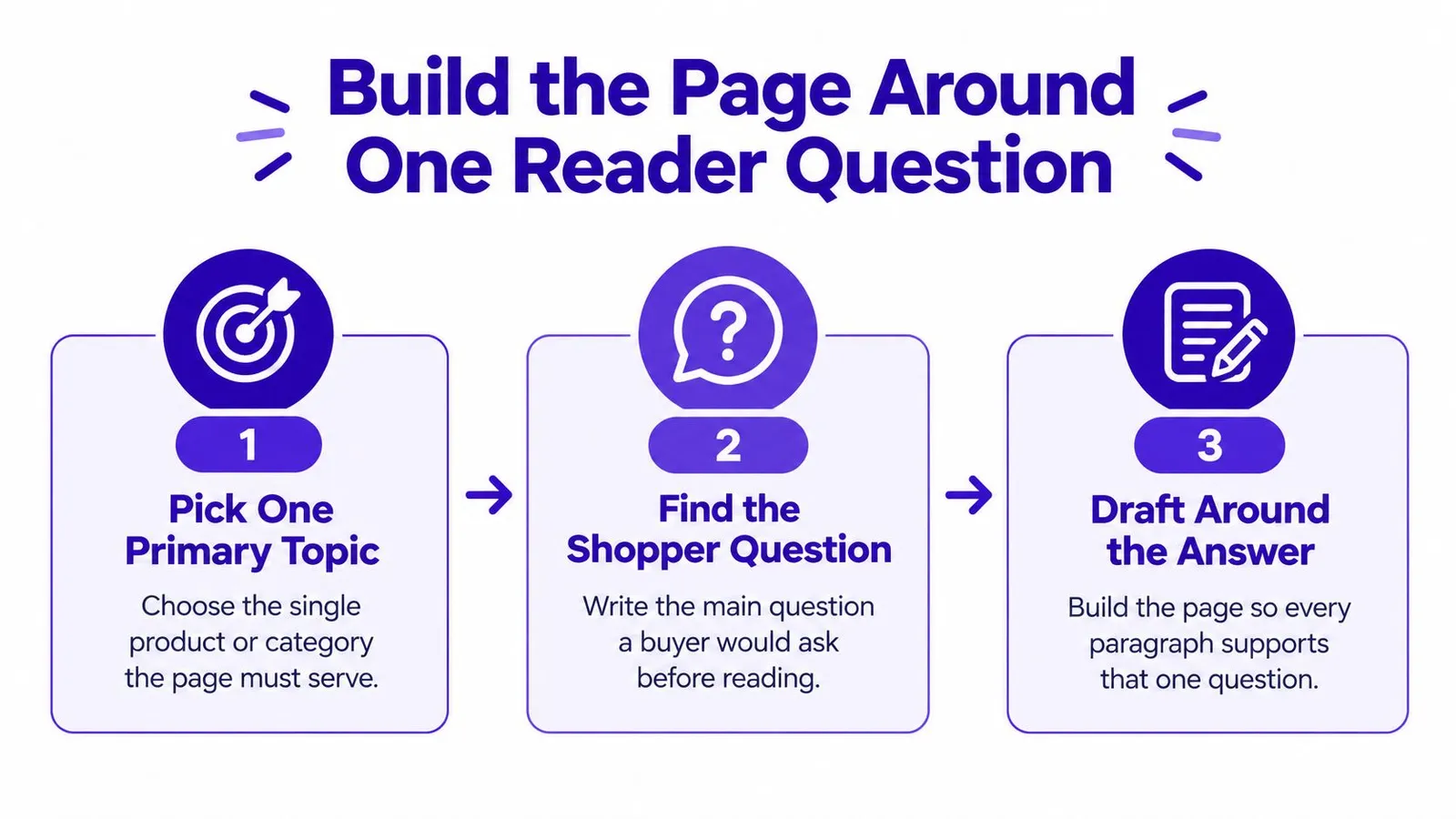
A cleaner draft starts before the first sentence. The merchant picks one primary topic tied to the catalog and writes down the shopper question behind it. A store selling merino sweaters doesn't need a generic article about winter fashion. A stronger topic is how to wash a merino sweater without shrinking it, because that question leads to specific advice about water temperature, detergent, drying, and storage.
That question controls the outline. Every section either helps answer it or gets cut. A paragraph about fiber structure earns its place if it explains why heat matters. A paragraph listing unrelated knitwear categories doesn't, even if those categories bring extra search terms into the page.
Where the main phrase earns its place
- Title and introduction: The phrase names the topic early so a shopper knows the page matches the search.
- One descriptive heading: A heading uses the phrase only when that section is about it, not as decoration.
- Descriptive image text: Image text describes what's shown, such as a folded merino sweater beside a wash basin.
- Passages where clarity depends on it: A later mention helps when pronouns would make the garment or material ambiguous.
Everything else can carry meaning without cloning the phrase. Product attributes do that work well. Gauge, fiber content, fit, and care requirements tell a shopper more than another exact repetition. Use cases help too. Wearing the sweater for travel, layering it under a coat, or airing it between wears adds information while keeping the language varied.
Pronouns and grammatical variations are not a weakness. Once the topic is established, "it," "the knit," and "this style" sound like normal writing because they are normal writing. Closely related subtopics, such as pilling or blocking after washing, deepen coverage without forcing the same words into every paragraph. A merchant who needs the earlier research process can follow keyword research step by step and then return to the single question for drafting.
Two habits create stuffing at this stage. The first is inserting extra product or location terms only to catch more searches, such as adding city names the article never discusses. The second is translating a fixed keyword count into another language. Each language version needs its own natural-language judgment, because a phrase that reads smoothly in English can sound mechanical when it's copied the same number of times in German or Spanish.
The finished outline should connect only to relevant products or collections. A merino care guide can link to the merino sweaters it discusses and to a suitable wool wash if the store sells one. It shouldn't route readers to unrelated seasonal stock just because a link slot exists.
Test Whether Each Repeat Helps the Reader
The question merchants ask is simple. How many times can a product or category term appear before it becomes spam? Google's practical line isn't a number. Google's spam policies for search describe stuffing as keywords repeated so often that the wording sounds unnatural, or keywords presented in lists or groups without useful context. That leaves an editor with judgment, not arithmetic.
The removal test
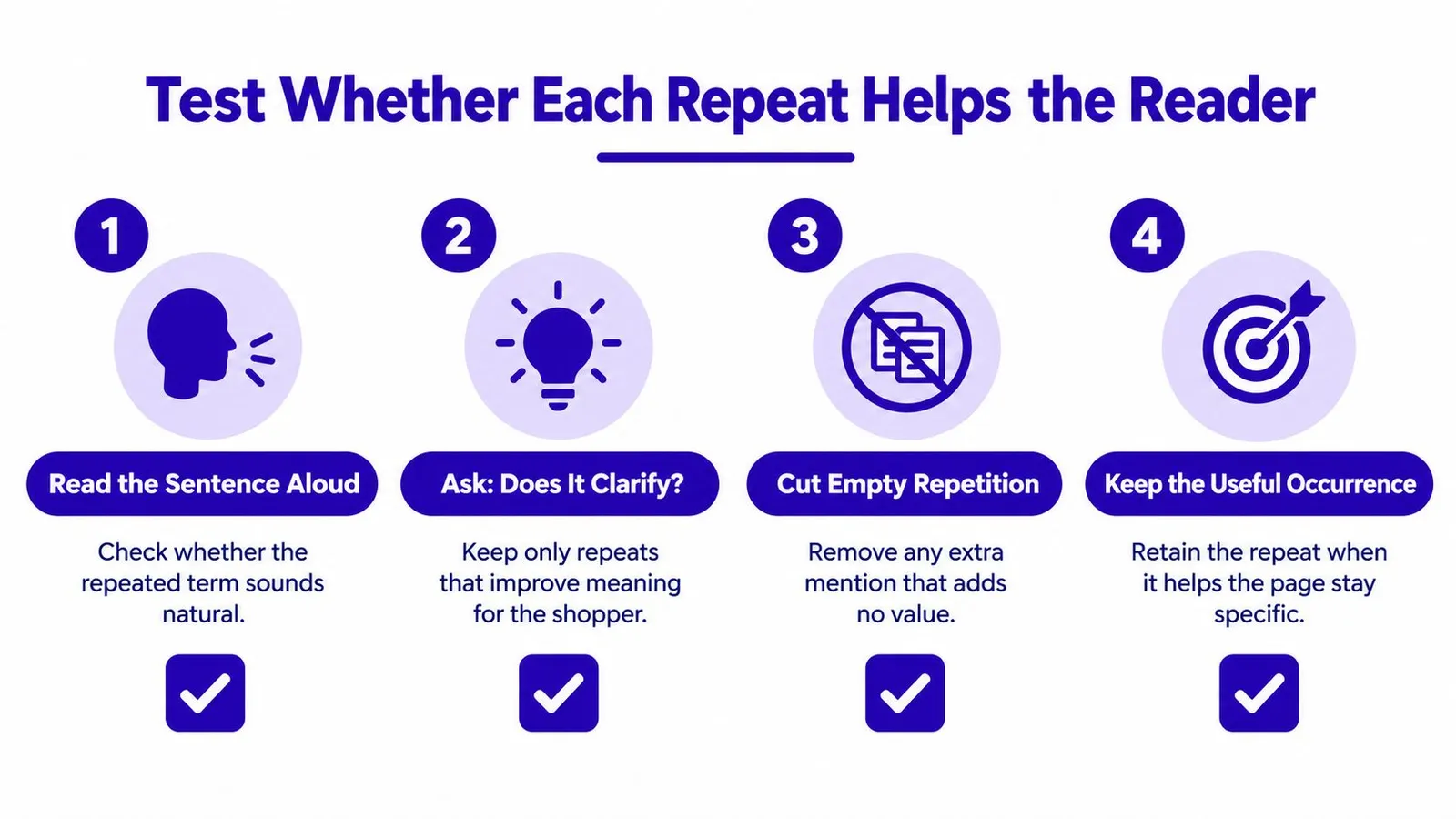
The paragraph-level removal test turns that judgment into a repeatable decision. An editor takes one paragraph, deletes the target phrase, and reads what's left. If meaning, specificity, and navigation stay intact, the repeat was serving a search engine rather than a reader. If the product, material, or next click becomes unclear, a natural mention stays.
A stuffed product paragraph might read like this. "These leather dog collars are durable leather dog collars made for owners who want leather dog collars that last." Remove two repeats and nothing is lost. "These leather collars use thick, vegetable-tanned hides and solid brass hardware, so they hold up to daily pulling." The revised version adds material and hardware details a buyer can evaluate.
The opposite failure is real. Stripping every repeat can leave a page vague, with sentences about "this option" and "the right choice" that never name the item. That's under-specification, and it weakens clarity. The goal isn't the fewest mentions. It's the fewest empty mentions.
A short video walkthrough can help a merchant see the difference between a mention that clarifies and one that only fills space.
The same test applies beyond body copy. Collection introductions often repeat the category name because there's little else to say, which is a sign the intro needs sizing, material, or use information. Headings should describe their sections. Image text should describe the image. A URL should stay readable, and internal anchor text should tell a shopper where the click leads, not repeat the target phrase every time.
Reading aloud exposes forced phrasing faster than scanning does. Sentences that stumble when spoken usually stumble for a reason, and the editing mindset behind how to humanize AI content applies just as well to hand-written drafts. A merchant without a content team doesn't need a slogan about writing naturally. A paragraph-by-paragraph decision is enough.
Audit the Draft Before It Goes Live
Sentence-level judgment catches single problems. A whole-page audit catches patterns. The editor starts by extracting the primary phrase and close variants, counting exact matches, and noting which sections hold them. A count is useful here as a map, not as a verdict. It shows where repetition clusters so each occurrence can be read in context.
What to flag first
- Consecutive repeats: The same phrase appears in back-to-back sentences without new information.
- List-like blocks: Product types, city combinations, or phone-number strings appear as groups rather than explanations.
- Boilerplate passages: Copied text repeats the phrase across pages where the details should differ.
- Identical anchors: Every internal link uses the same words regardless of destination.
Each flagged mention gets deleted or rewritten if it adds no information. Headings get special attention because they set the rhythm of the page. A heading that recycles the target phrase while the section covers sizing or delivery misleads a scanning reader. Renaming it for its actual subject improves navigation and removes a repeat at the same time.
Where a Repeat Stops Helping
| Page element | Stuffing signal | Clearer alternative |
|---|---|---|
| Title | Phrase appears twice with synonyms added | Name the topic and the benefit once |
| Heading | Every heading opens with the same phrase | Describe sizing, care, or comparison directly |
| Body copy | Exact phrase starts most paragraphs | Use attributes, examples, and pronouns |
| Image text | Keyword list unrelated to the photo | Describe the product, color, and setting shown |
| URL | Long string of repeated terms | Keep a short, readable topic slug |
| Internal link | Same anchor on every link | Name the specific product or guide |
Research shows why the audit can't stop at density. One small experimental study altered five of twenty webpages and observed manipulated-page keyword averages around 2–3% and page-density averages around 3–5%, yet still required a model combining compression ratio, average word length, and keyword density to identify stuffing in that keyword stuffing detection study. Those figures are study observations, not Google thresholds.
Audit rule: A page sitting near a popular benchmark can still sound forced if placement is unnatural.
After publication, measurement replaces guessing. The merchant compares Search Console impressions, average position, clicks, and engagement against the pre-edit baseline only after enough traffic accumulates. A quick dip or rise on thin data shouldn't trigger another rewrite. Success looks like fewer forced mentions, clearer prose, complete coverage of the shopper's intent, and stable or improving clicks without spam-policy trouble.
Choose a Workflow That Does Not Scale Repetition
How a draft is produced shapes how much repetition an editor has to remove. Writing manually gives a merchant full control, but habit plays a role. A person who believes the phrase must appear often will repeat it by hand just as reliably as any tool. Manual work also slows down when a store needs a steady publishing rhythm without a content team.
A generic AI draft creates a different risk. Google's guidance on creating helpful content states that content produced with automation, including AI, violates spam policies when its primary purpose is manipulating search rankings, while people-first content should benefit users rather than attract search visits. The guidance also describes approximately 16,000 external raters evaluating whether results satisfy information needs, which points to usefulness and task completion rather than phrase counts.
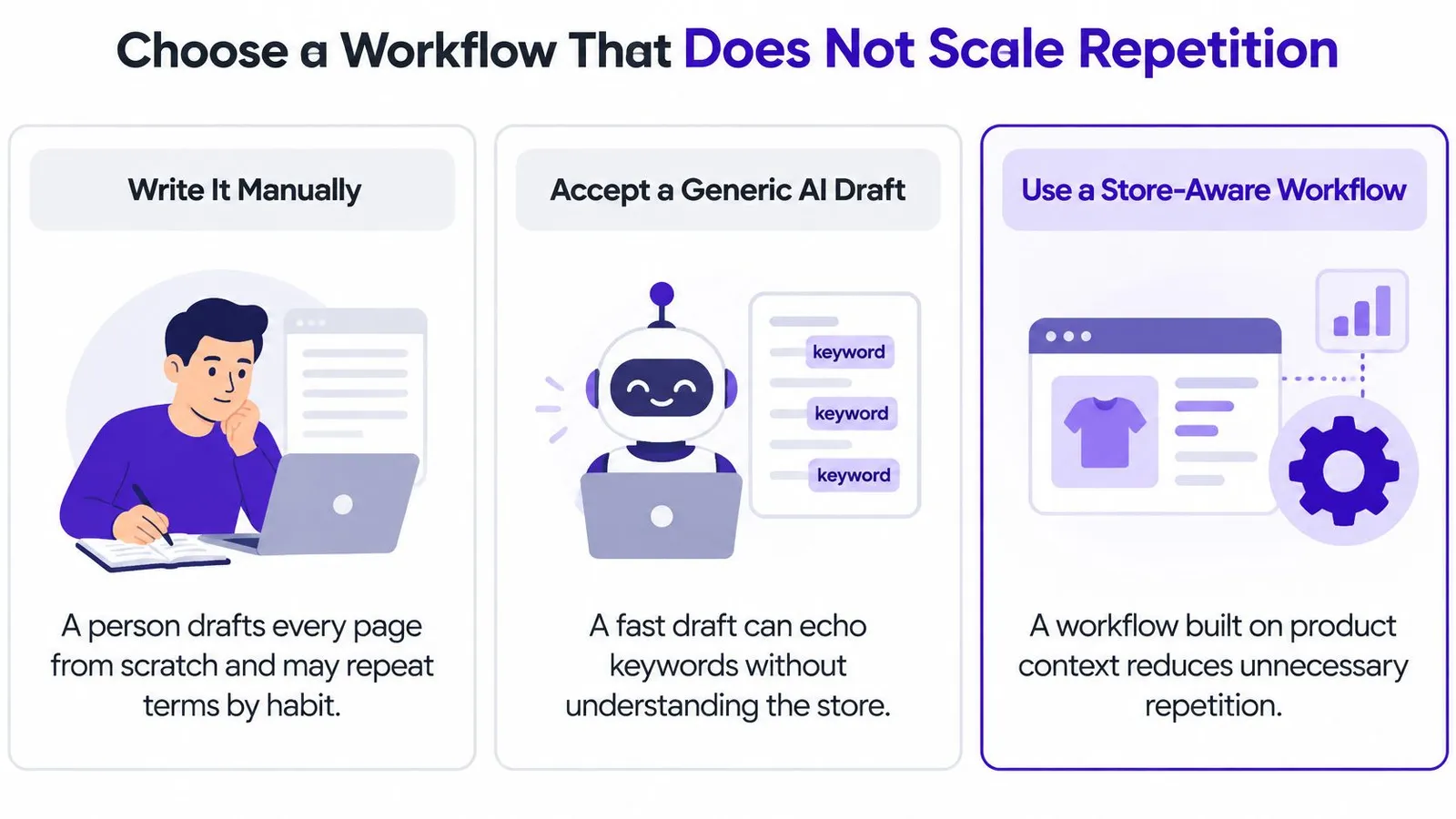
Low density doesn't clear a generic draft. It can repeat near-identical claims in fresh wording, generate templated city or product lists, force the keyword into every heading, or publish an article that never connects to the catalog. That's semantic stuffing. The exact phrase count looks reasonable while the meaning goes in circles, and multilingual publishing can multiply that problem across regional pages.
A store-aware workflow is the third option. Rankira runs inside Shopify admin and combines store, competitor, and Search Console inputs with volume and difficulty scores to plan topics. Its calendar schedules one keyword per day up to seven days a week, and generated posts can include a meta description, tags, a featured image, a clean URL, and links to relevant products, collections, and pages. Settings cover 12 tones, more than 150 languages, and over 190 regions, with the Standard plan at 39 US dollars a month after a seven-day trial.
That structure reduces some repetition risks because topics and links start from the actual catalog. Articles and files remain in Shopify if the app is uninstalled, and a merchant can publish on schedule or save drafts for review. A broader view of how content supports discovery sits in SEO content marketing, but no workflow removes the editorial step.
The human job stays concrete. An editor verifies that every section answers a real customer question, removes generic passages, and adds store-specific evidence such as materials, sizing limits, or compatibility. Claims get checked against the catalog before publication. Product links stay only where they're relevant. Scale is useful when it produces distinct, accurate pages. It's a liability when it produces the same page many times.
Publish the Next Article on a Cleaner Standard
The next article is the test. A merchant picks one keyword already tied to a real product or collection, not a topic borrowed because it looks popular. The shopper question gets written in one sentence at the top of the draft. If that sentence can't be written clearly, the keyword isn't ready yet.
Drafting or generating the post around that question keeps the structure honest. Each section earns its place by answering part of the question, and the primary phrase appears where it names the topic, prevents confusion, or guides a click. Planning that article inside a wider calendar is easier with the thinking in developing a content strategy, as long as the single question stays in charge.
The pre-publication pass
- Introduction: The topic is named once, clearly, and the promise to the reader is specific.
- One middle section: The removal test decides which repeats stay and which get cut.
- Headings and image text: Each one describes its section or image instead of echoing the title.
- Internal links: Anchors name destinations a shopper would recognize.
With Rankira, the practical move is to place that keyword on the calendar, review the generated draft inside Shopify, and fix awkward repeats with the editor or section rewriter. The article then gets scheduled or saved as a draft, depending on how much review it still needs. Trusting the first generation without that pass recreates the generic-draft problem inside a better tool.
Search Console clicks, impressions, and average position become the later evidence. They show whether the cleaner page holds its ground, and they shouldn't be treated as a reason to add the phrase back. More mentions won't fix a page that's losing clicks because its title is vague or its answer is incomplete.
The finished outcome is modest and durable. One article names its topic clearly, links only where the catalog is relevant, and doesn't sound like a keyword list. That's the standard to repeat.
Rankira helps Shopify merchants research store-based keywords, generate articles around real products and collections, and schedule or save drafts for human review inside Shopify admin, which makes the removal test and full-page audit part of a repeatable publishing routine. A merchant ready to publish on that cleaner standard can visit Rankira and start with one keyword tied to a genuine shopper question.
Keep reading
All articles
Shopify SEO
SEO Content Writing Principles for Readers and Search
Learn the principles of SEO content writing that balance search relevance, clear structure, and real reader value, with examples for online stores.
10 min read

Shopify SEO
Internal Linking Audit That Actually Improves Rankings
Run a practical internal linking audit to find orphan pages, fix broken links, and prioritize fixes that move revenue on your Shopify store.
10 min read
Shopify SEO
Share of Voice SEO: A Practical Measurement Guide
Learn how share of voice SEO works, how to calculate it, and how to use intent-based metrics to assess search visibility and business impact.
12 min read
Put your Shopify blog on autopilot
Rankira researches keywords, writes SEO articles, adds internal links, and publishes them to your store — every week. Start with a 7-day free trial.