How to Increase Website Authority in 2026
Learn how to increase website authority with useful content, credible links, and sound SEO practices. Practical steps for stores and publishers.
Published 12 min read
In this article
- Table of Contents
- What Website Authority Really Means Today
- Turning Strong Pages Into Link-Worthy Assets
- Earning Credible Mentions Without Risky Shortcuts
- Judging Which Referring Sites Are Worth It
- Making Authority Pages Easy to Crawl and Validate
- Building Recognition Across AI Answers and Search
- Choosing a Workflow and Taking the Next Step
The most popular advice on how to increase website authority is also the easiest to misuse: publish more content and build more backlinks. Neither activity deserves a budget unless it helps the right people discover, trust, and use the store's expertise.
A stronger approach treats authority as a reputation supported by independent, relevant mentions. For a small ecommerce business, that means producing something worth citing, earning attention from suitable publishers, and measuring qualified visitors rather than celebrating a larger backlink total.
Table of Contents
- What Website Authority Really Means Today
- Turning Strong Pages Into Link-Worthy Assets
- Earning Credible Mentions Without Risky Shortcuts
- Judging Which Referring Sites Are Worth It
- Making Authority Pages Easy to Crawl and Validate
- Building Recognition Across AI Answers and Search
- Choosing a Workflow and Taking the Next Step
What Website Authority Really Means Today
A backlink total records links. It doesn't explain whether those links represent genuine recommendations, reach potential customers, or support the topics a store needs to rank for.
Website authority has its roots in link analysis. Google's PageRank system developed at Stanford between 1996 and 1998, treating hyperlinks as recommendations and giving greater weight to recommendations from well-connected pages; Google still lists an evolved PageRank among its core ranking systems. The same guidance explains that link analysis helps Google understand what pages cover and which might be useful for a query.
For a merchant, the useful interpretation is straightforward: who recommends a page matters more than how many links appear in a report. A relevant editorial citation deserves a different assessment from repeated links placed across an unrelated website.
Reputation is broader than a score
An authority score can provide a convenient reporting shorthand. It shouldn't become the commercial objective.
Consider a hypothetical outdoor retailer. A specialist hiking publication citing its footwear-testing guide would deserve attention because the topic, audience, and destination fit together. An unrelated website offering links across miscellaneous articles would require much more scrutiny, even if its headline score looked impressive.
Practical rule: A worthwhile authority program should still make commercial sense when the third-party score is removed from the report.
That test changes the questions an SEO lead asks:
- Relevance: Does the referring publication cover subjects connected to the store's products or expertise?
- Independence: Did an editor choose the resource because it helps readers?
- Usefulness: Can the destination answer the question that prompted the citation?
- Commercial fit: Would visitors arriving through the mention have a plausible reason to explore the store?
Where a small store should focus
A practical authority strategy rests on useful content, credible links, and sound technical practice. These are working requirements, not separate campaigns competing for attention.
Useful content gives publishers a reason to cite the business. Credible links provide independent context. Technical practice ensures that readers and search engines can reach and interpret the destination.
The priority isn't to look larger than the business is. It's to make the expertise the business already holds easier to verify.
Turning Strong Pages Into Link-Worthy Assets
The cheapest starting point is often an existing page with a useful topic and incomplete execution. Rebuilding a promising guide can be more manageable than funding an entirely new research project.
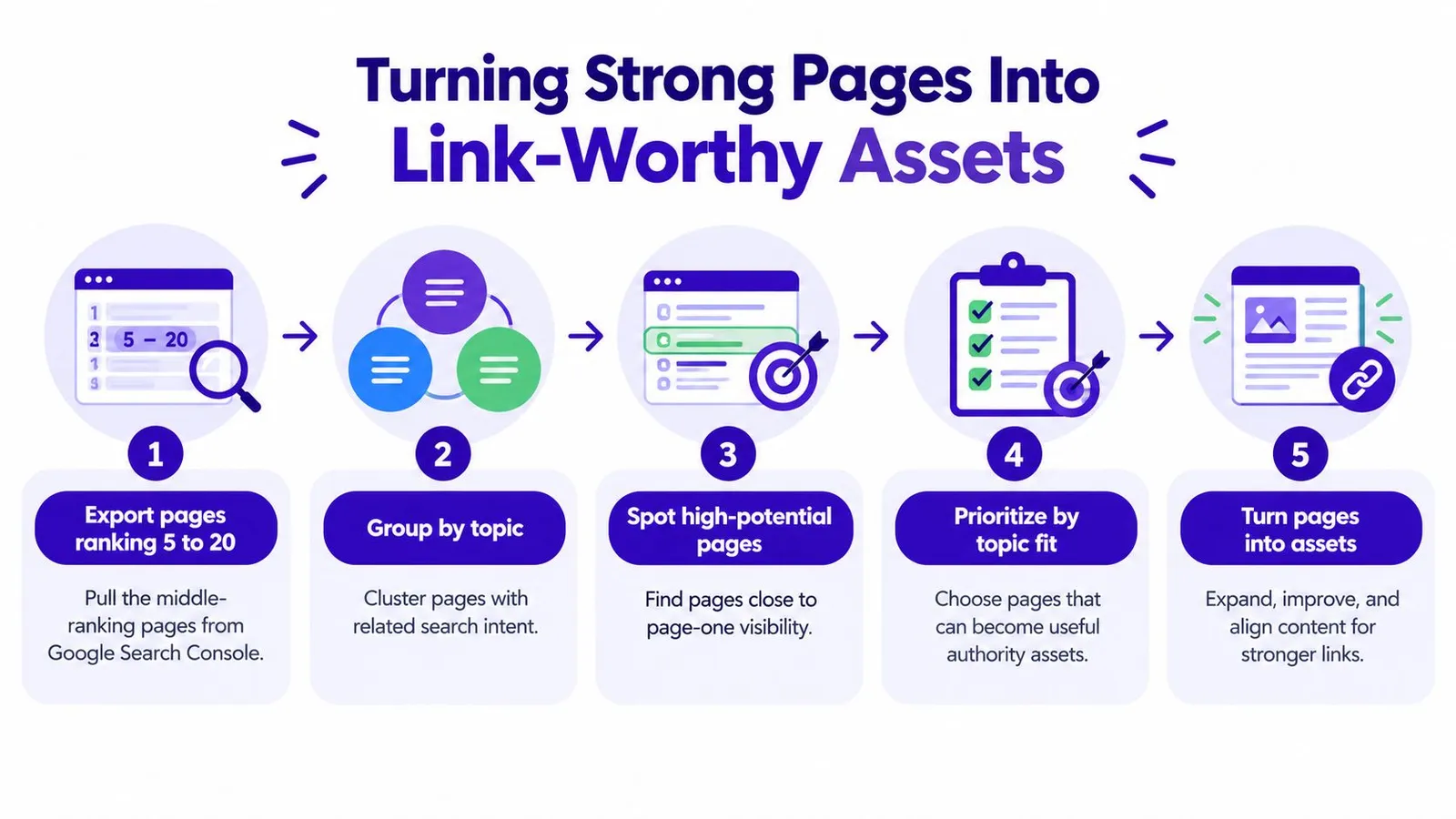
Start with a Google Search Console performance export and isolate pages with average positions 5 to 20. Keep query-level context beside the page data so that a blended average doesn't hide unrelated searches. This is the starting workflow described alongside the Ahrefs backlink-growth research.
The process below keeps page selection tied to topic fit rather than publishing volume.
Find pages with a defensible advantage
Group the export by topic and search intent, then compare referring-domain coverage using a backlink tool. Flag pages that answer a relevant question but lack an original contribution or independent citations.
A practical shortlist should include:
- Search fit: The page addresses the queries generating its impressions.
- Business knowledge: Staff can contribute evidence that a generalist publisher couldn't easily reproduce.
- Citation potential: Another writer could use a specific finding, explanation, or comparison.
- Maintenance capacity: Someone can keep the information accurate after publication.
A content strategy built around the store's expertise helps prevent the shortlist from becoming a collection of unrelated keyword opportunities. The asset should support the catalog without reading like a product advertisement.
Add evidence instead of extra paragraphs
For a hypothetical clothing store, a sizing guide could become an analysis of anonymized return reasons. Staff could explain how they classified fit complaints, which products were included, and where the records were incomplete.
The published asset might contain a measurement diagram, a comparison table, and a plain-language account of recurring sizing problems. It shouldn't claim that every shopper will experience the same fit.
That gives a journalist or specialist blogger something concrete to reference. A generic category introduction offers much less to cite.
Original evidence doesn't always require customer records. Supplier interviews, documented product tests, expert commentary, or a carefully maintained compatibility reference can also provide a distinctive contribution.
The important upgrade is verifiability, not length. Show how the information was obtained, separate observations from interpretation, and identify limitations. If the store lacks defensible statistics, a precise qualitative explanation is better than a manufactured research claim.
Earning Credible Mentions Without Risky Shortcuts
A useful asset still needs distribution. Waiting for publishers to discover it leaves too much of the program outside the merchant's control.
Build a prospect list from publications already covering the subject. For each prospect, record the relevant article, the editor or author, the audience, and the specific reason the asset would improve their coverage.
Run outreach around editorial usefulness
An effective pitch identifies a publishing need before introducing the store. For the hypothetical sizing resource, that could mean contacting a writer who has already covered inconsistent garment measurements.
The message should explain what the resource contains, how the evidence was assembled, and what its limitations are. It shouldn't demand a particular anchor phrase or pretend that an ordinary buying guide is breaking news.
Use a repeatable routine:
- Research the publication: Confirm that the topic appears in its actual editorial coverage.
- Match the asset: Identify the finding or explanation most relevant to that audience.
- Offer a contribution: Provide useful context, a chart, or access to the person responsible for the work.
- Record the outcome: Separate replies, editorial mentions, published links, and referral visits.
- Improve the pitch: Treat repeated objections as feedback about the resource or targeting.
A practical guide to building backlinks through relevant outreach can support execution, but a template can't replace a credible reason to contact someone.
Use growth benchmarks without turning them into quotas
The backlink-growth research cited earlier examined 10,000 U.S. keywords with 2,000–5,000 monthly searches. Many top-ranking pages gained followed links from new referring domains at roughly 5%–14.5% monthly growth.
Those observations aren't a required acquisition rate. A small starting base, different market, or specialist audience can make percentage comparisons misleading.
Track unique referring domains, relevance, rankings, impressions, clicks, and conversions in the study's recommended 30-, 60-, and 90-day cohorts. Group results by promoted asset so the team can see which work earns useful attention.
Steady acquisition is a planning preference, not permission to manufacture links until a chart looks smooth.
Excessive reciprocal exchanges and automated link creation create spam risk, as noted in that research's discussion of Google's policies. Publishing large volumes of AI-generated articles without original evidence or promotion creates a different problem: more pages without a persuasive reason for anyone to cite them.
Automation can organize outreach and reporting. It shouldn't substitute for editorial judgment.
Judging Which Referring Sites Are Worth It
A high domain-level score is a poor purchasing brief. The actual referring page, its editorial context, and its audience deserve inspection before the merchant commits time or money.
An analysis of one million keywords reported modest ranking correlations for backlinks (0.248), referring domains (0.255), and Domain Rating (0.131), with referring-domain diversity strongest among those measures, according to Ahrefs' explanation of backlinks and ranking relationships.
That evidence supports a restrained conclusion: no single link metric can settle the decision. It doesn't prove that adding a particular link will improve a page's position.
Signals That Separate Worthwhile Links From Weak Ones
| Signal | Worth Pursuing | Usually Skip |
|---|---|---|
| Topical relevance | Established coverage of the store's category | Unrelated subjects assembled around link placements |
| Editorial context | A citation that supports a specific explanation | An inserted mention with no useful role |
| Audience overlap | Readers with plausible product or category interest | Visitors unlikely to need the store's expertise |
| Referring page | A maintained, useful article with its own credible references | A neglected page created mainly to host outbound links |
| Editorial independence | An editor chooses whether and how to cite the asset | Placement depends on a compulsory reciprocal link |
| Referral potential | A clear reason for readers to visit the destination | A mention that offers no meaningful next step |
Inspect the page rather than buying the score
Read the proposed referring page from beginning to end. Check whether the recommendation makes sense in context, whether the publisher identifies responsible authors, and whether other outbound references help readers verify claims.
Then examine the page's own backlink profile where practical. A strong domain doesn't automatically make every page on that domain equally useful.
A review of backlinks already pointing to the store can reveal which publications have previously sent relevant visitors. Those patterns are a better prospecting starting point than a list sorted only by domain score.
Separate association from cause
Established businesses may attract links because they already have recognized products, original data, or strong brands. Their rankings and backlinks can move together without every acquired link causing a ranking improvement.
That distinction matters when evaluating an agency proposal. A forecast built from another company's backlink total leaves out the product, content, and brand differences.
The decision should survive a simple question: would the mention still be worthwhile if rankings stayed unchanged? A relevant publisher can provide qualified visitors, useful feedback, or credible recognition. If none of those outcomes seems plausible, the opportunity probably doesn't deserve priority.
Making Authority Pages Easy to Crawl and Validate
An editorial citation shouldn't send readers to a confusing, outdated, or technically isolated destination. Before promotion begins, the store needs a dependable publication checklist.
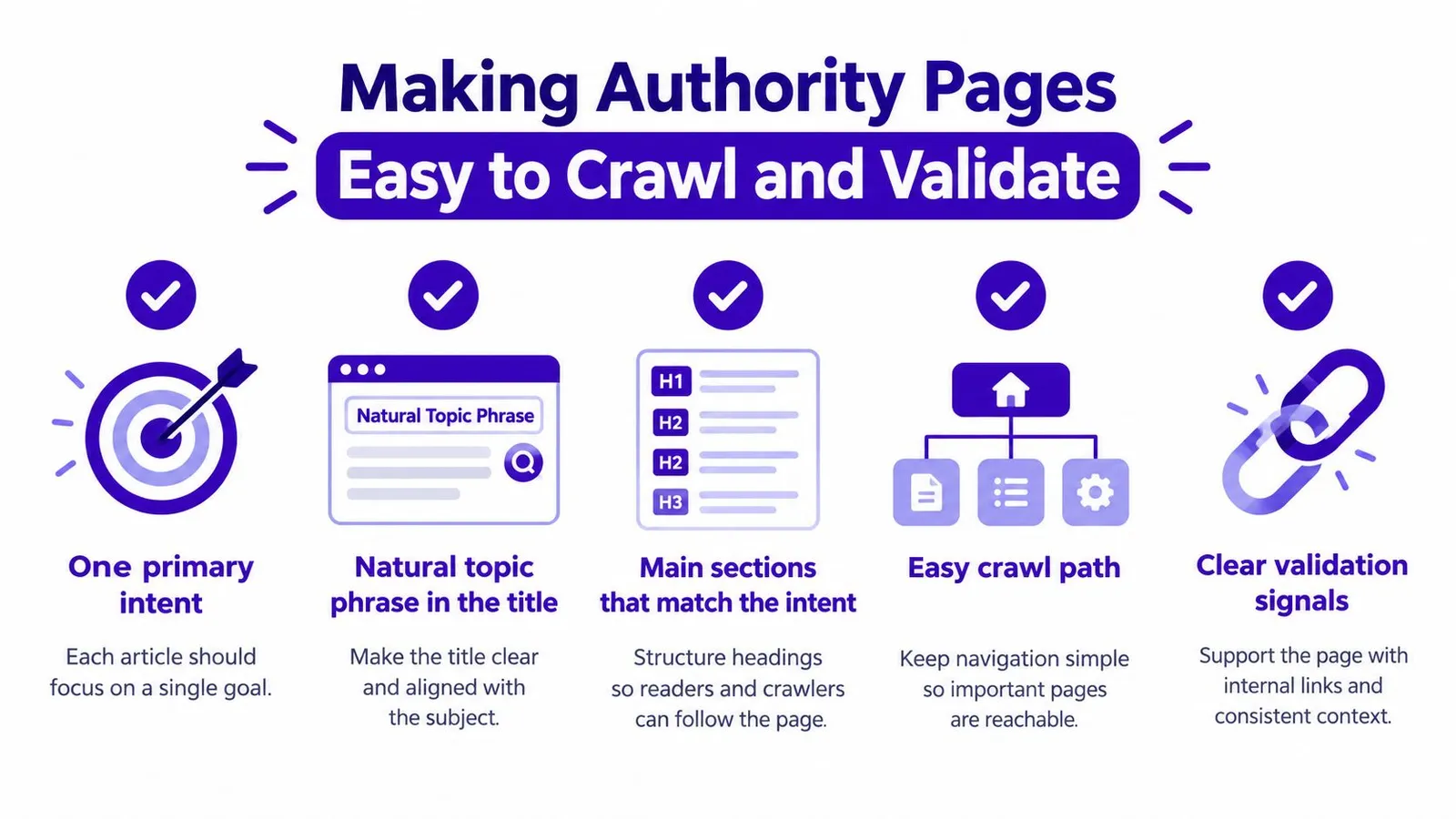
The checklist below connects page purpose, navigation, and validation.
Give the page a clear purpose and route
Define a primary intent before editing. A product-comparison guide should help readers compare, while a testing report should explain evidence and methods. Trying to satisfy every possible query can leave the page without a clear answer.
Use the natural topic phrase in the title, main heading, URL, and suitable internal anchors. Keep wording readable instead of forcing identical keyword phrases into every placement.
- Connect from relevant hubs: Add crawlable links from appropriate category, collection, or editorial pages.
- Support the next decision: Link to products or related guidance only where the destination helps.
- Review navigation: Confirm that readers don't need a site search or promotional email to find the resource.
- Inspect anchor text: Describe the destination rather than repeating a keyword mechanically.
An internal-linking audit helps locate orphaned posts and missing connections before outreach directs attention toward them.
Make markup match visible information
Google recommends JSON-LD, but structured data must represent accurate, visible content, and it doesn't guarantee a rich result, according to its structured-data policies. Article, BreadcrumbList, Product, or FAQ markup should be considered only where appropriate and eligible.
Validate the implementation before publication. A template that describes unavailable products, hidden answers, or outdated prices needs correction rather than additional markup.
Implementation check: Structured data should describe the evidence on the page, not invent evidence the page lacks.
Check publication and measure against a baseline
After publication, inspect indexing and canonicalization in Google Search Console. Request indexing for updated URLs where appropriate, and confirm that the preferred page is the intended destination.
Compare impressions, average position, click-through rate, and assisted revenue with a prepublication baseline. Record substantial content and navigation changes so the team doesn't attribute every movement to outreach.
Audit duplicate Shopify URLs, links blocked by scripts or robots directives, and schema that no longer matches the page. Refresh facts, products, prices, and availability when they change.
Technical housekeeping won't turn weak material into a trusted resource. It prevents avoidable implementation failures from undermining work that already deserves attention.
Building Recognition Across AI Answers and Search
The same reputation-first approach offers a useful framework for AI-generated answers. Merchants should make their expertise recognizable across independent sources rather than assume that another batch of backlinks will secure citations.
That work requires coordination between the people responsible for content, products, and external relationships.

An Ahrefs study of 75,000 brands found branded web mentions correlated 0.66–0.71 with AI visibility, while backlink and page counts had weaker relationships; the same search-authority report describes a 2025 analysis finding a 0.347 correlation between top-10 rankings and appearing among the first three AI Overview citations.
These are correlations, not instructions for manipulating answer systems. They support treating search performance and AI recognition as related but distinct measurement problems.
Build a corroborated business identity
A merchant's practical task is to make important claims consistent and independently checkable.
- Identify responsible people: Publish accurate author biographies and business information.
- Standardize product facts: Keep names, materials, compatibility details, and category terminology consistent.
- Expose original evidence: Give tests and research clear methods, limitations, and ownership.
- Earn outside recognition: Pursue relevant reviews, expert contributions, and community participation without scripting endorsements.
A regulated service business provides a useful comparison. Teams considering how expertise, terminology, and review requirements fit together can consult Advisor Momentum's resource on SEC-aware content for advisor websites, while recognizing that ecommerce stores have different obligations.
Keep conventional search in the measurement plan
AI visibility shouldn't replace ordinary ranking and revenue reporting. Teams can check Google rankings consistently while separately recording observed brand mentions, cited pages, and the questions that trigger them.
A team discussion can use the accompanying video as a starting point, then test ideas against the store's actual results.
The dual-track strategy is deliberately practical: maintain search-intent alignment and conventional editorial outreach while improving the consistency of the business's public identity. Neither track guarantees inclusion, and neither justifies unsupported product claims.
Choosing a Workflow and Taking the Next Step
A manual workflow remains a reasonable choice when a merchant has SEO skills and time for recurring production. Staff can research in Google Search Console, inspect competitors, draft in a preferred editor, publish through Shopify, and maintain separate reporting.
The trade-off is coordination. Someone must keep the topic plan, evidence, internal links, publication calendar, and outreach records aligned.
Choose support around the actual bottleneck
| Workflow | Suitable Situation | Main Responsibility |
|---|---|---|
| Manual production | Staff can research, edit, publish, and report consistently | Maintaining quality and coordination across tools |
| Tool-assisted production | The store lacks a dedicated content function | Reviewing generated work and contributing original expertise |
| Agency-supported execution | Several people or stores need shared oversight | Defining ownership, approval standards, and commercial goals |
For merchants comparing approaches, Yassine Malti's Shopify authority growth roadmap for 2026 provides an additional planning resource. Any roadmap still needs adjustment for the store's catalog, available evidence, and editorial capacity.
A Shopify-admin application is another option alongside separate tools or agency support. Its workflow can combine keyword research from store information, competitor analysis, and Search Console data with article generation, a drag-and-drop calendar, and automatic internal linking.
Keep human judgment where it matters
The application described below generates articles linked to relevant products, collections, and pages. It also reports clicks, impressions, search positions, and Ahrefs Domain Rating.
Its backlink exchange allows participating stores to earn and spend credits for external mentions. That feature isn't an exemption from the link-quality standards above. Merchants should assess editorial relevance and avoid excessive reciprocal or automated arrangements intended to manipulate rankings.
Draft review is the sensible choice when generated content needs product verification, original evidence, or specialist approval. A faster publishing workflow doesn't remove those responsibilities.
The practical first step is a Search Console audit. Select a promising existing page, identify the evidence it lacks, and assign responsibility for improving it before scheduling additional content.
A trial should test the operational fit: whether the team can review drafts, make useful product connections, and interpret reporting without adding another neglected system.
Rankira offers Shopify-based keyword research, article creation, scheduling, internal linking, and search reporting to support a more organized authority-building program. Its Standard plan costs USD 39 monthly and includes a seven-day trial, as listed by Rankira. Merchants can start with the Search Console shortlist and use the trial to assess the workflow while retaining editorial control over evidence, claims, and external mentions.
Keep reading
All articles
Shopify SEO
SEO Content Writing Principles for Readers and Search
Learn the principles of SEO content writing that balance search relevance, clear structure, and real reader value, with examples for online stores.
10 min read
Shopify SEO
Internal Linking Audit That Actually Improves Rankings
Run a practical internal linking audit to find orphan pages, fix broken links, and prioritize fixes that move revenue on your Shopify store.
10 min read
Shopify SEO
Share of Voice SEO: A Practical Measurement Guide
Learn how share of voice SEO works, how to calculate it, and how to use intent-based metrics to assess search visibility and business impact.
12 min read
Put your Shopify blog on autopilot
Rankira researches keywords, writes SEO articles, adds internal links, and publishes them to your store — every week. Start with a 7-day free trial.