8 Blog Writing Examples That Convert in 2026
Explore 8 blog writing examples with structure, tone, and tactics you can copy for Shopify SEO content.
Published 15 min read
In this article
- Table of Contents
- 1. How-To Guide (Step-by-Step Tutorial)
- 2. Listicle (Curated List Article)
- 3. Product Comparison Article
- 4. Ultimate Guide (Pillar Article)
- 5. Case Study (Customer or Results Story)
- 6. Brand Story or Behind-the-Scenes Article
- 7. Seasonal or Occasion Gift Guide
- 8. FAQ-Style Article (Question and Answer)
- 8 Blog Writing Examples Compared: Format, Purpose & Key Features
- Turn These Examples Into a Repeatable Content System
A store owner opens a blank blog draft with a keyword ready, a product nearby, and no clear sense of what shape the article should take. A tutorial might fit, or a comparison, or a gift guide. Choosing the wrong format produces a post that answers a question nobody asked, links to a product too late, or sells before trust exists.
Strong blog writing examples solve that decision problem. They reveal the search intent behind a topic, the order of sections, the point where a product or collection link belongs, and the tactic a merchant can reuse in the next article. Fame matters less than repeatability.
The eight formats below each get the same treatment: the reader they serve, the structure that holds them together, where a Shopify product or collection link fits, and one tactic worth copying into your next article. Read them as templates, not trophies. The goal is a format you can ship again with a different topic and the same skeleton.
Table of Contents
- 1. How-To Guide (Step-by-Step Tutorial)
- 2. Listicle (Curated List Article)
- 3. Product Comparison Article
- 4. Ultimate Guide (Pillar Article)
- 5. Case Study (Customer or Results Story)
- 6. Brand Story or Behind-the-Scenes Article
- 7. Seasonal or Occasion Gift Guide
- 8. FAQ-Style Article (Question and Answer)
- 8 Blog Writing Examples Compared: Format, Purpose & Key Features
- Turn These Examples Into a Repeatable Content System
1. How-To Guide (Step-by-Step Tutorial)
A clear outcome in the title sets the contract for a how-to guide, whether the task is choosing a bed frame for a small bedroom or cleaning a product correctly. The reader arrives with a job unfinished and wants ordered steps, not background theory. That concrete search intent makes the format a reliable entry point for Shopify stores.
Planning starts at a desk, with the task broken into verifiable steps before any product gets mentioned.

HubSpot publishes numerous how-to articles on marketing and sales tasks, while the Shopify Blog carries merchant-focused tutorials on store setup and marketing. Both work because each step delivers visible progress. A reader who completes step two trusts step three, and trusts the product recommendation that appears exactly where the task requires it.
Structure That Earns the Click
The title should be phrased as a task. A short list of required tools or materials near the top prevents mid-article abandonment. Each step then gets one action, one reason, and, where relevant, one link.
- Start with a task keyword: Phrasing such as how to set up or how to clean matches the query language readers already use, and a step-by-step keyword research process helps confirm that demand exists.
- Place links at the point of need: A collection link belongs in the step where the reader selects that item, not in a generic banner at the end.
- State the finished outcome early: Readers scan the introduction to confirm the guide solves their exact problem.
A worked demonstration shows the pacing better than description alone, particularly how a step transition should sound.
The trade-off is maintenance. Steps change when products, materials, or instructions change, and an outdated tutorial damages credibility faster than a stale opinion piece. Periodic review isn't optional for this format. Merchants should re-test instructions against current product information and update the article rather than publishing a duplicate.
A tutorial that cannot be followed to completion isn't educational content. It's an advertisement wearing numbered steps.
The reusable tactic is simple. Copy the sequence of outcome, materials, numbered steps, contextual link, then a short troubleshooting note. That skeleton converts because the product appears as the means to finish a job the reader already wants done.
2. Listicle (Curated List Article)
Scannability is the entire value proposition of a listicle. A title such as ways to style a linen throw or morning routine essentials promises multiple options without a long argument. Readers jump between entries, compare quickly, and leave through the entry that fits.
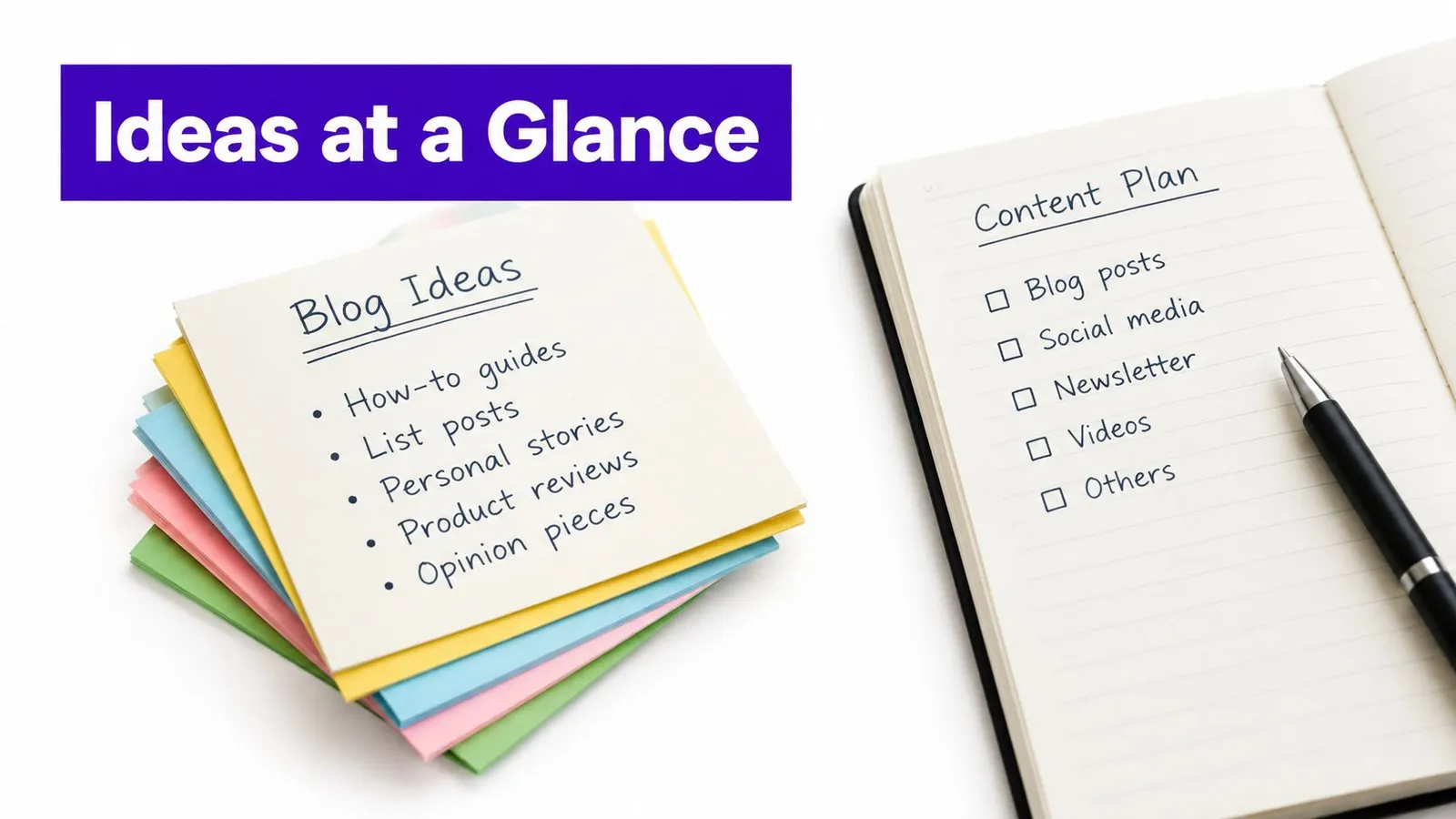
Content planning for this format usually starts with selection criteria rather than prose.
Backlinko regularly publishes list-based SEO articles with detailed entries, and lifestyle and home publications use listicles for product roundups. The shared discipline is consistency. Every entry follows the same pattern, so readers learn how to read the page within seconds.
Making Each Entry a Shopping Path
Each item needs a descriptive heading, a one-sentence summary, and a best-use note. That third element does the converting, because it tells a specific reader that a specific entry fits a specific situation. Without it, a listicle becomes a catalog copy exercise.
The introduction should explain the selection criteria in plain language. Readers distrust roundups that hide how items were chosen, especially when every entry links to the publisher's own store. Stating criteria such as material, room size, or use case up front makes later product links feel earned rather than inserted.
Practical rule: If an entry cannot name who it's best for, it doesn't belong on the list yet.
Internal linking discipline matters here more than in prose formats. Each entry should link to the most relevant product or collection page, not to the homepage or a broad category. Merchants reviewing older listicles can also check whether external sites already reference them, since a guide that helps readers compare snow blowers for gravel driveways illustrates how specific roundups attract links, and tools that help a store find backlinks to its site show which listicles deserve refreshing first.
The weakness is shallowness. A listicle with thin entries ranks poorly against detailed competitors and gives readers no reason to trust the ranking order. Fewer entries with real distinctions outperform a long list padded to reach a number. Merchants should cut any entry that only repeats the product description.
3. Product Comparison Article
Comparison searches signal a reader close to a decision. Two similar products, two variants, or two materials sit side by side, and the reader wants the trade-offs named plainly. That high purchase intent makes this the most commercially direct format in the set.
Wirecutter built its reputation on detailed product comparisons and buying recommendations, and consumer review publications rely on side-by-side comparison tables for the same reason. The table does the heavy lifting. Prose around it explains what the specifications mean in daily use.
Honesty as the Conversion Mechanism
A comparison that declares a universal winner loses credibility. Different buyers weight price, durability, size, and care requirements differently, so the article should state who each option is best for. That framing reduces returns as well as hesitation, because mismatched expectations get corrected before checkout.
- Use verifiable attributes only: Features, dimensions, materials, and care instructions should come from current product information, never from memory.
- Include a compact comparison table: Key specifications in one view let readers decide without scrolling between product pages.
- Link every compared item: Each option needs a direct route to its product page at the moment the verdict lands.
Merchants comparing their catalog against alternatives face a sharper version of the honesty problem. A structured comparison to competitors works only when weaknesses get acknowledged alongside strengths. Readers researching at this stage will find competitor claims anyway, and an article that omits known trade-offs reads as concealment.
The risk is factual drift. Prices, variants, and specifications change, and a comparison frozen at publication date misleads within months. Merchants should date-check every attribute during routine content reviews and retire comparisons for discontinued products. Accuracy is the format's entire authority, so there's no version of this article that survives on style alone.
For Shopify stores, the highest-value starting point is comparing two best-selling variants that generate repeated customer questions. Those questions reveal exactly which attributes belong in the table.
4. Ultimate Guide (Pillar Article)
Breadth defines the ultimate guide. One broad topic tied to a major collection gets covered in depth, with supporting articles handling the subtopics. The guide becomes a pillar page inside a topic cluster, giving search engines a clear map of related content.
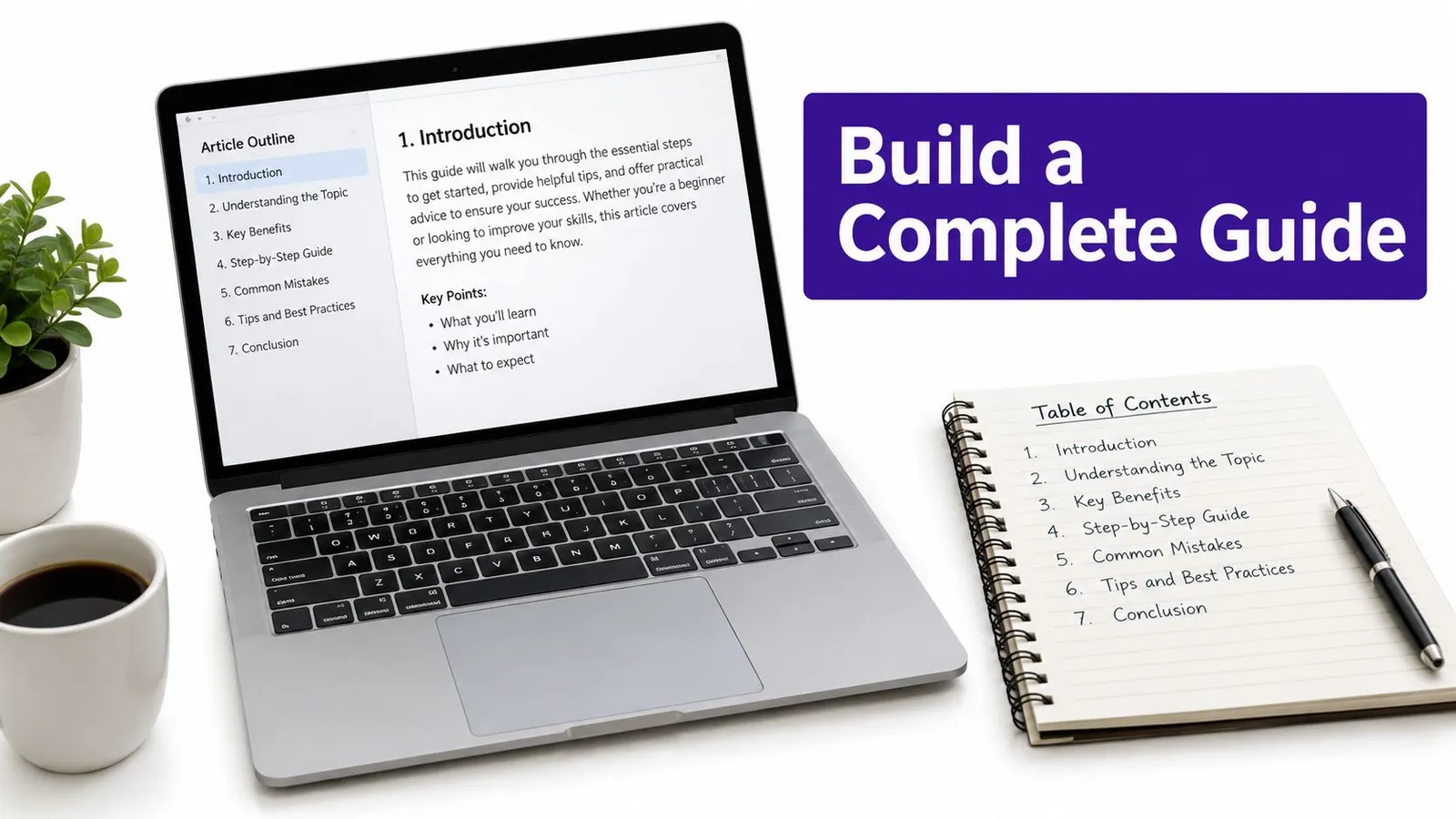
An outline with a proper table of contents is the working document behind every guide that stays readable at length.
Moz's Beginner's Guide to SEO remains a widely referenced pillar resource, and Backlinko's long-form guides are cited across the industry. Neither succeeds on length alone. Both organize a large subject into named sections that a reader can enter at any point, supported by internal links to narrower articles.
Building the Cluster Around a Collection
The pillar keyword should match a core product category, such as how to choose a running shoe for a footwear store. Supporting posts then map to subtopics like sizing, terrain, or care, and each one links back to the pillar and to the relevant collection. A deliberate content strategy development process keeps that mapping planned rather than accidental.
Evidence for the educational, category-mapped approach is concrete. One UK e-commerce brand selling specialist equipment grew monthly organic visits from approximately 5,000 to 18,000 within five months after replacing product-focused posts with educational content mapped to categories and search intent, and its organic conversion rate improved by 40%, as detailed in the UK specialist equipment content marketing case. The internal links from informational articles to product pages carried qualified readers forward.
A pillar guide earns its length only when every section routes somewhere useful. Length without routing is just storage.
The trade-off is production cost and decay. An in-depth guide takes longer to write and longer to refresh, and stale product details spread across many sections. Merchants should schedule periodic reviews for statistics, links, and discontinued items, and resist building a pillar for a category the store may drop. One maintained guide beats three abandoned ones.
5. Case Study (Customer or Results Story)
Proof, not persuasion, drives a case study. A specific problem, a documented approach, and a measurable outcome give prospective buyers something stronger than a product claim. Readers believe specifics they can compare against their own situation.
Reviewing documented results before drafting keeps the narrative anchored to evidence rather than adjectives.

HubSpot publishes customer success stories with specific outcomes, and Shopify features merchant success stories on its website. The pattern holds across both. One clear problem, described in the customer's terms, followed by what changed and how the change was measured.
Separating Visibility From Revenue
A content program for College Ave produced a 263% increase in keyword visibility, roughly 4,500 keywords ranking in positions 1 to 100, and conversions then rose 219% during a seasonally slow period compared with the same period the prior year, according to the College Ave blog content case study. The lesson for merchants is measurement discipline. Visibility shows content is being discovered, while conversions show the traffic is commercially useful, and a defensible case study reports both without blurring them.
- Get written approval first: Customer names, quotes, and results require permission before publication, without exception.
- Keep one problem central: Multiple problems dilute the outcome and make attribution impossible to defend.
- Preserve the comparison period: Seasonality can manufacture or hide results, so the before and after windows must be stated.
- Link featured products contextually: The product or collection in the story should be reachable where it enters the narrative.
The weakness is availability. Small stores may lack customers willing to be named, and an anonymous case study persuades less. A short, approved quote plus honest scope limits still outperform invented certainty. Merchants without a full case can publish a narrower results story about one product use, clearly labeled, rather than inflating it into proof it isn't.
6. Brand Story or Behind-the-Scenes Article
Differentiation is scarce in crowded Shopify categories where competitors sell similar products at similar prices. A brand story supplies what a specification sheet cannot, including sourcing decisions, craftsmanship, founder reasoning, and the constraints behind a product line. Readers remember a specific production step long after forgetting a feature list.
Glossier's Into The Gloss grew from its founder's beauty writing, and Patagonia publishes stories about materials, activism, and product design. Both treat narrative as product education. The story explains why materials were chosen and what trade-offs were accepted, which answers quality objections.
Keeping Story Tied to Search
Pure narrative rarely ranks. The article needs a clear keyword anchor, usually the product category or material, so behind-the-scenes detail attaches to a query with demand. A story about a workshop process, for example, should live under a heading structure that also answers how that product is made.
Specifics carry the format. Sourcing locations, production steps, rejected materials, and packing decisions give readers details competitors cannot copy. Vague values language does the opposite, since any store can claim passion or quality. Merchants should interview whoever handles production or sourcing and publish the concrete answers, even when the answers are unglamorous.
This format also exposes the limits of automated drafting. Analysis of top-ranking pages found that 86.5% contained some AI input while only 4.6% were fully AI-generated, and 81.9% combined AI and human contributions, with a statistically negligible correlation of 0.011 between AI content percentage and ranking, as reported in the eMarketer summary of the AI content ranking study. The practical reading is direct. Unreviewed, generic content is the risk, not assistance itself.
That distinction shapes workflow. Generated drafts still need first-hand merchant detail, verified product claims, and voice editing, which is where guidance on how to humanize AI content becomes operational rather than cosmetic. The story format fails without those human details, because invented warmth reads as filler. One focused theme per article keeps the narrative tight and the product links natural.
7. Seasonal or Occasion Gift Guide
Predictable demand makes the gift guide the most plannable format in the set. Holidays, graduations, and seasonal occasions produce search peaks that merchants can see coming months ahead. A guide organized by recipient, occasion, budget, or interest converts that timing into structured shopping paths.
Major retailers and publications publish annual holiday gift guides, and Etsy publishes curated guides organized by occasion and recipient. The organizing logic matters more than the product count. A shopper buying for someone else lacks product knowledge, so sections labeled by recipient type or interest remove the expertise barrier.
Timing and Annual Reuse
Publication needs to happen several weeks before the peak date, allowing time for indexing and ranking movement. A guide published during the peak competes after the buying window has already narrowed. A scheduled publishing calendar turns that lead time into routine rather than annual panic.
- Organize by recipient or budget: Gift buyers think in terms of the person and the spend limit first, product features second.
- Update one URL each year: Refreshing the existing guide preserves accumulated authority instead of splitting it across duplicates.
- Remove sold-out items promptly: A gift guide linking to unavailable products during peak season wastes the highest-intent traffic of the year.
International stores face an additional layer that translation alone doesn't solve. A 2025 global expansion survey reported that 92% of businesses are translating or localizing marketing content, while 55% of business leaders said their companies had lost business because of inadequate translation or localization, according to the Phrase 2025 global expansion guide for retail and e-commerce. Seasonal references, measurements, currency framing, and occasion calendars differ by market, so each regional version needs its own introduction and product links.
The reusable tactic is a standing template with fixed sections and swappable products. Merchants refresh inventory and dates annually, compare performance by market, and retire occasions that never produced clicks.
8. FAQ-Style Article (Question and Answer)
Customer questions are pre-written article headings. Sizing, care, material choice, shipping, and returns generate the same queries in support inboxes and search results, so an FAQ-style article captures long-tail traffic while reducing repetitive service work. Each question mirrors a real search, which keeps the content grounded.
Many e-commerce stores maintain FAQ pages on sizing, care, and shipping, and search engines surface question-based content in featured snippets and People Also Ask results. The blog version goes further than a policy page. It answers in a few direct sentences first, then expands with the reasoning a hesitant buyer needs.
Sourcing Questions That Already Exist
The strongest questions come from support tickets, product reviews, and Search Console queries. Those sources reveal wording customers use themselves, which rarely matches internal product language. A merchant may write about garment care instructions while customers search for whether an item can go in a dryer.
Editorial standard for FAQ answers: The first sentences must answer the question completely. Explanation earns its place only after the answer exists.
Each answer should link to the supporting product, size guide, or policy page. That link placement turns uncertainty reduction into a shopping path. A sizing answer that ends at the size guide, and from there to the product, shortens the distance between reassurance and purchase.
Accuracy risk runs high in this format. Shipping windows, return conditions, and material details change, and an outdated answer creates disputes rather than preventing them. Merchants should review FAQ articles whenever policies change and treat policy pages as the source of truth. There's also a scope limit worth respecting. One article per product category or policy theme stays useful, while a single giant FAQ covering everything becomes impossible to scan or maintain.
The trade-off against other formats is depth. FAQ articles rarely build authority alone, but they convert readers who were one unanswered question away from leaving. Paired with a pillar guide or comparison article, the format closes the final gap in the buyer journey.
8 Blog Writing Examples Compared: Format, Purpose & Key Features
| Content Format | Implementation Complexity 🔄 | Resource Requirements ⚡ | Expected Outcomes 📊 | Ideal Use Cases | Key Advantages ⭐ |
|---|---|---|---|---|---|
| How-To Guide | Medium: requires tested, ordered instructions | Research, visuals, and periodic updates | Qualified search traffic, trust, and product clicks | Products that solve a task or need setup or maintenance | Matches task-based searches; creates natural product links |
| Listicle | Low–medium: repeatable item structure | Product selection and concise descriptions | Skimmable engagement and visits to multiple products | Broad catalogs, seasonal picks, and product roundups | Quick to produce; easy to scan and link |
| Product Comparison Article | Medium–high: requires fair, accurate comparisons | Current product data and clear evaluation criteria | High-intent visits and more confident purchase decisions | Stores with similar products, variants, or bundles | Addresses trade-offs and buyer objections |
| Ultimate Guide | High: broad research and detailed planning | Significant writing, research, internal linking, and updates | Topical authority, broad search reach, and lasting reference value | Stores building authority around a core category | Organizes supporting content and links to multiple collections |
| Case Study | High: requires evidence and approvals | Customer interviews, verifiable results, and permissions | Credibility, social proof, and potential mentions or backlinks | Stores with customer success stories, B2B offers, or client work | Demonstrates real-world product outcomes |
| Brand Story or Behind-the-Scenes Article | Low–medium: interview or narrative-led | Founder or production details and authentic visuals | Brand connection, differentiation, and social sharing | Founder-led or small-batch brands with a distinctive origin or process | Builds emotional connection with less keyword research |
| Seasonal or Occasion Gift Guide | Medium: product curation and timely planning | Advance scheduling and product availability checks | Seasonal traffic and product discovery during peak periods | Giftable, seasonal, or broad-catalog stores | Supports timely merchandising across collections |
| FAQ-Style Article | Low–medium: direct question-and-answer format | Customer questions and periodic accuracy checks | Long-tail traffic and fewer pre-purchase questions | Stores with frequent sizing, care, compatibility, or shipping questions | Simple to create and maintain; reduces customer uncertainty |
Turn These Examples Into a Repeatable Content System
Format selection is a decision made before writing, not during it. A task keyword calls for a how-to guide, a decision keyword calls for a comparison, and a question keyword calls for an FAQ article. Merchants who match format to search intent first avoid the most common failure in store blogging, which is a well-written article built in the wrong shape.
Internal linking needs the same discipline. Each article should carry one clear internal-link job, whether that job is moving tutorial readers to a collection, routing pillar readers to supporting posts, or sending FAQ readers to a size guide. Links scattered without a job dilute the path and make performance harder to read. When every article has one defined destination, Search Console clicks and conversion events can show whether the routing worked.
Refresh discipline separates a content system from a content archive. Comparisons, tutorials, gift guides, and FAQ articles all decay as products, prices, policies, and seasons change. A scheduled review cycle catches that decay before readers do, and updating an existing URL preserves the authority the article already earned. Publishing volume without maintenance produces a larger liability, not a larger asset.
Measurement should follow the same separation used in strong case studies. Impressions and ranking distribution show whether content is discoverable, clicks show whether titles earn attention, and conversion events show whether readers were commercially qualified. Treating traffic growth as proof of revenue impact misleads planning. Merchants get better decisions from smaller, cleaner signals tied to each format's actual job.
Production workflow determines whether any of this survives contact with a busy store. Keyword scoring, drafting, internal linking, scheduling, and reporting scattered across separate tools tend to collapse into irregular publishing. Rankira addresses that operational problem inside Shopify admin, turning scored keywords and product context into scheduled articles with internal links and performance reporting, while leaving draft review available for merchants who want manual approval. That review step matters. Product claims, shipping statements, and brand voice still need a human check before publication, regardless of how the draft was produced.
The standard for judging the next article is now straightforward. The format matches the intent, the structure follows the format, the product link sits at the point of need, and a review date exists. Articles built to that standard convert because readers find the right help in the right shape at the right moment.
Rankira helps Shopify merchants turn these eight formats into a steady publishing workflow, with keyword research, article generation in the store's tone, internal links to products and collections, scheduling, and search performance reporting inside Shopify admin. Merchants ready to replace blank drafts with a repeatable system can start at Rankira and build the next article from a scored keyword rather than a guess.
Keep reading
All articles
Shopify SEO
SEO Content Writing Principles for Readers and Search
Learn the principles of SEO content writing that balance search relevance, clear structure, and real reader value, with examples for online stores.
10 min read
Shopify SEO
Internal Linking Audit That Actually Improves Rankings
Run a practical internal linking audit to find orphan pages, fix broken links, and prioritize fixes that move revenue on your Shopify store.
10 min read
Shopify SEO
Share of Voice SEO: A Practical Measurement Guide
Learn how share of voice SEO works, how to calculate it, and how to use intent-based metrics to assess search visibility and business impact.
12 min read
Put your Shopify blog on autopilot
Rankira researches keywords, writes SEO articles, adds internal links, and publishes them to your store — every week. Start with a 7-day free trial.