SERP Competitors Ranking: How to Find and Track Them
Learn how to find SERP competitors ranking for your keywords, compare their positions, and turn the gaps into a content plan that drives sales.
Published 12 min read
In this article
What if the store ranking first for your best keyword isn't the one taking your sales, and a rival in position four is? That gap is where most SERP competitors ranking work goes wrong. Merchants track familiar business rivals, celebrate average position, then wonder why clicks and revenue don't follow. A sharper method judges each competitor by the query, the exact page that wins it, and the commercial visibility that page earns.
Table of Contents
- Separate SERP Rivals From Business Rivals
- How to Build Your SERP Competitor List
- Score Each Competitor Keyword on Clicks as Well as Rank
- Match Your Page Format to Search Intent
- Tracking Volatile Results Across Repeated Checks
- Turn Competitor Gaps Into Your Next Content Plan
Separate SERP Rivals From Business Rivals
A business rival sells what you sell. That store may never appear when a shopper searches for your target keyword, which makes it useful for price and catalogue checks but poor evidence for content decisions. A SERP rival is different. It's any domain holding a top ten position for a query you want, whether it sells your products or not.
A content rival sits between the searcher and your store. A blog, buying guide, or review site can answer the question first, shape the shortlist, and send the shopper elsewhere. Those pages often matter more than a familiar store name because they control the click you're chasing.
Four Groups, Four Different Jobs
| Competitor type | Who it is | How it shows up | What it means for you |
|---|---|---|---|
| Business rival | Stores selling the same products | Often absent from results for your keywords | Compare catalogue, not rankings |
| SERP rival | Domains ranking for your target queries | Appears in the top ten for the same keyword | Primary target for gap analysis |
| Content rival | Blogs and guides answering the same question | Holds informational results above product pages | Study its format and depth |
| Marketplace or directory | Large platforms with broad domain authority | Often holds several positions on one page | Track separately; rarely the easiest gap |
One domain can sit in several groups at once. A large retailer might be a business rival, a SERP rival on transactional terms, and a content rival through its guides. Treat each role separately, because the page that wins a guide query tells you something different from the collection page that wins a buying query.
Run a quick test before building anything elaborate. Search your top three keywords and note which domains appear for all three. Domains that repeat across queries are your real competitive set, while one-off appearances are usually noise.
Practical rule: Analyse the domains Google puts in front of your customers, not the brands you recognise from trade shows or social feeds.
Marketplaces deserve separate handling. They can occupy several positions on one page through sheer breadth, and copying them rarely reveals an achievable gap. Track them so you know how crowded a result is, then focus gap analysis on SERP rivals whose pages you can realistically match or beat.
How to Build Your SERP Competitor List
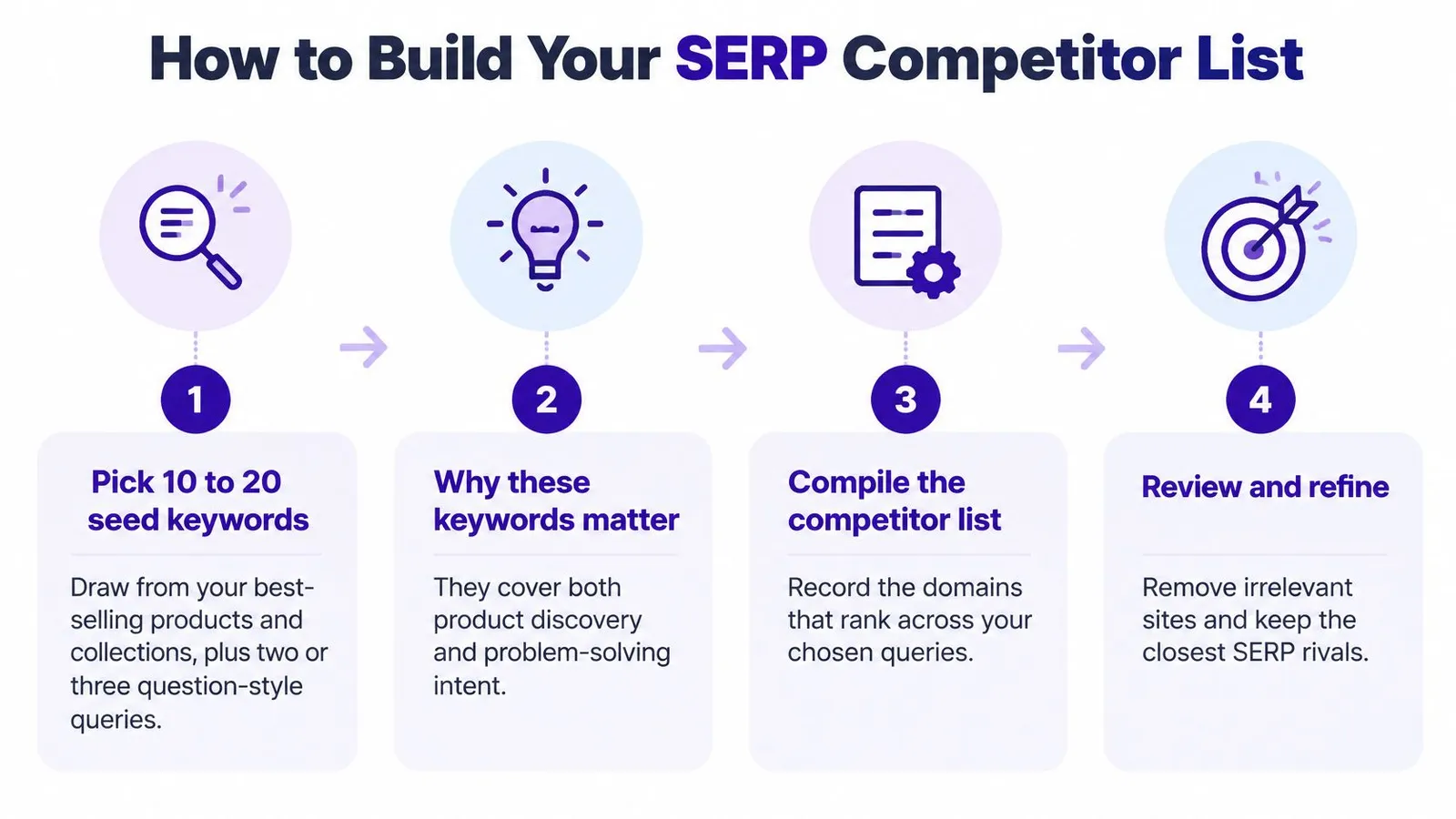
A usable list comes from a fixed routine, not from guessing familiar names. The process below turns seed keywords into five to seven domains worth tracking.
The Numbered Routine
- Pick 10 to 20 seed keywords from best-selling products and collections, plus two or three question-style queries. That mix covers buying and research intent. Choosing only brand terms is the common slip, because brand results hide the rivals winning new customers. A structured keyword research step by step process helps keep that seed set tied to products rather than hunches.
- Search in the right market using the country and language you'll publish in, in a private window so personal history doesn't skew results. Searching the wrong market returns the wrong competitors, and every later decision inherits that error.
- Record the top ten organic domains for each keyword, plus the exact URL that ranks. The URL matters because a domain's guide and its collection page win for different reasons.
- Count frequency and average position for each domain across the full set. Frequency shows breadth, while average position shows how close to the clicks that breadth sits.
- Keep the top five to seven domains, ranked first by frequency and then by average position. That shortlist becomes the set you score in detail.
- Drop one-off domains that appear only once, unless a single appearance holds an important commercial term. Relying on one keyword gives one snapshot, and snapshots mislead.
Once the list exists, load it into a rank-tracking tool so the same domains are followed across the full keyword set over time. Rankira's Competitors setting accepts 3 to 7 other stores, and it studies what they rank for to find gaps. Setup also asks for the country and language you want to rank in, plus competitors and target audiences, three of each at minimum and seven at most.
The short video below walks through competitor identification in practice, which helps when the spreadsheet starts to feel abstract.
Where two brands compete head to head on the same commercial terms, comparison articles for competing brands from Verbatim Digital show how structured side-by-side content can target shoppers already weighing options. That's a publishing tactic to consider after the list is built, not a substitute for building it.
A finished list should feel narrow and defensible. Five to seven domains, each appearing on at least a third of your keywords, gives enough evidence to spot patterns without drowning in one-off results.
Score Each Competitor Keyword on Clicks as Well as Rank
A domain can average position three across your keyword set and still win almost no buying clicks. Another can sit lower and dominate the queries that lead shoppers to product pages. Rank alone can't tell those two apart, so each keyword needs a scorecard that weighs click opportunity and commercial intent alongside position.
The Scorecard Columns
| Metric | What it tells you | Strong signal | Caution |
|---|---|---|---|
| Average position | Where a domain sits across your keyword set | Consistently in the top three | One high position can hide thin coverage |
| Top-ten presence | Share of keywords where the domain appears | Appears on most of your keywords | Frequent informational presence may not sell |
| SERP features owned | Featured snippets, AI summaries, FAQs and video | Owns features on commercial queries | Feature ownership can lower clicks to the page |
| Page type ranking | Whether the ranking page is a product, collection, guide or blog | Matches the format you plan to publish | A mismatched type signals misaligned intent |
| Commercial visibility | Ranking on transactional or product-led queries | Ranks for buying terms | Easy to overlook because it is not in the top three |
| Click opportunity | CTR compared with the band for its position | Clicks at or above the band | Summaries can absorb clicks even at position one |
Read the columns together rather than in isolation. A domain in the top three on informational queries but absent from product terms is a content rival shaping early research. A domain that rarely cracks the top three yet appears on every buying query is a direct revenue threat. Those two rivals call for different responses, and average position alone can't separate them.
Why Position Stopped Predicting Clicks
Position still concentrates visibility, but it no longer guarantees traffic. Published CTR studies vary widely by query type, device, market, and which SERP features appear on the page, so estimates for the same position can differ by a wide margin from one study to the next. That spread is the point. Two stores can both hold position one on different queries and receive wildly different click volumes.
AI Overviews widen that gap further. When a summary appears above the results, the first organic listing loses a large share of the clicks that ranking used to deliver. A competitor can therefore keep position one on paper while the summary above it absorbs the demand it once captured.
Field evidence points the same way. A 2026 randomized field experiment involving 1,065 U.S. desktop users and 68,089 searches found organic clicks fell from 0.62 per search when AI Overviews were hidden to 0.37 when they appeared, while zero-click searches increased from 54% to 73%, as reported in the Conversion Pipeline summary of the AI Overviews click study. For a Shopify store, the practical reading is simple: a lower-ranked rival cited inside a summary, or winning transactional terms where summaries matter less, can earn more qualified visits than a higher-ranked rival sitting under a summary on informational terms.
A ranking you can see but shoppers never click is visibility without revenue. Score the click opportunity, not just the slot.
Take a concrete case. A competitor sits at position four for a commercial query, but its comparison guide is cited in the AI summary and its page matches buying intent closely. A rival at position one with a thin product page may collect fewer useful clicks on that query. Flag it. The winning move is to match the cited guide's usefulness and link it tightly to products, so the page earns both the citation and the sale-ready click.
The Five-Step Check for Flagged Keywords
- Pull clicks and impressions from Search Console for the keyword and the page ranking for it.
- Compare CTR with the expected band for that position, using your own store history as the baseline.
- Flag keywords where clicks fall well below that band despite a respectable position.
- Check whether the competitor is cited in the AI summary or owns another feature on the page.
- Record the flag beside the scorecard row so the next content decision starts from evidence rather than memory.
Published CTR studies are averages across many markets and devices. They're useful for spotting the pattern, but your own Search Console data sets the baseline for your store, your country, and your product mix. International stores should be especially careful, since AI feature exposure and click behaviour can differ by market.
Disciplined tracking of search engine optimization metrics pays off here, because clicks, impressions, and position need to be read as a set rather than as isolated wins. One metric moving alone usually signals a changed SERP layout instead of a change in page quality.
Record the same columns for your own store to close the loop. Every competitor row should compare like with like: your position, features, page type, and click opportunity in the same table. Without that mirror row, the scorecard describes rivals in detail and says nothing about where your store stands. That mirror is what turns competitor trivia into a ranking-to-revenue view, one that separates visibility, click opportunity, and commercial intent for each keyword.
Match Your Page Format to Search Intent
Which format should your page take? The top results usually answer that question before any tool does. Google states its ranking systems combine query relevance, page usability, source expertise, and contextual factors such as location and settings, as explained in Google's guide to how ranking results work. A page that satisfies intent more directly can outrank a stronger domain, which is why format decisions belong at query level.
Intent Types and Winning Formats
| Intent | Example query | Format top results use | Your move |
|---|---|---|---|
| Informational | how to choose running shoes | Guides and how-to articles | Publish a guide that links to matching products |
| Commercial | best running shoes for flat feet | Comparison and review pages | Publish a comparison with clear product criteria |
| Transactional | buy trail running shoes size 10 | Product and collection pages | Optimise the collection page; a blog post alone will not win |
| Navigational | brand name plus product name | Brand homepage and product pages | Track only; rarely a content gap |
Run the majority test on every keyword. Count how many page-one results share a format, and treat that proportion as your benchmark. If most results are buying guides, a purely promotional article is structurally misaligned even when it contains the target phrase.
- Note the content type of the top five results, whether guide, comparison, collection, or product page.
- List the topical sections those pages share, since repeated subtopics signal what searchers expect covered.
- Check freshness and product links so you can see whether winners are recently updated and how they route readers to products.
Google also says its systems can understand relevance without requiring an exact keyword match, so covering shared subtopics with clear answers beats repeating the phrase. A Shopify blog post targeting a transactional query with no product link fails that test even if the exact phrase appears in every heading. For a fuller grounding in how intent shapes these choices, understanding search intent for SEO from SEO 2 RANK lays out the categories in plain terms.
Pair that reading with a structured SEO keyword analysis so intent labels attach to keywords before briefs get written. Briefs built after format decisions tend to inherit the wrong structure.
Rule of thumb: Copy the winning format when the majority is clear, and differentiate on angle, evidence, or product fit. Choose a different format only when top results neglect a subtopic shoppers clearly need.
Tracking Volatile Results Across Repeated Checks
A competitor holds position one for eight straight weeks and still loses traffic because an AI summary answers the query above it. Another domain never enters the top ten yet gets cited in that summary and picks up brand searches. A single snapshot misses both stories, and acting on it can mean copying a rival whose visibility is already hollow.
The layout itself is shifting fast. Semrush tracking of 400 U.S. desktop commercial keywords found AI Overviews on 88% of tracked commercial queries in August 2026, compared with 45.75% in September 2025, according to Search Engine Land's report on AI Overviews across commercial keywords. That sample doesn't represent every commercial search and didn't measure conversions, so treat it as a volatility warning rather than a universal rate.
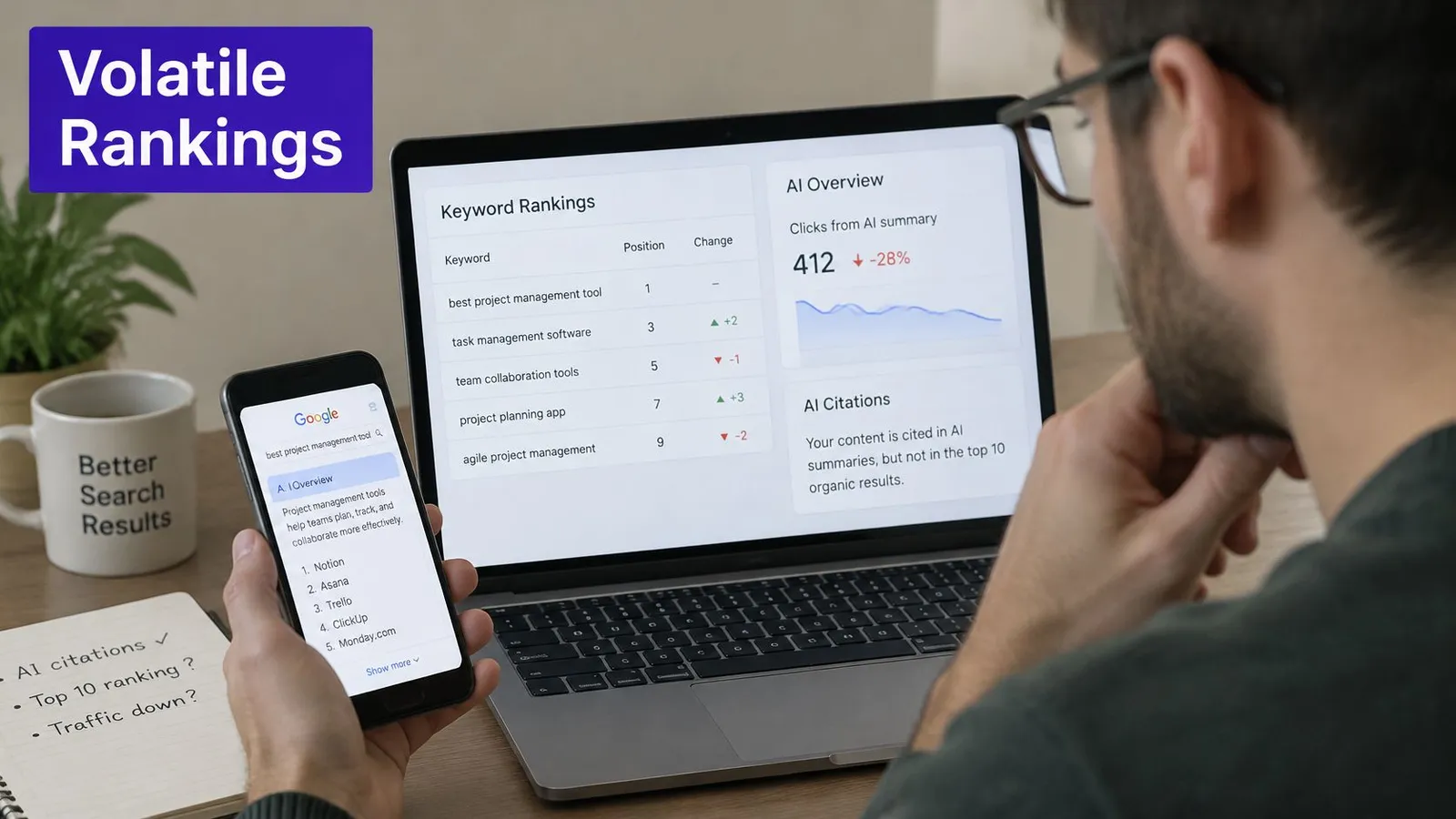
The image below shows the kind of cross-device checking this work now requires, since desktop and mobile layouts rarely match.
The Repeated-Check Method
Run the same keyword set every two weeks for eight to twelve weeks. At each check, record feature ownership, citation presence, rank changes, and click opportunity beside the date. Rankira's dashboard tracks clicks, impressions, positions, and Domain Rating, powered by Google Search Console and Ahrefs, which gives that log a consistent data source. Consistent keyword SERP tracking also separates genuine ranking movement from changes caused by your own publishing.
After several checks, label each keyword for the content plan:
- Stable organic: Rankings hold, no summary dominates, and clicks track position. Improve product relevance and internal links, because gains here should convert into visits.
- AI-summary dominated: A summary takes most visible attention and clicks sag. Strengthen original evidence, clear subtopic answers, and product-specific detail that a summary can't easily reproduce.
- Commercially volatile: Rankings and features shift between checks. Avoid head-to-head battles on low-click informational terms, and wait for a stable pattern before committing a major page.
Keep the dated log even when results look boring. Boring stretches establish the baseline that makes a sudden feature change visible. Check every conclusion against your own store data too, since one market and one period never describe your catalogue exactly.
Turn Competitor Gaps Into Your Next Content Plan
Research only pays when it becomes a publishing queue. Start with the gap test: a keyword is a genuine gap when a competitor's ranking page is relevant to your products but under-supported, meaning its topical fit is beatable or its link support is thin. A structured content gap analysis keeps that test consistent across the whole keyword set.
The Prioritisation Sequence
- List every keyword labelled stable organic or commercially relevant from your tracking.
- Score each one on intent match, competitor weakness, and product relevance.
- Pick the top five for the next month rather than spreading effort across twenty.
- Assign each keyword to a product, collection, or guide page, and add internal links to matching products.
- Schedule publication and set a review date so results get judged on evidence.
Link evidence helps sort step two, provided it stays in proportion. An Ahrefs analysis of the top 1 million US keywords reported Spearman correlations of 0.255 between rankings and referring domains, 0.248 for total backlinks, and only 0.131 for Domain Rating, as set out in Ahrefs' analysis of whether links still matter. Those are correlations, not proof of cause, since strong pages attract links after ranking. The practical reading is to compare referring domains, followed links, topical relevance, and link growth per page, then seek a few relevant, editorially credible referring domains instead of chasing volume. Link support matters most on high-volume queries, where content quality alone rarely closes the gap.
Set expectations before publishing. Rankira does not guarantee search rankings, traffic, revenue, or any other specific outcome, and it recommends two to three months of consistent publishing before judging results because SEO compounds slowly. That's the honest timeline for any store working this method manually as well.
Take one action this week. Build the five to seven domain competitor list, run the first scorecard on your highest-value keywords, and only then choose the next article to write.
Ready to stop guessing which rivals win your customers' clicks? Rankira researches keywords around your Shopify products and competitors, generates and auto-publishes articles with internal links to matching collections, and tracks clicks, impressions, and positions in one Search Console dashboard, all inside your Shopify admin. Visit Rankira to build your competitor-informed content plan and publish your first scorecard-driven article this week.
Keep reading
All articles
Shopify SEO
10 Proven Ways to Increase Traffic Site in 2026
Discover 10 proven ways to increase traffic site visits through search, content, and email, with practical steps for Shopify stores.
15 min read

Shopify SEO
Meta Description Check: How to Audit and Fix Yours
Run a meta description check in page source or an SEO editor, judge length and query fit, and rewrite only the descriptions that mislead or repeat across pages.
10 min read
Shopify SEO
Title Tags SEO: How to Write Titles That Earn Clicks
Title Tags SEO explained: what a title tag is, how Google picks the title shown in results, and how to write titles that earn clicks.
10 min read
Put your Shopify blog on autopilot
Rankira researches keywords, writes SEO articles, adds internal links, and publishes them to your store — every week. Start with a 7-day free trial.